Scented candles—fragrance and squishy wax


There’s a lot to like about scented candles.

First, there are all the different fragrances available. I’ve been fascinated with fragrance most of my life:  perfume, flowers, homemade potpourri, and soaps wrapped in delicate tissue. But candles have always been the easiest way to accumulate a lot of different scents in a compact and relatively inexpensive form.
When I was growing up, I read a lot about perfumery and the fragrance industry. I could have told you the difference between a top note and a base note, cologne as opposed to toilet water, and distillation versus enfleurage. I was particularly interested in people’s ability to identify different smells and the psychological effects thereof. Since I had a large collection of scented candles, I ran a totally unscientific study in which I blindfolded family and friends and handed them candle after candle, asking them to guess at the scent and describe their reaction to it. There wasn’t really a purpose behind the questions, just curiosity.
More recently I tried to make use of scent psychology by deciding to pair my stories to particular scents. For the Cinderella story I’m currently revising (The Slipper Ball), I decided to use Yankee Candle’s “Sage and Citrus”. The idea was that I would burn the candles as I worked, thus forever linking the fragrance to the work and making it possible to get into the right frame of mind simply by striking a match. So far I haven’t been consistent enough to get the plan to work, but I’ve still got plenty of revision ahead. And when I get back to the story about the psychic teenager (The Summer of the Deer), I’m going to run through my collection of Tyler Candle Company’s “Head Over Heals”(sic).
But scent isn’t the only appealing thing about scented candles. The wax itself has fascinating qualities as it goes from solid to liquid and back, with a soft, putty-like stage in between. As a kid, I loved to pour some of the melted wax out and squish it around until it hardened. My father showed me how to melt blocks of paraffin and make new candles in Dixie cup molds. Later, I graduated to dipped and braided candles, candles made in a duckie mold, “whipped wax”, and trying to carve designs in wax with wood carving tools (hint: warm wax is less likely to break off in chunks.)
I haven’t done much with candle-making for a long time, but some of the fascination with wax got passed on. For my birthday a couple of years ago, my daughter borrowed some essential oils and presented me with lemon- and peppermint-scented candles that she had made while I was out of the house. Aww…
On top of having fragrance and squishy wax, scented candles are an opportunity to use decorative candleholders, thereby delighting the eyes as much as the nose. Elegant or fun, sparkly or subdued—there are holders for every taste.
And then finally, scented candles are candles
Their flames are so pretty in a darkened room.
Till next post.

Gossip and Lies


This week’s post isn’t about something shiny and wonderful. It’s about evils of repeating gossip and making up lies. 
No, not wonderful at all.
I’m going to give three examples here—two from recent news and one that is personal. The first one is the story of Cameron Harris, who made up a story about uncounted ballots in order to make money off the advertising revenue. He needed a story that would make people mad, because people are more apt to share stories that outrage them, and more shares equals more clicks equals more money for Cameron.
And his story was shared by around 6 million people and he made about $5,000 from his lie.
That’s wrong. That’s clearly wrong.
But the people who shared the story aren’t entirely blameless. We all know that anyone can pretend to be whoever they like on the internet—“On the internet, no one knows you’re a dog”—and it’s up to us to check the source of something that incendiary before repeating it. Cameron used the name ChristianTimesNewspaper.com, but I wonder how many people even tried to see whether such a paper really existed?
In this case, we know the story was false because Cameron admitted to making it up when he was questioned about it. He explained why he chose the particular details he did for maximum effect, and the photo he used was identified as originating with a British newspaper on some entirely unrelated subject. It’s unlikely that everyone who read the original story will read an account of its falsity, but at least some will. 
But sometimes stories can’t be shown to be either definitely true or definitely false.
That brings me to the second example, the unsubstantiated reports of a Russian dossier of compromising information on Donald Trump. U.S. intelligence agencies investigated the contents of the reports, as did major newspapers, but couldn’t find evidence that they were true. Nor could they show that the reports were false. Officials decided to let Trump know of the reports’ existence, and newspapers reported that fact. But since the details could not be substantiated, most newspapers wouldn’t print them. Except, apparently, Buzzfeed.com.
I say “apparently” because I haven’t looked. I don’t think the details should have been made public. It’s not as though the average American is in a better position to investigate their truth than either the intelligence agencies or the major newspapers, so what purpose is served? And once you print something negative about someone, even if you don’t claim to know its truth, you have planted a seed of doubt in people’s minds and you can never take that back.
And on to the third example. Long ago and far away (so long ago that there was no World Wide Web, let alone social media, and so far away that it was the other side of the country), I was in a coffeehouse with my then-boyfriend (whose name I will omit.)
Some friends of his came in, and for reasons I will never understand, he decided to mess with them. He said, “Have you heard our big news?” and reached over to pat my tummy in a meaningful way.
Shocked, I looked daggers at him and he said, “I’m just kidding.”
That was all, apart from my yelling at him afterward, but I had seen his friends’ eyes go wide at his initial announcement. I remain hopeful that they all believed he had just made a really bad joke, but I’m afraid some of them may have wondered if perhaps he had said something true that he just wasn’t supposed to say.
And if they did wonder—if the seed of doubt was there—then there was nothing I could have done to remove it. Not even the fact that time passed and nothing newsworthy happened would have shown otherwise. After all, maybe the reason I’d been upset with what he said was because I didn’t plan to keep it. How on earth could I have proven otherwise? Even to try would have seemed to protest too much.
That’s how easy it is to start a rumor—and how impossible it is to take it back. Had there been social media back then, and had he made the joke on Facebook, it could have traveled far beyond the group of people who actually knew me. Even now, telling this story, I wonder if there is anyone thinking, “But why would someone make a joke like that completely out of the blue?” And all I can say in reply is, “Well, he did.”
So watch out for gossip and lies. Check your sources before passing information on, don’t make stuff up, and don’t repeat stories for which there is no evidence.
Because you can’t take it back.
Till next post.

Books, Nostalgia, and Death


Warning: the following post might get a little depressing, but I’ve tried to end on a positive note.
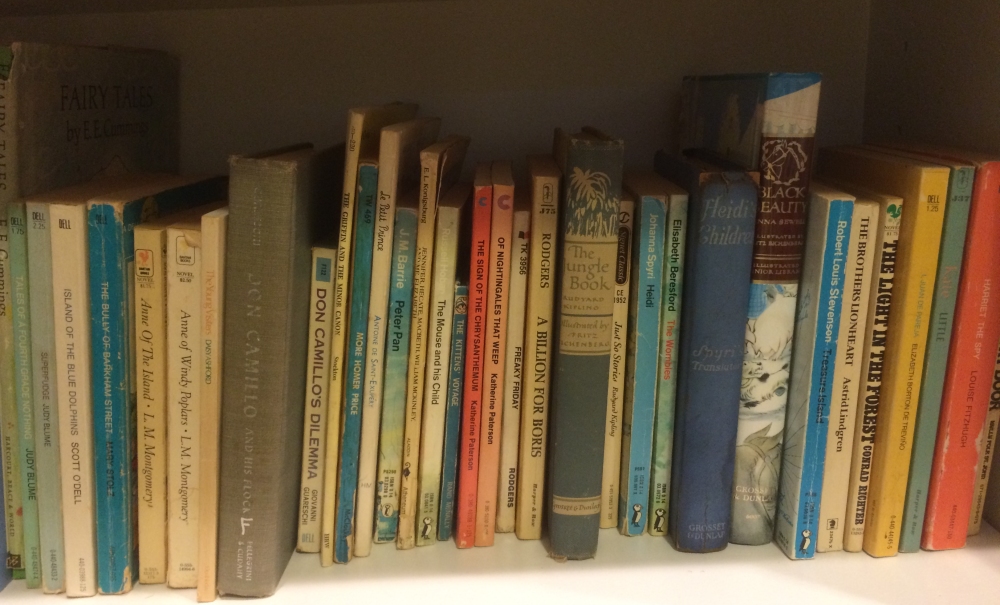
I’ve been sorting through my books this week, shelf by shelf. I lay them in rows on the floor, dust the shelf, and replace only the ones I really want to keep. That’s most of them, but I have so many shelves that I’ve managed to pile up a sizable stack for the  library nonetheless.
As I lay them out, I’m reminded of when I read them. The Deryni books? That was college. Piers Anthony and Anne McCaffrey? Mostly high school. Laura Ingalls Wilder? My mom read Little House in the Big Woods to me in first grade, and we went on from there. She still remembers the night we read the chapter “Fever and Ague” and stayed up really late to finish it.
Some of these books I read to my daughter when she was young enough to want to be read to: The Book of Three, Understood Betsy, The Westing Game. Some I got on audiobook so we could share them on long car trips: The Trumpet of the Swan, Bagthorpes Unlimited, Little Women. But a lot of the books I enjoyed growing up, especially the ones I read after age ten or so, she was never interested in reading.
I feel sad as I look at the lines of books on the floor, thinking of the time I spent repeatedly re-reading certain books and knowing that I will probably never read them again nor find someone else with whom to share them. They were important to me at the time, but there are lots of new books that are also good and worth reading, so except for the very best ones (and these are the ones I continue to re-read: Watership Down, Lord of the Rings, Peter Pan) it isn’t worth trying to talk anyone into reading them.
I can’t let go of them either, though, so there they sit on the shelf—the Gemma books by Noel Streatfield, the Prydain books by Lloyd Alexander (battered from much love), C. Dale Brittain’s A Bad Spell in Yurt (actually, I suddenly want to reread that one), and so many more. Do people even read Where a Red Fern Grows any more?
So I look at these rows of books that are slowly growing outdated, or at any rate forgotten, and I realize that as the world’s supply of good books continues to grow, almost all books face this fate. Books, like people, have a limited lifespan, with some living much longer than others but none forever. Just as some day I will be gone, the books that helped make me who I am will some day no longer be read—and that includes any books I might myself contribute to the current supply.
That thought is rather depressing, so here’s the attempt at a positive spin. Just as these books helped make me who I am, they also influenced the authors of the subsequent generations of books. Their effects live on beyond themselves, as I hope my own influence will.
And if that isn’t good enough, try this. There are some really great books out there—more than enough for a lifetime. You don’t have to read them all to be glad they exist.
Till next post.