Variations on a Banana Muffin

One of the things I really appreciate about basic recipes, such as a basic banana muffin recipe, is that I can mess with the flavoring and see if I like the result.

I don’t add nuts to banana muffins. As a kid, I didn’t like nuts in baked goods. For that matter, I didn’t really like any nuts besides peanuts, period. That’s changed. I now really like nuts with chocolate–not just hazelnut, but pecan, almond, and even walnut. I even like almonds with green beans, and walnuts in spinach salad with craisins, just like a real grown-up. And chocolate-pecan torte is now my preferred birthday cake (the pecans are ground, not chopped). But I still don’t like chopped nuts in most baked goods.

On the other hand, I have always been enthusiastic about chocolate, so I frequently add chocolate chips to banana muffins (and to oatmeal cookies, and to oatmeal, for that matter.) Sometimes I add orange zest as well as chocolate chips, or by itself. Banana and orange is a good combo. Banana and orange and chocolate are great.

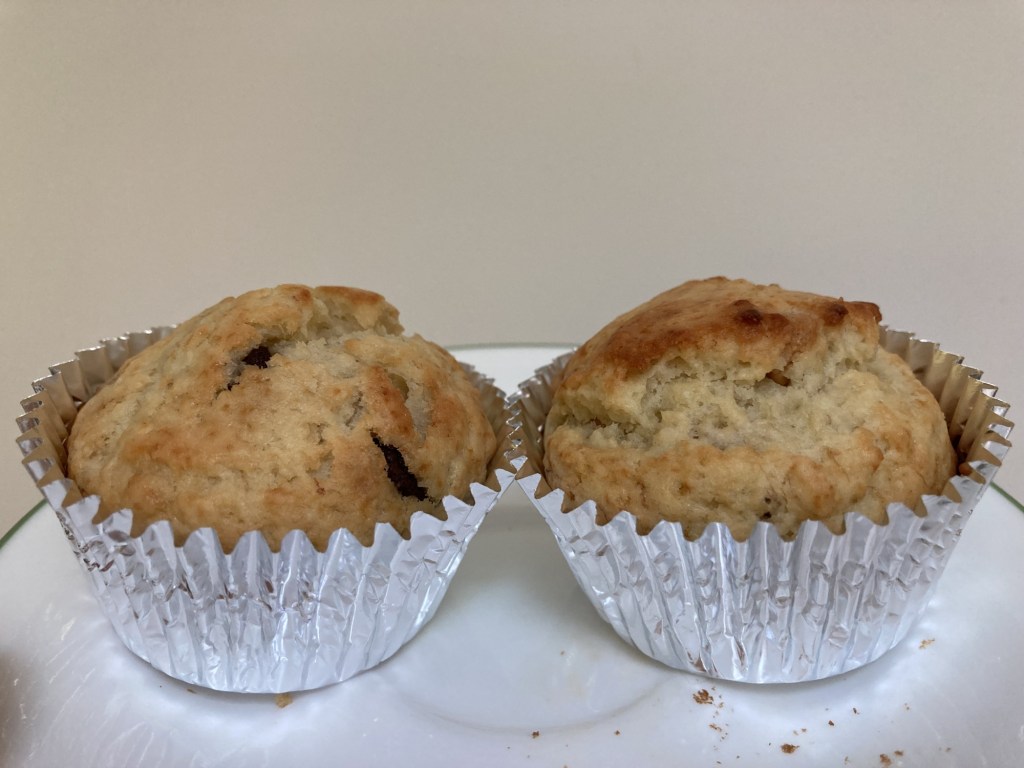
I had four overripe bananas, just enough for two batches of basic banana muffins, and some leftover peanut-butter chips in the pantry. So, in the spirit of experimentation (and because bananas and peanut butter go together so well), I made one batch with chocolate chips and the other batch with peanut-butter chips.

Here you probably expect me to rave about how delicious peanut-butter chip banana muffins are. And they did taste good, but I didn’t think they were anything to get excited about. My husband actually liked them more than I did. I thought they were… subtle. Good, but I could barely identify the added flavor as peanut. That surprised me.

And that’s why it’s fun to try adding flavors to basic recipes. You just don’t know for sure how you’ll like the result till you try it. I really expected the peanut flavor to jump out more. But now I’m eager to try something different the next time I make banana muffins–vanilla. There’s no vanilla in my basic banana muffin recipe, and vanilla is delicious in a banana milkshake. But I’m not going to stop there. I’m going to add spices as well, probably nutmeg, maybe cinnamon, maybe even cardamom. No idea how the cardamom will turn out.

You don’t really need my banana muffin recipe, since you can find a perfectly good one with no trouble at all, and maybe a better one than mine. But I’ll copy it here anyway, in case you’re curious. It’s from the 11th edition of the Better Homes and Gardens New Cook Book (the one with the plaid cover.)

Banana Muffins

Preheat oven to 400.

Grease or line 12 standard size muffin cups. (That is to say, neither jumbo nor mini size. I like foil liners because they peel right off without stealing any of your muffin.)

Mix dry ingredients in a big bowl.

  • 1 3/4 cups all-purpose flour
  • 1/3 cup sugar
  • 2 tsp baking powder
  • 1/4 tsp salt

Squash two very ripe bananas with a fork, hopefully resulting in 3/4 cup well-mashed banana. Mix wet ingredients in a separate bowl or large measuring cup. I suggest this order:

  • 1 egg, beaten
  • 1/2 cup milk
  • 3/4 cup mashed banana
  • 1/4 cup vegetable or canola oil

Add the wet to the dry, along with

  • 1/2 cup nuts (except I would never add nuts–I’d rather add 1/2 cup chocolate chips)

Mix gently with a spoon till all combined. Scoop into muffin pan and bake about 20 min till golden (or 18 in my oven, which tends to run hot.)

The Mystery of Lace

What is the mysterious appeal of lace? What makes lace so special among fabrics?

My current writing project, a cozy mystery sequel to Alibis and Aspidistras, centers on an incident at the Lacemakers’ Ball–an annual event in the fictional town of Grey Harbor. So, not surprisingly, I’ve been thinking a lot about lace. And how to create an air of mystery.

Lace itself has an air of mystery. On the one hand, it’s a fabric (or a trim). On the other hand, it depends as much on air and empty space as it does on substance. It teases, blocking your view, but only partially. It occurs to me that the appeal of lace is a bit like the appeal of reflections and shadows. Lace shows you not just itself, but a bit of something beyond.

Lace is mysterious in another way. How does that delicate network hold together?

There are different kinds of lace, of course. I understand crochet lace–how you can take one very long thread and make loops within loops to create a structure than doesn’t simply unravel. And years ago I took an introduction to bobbin lace and learned the basics of how threads and pins used together could create a woven web that remained even after the pins were removed–and how that web could be created in many varied patterns. But even having seen it firsthand, I find it amazing that it doesn’t just fall apart.

Photo shows three small samples of bobbin lace from introductory lesson, and a set of bobbins.
The sum total of my experience in bobbin lace.

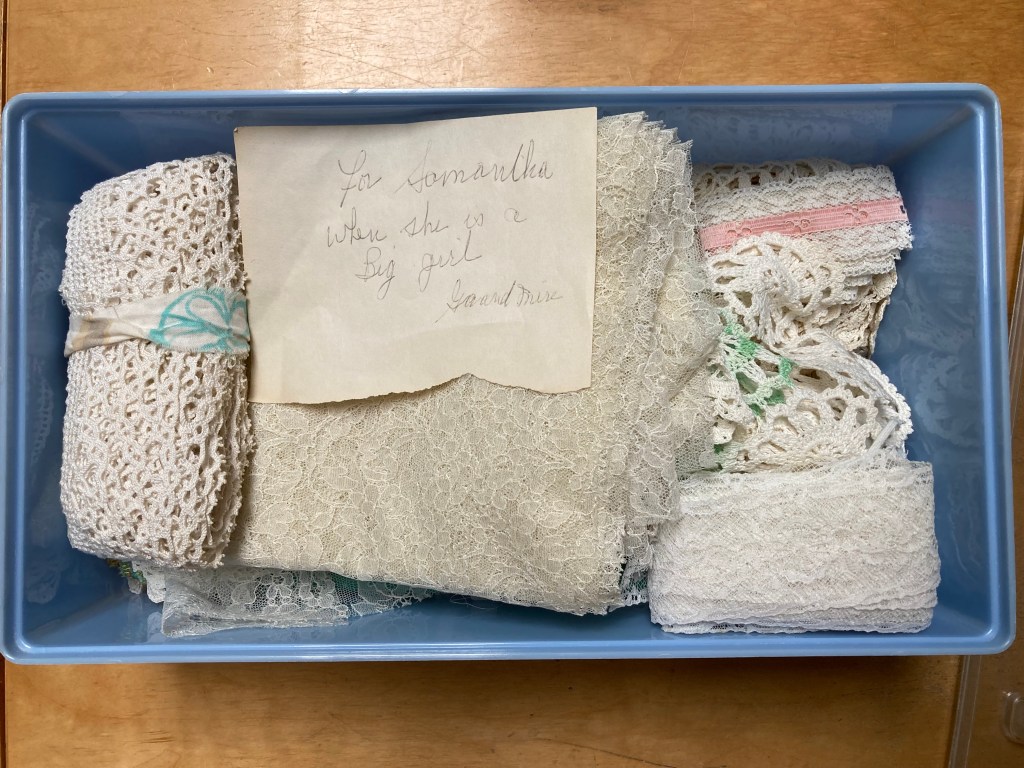
This brings me to more personal mystery involving lace. My grandmere–my paternal grandmother–left me a box of lace. She had it stored away in a plastic box with a flower-embossed lid and a note, “For Samantha when she is a big girl.” I loved frills and froufrou as a little girl, so she probably imagined me adding lace trim to my clothes and household linens, just as she filled her house with lacy runners and ribbon-trimmed drapes.

Photo shows box containing assorted kinds of lace and a handwritten note: For Samantha when she is a big girl, signed Grandmere.
“For Samantha when she is a Big Girl”

Where did the lace come from? Were these all bits and pieces left over from her own projects? My grandparents were thrifty and she would have saved any remnants, and probably anything that could be salvaged from old clothes as well. Or perhaps some of it was for projects she never started?

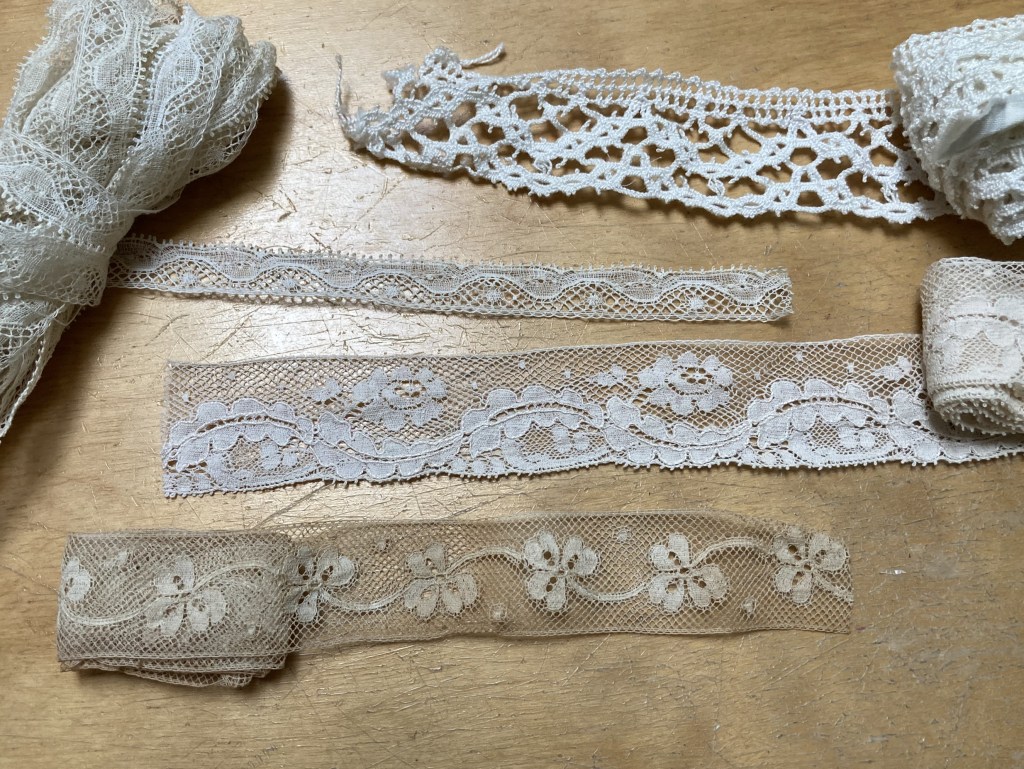
Four samples of lace: two abstract and two with realistic designs (cloverleafs and flowers).
Some of the lace trim, designs from abstract to realistic

On the other hand, one of the pieces in the box was a runner made of crocheted doilies, very like the partially completed doilies that were in with her other things, so presumably that piece is one she crocheted herself. Looking at it, I realize that I know very little about my grandmere’s skills beyond cooking and sewing. She once demonstrated tatting to me, but I wasn’t especially interested at the time and never asked to see more. Somewhere I have a wisp of tatting in the same beige thread as the partial doily–what else did she create? And did her lacemaking ever extend beyond crochet and tatting?

Some of the lace is clearly machine-made, and probably the rest of it–other than the doilies–is too. But I wish now that I had asked her to tell me more about her skills, instead of taking for granted the things that she made us–the crocheted cushion covers, and the pillows with our initials embroidered on them. It’s too late now. It will forever remain a mystery.

Till next post.