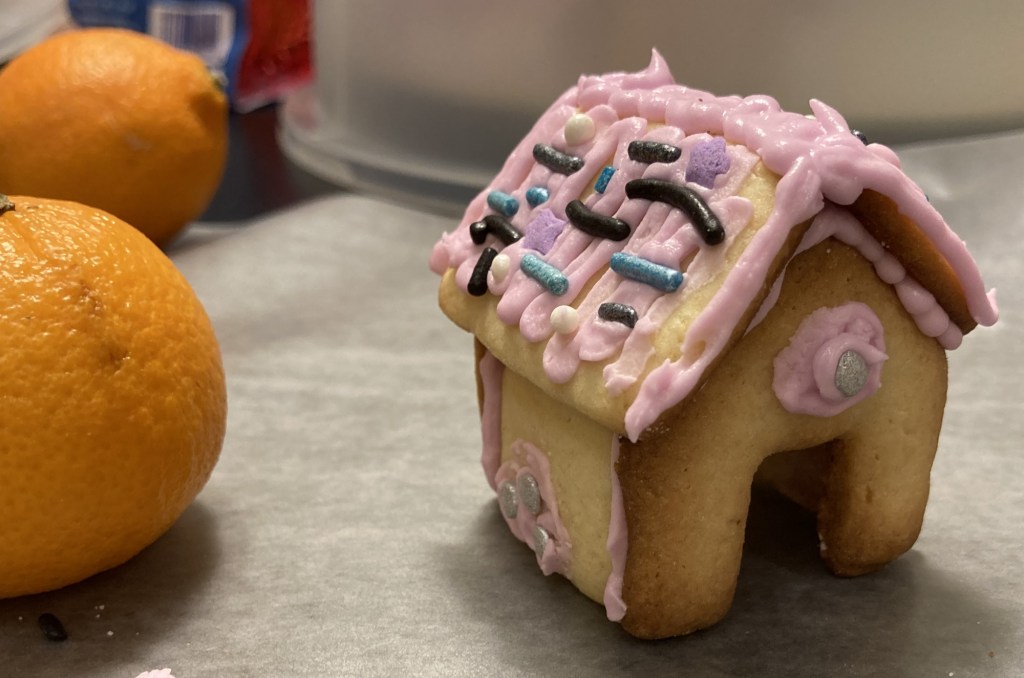
Cookie Houses–smaller is better

There are two kinds of people in the world: those who are more interested in the appearance of food, and those who are more interested in the taste. (Joke–there are two kinds of people in the world–those who divide the world into two kinds of people, and…)

Okay, it’s really more of a spectrum, but by way of illustration, every year I see magazines in the checkout showing clever ways to create cupcakes that look like spiders for Halloween, cookies that look like nests of eggs for Easter, and so forth. These are ingenious and very attractive comestibles, and I appreciate them as such, but I also can’t help thinking–do licorice whips really taste good with chocolate cake? Will the marshmallows work with pretzel sticks?

Partly for that reason, I’ve never been all that excited about making gingerbread houses, even though I love baking. I’ve always seen them as purely decorative–after all, surely pretzel logs and Necco wafers don’t taste as good combined with gingerbread. My husband, on the other hand, sees gingerbread houses as edible as well as decorative. His position is that one should enjoy it for a few days, then start picking candies off, then eat the cookie before it gets stale.

Still, I do like to decorate sweets, and I do like constructing things. This year, I had an urge to make a cookie house, possibly as a result of watching too many episodes of The Great British Baking Show. But did it have to be made of construction gingerbread? What other flavors might there be?

In looking up recipes, I found some blogs with pictures of miniature cookie houses: Pretty Petunias and For the love of butter, among others.

Brilliant! Not only were the little houses cute, but they had the following advantages over full-size cookie houses.

–I could make cookie houses and still enjoy fresh cookies from the rest of the dough.

–Each person could decorate their own house.

–It would be easier to cover the finished houses (to protect them from our cat who has been known to lick at them.)

–The cookies would not need to be quite so sturdy as the pieces would be smaller and subject to less tension and compression. (Thank you, Stephen Ressler of The Great Courses for the engineering vocabulary!)

–And finally, we could eat one while still enjoying the appearance of the remaining ones.

I tried two different doughs, and I tried cutting out my own small pattern (which was a bit of a pain) and then bought some ready-made cookie cutters for mini cookie houses. Photos below.
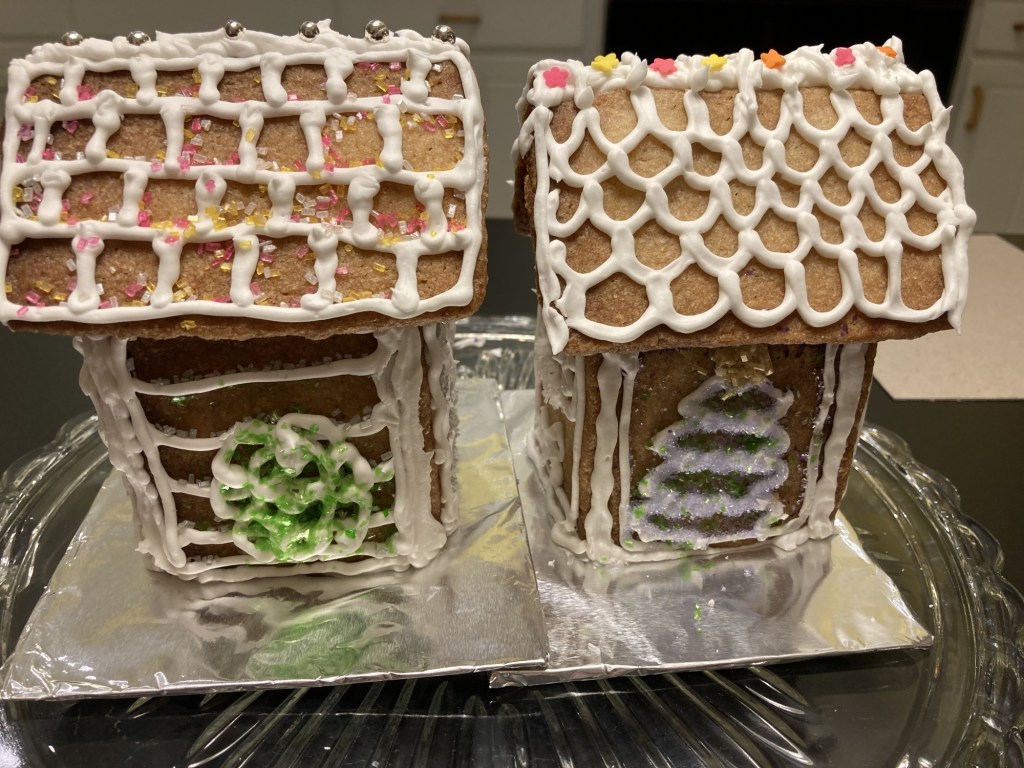
Cookie houses made from my own pattern.
Cookie houses made using purchased cookie cutters.

I’m not going to provide links to recipes, as the recipes I tried were okay but not thrilling. Better that you should scout around for recipes you find exciting and try those. (And then let me know, please, if you find a recipe you think is especially good.)

I will provide links to some of the cookie cutters, however, because they make it much easier. I didn’t recut my pieces after they were baked, which probably would have improved the results, but they stuck together all right anyway.

These are the cookie cutters I bought:

Fox Run Christmas Village

and this mini set which seems to come from several different sources. There is also one that cuts out all the pieces at once, which I didn’t try.

Till next post.

Thoughts on “Bittersweet: how sorrow and longing make us whole” by Susan Cain

I recently enjoyed reading Bittersweet by Susan Cain, author of Quiet (another book I liked.) She says the book started with her wondering why she likes sad songs so much. (And suddenly lyrics from Hadestown pop into my head–“It’s a sad song/ We’re gonna sing it anyway.” I really like Hadestown.)

Why we like sad songs seemed like an interesting question, but while her answers are worth reading, I’m not really going to discuss them here. Instead, there are two quotations from the book that I copied down into my “everything” notebook, and I want to offer them to you, with some thoughts.

Speak to yourself with the same tenderness you’d extend to a beloved child […] If this strikes you as hopelessly self-indulgent, remember that you’re not babying yourself, or letting yourself off the hook.

Bittersweet by Susan cain

What I like about this advice is that it makes clear that you are not supposed to simply go easy on yourself in the sense of not holding yourself accountable. You don’t get to let yourself off the hook. Rather, you are supposed to be gentle with yourself. You wouldn’t tell your beloved child that they were a hopeless failure and doomed just because they made a mistake or did something wrong. At least, I hope you wouldn’t. But neither would you tell them everything was fine. They still need to learn from their experience. And so do you.

There’s actually one further sentence to this quotation, which I left out.

You’re taking care of yourself, so that your self can go forth and care for others.

bittersweet by susan cain

While I can see how this provides a nice justification for taking care of yourself, it also seems to suggest that you are valuable only insofar as you take care of other people. That’s wrong. Other people matter, but so do you. And that’s a reason to take care of yourself right there.

The second quotation concerns how we relate to the past.

But there’s one more thing we can all do, even as we seek out and honor our parents’ stories, our ancestors’ stories. We can set ourselves free from the pain. […] It’s easier to see this when we look forward. Our stories will inevitably become our children’s stories, but our children will have their own stories to tell; we want our children to tell their own stories; we wish them that freedom. We can wish the same for ourselves.

bittersweet by susan cain

Here she clearly reminds us that we too are people. The way we want other people to be treated, the freedom we want for other people, is something we should offer ourselves as well. We often remind people to treat others as they would want to be treated themselves, but occasionally we need to remember the reverse–to treat ourselves as we think we should treat others.

(On a slightly different note, there are people who seem to think that how they were actually treated in the past, as children, is how others should be treated. “It was good enough for me,” they say, even when “it” was actually pretty terrible. But that’s a topic for a different post.)

There are lots of other interesting things in this book: thoughts about art, about longing, about immortalists (I didn’t know there was a group of people seriously seeking immortality), about “Self-Transcendent Experiences”, and about facing our own mortality. If these are topics you find interesting, then you should read this book.

And to return to the idea of bittersweetness, it’s back to Hadestown again,

Some birds sing when the sun is bright/ Our praise is not for them/ But the ones who sing in the dead of night/ We raise our cups to them.

Hadestown

Till next post.

P.S. I can’t italicize within italics, so I’ve turned italicized text into bold text in the quotations. Also I used […] to indicate some sentences were left out.