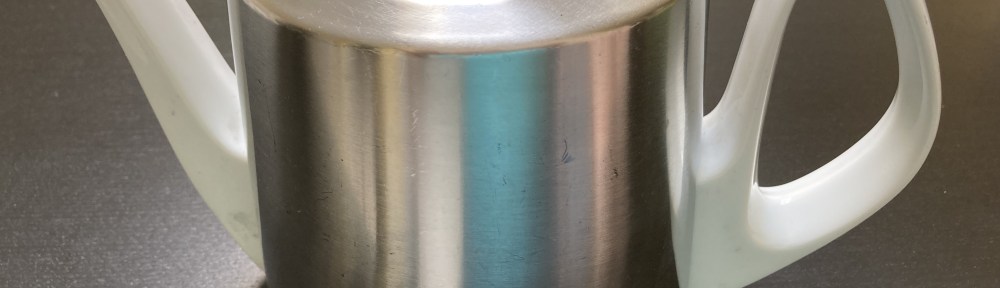

Above is a photo of the family teapot.
This is the teapot that traveled with my family since… I’m not sure when my parents bought it, but I’m currently sifting through family photos so possibly I will have a better answer later on. The steel part is a sort of tea cozy that fits over the plain white pot. No need to worry about the lid tipping off when you pour.
I love tea paraphernalia, and I have several teapots of my own. Some are inherited (silver with scallops, white with blue-and-gold); some were chosen (spring green, spring flowers). I like teapots with pretty designs or in appealing colors. I don’t like pots that are made to look like something else, such as a cake or a rabbit. That just isn’t my thing. I do like some teapots with simple, modern shapes, like this one. But there’s also one other important thing.
It has to pour well.
You’d think this would be required for any teapot, but I guess a lot of the really decorative teapots are bought by collectors and don’t get much use. (Mine don’t get much use, and I only have seven or eight! Imagine trying to use all of forty or so teapots!)
What makes a teapot pour well? I don’t know the answer. I do know that my parents’ teapot has a very unusual spout, and I can only assume it was meant to help it pour. I had never really looked at it, despite all those home-for-break teatimes, until now.
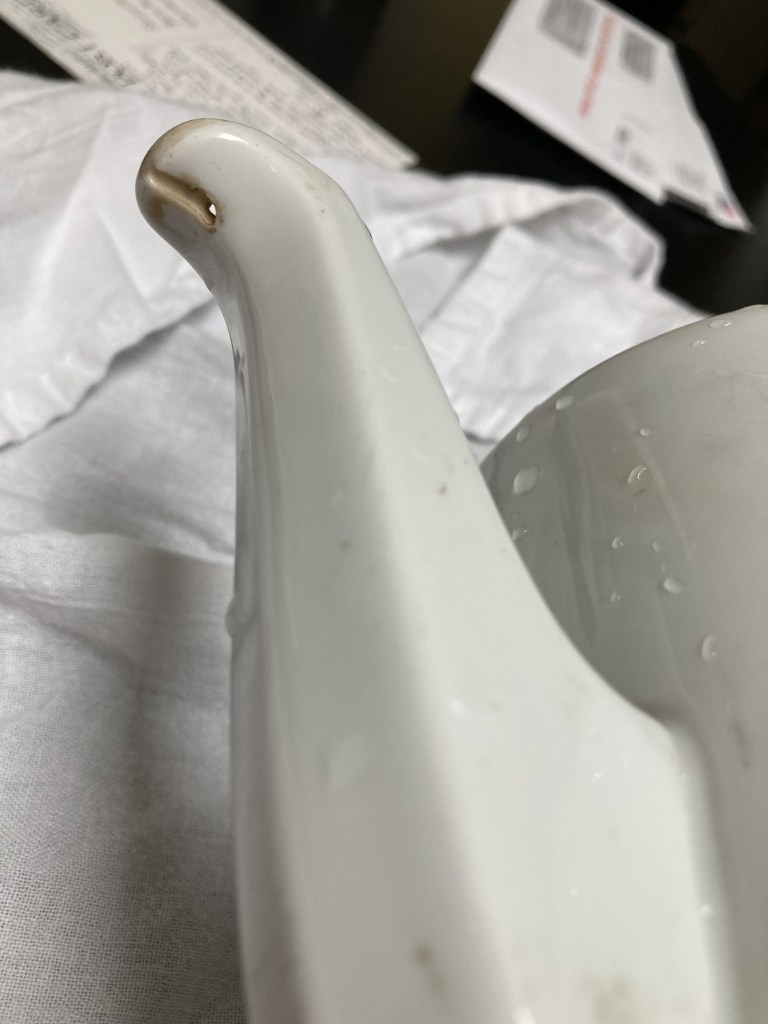
As you can see, there’s a small channel that runs down from the tip of the spout, and it is pierced.

And there’s a channel inside the spout that starts right at the hole. Is the drip meant to go back inside? Does this actually work? Did someone really do all this work to create a teapot that doesn’t drip? Surely this is more than is required.
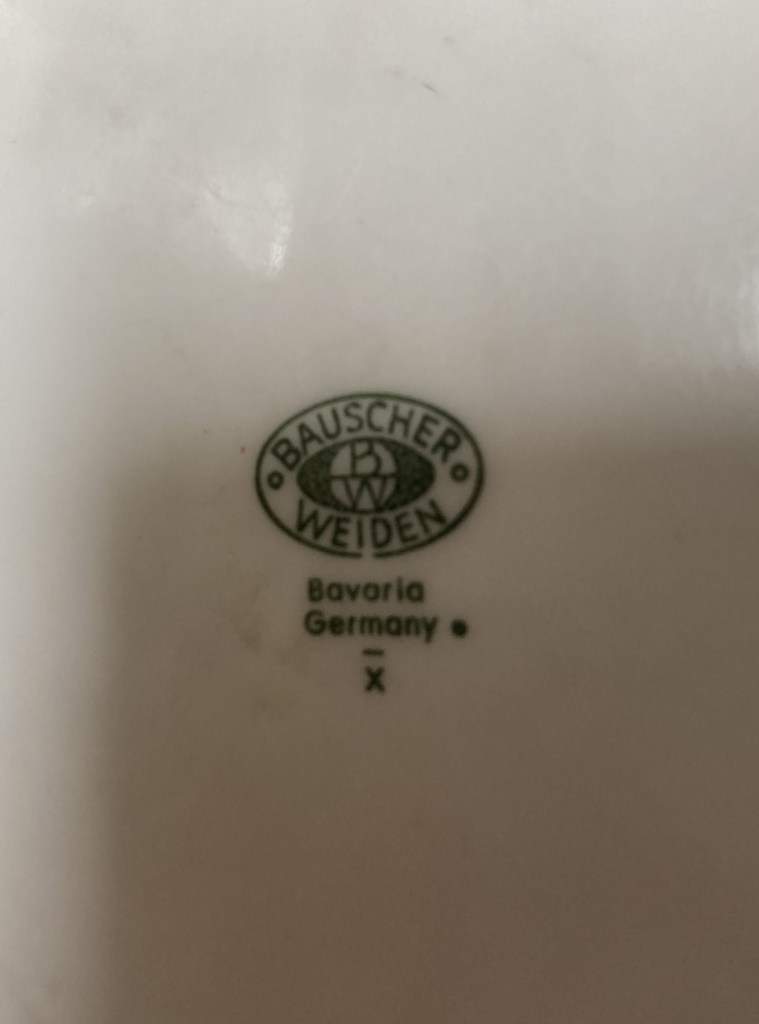
I just looked up this company. It appears that other pouring vessels they made in the past, such as coffeepots, did have pierced spouts. I couldn’t find out if this was true of their current products. I would love to read more about this feature, how it compares to other spout shapes, and who came up with it. Maybe someone out there can point me to an article?
Till next tea-time–and next post.

 Ravens and Pears