Thoughts on “Bittersweet: how sorrow and longing make us whole” by Susan Cain

I recently enjoyed reading Bittersweet by Susan Cain, author of Quiet (another book I liked.) She says the book started with her wondering why she likes sad songs so much. (And suddenly lyrics from Hadestown pop into my head–“It’s a sad song/ We’re gonna sing it anyway.” I really like Hadestown.)

Why we like sad songs seemed like an interesting question, but while her answers are worth reading, I’m not really going to discuss them here. Instead, there are two quotations from the book that I copied down into my “everything” notebook, and I want to offer them to you, with some thoughts.

Speak to yourself with the same tenderness you’d extend to a beloved child […] If this strikes you as hopelessly self-indulgent, remember that you’re not babying yourself, or letting yourself off the hook.

Bittersweet by Susan cain

What I like about this advice is that it makes clear that you are not supposed to simply go easy on yourself in the sense of not holding yourself accountable. You don’t get to let yourself off the hook. Rather, you are supposed to be gentle with yourself. You wouldn’t tell your beloved child that they were a hopeless failure and doomed just because they made a mistake or did something wrong. At least, I hope you wouldn’t. But neither would you tell them everything was fine. They still need to learn from their experience. And so do you.

There’s actually one further sentence to this quotation, which I left out.

You’re taking care of yourself, so that your self can go forth and care for others.

bittersweet by susan cain

While I can see how this provides a nice justification for taking care of yourself, it also seems to suggest that you are valuable only insofar as you take care of other people. That’s wrong. Other people matter, but so do you. And that’s a reason to take care of yourself right there.

The second quotation concerns how we relate to the past.

But there’s one more thing we can all do, even as we seek out and honor our parents’ stories, our ancestors’ stories. We can set ourselves free from the pain. […] It’s easier to see this when we look forward. Our stories will inevitably become our children’s stories, but our children will have their own stories to tell; we want our children to tell their own stories; we wish them that freedom. We can wish the same for ourselves.

bittersweet by susan cain

Here she clearly reminds us that we too are people. The way we want other people to be treated, the freedom we want for other people, is something we should offer ourselves as well. We often remind people to treat others as they would want to be treated themselves, but occasionally we need to remember the reverse–to treat ourselves as we think we should treat others.

(On a slightly different note, there are people who seem to think that how they were actually treated in the past, as children, is how others should be treated. “It was good enough for me,” they say, even when “it” was actually pretty terrible. But that’s a topic for a different post.)

There are lots of other interesting things in this book: thoughts about art, about longing, about immortalists (I didn’t know there was a group of people seriously seeking immortality), about “Self-Transcendent Experiences”, and about facing our own mortality. If these are topics you find interesting, then you should read this book.

And to return to the idea of bittersweetness, it’s back to Hadestown again,

Some birds sing when the sun is bright/ Our praise is not for them/ But the ones who sing in the dead of night/ We raise our cups to them.

Hadestown

Till next post.

P.S. I can’t italicize within italics, so I’ve turned italicized text into bold text in the quotations. Also I used […] to indicate some sentences were left out.

Temporary Traces of Leaf on Stone

It isn’t just animals that leave traces of their passing. As the leaves fall in autumn, they leave marks–temporary ones–in mud and in stains. The sidewalks are marked with the tannic traces of fallen oak leaves and pine needles, and rain has collected the dust around the edges of wet leaves on my flagstones, creating mud traces of leaf even after it has dried and blown away.

I like looking at these interesting shapes and trying to guess what left them.

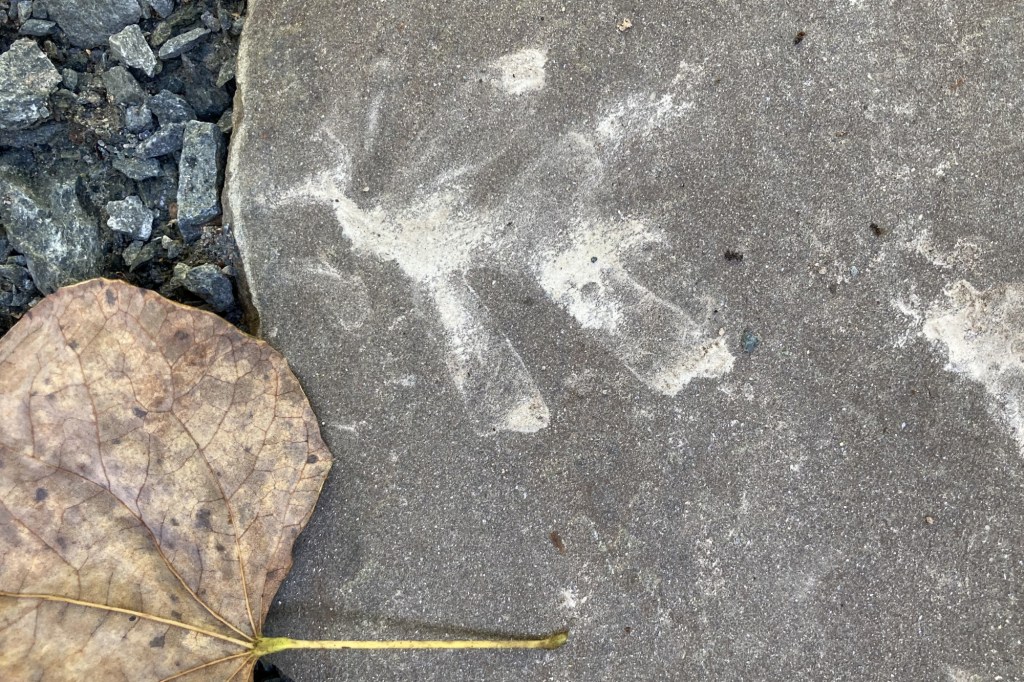
Traces of mud showing the outline of a tulip poplar leaf
Tulip poplar

Here we have what is almost certainly the trace of a tulip poplar leaf, those tall trees that have yellow-orange-green flowers in spring. Liriodendron tulipifera, if I’m remembering my high school class in dendrology correctly. (Thanks, Mr. Trott!)

I know we have tulip poplars nearby, so that makes sense. Here’s another.

Traces of mud show the outline of an oak leaf
Oak leaf

This one is pretty distinctive: some type of oak, maybe white oak. We have a lot of oak trees around our house, too. I can hear the acorns falling on my neighbors’ metal roofs, and also (only slightly less dramatically) on mine. It’s a nice reminder that fall is here.

Traces of mud show the heart-shaped outline of a redbud leaf
Redbud leaf

I can feel especially confident about this one as there is a redbud (Cercis canadensis) overhanging my new flagstone patio. It was a volunteer that I never took out, and now I’m too attached to its heart-shaped leaves and pink-purple spring flowers to do anything about it. The flowers are edible (though I haven’t tried one for years), but the seeds are not. Don’t eat them!

Mystery leaf

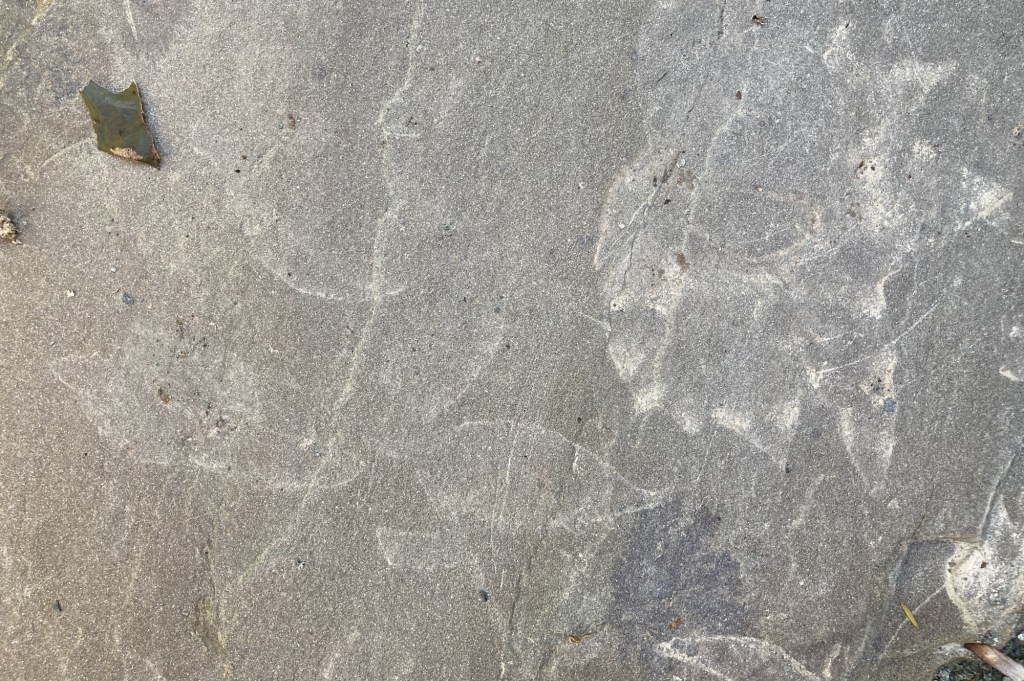
Here I can only guess. On the right, I think I see another tulip poplar leaf. On the left–is it traces of a hickory leaf, with its various leaflets, or just overlapping traces of some other leaves, maybe wild cherry? I really can’t tell.

These traces are temporary. One good rain will probably erase them. The brown stains on the sidewalks from oak and pine will last longer, but they too will fade eventually. Everything changes, so enjoy the little things while they last.

Till next post.

#CarolinasKidLit2022 —lessons in marketing

I’m delighted to be at the SCBWI (Society of Children’s Book Writers and Illustrators) conference in Charlotte, after two years of attending only virtual writing events. I was worried for a while that the weather might intervene, and decided to take the train down rather than chance driving in a lot of rain. I hate driving in heavy rain.

The first session I found myself in was about building an online kidlit platform. Thank you, Micki Bare, for a thorough look at the various forms on online presence and the ways in which they differ. Also, I didn’t know you could make a Facebook page that was accessed separately from your personal FB stuff. I’ll have to look into that.

But if you’ve read my earlier blog post Too Many Books, Too Little Time—writers want to write, not do marketing, you know that marketing is not my forte. In fact, I have complained loudly that I want to write, not spend time coming up with interesting tid-bits for strangers online. Yet I do recognize the difficulty of just relying on writing a good book to get people’s attention when we live in a world that is FULL of very good books already. And yes, people do spend a lot of time looking at what other people say online, so there’s an opportunity there.

I’m usually good about doing whatever exercise the speaker assigns—write something about a past experience, list five children’s books that you wish you’d written, that kind of thing. But “Take a silly selfie and post it using the following hashtags”? I started to take out my phone, then thought—wait, I don’t do Twitter. I don’t even want to do Twitter. Where else can you post with hashtags? (Answer—Instagram, apparently, but I don’t have that either.)

As you notice, I’m now experimenting with using a hashtag in the title of a blog post. Will it actually be recognized as a hashtag? I kind of doubt it, but it makes a good title.

All of the above is actually a preamble to some thoughts I had while waiting (and waiting and waiting) for my restaurant check. (I think the weather meant they had more diners than they are used to—either that or the weather left them very understaffed.)

Why can’t writers just hire someone else to do all the marketing stuff without any involvement from them? The answer, presumably, is that people want to read something personal, something that is actually about the author or has some connection to the author’s life. But why? The author is not the book character. The author may or may not be a terribly interesting person. (Everyone is interesting to some degree, but why should an author be any more interesting than your next-door neighbor?)

It’s unfair, I thought. Authors didn’t always have to put themselves out in public to this extent. One used to be able to write and still be a private person.

Then I thought—what about actors?

An actor isn’t the character he plays in the movie, but actors have always known that publicity was a crucial part of being an actor. People expect at least some engagement from them, or that they will at least tolerate a lot of gossip about themselves—maybe even go out of their way to create some interesting rumors. The crucial difference seems to be that actors are SEEN. They tell their stories with their faces and their bodies. And that has always made them very interesting to the people watching their films, unlike authors, who are unseen creators. The actor’s appearance in a film creates interest in the actor—something which doesn’t happen nearly as much with books.

Studios know that interest in a particular actor creates interest in that actor’s films. So I guess managing and encouraging that publicity becomes part of the job. Publishers want authors to generate interest in themselves, but they want them to do so even before the book creates any interest in them.

I’m not sure what to conclude from this. That authors need a new conception of their role? That they should hire publicity people to do all the tweeting for them? That the whole system seems really unsustainable in a world of seven billion people connected by internet?

I don’t know. I do know that I need to get some sleep, because tomorrow starts early and there are still many exciting sessions to attend at #CarolinasKidLit2022.

Till next post.