 |
| Going, going,… |
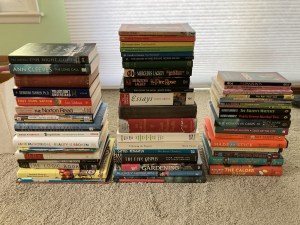
I’ve been going through my overcrowded shelves of books recently and “pruning,” as my mother likes to put it. It’s difficult. At this point, I’ve gotten much better at getting rid of books I’m not really thrilled with shortly after I read them, which means most of the books I’m sorting through are 1) books I’ve had for years already and am sentimental about, 2) books I haven’t read yet, and 3) books I’ve loved, either recently or in the past.
The first category, books I’ve had for years, is composed of books that have already made it through many previous prunings, one as recent as 2017. Clearly I have some sort of attachment to them. (See “Books, Nostalgia, and Death.”) Most of these titles will make it through this pass as well.
Not all of them, though. For example, I’ve decided that while I enjoyed Noel Streatfield’s Gemma series, I’ve been keeping it all these years partly because I’m keeping her Ballet Shoes and A Vicarage Family, which is not a good enough reason for keeping Gemma. How much do I even remember about the series? I remember Gemma’s initial difficulties in a new school, the chair outside the headmistress’ office, something about a pink sweater, and a difficult decision between going back to acting or staying in school… but if I had to decide between rereading the Gemma books and reading a new middle-grade novel off my wish list, I would probably read the new one. That means it’s time to hand Gemma on to the library, and hopefully from there to some middle-grader who will enjoy reading about her for the first time.
The second category, unread books, probably numbers fifty titles at the moment. I bought them because they looked promising, and chances are they still do. The best way to decide is to compare each book to other shiny new options and ask myself, “Which would you rather give your time to?” Maybe I’m no longer quite as interested in art forgery as I used to be. Maybe I’ve already read enough books about dogs and their abilities. Maybe it’s time to move on. If not, at least by looking at it I’ve reminded myself that this book exists and that I want to read it someday.
Most of the third category, books I’ve loved, gets an automatic pass. I still have enough shelf space for the books that filled my early life, even if I haven’t read them for years and possibly never will again. Will I reread the entire Dragons of Pern series? I read it many, many times as a teen and I can’t let go of it yet, even if I haven’t reread it for decades. The Deryni series? Dune? They can stay, for now.
The Little House books were a staple of my childhood and I still open them up now and again. The Far Side of Evil, the Prydain books, Heidi… those too can stay, though I’m suddenly wondering if I need to keep the copy of Heidi. Surely I can get it from a library if I really want to reread it.
No, it stays—for now.
Books I’ve read (or re-read) recently and loved are absolutely keepers. Howl’s Moving Castle isn’t going anywhere. (Haha.) Neither are The Two Princesses of Bamarre, or My Friend Flicka, or that interesting books about pigments, or that other interesting book about flavors. (I don’t just read fiction.) All my Louise Penny mysteries are staying, as well as the Rivers of London series.
In the process of pruning my library, I’ve realized there are some principles that help me make the decision to put a book—or any item—in the donation box. I discussed these before in an earlier post, “Decluttering: on the one hand and on the other”, but to remind myself, I’m going to write them down here as well.
First, space has value. While I’m not paying extra to house these books, the piles of books outside the bookcase take up work space, floor space, and mental space. Clutter is distracting. If I can reduce the volume to fit the shelves, I will breathe easier and have more space for working on craft projects and moving around.
Second, it’s easier to find the books I really want to read if those are the only books on my shelf. Why spend time on a so-so book when I have all these books I really enjoy?
Third, keeping all these books around is a waste of resources. The Gemma books have been sitting on my shelves for the past forty years, and it has probably been at least twenty or twenty-five years since I’ve re-read them. Other people could have been reading them during that time, if they had had the books. I should free them up for someone else to enjoy.
And so, onward with the book pruning. At this rate, I might get through it all by the end of the month. Oh wait, I forgot the books tucked away in the guest room…
Till next post.


 Ravens and Pears