Making Your Own Flavored Yogurt (From Plain Yogurt) and Making Dalgona Coffee

I remember when regular yogurt came in lots of flavors and brands. That was before Greek yogurt took over, along with the sugar-free, fat-free, everything-free yogurts. The rising interest in full-fat yogurts was a brief respite, but it seems to be passing in favor of various international style yogurts. Regular flavored yogurts make up only a small patch of the yogurt section, and I think this is even more the case for vegetarians, since Yoplait uses gelatin in their yogurts. (They used to, anyway–I haven’t checked recently.)

I have long been a fan of Dannon coffee yogurt, and apparently a lot of other people are, too. I can still find it in four-packs in some stores… sometimes. But I can’t find it reliably, and Dannon lemon yogurt has been gone for a long time. Fortunately, I can mix up a decent coffee yogurt and a very tasty lemon yogurt using plain yogurt and flavoring. As long as you don’t mind stirring your yogurt before eating it, you can get a variety of flavored yogurts from one large tub of plain yogurt. (Some people only like yogurt when it has that perfect jelly-like consistency straight out of the container–I can’t think of a good word to describe the texture–and so would not like home-flavored yogurt.)

For lemon yogurt, I have been using a large spoonful of lemon curd. Make sure it hasn’t been sitting in your fridge for months–I think the flavor deteriorates. Put the spoonful in a microwaveable bowl and nuke it for 5-7 seconds, just until it softens and stirs easily. Then add plain yogurt and mix.

For coffee yogurt, you can mix up some instant coffee and sugar with a little water, and keep it in the fridge for flavoring yogurt. For maximum entertainment value, make Dalgona Coffee. A friend told me about this, and it really is fun to make if you have an immersion blender with a whisk attachment.

Braun immersion blender with whisk attachment
Immersion blender with whisk attachment

Mix equal parts coffee powder, sugar, and water (hot water works fine.) Whisk until really stiff. It’s amazing!

Dalgona coffee, whipped, and the whipping container held upside down.
See how thick it is?

How do you use it? The on-line photos show it spooned onto milk, over ice, for iced coffee. It looks nice, but I just end up stirring it in, and it doesn’t taste any different.

Dalgona coffee also makes a nice cafe au lait when stirred into hot milk. And (more to the point) you can also add it to yogurt, though I suggest adding extra sugar. I haven’t tried whipping the coffee mix with extra sugar, but that would cut out a step if it whips successfully.
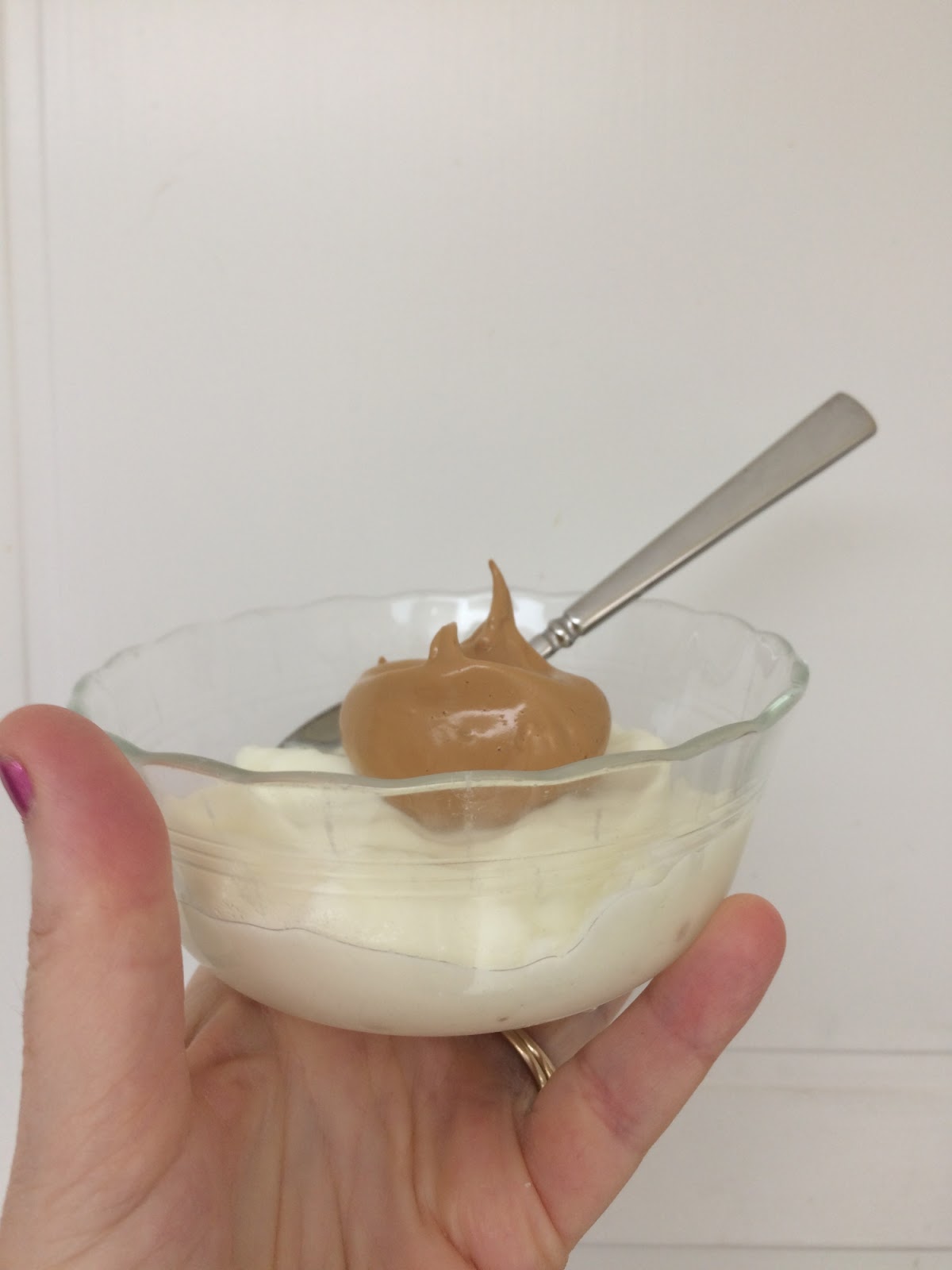
A bowl of plain yogurt with a blob of Dalgona whipped coffee on top
Dalgona coffee on yogurt–remember to stir!

Other flavorings: maple syrup (not maple-flavored pancake syrup, though I suppose that would be a flavor all its own), brown sugar (works well with yogurt), and what about jam? Presumably you could warm up strawberry jam just as easily as lemon curd and make fruit-flavored yogurt.

None of these ideas is particularly original, but sometimes it’s nice to be reminded that you have options.

Till next post.

Crumpets and Tea–trying out a treat I've only read about

Buttered crumpets and tea. Crumpets always sounded appealing when they showed up in a novel, but for a long time I had no idea what a crumpet even looked like. I assumed it was a baked good (not exactly), and apparently good with butter (true), and I also vaguely assumed it was sweet.

Not so, apparently. When Cook’s Illustrated offered a crumpet recipe in their March/April 2020 issue, I decided I would have to try it. A few weeks ago, I did.

As I mixed the batter, I realized there was no sugar in the recipe. Well, there’s no sugar in a lot of French bread recipes either, but French bread works beautifully with butter and jam, as well as with savory toppings. So I just figured I would have to put jam on them.

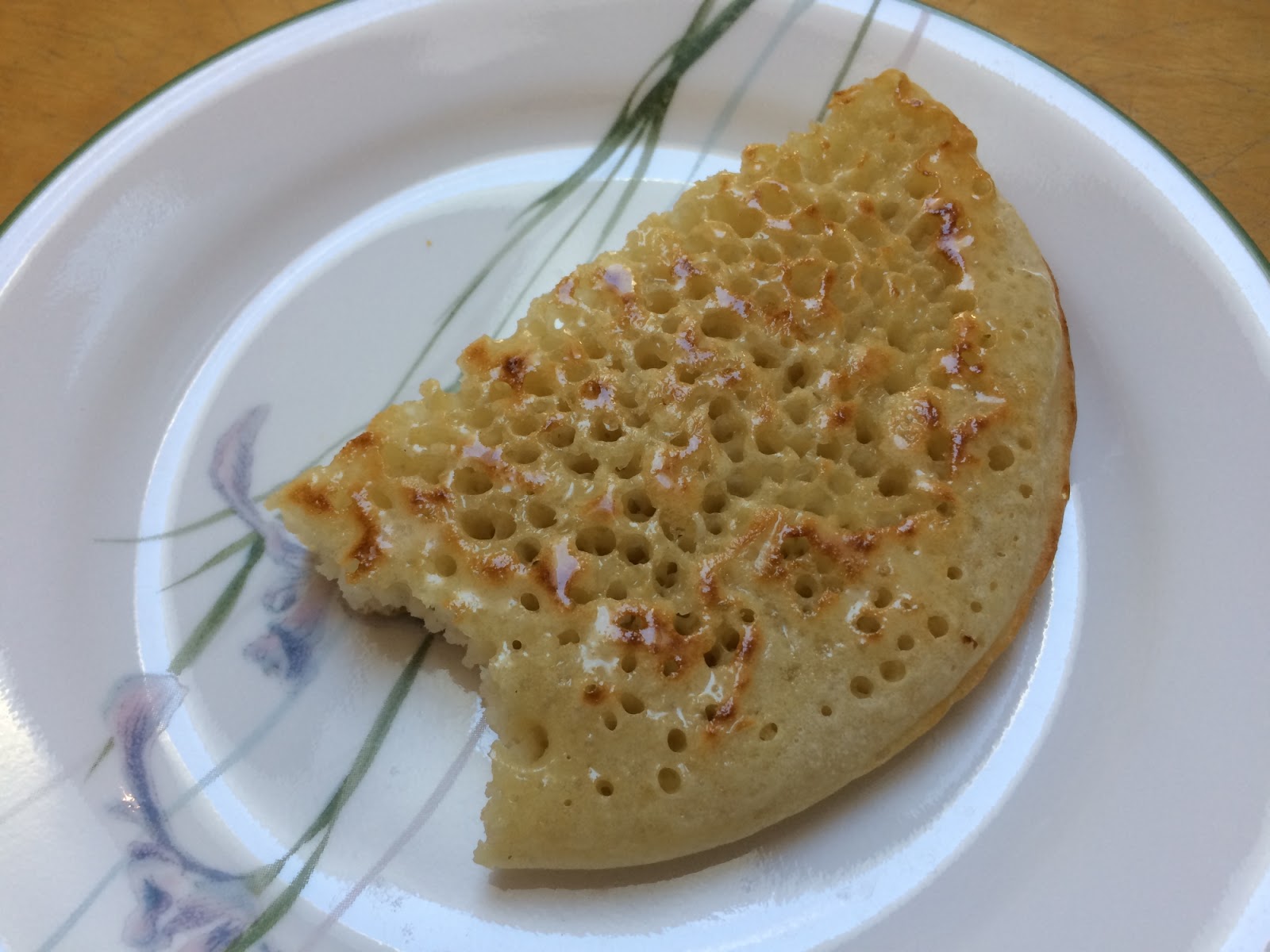
Watching the crumpets cook was interesting. They got bubbles all over, which was almost disturbing, and the recipe advised touching the surface with a spatula to turn the bubbles into little holes, then flip the crumpet to cook the other side. The result, then, is something like a pancake absolutely full of little holes.

Crumpets have holes on top and a smooth side below
 

These many little holes are good at trapping the butter that melts on a hot crumpet, and that helps me understand one of the descriptions of buttered crumpets found in House of Many Ways, an excellent book by Diana Wynne Jones.

To set the scene–Charmain is at the palace, where she is unexpectedly invited to tea with the king and some newly arrived visitors.

     Charmain thanked the gentleman again and took two. They were the most buttery crumpets she had ever encountered. Waif’s nose swiveled to dab gently against Charmain’s hand. “All right, all right,” Charmain muttered, trying to break off a piece without dripping butter on the sofa. Butter ran down her fingers and threatened to trickle up her sleeves. She was trying to get rid of it on her handkerchief, when the lady-in-waiting finished saying all anyone could possibly say about the weather, and turned to Mrs. Pendragon. (p. 178)

 Charmain isn’t the only one having a problem. The lady-in-waiting asks about Mrs. Pendragon’s little boy.

    “Yes, Morgan,” Mrs. Pendragon said. She seemed to be having trouble with butter too and was mopping her fingers with her handkerchief and looking flustered.
    “How old will Morgan be now, Sophie?” Princess Hilda asked. “When I saw him he was just a baby.”
    “Oh, nearly two,” Mrs. Pendragon replied, catching a big golden drip of butter before it fell on her skirt. “I left him with–“

And now we’ll leave Charmain and Mrs. Pendragon to struggle with their hot buttered crumpets and other, as yet unmentioned, problems.

Back to my homemade crumpets. We toasted the crumpets (one was slightly underdone, one slightly overdone, one seemed about right) and buttered them.

Buttered homemade crumpet (with a bite missing)

So what did these particular buttered crumpets taste like? Slightly salty. And buttery. It made me think about the appeal of plain bagels grilled in salted butter. Not sweet, but wonderfully buttery and chewy and slightly salty. The texture was different, of course, but the comparison helped me understand why they would be appealing.

I should add that I don’t like my sweets to be particularly salty. When I have bread and butter and jam, I always use unsalted butter. Salted butter puts me off jam almost completely. So perhaps for other people, crumpets and jam is a better combination than it is for me.

All in all, I’m not sure I’ll bother to make them again. It was fun, but there are so many other exciting things to make that I like better. I’m glad I tried it, though.

Till next post.

Too Many Books, Too Little Time–writers want to write, not do marketing

A friend’s book is being published this year, so I’ve been learning from her about all the work expected of a debut author. It isn’t enough to have written the book. No, one must also be active on social media, do blog tours, notify contacts, seek out opportunities to do book talks, and I-forget-what-all-else.
But writers just want to write! Most of us don’t want to do marketing. We’d rather spend the time holed up in our cubbies with our laptops, lost in imaginary worlds, coming up with new books.
The problem? Basically, there are lots and lots of new books out there. There are lots and lots of readers as well, but readers all want to read the “best” books, books that are a guaranteed good read. Readers have easy access now to books from all over the English-speaking world, so they can pick just the books that they’ve heard are really good, and these tend to be the same books that other readers have also heard are very good. So a small number of  books get read by lots of readers, and the rest of the new books (including some that are also very good) tend to go unread.
It’s a depressing situation if one of those new books is yours. Thus the need to market your book.
Shouldn’t the publisher do the marketing? Certainly they want your book to sell. But whether they sell a total umpteen copies of a wide variety of books or umpteen copies of the same book, they’ll still make money. It might be more efficient for them to focus their efforts on a few books, in that case. At any rate, that’s how it is. Unless they’re expecting great things, they probably won’t do that much.
Is there any way around this? The problem seems to be with our filtering system. There are several levels to it. First, the author writes the book. Agents filter out a lot of the books that are written, though some books are self-published and skip that filter. Then publishers filter the books presented by agents, accepting only some of them. Then the books go out into the world, where…
I think that’s where it turns into a combination of luck and money. Luck in who happens to pick the book up and how much influence they have with other readers. Money, because people are more likely to pick up a book if they’ve heard of it or seen it, and advertising can do that. Obviously the quality of the book also matters. If the people who read it don’t like it, they won’t recommend it to others. But a good book that never gets read won’t get recommended either.
So now I’m fantasizing about a system where new books enter a database and are assigned to readers to evaluate. Every book gets a chance, regardless of its author’s ability to generate interest on Twitter or lack thereof. Readers aren’t deluged with attempts to pique their interest, attempts that lead to their becoming more and more overwhelmed by the demands on their attention, and their having less and less time to actually read books.
The problem with this idea is that readers want to choose their books, not be assigned them as though they were in school. Some might volunteer to be assigned books, hoping for a serendipitous discovery, but more likely they’d rather browse the shelves and try only books that look appealing to them.
So that’s not promising. Well, who has the most reason to want such a system to work? Probably the writers themselves. So instead of assigning new books to random readers, assign them to other authors. Maybe their book gets as many reads as the number of others’ books they are willing to be assigned. This would provide a preliminary filter and ensure that at least a few people sample their books—and maybe go on to recommend them to friends.
Some further rules would be necessary. First, no reciprocal reading. If I am an author and I want fifteen people to read my book, I do not get assigned books by any of the fifteen who are reading mine. Nor do I get assigned any books by people I know. There can’t be any pressure to like the book.
Second, these aren’t book reviews. The only thing the reader has to do is respond, “I like it and would probably read another book like this,” or “I don’t like it and wouldn’t choose to read a book like this.” No discussion of merits, no details, no reasons why.
Third, given that people occasionally cheat (shock! gasp!), there would probably need to be some factual question that the reader has to answer to prove that they actually read the book. The author of the book could provide one. Otherwise, unscrupulous people could get their books read without reading anyone else’s in return.
Fourth, complete confidentiality. You don’t want to meet another author and have them know that you didn’t like their book—or the other way around. Too awkward. Again, there can’t be any pressure to like the book.
Given that there is nothing new under the sun, and especially no new ideas that aren’t already on the internet, there is probably something wrong with this imaginary system. Maybe it wouldn’t be of any use, or maybe not enough authors would participate, or maybe people would try to game the system by reading lots of competing books and saying they dislike all of them, in the hope of making their own book look better.
Or maybe it would work and is already in use somewhere on the web. There are lots of book-related organizations out there that I don’t know about, and maybe there are genre-specific groups that do this. If so, I hope I find out some day.
I hope I have reason to.
Till next post.