Decorating Boxes For Flashcards — Zentangle and ZIA on tuckboxes

Two books on language learning that I’ve read in the past several years (or has it been longer than that?) recommend using spaced repetition with flashcards. “Spaced repetition” means that so long as you are getting a word right, you increase the length of time before you review it again, while if you get it wrong, you shorten the interval. The Leitner system is a spaced repetition system. It is a list of days and levels of words to review on that day. When you review a word, if you get it right the word moves up a level; if you get it wrong, it moves down.

There are lots of on-line flashcard programs, but I like actual cards. Actual cards take up space, though, and need to be contained so cards at different levels don’t get mixed up. So I’ve been making tuckboxes for my flashcards out of cardstock and decorating them.

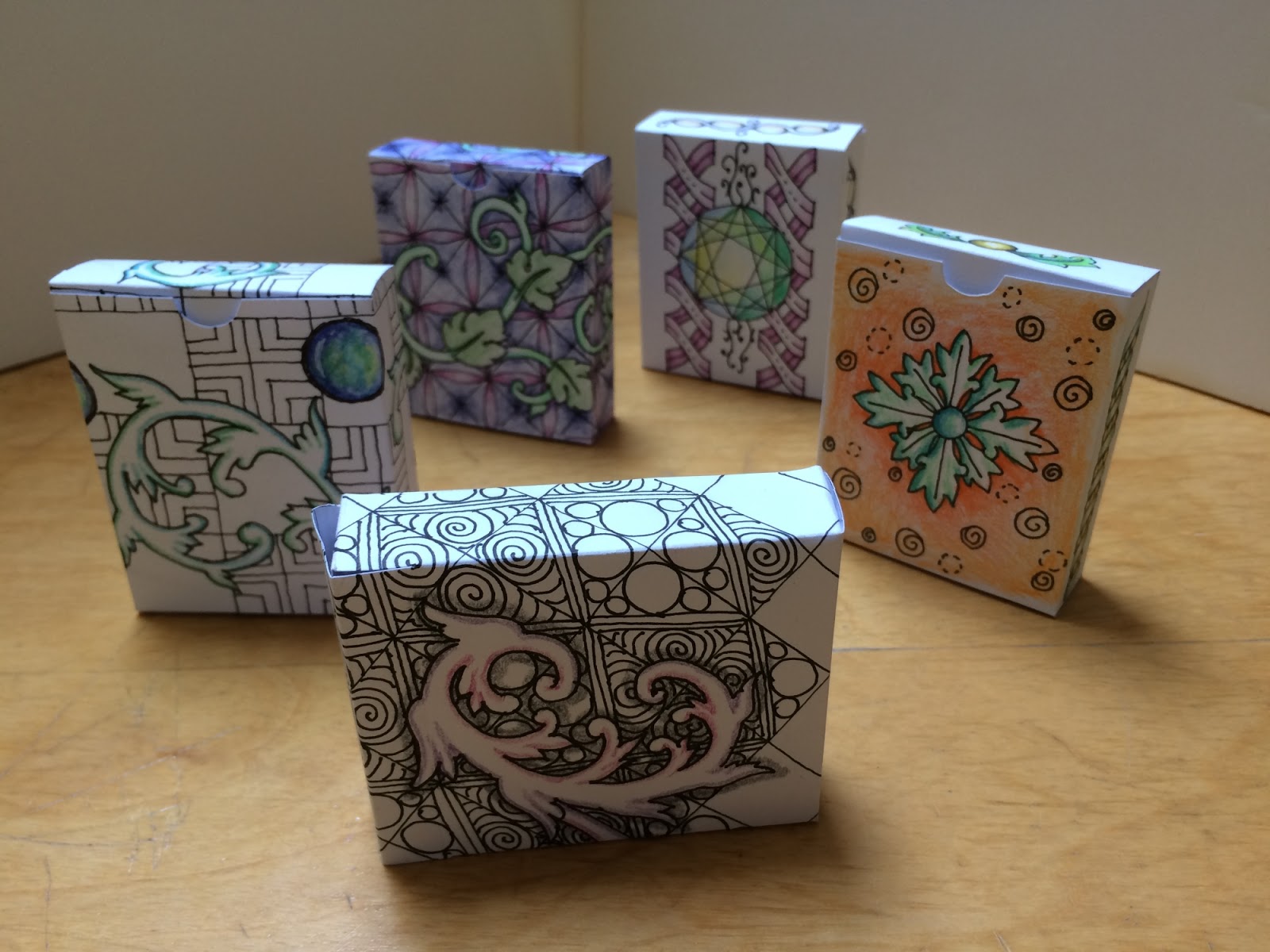
Tuck boxes for flashcards made from cardstock and decorated using Zentangle and ZIA
The earlier boxes.

I’ve discovered that you need more boxes for the later levels, as those cards accumulate while waiting to be moved up or down. Cards in level 1 get reviewed every day (if you’re being consistent about the system, which I admit I am not) and rapidly move to box 2, and fairly quickly to box 3. Cards start really piling up at level 4, which is only reviewed once a week or so.

Tuck boxes for flashcards made from cardstock and decorated using Zentangle and ZIA
Later boxes.

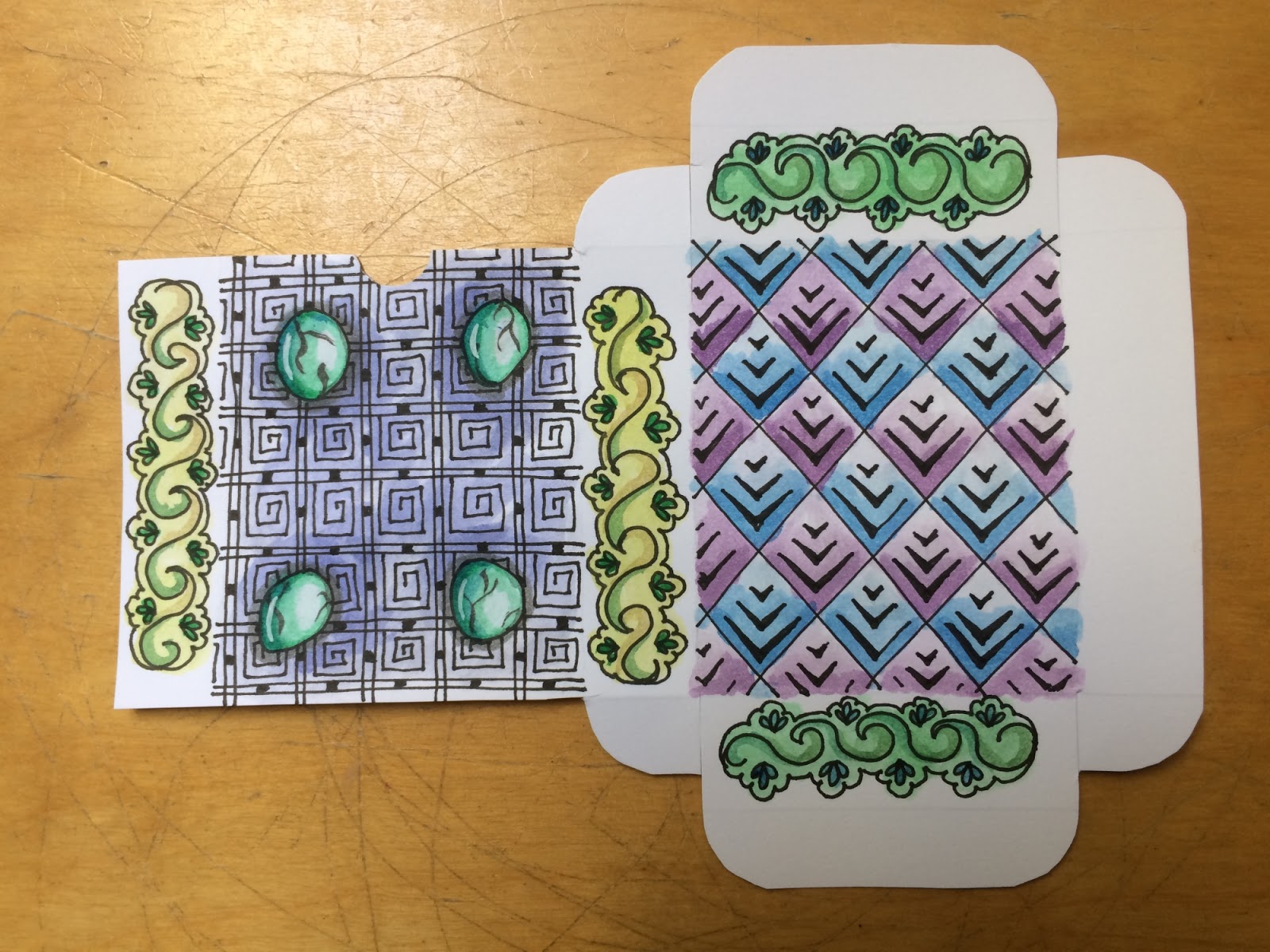
Although I’ve been using patterns from Zentangle (R), these designs are really Zentangle Inspired Art (ZIA) mixed with … whatever. I do use pencil guidelines for a number of these, especially the scrolls. I also use a lightbox so I can draw guidelines where the edges the template are on the other side of the paper. That way, I can decorate the box before I cut it out (especially helpful with watercolor.)

Decorated template of tuckbox for flashcards.
I already erased the pencil outline that shows me where the edges are.
Decorated template of tuckbox for flashcards.
A different box, cut out.

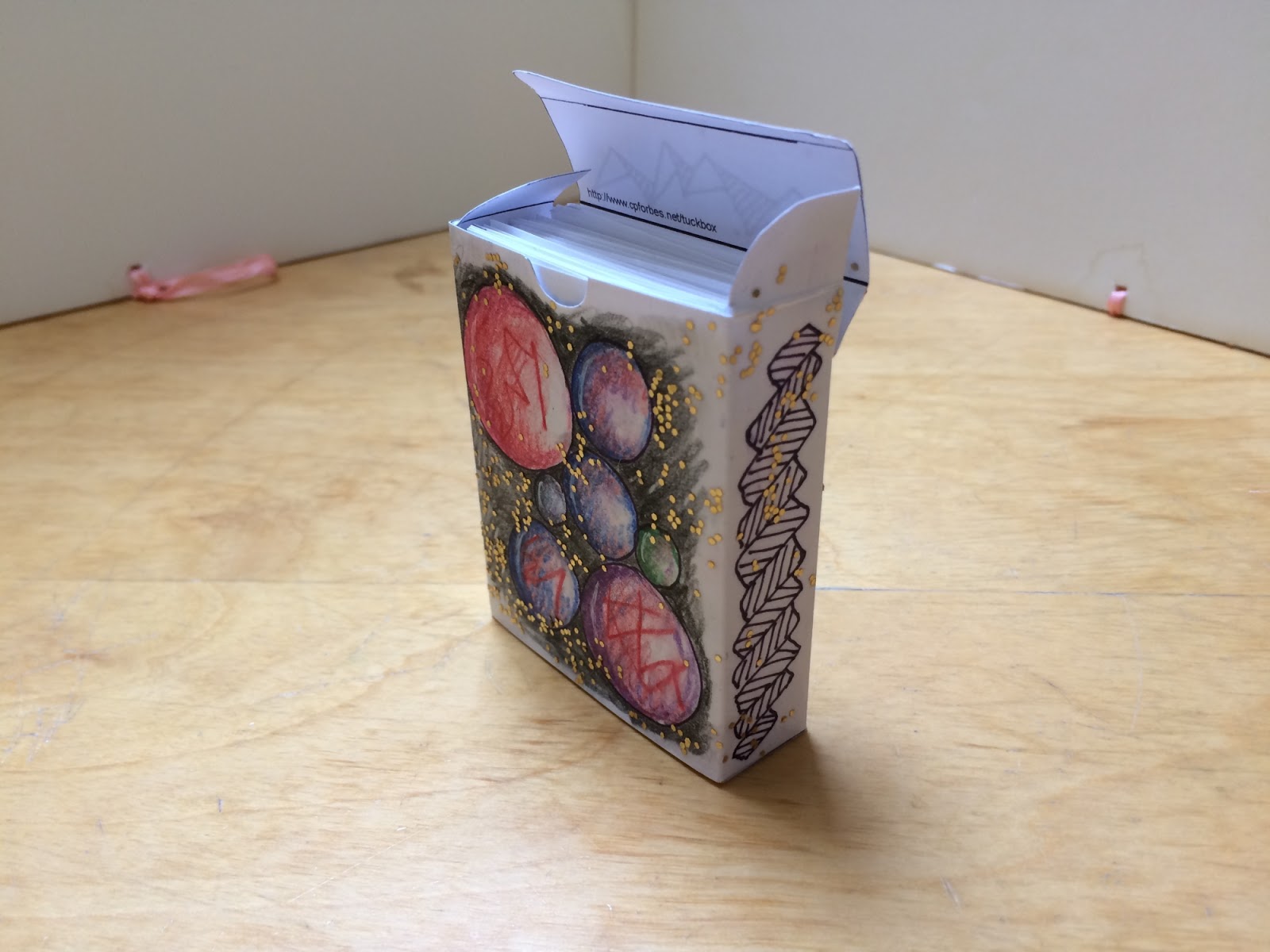
 I’ve been trying different media for coloring–Prismacolor pencils, watercolor pencils, and watercolor. One of the boxes is coated with ModPodge and glitter, which gives it an interesting feel.

Box for flashcards decorated with ModPodge and glitter
ModPodge and glitter.

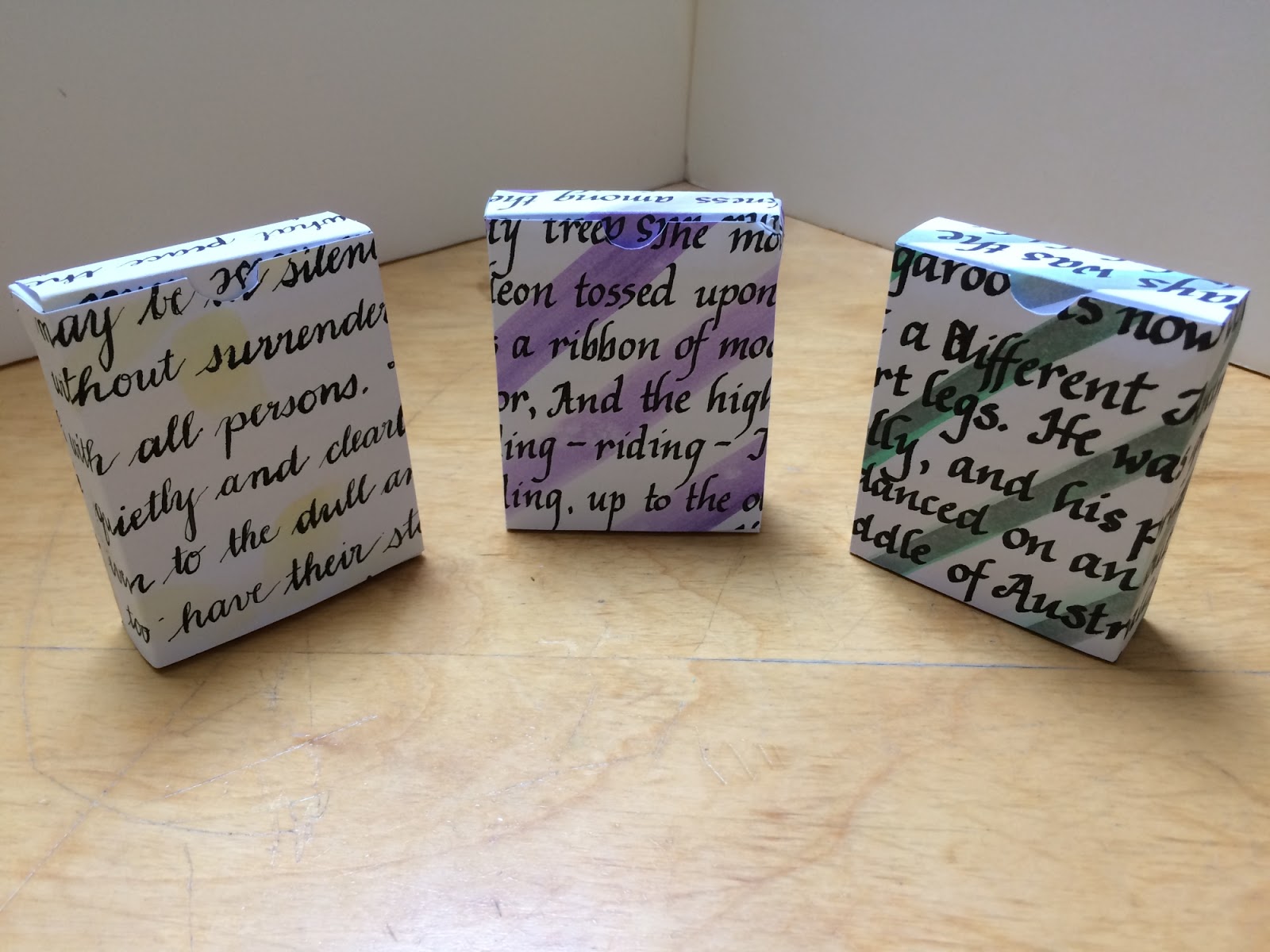
For three of the boxes, I wrote across the cardstock in calligraphy, then cut out the box. Can you identify the quotations?

Tuckboxes for flashcards decorated with calligraphy.
Boxes with calligraphy.

The template for these boxes was generated using Craig Forbes’ tuckbox template generator. (I am having difficulty getting to the webpage now–hope that changes.) You can choose the dimensions of your box to suit the size of your flashcards. Be careful to select “actual size” when printing them, or your boxes may be unexpectedly too small.

Box (tuckbox) for flashcards decorated with tangle patterns

Happy vocabulary practice!

Reflections on the book "The Circle" by Dave Eggers–transparency versus privacy

When I first read The Circle by Dave Eggers, I expected it to become the 1984 of our time. It took to the logical extreme a number of problems that were already visible—reduced privacy, an increased sense of insecurity resulting from too much social media, and the constantly increasing requests for feedback from every quarter. Instead, as far as I can tell, the book just disappeared in the ever-growing flood of new books.
I’m of two minds about recommending it to other people. On the one hand, I thought it raised the issues very cleverly. On the other hand, I wouldn’t exactly call it a fun read—though it is much more entertaining than 1984, The Jungle, or The Grapes of Wrath, all of which I’m glad I (was forced to) read, and none of which I enjoyed.
I’m going to focus on privacy versus transparency for this post, setting aside the mostly separate issue of too much emphasis on feedback (really, there are areas in which asking for feedback is just a terrible idea!). There is a moment near the beginning of the story in which our main character, Mae, tries to wring clever changes on a trite phrase and ends up saying something she never meant to say. Ouch. But
“it didn’t matter. He was laughing now, and he… made her trust that he would never bring it up again, that this terrible thing she said would remain between them, that they both understood mistakes are made by all and that they should, if everyone is acknowledging our common humanity, our common frailty and propensity for sounding and looking ridiculous a thousand times a day, that these mistakes should be allowed to be forgotten.” (p. 34)
Mae is new at the company when this happens, and hasn’t yet absorbed the company’s view of things, expressed by one of their founders as “All that happens must be known.” And by “known”, he pretty much means accessible to anyone, anywhere, and at any time. It isn’t Big Brother that’s watching you, it’s your peers—everyone with an internet connection.
One of the things that kept me caught up in the book was the way the company’s spokespeople somehow managed to make the most outrageous claims seem not just plausible, but positively progressive. (I spent a lot of time mentally shouting at Mae to get a clue and realize why they were wrong.) The founder in question, Bailey, gives two main reasons for promoting transparency.
The first is that people behave better when they know they are being watched. He thinks the only reason people have for wanting privacy is that they are ashamed, either because they are doing wrong (in which case we should know about it) or unnecessarily (in which case we should all just get over it.) If we know we are watched, we will be our best selves—and don’t we want to be our best selves?
The second, lesser reason is that we owe it to others to share with them experiences that they may not have an opportunity to have for themselves.
To take the second reason first, no, we don’t owe that to others. Furthermore, sometimes part of what makes an experience special is that it is unrepeatable or rare. Sometimes the fact that an experience is shared with only one or a few people is what makes it special. Recording the experience wouldn’t really convey what made the experience special to anyone else, and might take away from it for those who were there. There are plenty of people happy to create logs of interesting places and events, and  enough places and events to fill several lifetimes, without having to record everything.
The first reason Bailey gives for transparency is more interesting. People almost certainly do behave better when they know they are being watched. But people can have good reasons for wanting privacy. As Mae noticed early on, we are terribly prone to making mistakes and we hate having everyone know about them and judge us based on them. People who don’t know us well may take our mistakes for character traits, and people who are malicious may use them as an opportunity to pounce on us and malign us to others. When we know we are being watched, we are likely to play it safe. Not only do we avoid doing wrong, we also won’t say or do anything risky, that might be taken wrong or go badly. Unfortunately, making mistakes is a large part of learning, and taking risks is how we (sometimes) make progress. So if we are constantly watched, we won’t be our best selves, we’ll just be our most conformist selves.
The other reason for wanting privacy is that we don’t necessarily want to be judged even in areas where there are no “mistakes.” I don’t want to hear what the world has to say about my taste in paint colors. It’s none of their business if I want to live in a house decorated in Easter egg colors. Some of them might think the color scheme enchanting, but others will not, and as Mae discovers when only 97% of fellow Circlers think her awesome in a silly quiz, “she could only think of the 3 percent who did not find her awesome.” (p. 405) Negative evaluations are disproportionately upsetting.
On top of that, some people are mean and will say nasty, critical things about your paint colors (or whatever) just to make you feel bad. Who needs that kind of unsolicited comment?
So we should have some control over what is offered up for public comment. Things I post on this blog are fair game; things I say to my family over dinner are not.
Other times, the benefit of producing better behavior does outweigh the value of privacy. Security cameras, open meetings, proctored tests… sometimes these are worth it. But there is usually some cost to be taken into account.
I won’t say how the book ends.
Till next post.

Reflections on the book "Good Omens" –and the importance of shared hobbies

The other day, passing the newspaper rack, I saw a shiny, colorful paper titled The End Times. It turned out to be an advertisement wrapped around The New York Times. It was for a television series (is it television if it’s Amazon Prime?) based on Good Omens, a novel by Neil Gaiman and Terry Pratchett.

Of course, I had to find my copy and reread it. It was as good as ever, despite showing its age. (Who has an answering machine anymore, besides my mother? And between GPS and cellphone apps, it’s a lot harder to get effectively lost on the road any more.)

It’s the kind of book that has a lovely narrator’s voice, one that offers comments on the proceedings, such as this one on the relationship between two main characters, an angel and a demon:

“The Arrangement was very simple, so simple in fact that it didn’t really deserve the capital letter, which it had got for simply being in existence for so long. It was the sort of sensible arrangement that many isolated agents, working in awkward conditions a long way from their superiors, reach with their opposite number when they realize that they have more in common with their immediate opponents than their remote allies. It meant a tacit non-interference in certain of each other’s activities. It made certain that while neither really won, also neither really lost, and both were able to demonstrate to their masters the great strides they were making against a cunning and well-informed adversary.”

Why do I single out this particular bit? It makes me think of several things: unifying influences, an article on friendship that I read long ago, and politicians.

I’ll take politicians first, since that is the simplest and shortest to discuss. Where the quotation reads “agents”, substitute “politicians.” For “remote allies”, “superiors”, and “masters”, substitute “constituents”. The result suggests the reasoning: “If you let me pass this bill, I’ll stay out of your way on that bill, and we’ll both get re-elected, after which we can go after the robo-callers, since they are universally detested.”

And that’s all I wanted to say about politicians. Onward.

If I remember the article on friendship correctly, it claimed that shared activities have a significant role in who your friends are—more so than shared interests or values. Sharing activities isn’t exactly the same as having similar roles in different organizations, but I find myself envisioning opposite numbers from feuding governments commiserating about long and pointless meetings, superiors who don’t really understand what’s going on, insufficient resources, and, of course, the poor work ethic of today’s youth. (That last is an especially safe bet, since people have been complaining about “the youth of today” since the start of recorded history.)

This leads to the third thing I mentioned, “unifying influences.” Commiserating about similar problems is one activity that brings people together. There are a lot of other activities people can have in common: knitting, basketball, cat ownership, video games, and so on. People meeting other enthusiasts want to know: can this person demonstrate a S-S-K (slip, slip, knit)? Can this person make a foul shot reliably? Does this person know why a cat might start pulling out its own fur, and more importantly, how to stop it doing so before it goes completely bald?

In the process of discussing these important matters (move this loop to the other needle… is the cat feeling stressed or itchy?), people have a chance to discover each other’s strengths before discovering each other’s weaknesses. We all have a mix of good and bad qualities, but perhaps we are at our best when we are sharing our preferred activities with others.

This is important because we have differing mixes of beliefs and ideological positions as well. If, instead of getting to know each other through shared activities, we start by mentally sorting everyone according to one particular quality—political party, say—we risk losing sight of all the diversity of character that exists. We also risk dismissing people out of hand without really knowing anything about them.

Now I’ve really gotten far away from the book I quoted—or have I? When I think about it, one of the other charming things about the book is the unlikely alliances that form.

Probably the filmed version of the book will be very different. Certainly the narrative voice is unlikely to be there, and no doubt they’ll have changed the plot quite a bit as well. I’m still looking forward to it, though. I think it could be really fun. Time will tell (today, in fact).

Till next post.