Dissecting Mysteries–the many kinds of clues

Yesterday, I sat in a bookstore thinking about mysteries. Kids’ mysteries, particularly. How do they work?
Actually, they vary. Like adult mysteries, some are more about the adventure of solving a case. I’m thinking here of the traditional Nancy Drew mysteries (not the Nancy Drew Clue Book books). First, Nancy has to discover what the mystery is. Further problems occur as she pursues answers. (She often gets knocked over the head along the way—in real life, she would need to see a neurologist for the repeated concussions.) Eventually, in a dramatic chapter, she comes into direct conflict with the villain, triumphs, and the mystery is solved.
By contrast, short mysteries like the Encyclopedia Brown stories have a clear, quickly revealed mystery. It hinges on some particular fact or statement, and in the Encyclopedia Brown stories, the author breaks the story into two parts: the mystery, and the solution. The reader can “match wits” by figuring out how Encyclopedia Brown solved the case, then continue on to the solution to check herself.
Not all short mysteries separate the solution out so explicitly (the Nate the Great stories don’t), but they do generally turn on some one clue, so I started making a list of different kinds of clues.
Some clues link the suspect to the scene of the crime. Sometimes the suspect leaves traces on the crime scene (footprints, a pocketknife with his initials on it), and sometimes the crime scene leaves traces on the suspect (ink stains from the spilled bottle, red mud on his boots).
Some clues involve discovering a falsehood in the suspect’s story. Often the detective knows something that the suspect doesn’t. (Mules are sterile. Oil paintings aren’t framed under glass.) Alternatively, the suspect has forgotten a detail that makes her story impossible. (How did she buy an ice cream when she was in her swimsuit and her money was still in her shorts’ pocket?)
Things that undergo change over time or under special circumstances make good clues. (They also make good weapons in adult mysteries.) One way in which change can be a clue is when it indicates that the suspect is lying about time or about where he has been. (He can’t have been out on the warm porch sipping lemonade for the past hour, because the ice cubes in his glass are clearly fresh from the freezer.)
Another way that change provides a clue is by making something more detectable. (The missing lunch is discovered in someone’s closet because—phew, it’s gone moldy. Spilled lemonade brings out a message written in pH-sensitive ink.) The problem with this kind of clue is that it isn’t to the detective’s credit unless she is the one who correctly identifies the smell, or notices the partial markings and deliberately spills more lemonade to reveal the rest of the message.
I’m sure there are other categories I’ve missed. There’s the locked-room puzzle (how could someone have committed the crime?), as well as the “you had no way to know that unless you did it” categories.Some might be combinations. Something that becomes deadly as it changes over time, or that disappears over time, might be the key to solving the locked room puzzle.
Now that I’ve made this list, I need to come up with an interesting detective and a small world to set the mystery in. But that’s a problem for another day.
Till next post.
Making a Bag For a Folding Chair–NOT a how-to story

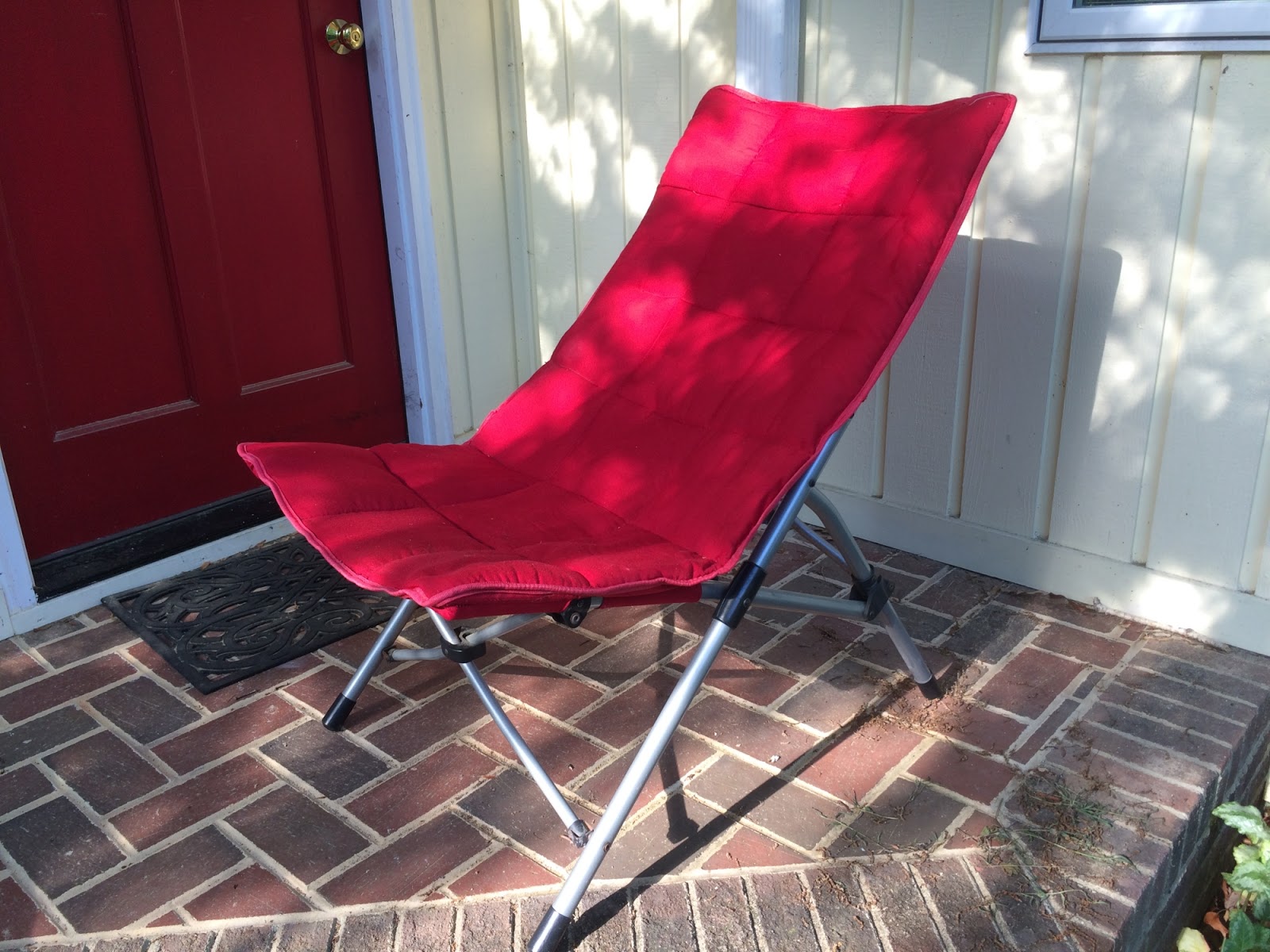
We’ve spent a lot of time recently sitting around outside during mountain bike races, generally on folding chairs that we bring with us. One of these chairs, an upholstered red chair, no longer has a carry bag. This makes it somewhat awkward to carry around.

Red upholstered folding chair.
The chair.

So I thought I’d make a bag for it before the next race. I went through various ideas. First, I thought I’d make a bag like the one that came with the orange chair (which is not upholstered, but is your basic take-to-a-game chair.) Then I thought I’d modify it–have a long zipper so we wouldn’t have to wiggle the bag down over the chair. But a zipper could break under stress, not to mention adding a trip to the notions store and extra work to the project. I eventually decided to keep the drawstring at the end, and use ties so I could have a large opening and avoid the effort of squeezing a lumpy chair into a snug bag.

I still had some of the tulip-flowered sheet and plain canvas that I used for the grocery bag project. (Someday I will go back to that project and try again.) I measured, cut out the pieces I thought I needed, and got started.

Things I learned:

-Old poly-cotton percale and cotton canvas are very different weights. Using a thin fabric and a thick fabric (except when one is for a lining) makes for weird seam allowances and other problems. I already knew this, but discounted it when planning. I should pay more attention to things I “know.”

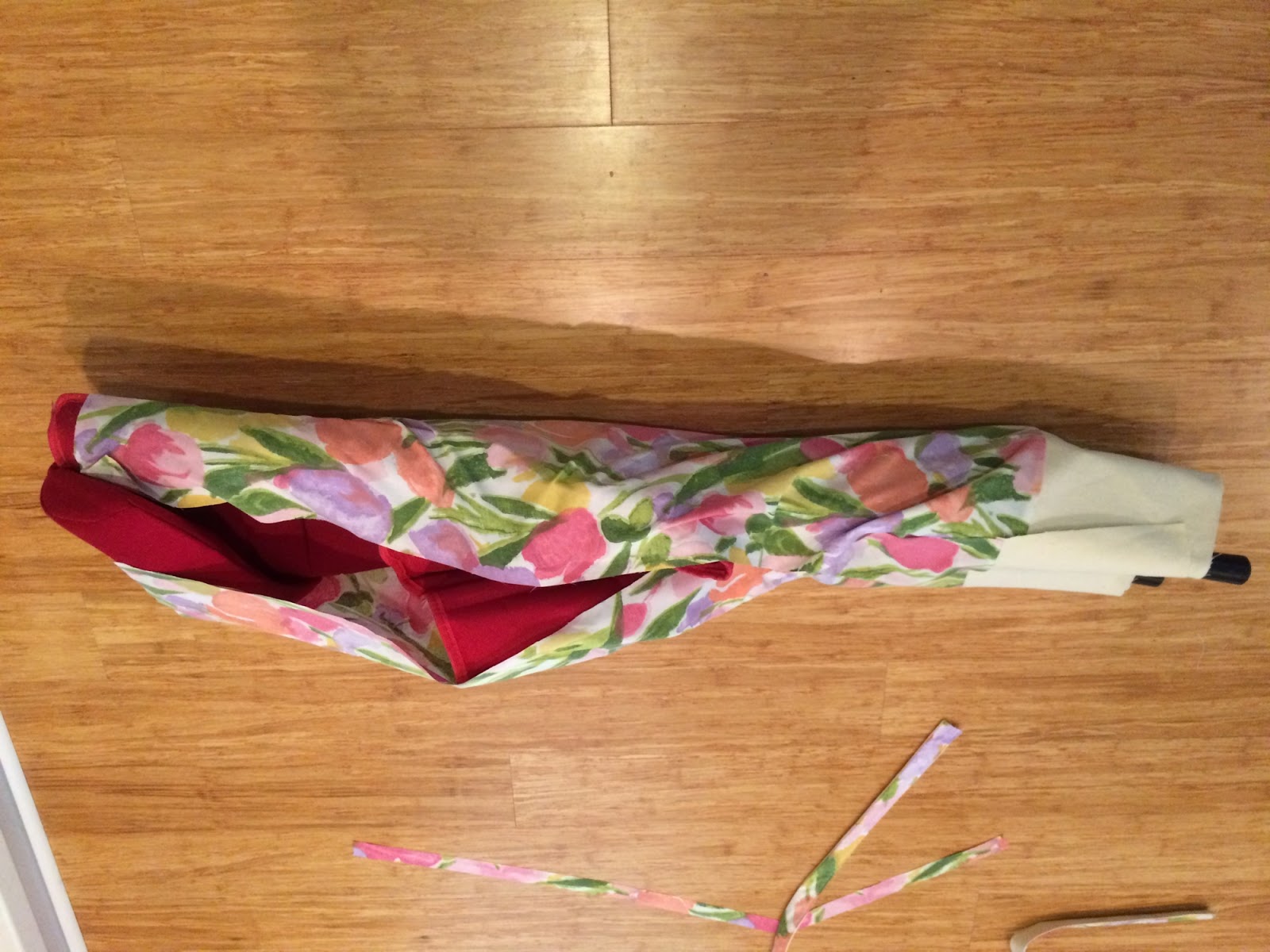
-Measure carefully. I knew I’d forgotten to allow for the drawstring casing, but if I hadn’t wrapped the partially sewn bag around the chair, I wouldn’t have realized it was that much too short. So measure carefully and check against the model frequently.

Oops. Much too short.

-Maybe think more about the materials. Did I really need to use the tulip sheet? Granted, I got the two king size sheets at a thrift store years ago and I’ve been using that material for miscellaneous projects ever since, but it’s pretty stuff and this bag really didn’t need to be pretty. It’s not as though it even goes with the chair. So… better the tulip sheet than buying new fabric or using my stash of quilting fabrics, but I could have gone to the attic for a holey white sheet or other rag. I guess I was being lazy.

-Think more about shortcuts. I didn’t really need to sew the ties from tulip fabric. I could have used ribbon that I already have on hand and saved myself some time. I did realize (in time) that I didn’t need to put a square bottom on the bag. Unlike other folding chairs whose feet meet in a neat square, this one folds up unevenly. Just sewing the bottom of the bag straight across was sufficient.

-I didn’t pay much attention to the grain of the fabric because I didn’t care that much what the bag looked like and it doesn’t need to “hang” right. But it still leads to some weirdness when ironing seam allowances and folding over hems. Again, something I “knew” but discounted.

I’m not including “how to” steps in this post because (a) you probably don’t have the same chair, (b) if you did have the same chair, you’d probably still have the bag it came with, and (c) I wouldn’t recommend making your bag the same way I did.

I do like the large opening. It makes it easier to get the chair in. And having a bag with a strap will definitely be better than dragging the chair around without a bag.

Woman carrying folding chair in homemade flowered bag with strap.

One final side note: is it just that I’ve been watching too many mysteries, or does the chair end up looking a bit like a dead body wrapped in a sheet?

Till next post.