Trying the Diva's Challenge–Zentangle (TM) and ZIA on the internet

I love to browse through images of Zentangle (TM) and Zentangle Inspired Art. Earlier in the year, for instance, I was besotted with the use of “gems” in ZIA. Mandalas (Zendalas?) are also an interesting kind of ZIA. I can run through a lot of time just looking at all the pretty pictures online.

One thing that keeps coming up when I browse people’s blogs is “the Diva’s challenge.” This comes from the popular blog “I Am the Diva”. The Diva’s weekly challenge is (generally) to do a tile with only one or two specified tangles, though some challenges don’t restrict the tangles used and instead involve some other requirement.

Now, being challenged to make something while abiding by restrictions on what can be used is a great creative challenge, so I kept thinking, “Hmm, I should try that.” This week, I decided to do so.

Challenge #361 was to celebrate Earth Day (a week ago last Sunday) by tangling on some recycled material. The Diva used the back of a frozen pizza carton. I used the back of a cracker box.

Turns out I really like the way things look in black and white on a tan background. I hadn’t tried it before. I don’t know whether I’ll do more challenges or not, but it was definitely worth doing this one.
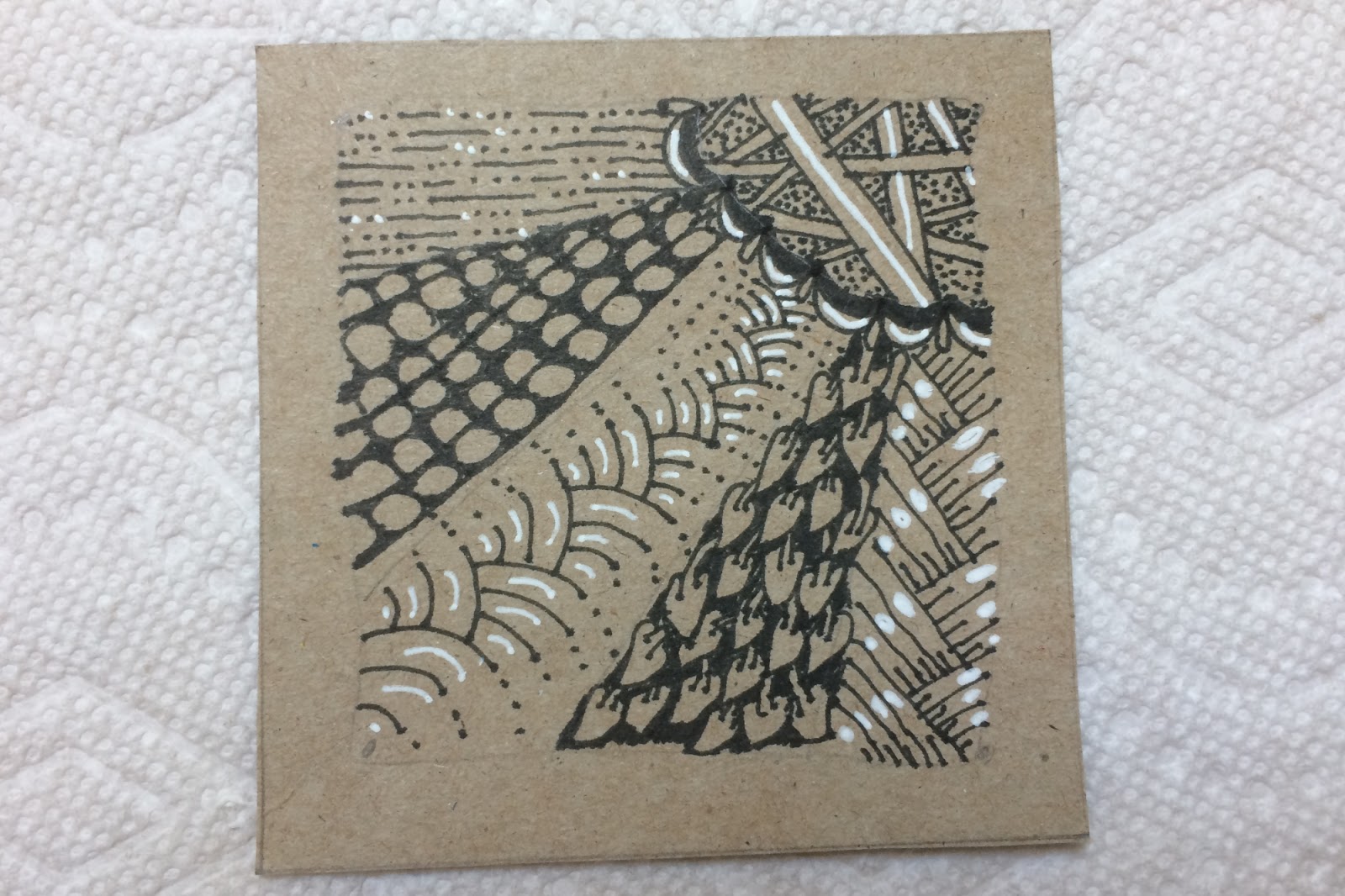
Tan square with Zentangle design in black ink with white accents
Here is the first one, with the sunshine string.

The Diva explained that in her house, Earth Day is called “Amanda Day” because her son thought the Earth should have a name. Since “Amanda” means “beloved” (or “worthy of love”, both of which seem appropriate for the Earth) I decided to write that in the center of my second try. (I have also been messing around again with calligraphy recently.)

Circles make things more interesting.

It’s possible that some of this artistic enthusiasm stems from the problems my current writing project is giving me. I’ve had to toss most of the last couple of chapters. It’s hard to tell myself that I’m making progress, even slow progress, when I’ve just given up many hours worth of work. Hopefully next week I will be able to look at it more positively.
Woodsmoke, Kayaks, and My Dad

Last weekend, my daughter camped out with other members of her mountain bike team on the night before the race. We dropped her off at the campsite before heading for our own, cozy hotel room.
The family camping area was packed to capacity. Kids ran around yelling; someone had a campfire going. The trees, the smell of woodsmoke, and the noise brought me back to the times my dad took us all camping, and my brother and I were the ones running around playing loud games. I vaguely recall helping out with the tent—something about poles that fit inside each other, perhaps matched by color? Sleeping bags, of course, and maybe air mattresses that had to be blown up? And Cutter’s, of course, to keep off the mosquitoes.
You can tell I didn’t really take to camping, since I haven’t camped for years. Still, standing there smelling the woodsmoke, I thought about my dad and was glad that he had taken us.
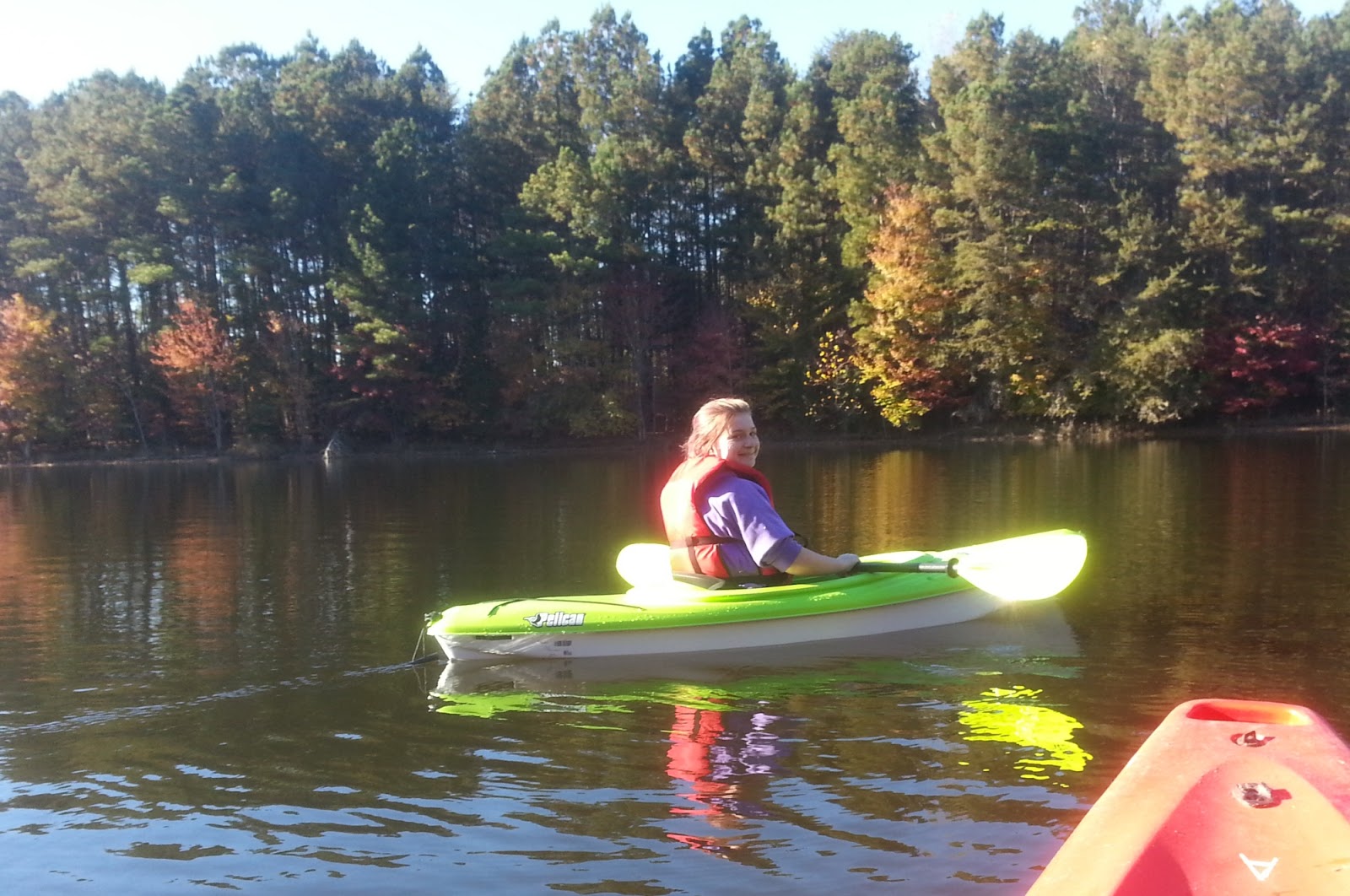
I thought about my dad a month or so earlier as well, when my daughter was going kayaking with members of Boat Club.  They needed another adult on the water. So I rented a plastic kayak along with the others and got in awkwardly. Once on the water, though, I really enjoyed it. I watched the kids messing around and wished that my dad could be there to see his granddaughter on the water—and to paddle his own kayak again.
Girl in plastic kayak
M out on the water in her kayak
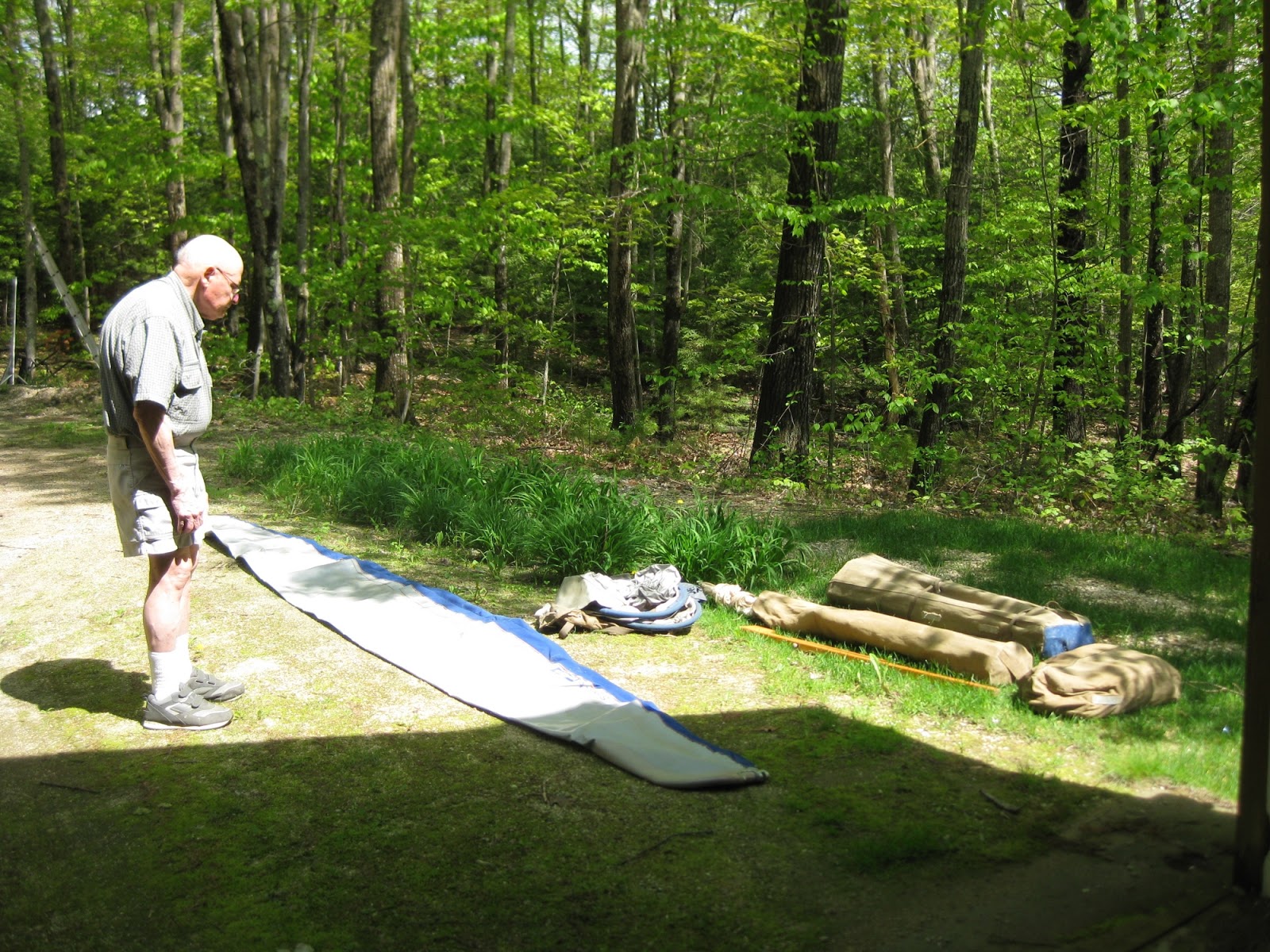
I remember helping him put together the kayak when I was a kid. It came in several heavy canvas bags. Wooden pieces had to be slotted together, poles had to be inserted along the sides, and then the two ends had to be pushed into the rubberized hull before they could be locked together and the seat backs put in place.
Collapsible kayak Klepper Aerius in bags
Taking a last look at the Klepper Aerius.
Then we would go out on the quiet lake and paddle around the edges. 
There are other things I learned from my dad. He liked to make things, sometimes from kits. I remember a down parka, a paper clock with a pendulum, and of course the electric organ, which took forever with all those wires to solder. I learned some basic skills from him as he carried out his projects—how to use the sewing machine, and how to cut and score paper. (I didn’t get into electronics, though he let me try soldering some wires.)
He also had a great interest in the latest technology and insisted on getting a computer back when it seemed like a crazy idea. I mean, who had a computer in their home?
But he got a Sinclair and it had so little memory that you could easily type in a Basic program and run out of room before you were done. And what do you know—he was right about computers being interesting. Now everyone has one.
He liked to garden as well, but since he also liked to travel and we moved every two years, his gardening was limited. I, on the other hand, was determined to live in one place when I grew up and have a really nice garden. But we shared a love of home-grown tomatoes. I always try to have tomato plants, even in years when the rest of the garden is in sad shape.
Girl in front of light-box with lettuces and other plants
Me as a kid in front of his light-box for growing plants
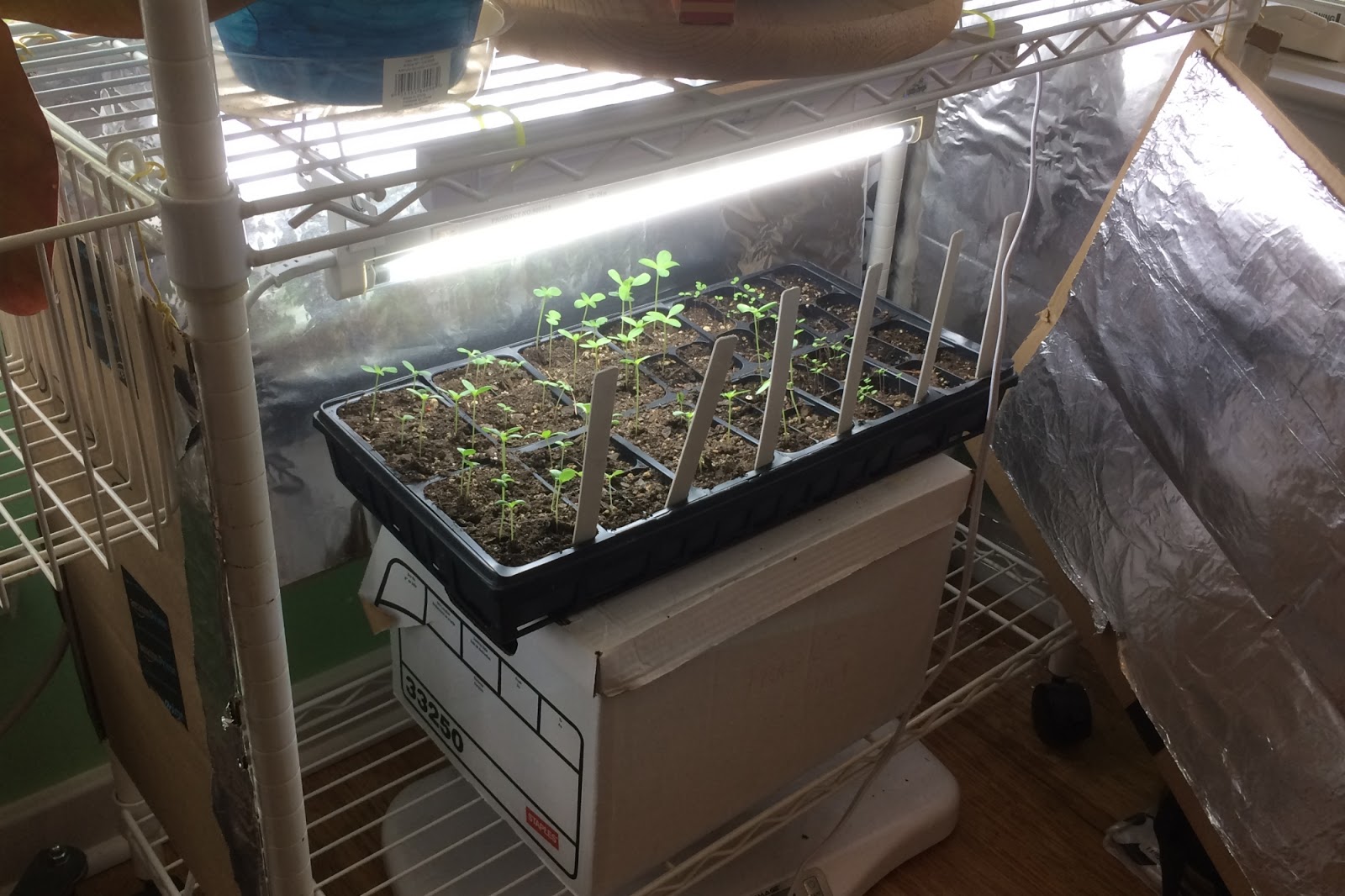
Light-box made from wire shelving with cardboard and foil for starting seedlings
My own attempt at a light-box for starting plants
There were things my dad didn’t like, certainly. He was scornful of “ya-ya music”, which is what he called rock, and probably most music that followed it. (Did he get the term from the Beatles’ song “I love you, yeah, yeah, yeah, I love you, yeah, yeah, yeah”?) He abhorred the practice of having a TV in the living room (never in our house) or watching TV during meals. Really, he disliked most TV shows except documentaries.
And he could have the most irritating little smirk when he felt he was winning an argument.
Overall though, he had a lot of enthusiasm and a lot of interests. I wish that he could be here to share them with his granddaughter.

Arguing About Gun Control—conflicting intuitions and the need for good research

Between the shooting at the concert in Las Vegas and the Parkland school shooting, people have had compelling reasons to talk about gun violence and how we should respond to it. We all have an interest in our own safety and the safety of our kids. And yet, people still come to drastically different conclusions about how to approach this.

One group of people finds it intuitively obvious that making it harder for people to get their hands on guns, especially guns that can be fired many times without reloading, will reduce deaths in school shootings. If the shooter has to keep stopping to reload, he won’t be able to shoot as many people before someone stops him.

Another group finds it intuitively obvious that having more armed adults at schools will reduce deaths in school shootings because it takes someone with a gun to stop someone with a gun. Having armed personnel on hand will mean shooters are stopped faster, before they can kill a lot of people. Therefore, they think, we should make it easier for teachers and staff to bring guns to school.

The first group, on the other hand, thinks that it is intuitively obvious that having a lot of guns and a lot of kids in the same building is a recipe for disaster.

The problem with intuition is that what seems blindingly obvious sometimes isn’t. This is well known to people involved in medicine and is the reason that new treatments have to prove themselves in trials, no matter how plausible they seem. So in making decisions about gun policies, one thing we desperately need is good research on guns and safety. The RAND Corporation recently published a review of available studies on the effects of gun policies, and one of their conclusions is that there are big gaps in the research available. They also noted that changes in the way information is collected could be tremendously useful.

I would hope good research would also try to control for different circumstances. For instance, when it comes to guns and self-defense, does it matter where you live? Whether law enforcement is five minutes away or an hour? Whether there are large predators in your area? What about your domestic situation?

I’m not saying that better research will end the arguments over gun policies. There will be conflicts of interpretation. There will probably also be some trade-offs to be argued about–personal freedom versus public safety. However, better research would give people something more concrete to argue about and something to test their intuitions against. That’s worth funding.

I have one more thing to add. When I showed the draft of this post to my husband, I said that I thought the most important part of it was the link to the RAND report. He said he doubted it made any difference–that most people have already made up their minds and won’t consider research except insofar as it supports what they already believe. Please, people, prove him wrong. When you read about research results, consider them with an open (but critical!!) mind. Consider the source, the reasoning, and who, if anyone, has reviewed it. Don’t judge it by whether it matches your “intuition”.

Till next post.