Catalogs–a glimpse into other worlds

We get way too many catalogs at our house. A lot of them are repeat copies from familiar companies, but others come from companies we’ve never heard of before. Once in a while, a catalog arrives that gives an interesting glimpse into another world.
Just recently, I received a catalog from NRS. That’s “National Roper’s Supply”, suppliers to those who engage in cattle roping. It’s a very thick catalog, with everything from clothing to saddles to horse trailers. And, of course, ropes. I have no idea how I ended up on their list.
I leafed through it, marveling at the incredible variety of boots for sale. Nothing surprising about boots for sale in a catalog aimed at people who spend a lot of time riding, but I had no idea that there was such a fashion for brightly colored accents on western boots, or textured finishes on the leather.
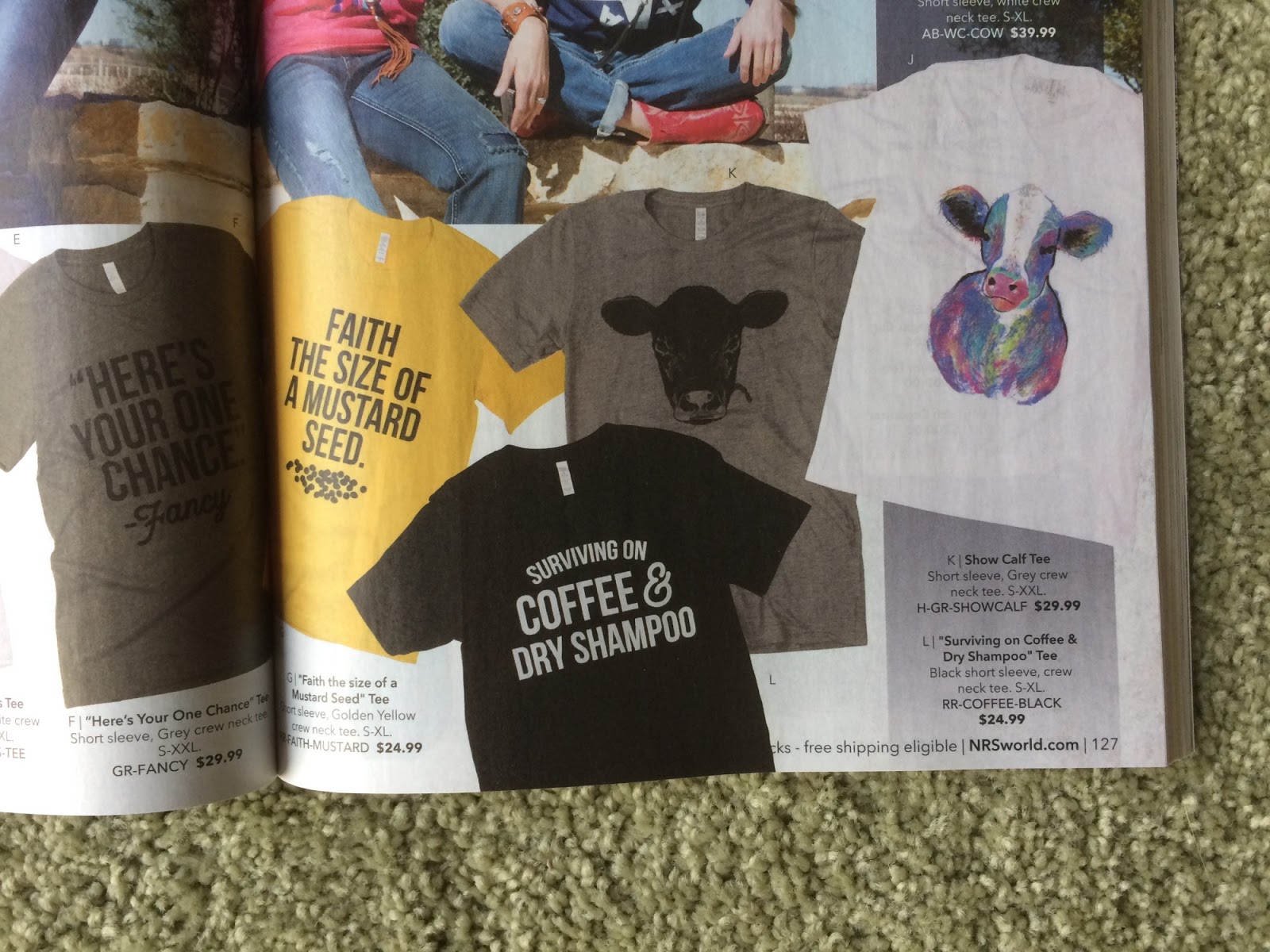
Beautiful leather belts, folding knives of many kinds, shirts, hats, and a smattering of household goods followed. Catalogs always include some t-shirts with topical pictures or sayings on them, and this was no exception. I was particularly captivated by a women’s tee that said, “Surviving on coffee and dry shampoo.” Is this a popular catchphrase? I find myself wondering if it simply means “I’m way too busy right now for regular meals, sleep, and dealing with my hair,” or whether it makes reference to people camping out at roping events with their horses and equipment. Perhaps cooked meals and showers have to wait till they get home again?
The largest part of the catalog was concerned with tack and other gear needed for a competition that involves horses. I only glanced through, since I don’t ride, but what struck me is that any item people need will be made available in a variety of colors or styles. Pads and blankets don’t just vary in materials and other functional ways, but in stripes and patterns as well. Breast collars are available with stitched or stamped designs. The selection of spurs made me think of jewelry.
catalog page showing large selection of spurs
On the one hand, then, looking through the catalog reminded me of the many different communities that exist in this country, not just grouped geographically but also by interests and activities. I know almost nothing about competitive cattle roping or the way of life that includes it. I don’t know its fashions or its “in” jokes. I know nothing about most of the essential equipment.
At the same time, the catalog reminds me of some commonalities among people. We all like to personalize our things, to display our own sense of style. Whether that’s more likely to involve patterned Converse high-tops or western boots with neon-blue tops depends on the groups you belong to.
We like to show our sense of humor, too, with t-shirts or tea-towels or bumper stickers. Sometimes what one group finds funny doesn’t translate well to another group*, but we all like to share jokes with others who have the same interests and who will notice our shirt and “get it.”
And given that we like to display our sense of style and humor, the businesses of America will ensure that we have ample choices, not just in clothing but in pretty much every little item that we need, and will send us a big, full-color catalog to make sure we’re aware of what’s available, whether our interests are cattle-roping, knitting, or baking muffins.
We all get catalogs.
Till next post.
*To take an example from some other catalogs– I’ve never understood why anyone would want to label themselves an “Old Fart.” That joke wouldn’t go over well in my family, but judging by its persistance in catalogs, clearly it’s funny to a whole lot of other people. On the other hand, the button “I’d like to save the world but no one will give me the source code” went over very well here.
"Flowers or Vegetables?"–reasoning about gardening

 Some years back, I heard a fellow gardener say that she only grew flowers, never vegetables. “I can get all the vegetables I want at the farmer’s market,” she said, “so why waste garden space?”

Her reasoning caught my attention then, and I am still thinking about it even now . “Flowers or vegetables?” is an important question for a gardener.  Plenty of gardeners–maybe even the majority–grow both. But some gardeners are mainly interested in creating a beautiful landscape, while others think flowers are a waste of space since you can’t eat them. (At least, not most of them, and not in a very sustaining way.)
I belong to the “both” school. I love flowers, but I can’t imagine having a garden without growing some tomatoes, maybe some carrots, certainly basil and parsley. When I browse seed catalogs, I spend at least as much time contemplating the enormous range of possible lettuces, sizes of carrots, varied summer squash and of course tomatoes, as I do looking at photos of zinnias, violas, and sweet peas (so lovely and so unsuited to my climate.)
Why grow vegetables? As my fellow gardener pointed out, I do live in a town with a flourishing farmer’s market. Most of the vegetables I grow (at least the ones I grow successfully), I could buy. They offer plenty of heirloom tomatoes, cute squash, leafy greens and so on. They sell beautiful green bouquets of basil. Most of their vegetables look better than mine, and I could pick and choose the ones I want.
I asked a similar question earlier about making homemade French bread. I can buy better French bread locally, so why make it? But I don’t think the answer is the same in the two cases. With French bread, I make it in large part for the challenge of the thing. I don’t grow vegetables for the challenge of it. In fact, I prefer vegetables that are easy to grow and don’t require much fuss.
Do I grow my own vegetables so I can get them exactly the way I want, as in the case of making myself a pair of lightweight green corduroy pants with double pleats? Or the time I tried to manufacture a grocery bag that was washable and yet would stay open easily?
There is certainly an element of choice. When I grow my own vegetables, I can choose unusual varieties that aren’t offered at the Farmer’s Market. Getting to choose is certainly what keeps me browsing seed catalogs through the winter.
However, some of the varieties I grow are available at the Farmer’s Market. Every year I plant a couple of Sungold tomatoes, even though I can buy the little orange globes by the pint. And while I’ve experimented with different kinds of basil, I’ve discovered that when I’m cooking I actually prefer plain, basic basil. As a result, that’s mostly what I grow now.
For some of the vegetables, and especially for the herbs, it is helpful to be able to go out back and pick just what I need, when I need it. A few leaves of basil, some sprigs of parsley, just enough lettuce for a salad. In fact, I should probably keep this in mind when planning and give priority to plants that don’t store well or are used in small quantities.
So why grow any other vegetables?
The answer, I think, is that there is just something very appealing about growing some of my own food. It’s the feeling of providing for myself–even if, in truth,  I’ve got hardly enough for one meal. It feels (ironically) deeply practical. This is probably the reason I keep planting fruit trees and bushes, even though the squirrels and birds make off with most of it. I could plant purely ornamental trees, but I like the thought of producing fruit in my own backyard.
Hyacinths may feed the soul, but peach trees feed the stomach as well. (Or, given squirrel thievery, maybe just the imagination.)
Till next post.

More Acanthus Scrolls, plus Homemade Envelopes

When I was looking for techniques for drawing that interesting foliage-like scroll, I found two useful sites. I made use of one of them in my last post, to draw a decorative scroll on a tuckbox. This time I tried Calligraphy Pen’s technique to make an interesting envelope. In doing so, I also discovered that my cut-and-paste skills need work.

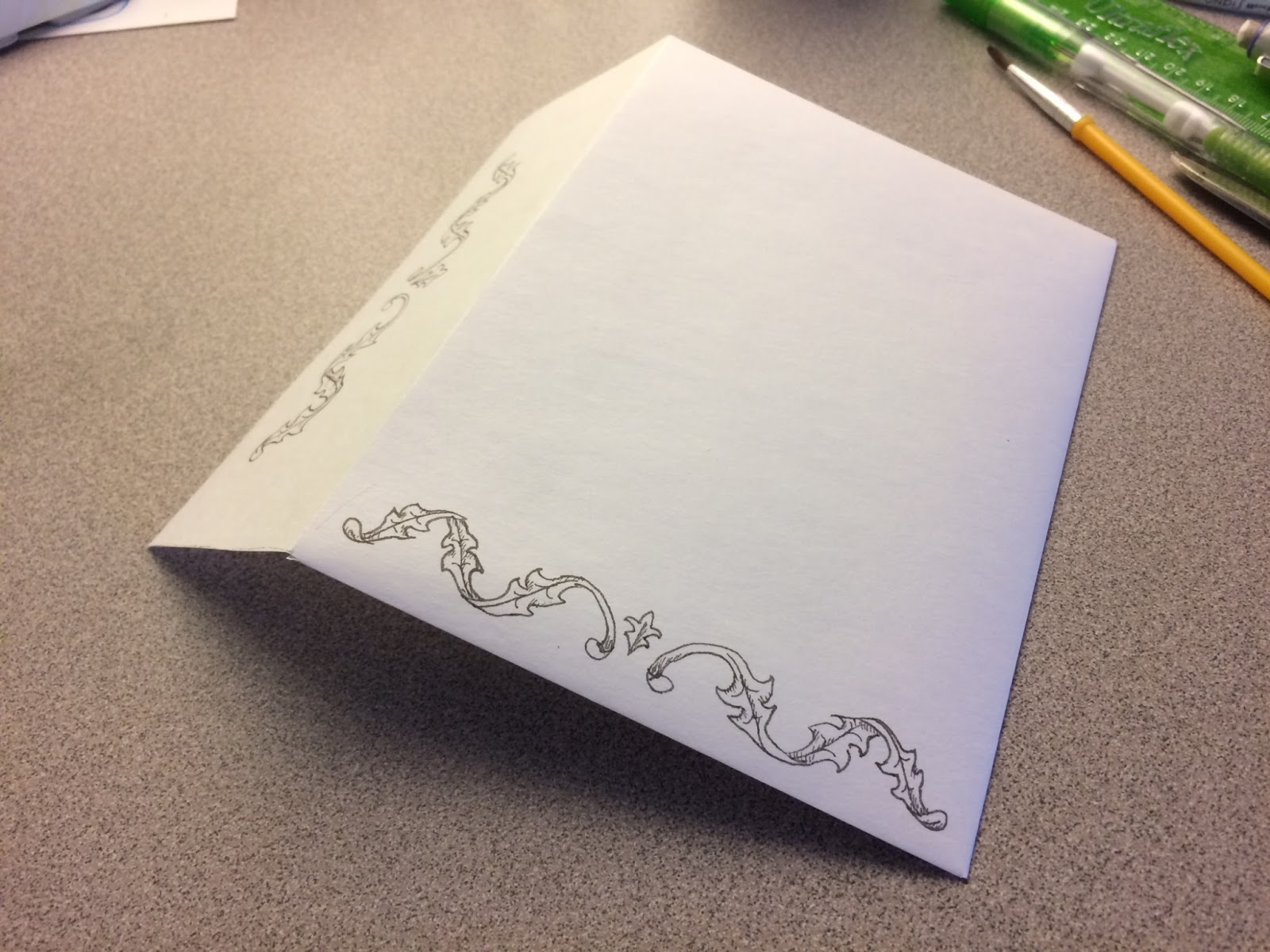
Homemade envelope with acanthus scroll decoration
The finished envelope
 The envelope template that I used is from The Postman’s Knock. She offers a number of decorative printable envelopes, some for free. If you print them full size, they will hold a standard sheet of paper folded into quarters (important if you are making cards this way.) I traced around one and then started adding a scroll to the back flap of the envelope, and then started one that I wanted to go along the left-hand side of the envelope where it would not interfere with the readability of the stamp or zip code.
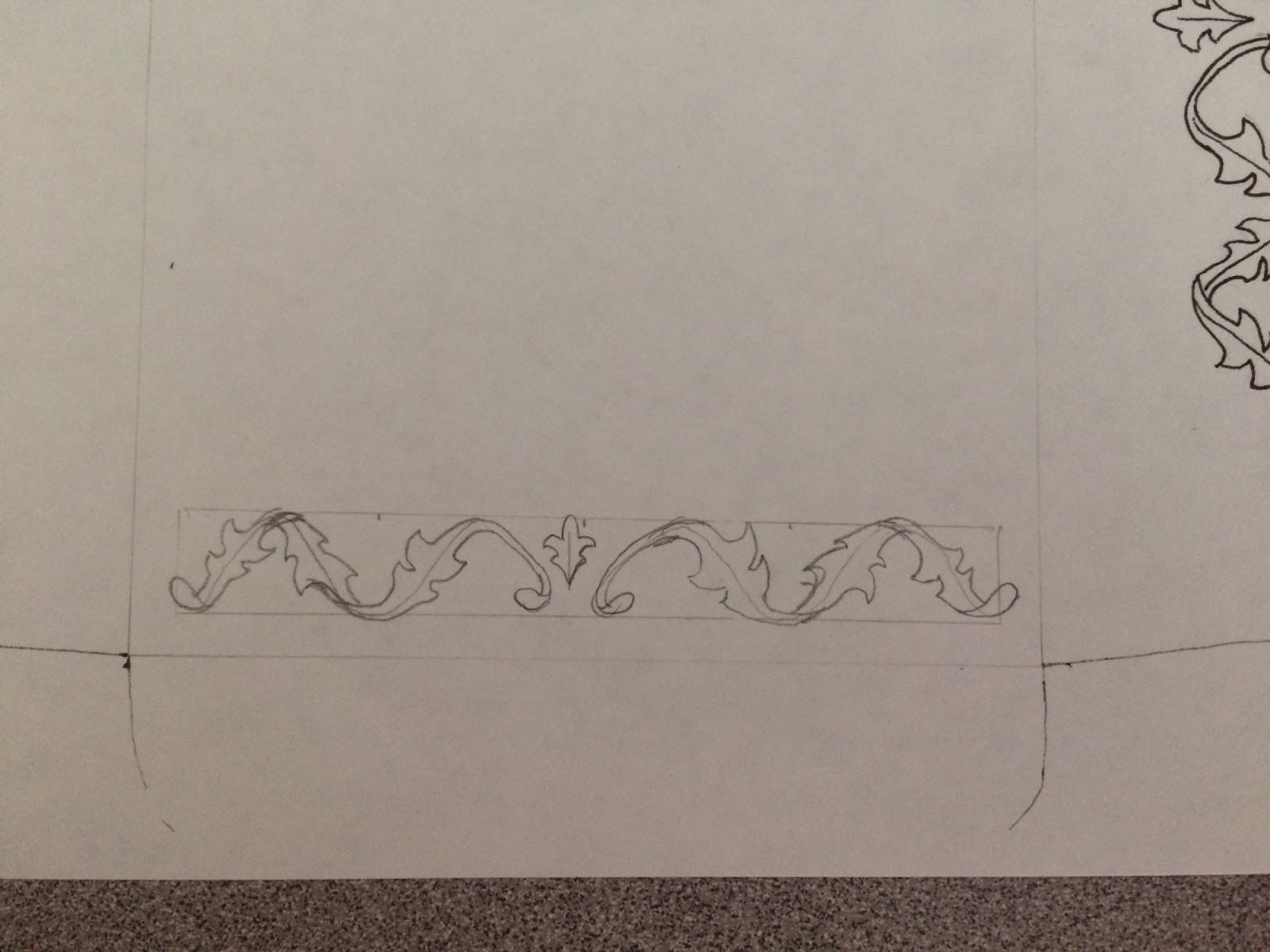
Here I have drawn a box lightly in pencil where I want the second scroll to go. You can see the one on the back flap already done.
Box penciled in
Here I have drawn the scroll in pencil.
Penciled-in scroll
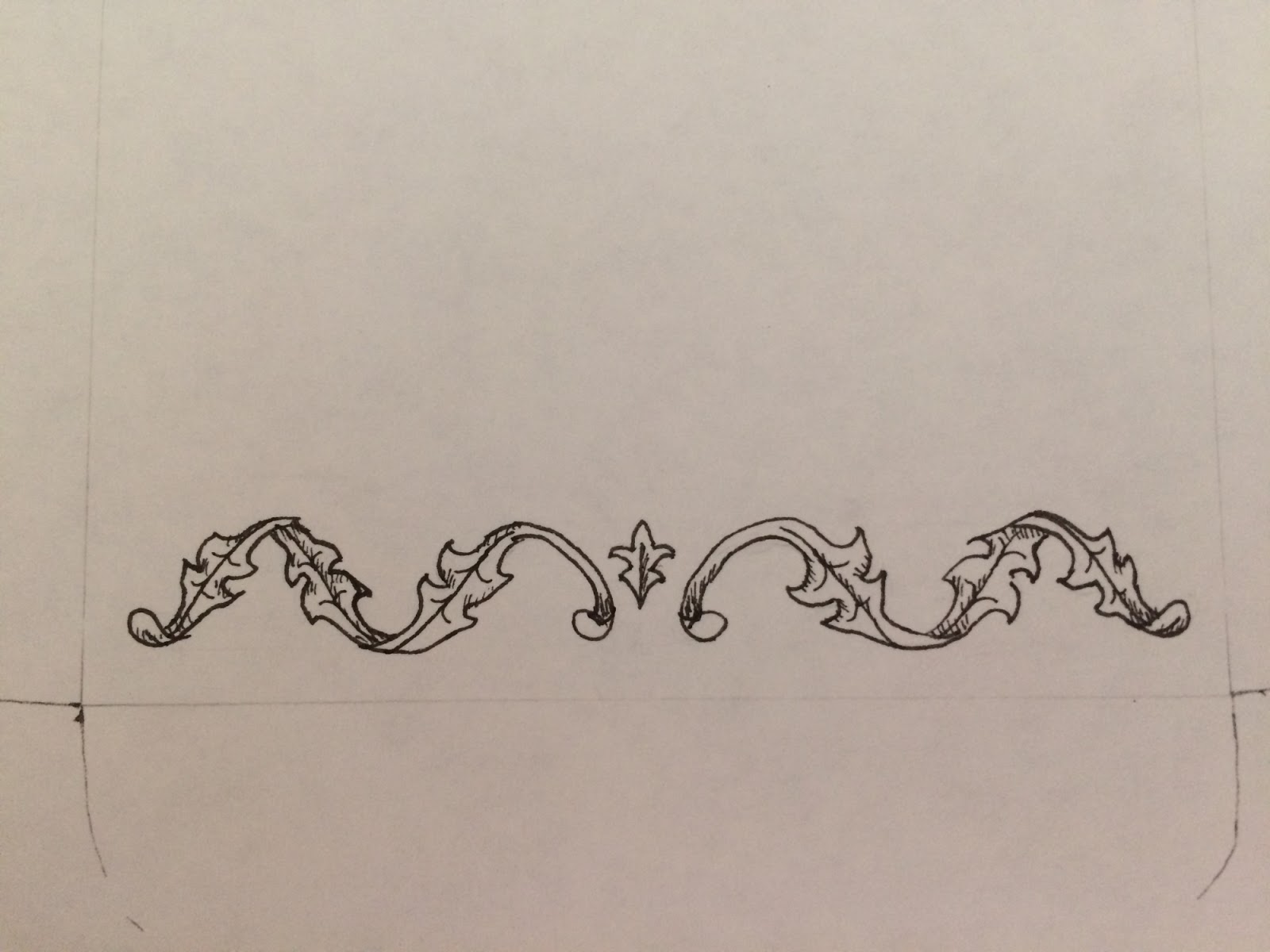
Here I have gone over it in pen, and added some rather random shadows with a finer pen. If the art critiquer at SCBWI saw this, he would no doubt ask me where the heck my light source is supposed to be coming from. Oh well.
Inked-in scroll
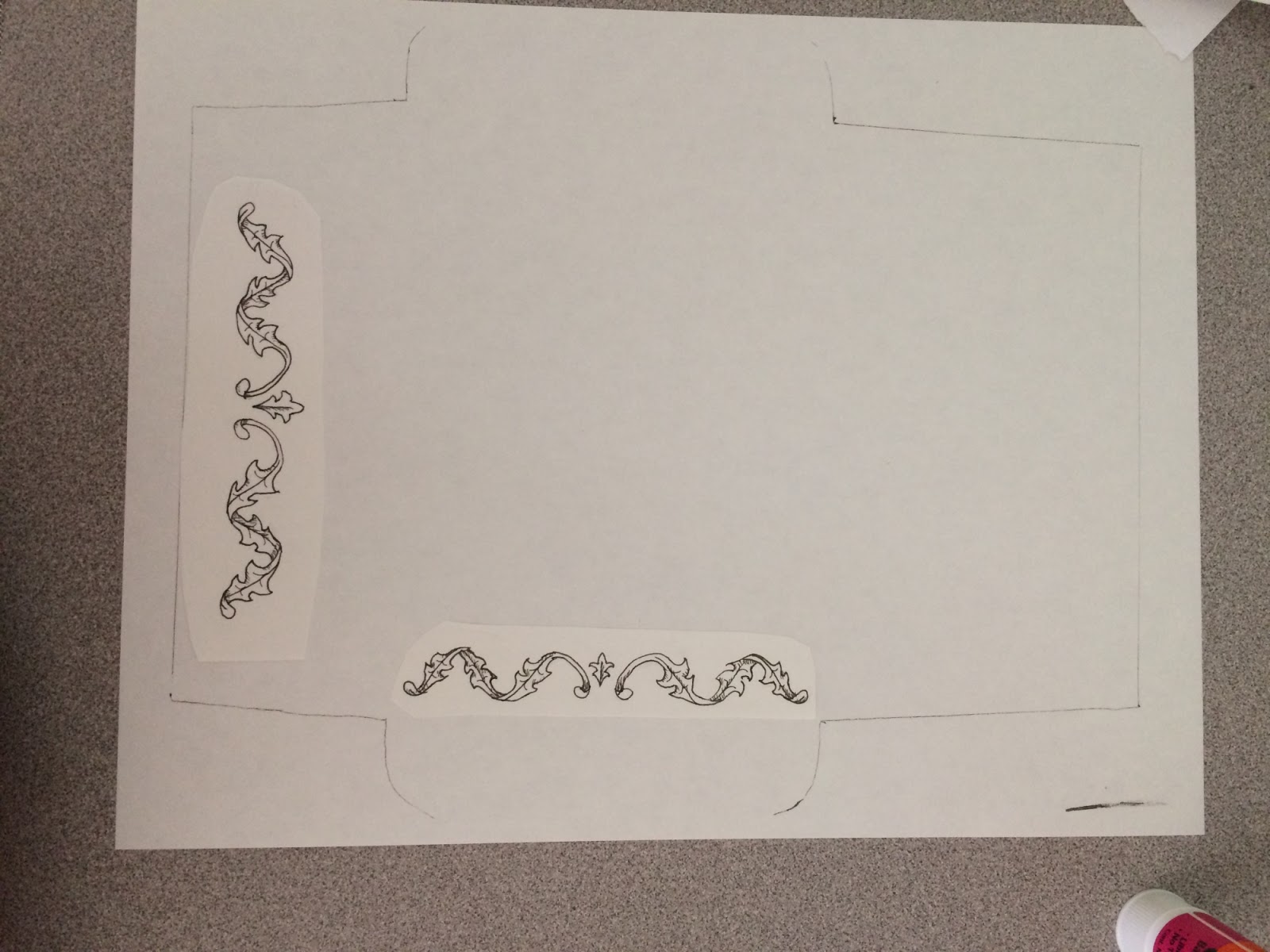
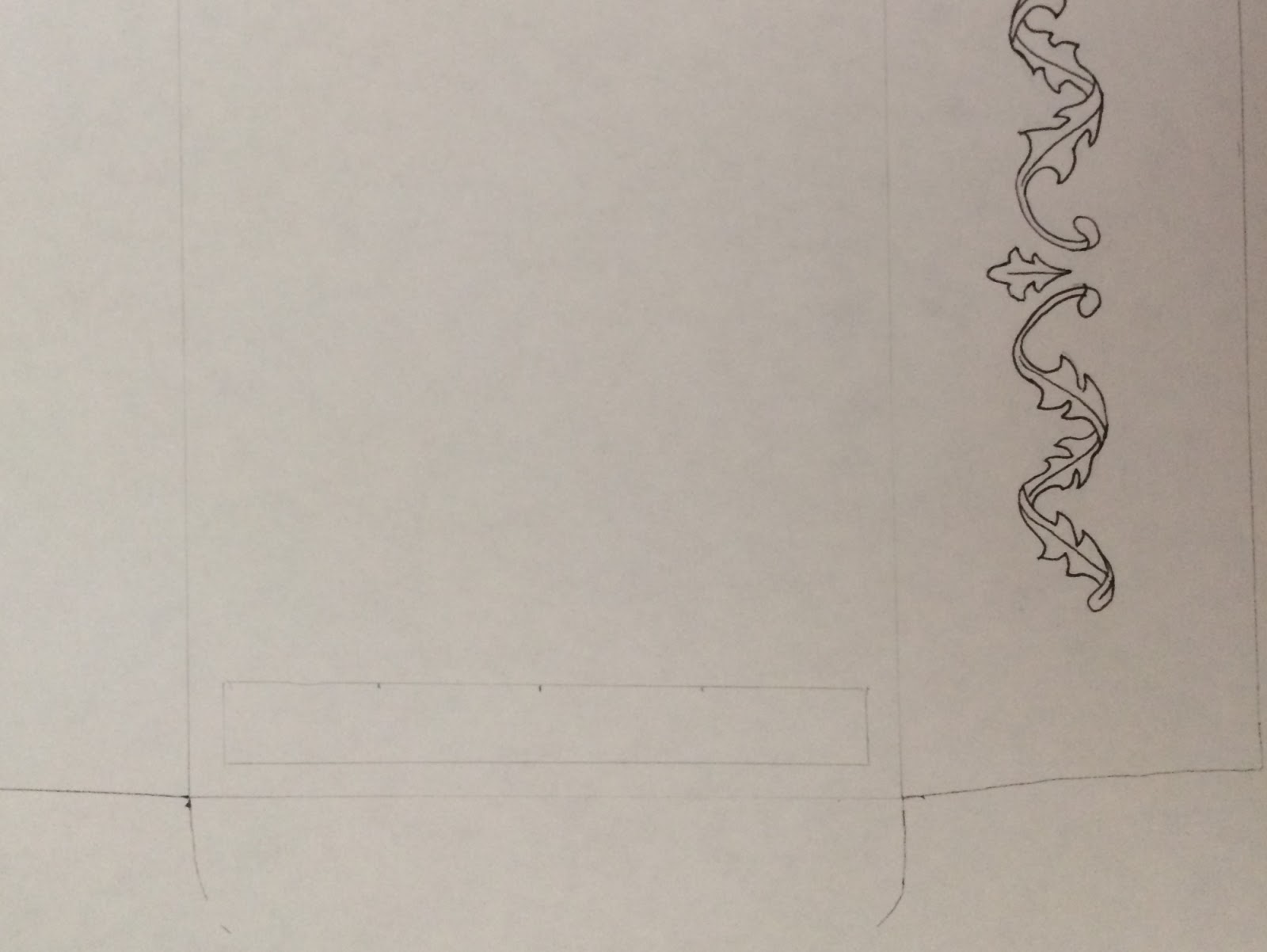
Now that I’ve gone over it in pen, I have a sudden realization. This scroll is on the WRONG SIDE of the envelope. Oops. Rather than start over, I decide to cut and paste. Since my computer art skills are limited, I cut and paste in the original sense of the phrase, then use the photocopy function on my printer.
Envelope template with scrolls cut and pasted in
Unfortunately, I haven’t stuck the pieces down well enough and faint lines show where I have pasted. And it turns out there is not a single bottle of white-out in the house. I try white watercolor, and then I try running white gel pen over the faint lines on the photocopy.
Finally, I decide that this isn’t such a wonderful scroll anyway, and I may as well make an envelope out of the copy with faint lines. I’ll make a better scroll decoration some other day. Meanwhile, I have plenty of photocopies that I can color in different ways if I want.
Till next post.