Candy Hearts and Conversation Sweets


Valentine’s Day is nearly here. Shelves in stores are crowded with red and pink containers. Much of the space is taken up by chocolate in heart-shaped boxes, but there are also a lot of bags of what is basically heart-shaped sugar. The most Valentine’s-y of these are the candy hearts.
Candy hearts are so appealing that you can find them depicted on fabrics, wrapping paper, and cards. I guess Hershey’s kisses show up once in a while, but candy hearts are a much more popular Valentine’s Day icon.
What’s so appealing about them? I think it’s the messages. Without messages, candy hearts would be just another heart-shaped candy that isn’t chocolate. Boring.
But what is it about the messages that makes candy hearts fun? After all, they aren’t exactly poetry. Mostly candy hearts offer a random assortment of sentimental cliches and catch-phrases, nothing particularly interesting or original.
I think what makes them fun is the very fact that you get such an assortment. You can pick through the hearts till you find just the right message to hand to a particular person. It might be a compliment: “Shining Star”, “You Are Nice”, or “Dear One”. It might be a request: “Be My Friend”, “Let’s Talk”, “Dance With Me.” It might even be a question: “Will You Marry Me?”
Alternatively, you can draw one at random and be surprised. It’s a bit like a fortune cookie.
It occurs to me that, like many other things, candy hearts lend themselves to stories. What if someone pulled a candy heart out of a jar, just for a quick mouthful of sugar, and discovered that it said something really unexpected?
 “You are being watched.”
 Or: “She’s lying.”
Or: “Look up.”
In fact, candy hearts (or something like them) do show up in stories. In Mary Poppins Comes Back by P. L. Travers, Mary takes the children to a very odd store where she asks for “an ounce of Conversations.”
“‘Are those the Conversations?’ asked Jane, pointing to the Jar. ‘They look more like sweets.’

‘So they are, Miss! They’re Conversation Sweets,’ said Uncle Dodger, dusting the jar with his apron.”
Jane gets “a flat star-shaped sweet rather like a peppermint” with the words “You’re My Fancy.” Michael pulls out a shell-shaped one with “I Love You. Do You Love Me?” The twins, John and Barbara, are given “Deedle deedle dumpling” and “Shining-bright and airy”, but Mary Poppins’s sweet is shaped like a half-moon and reads, “Ten o’clock to-night.”
Naturally, Mary Poppins explains nothing, and equally naturally, strange things happen that night at ten o’clock.
The tales of Raggedy Ann also involve a candy heart, if I remember correctly. A disaster leads to Raggedy Ann being restuffed, and the woman repairing her puts in a candy heart that says “I love you.” Later, Raggedy Ann falls in some water, and she tells her friends that since the candy has melted, the “I love you” is now spread throughout her insides.*
But enough about stories. Setting aside the content of the messages for the moment, how well do candy hearts succeed at being Valentine decorations? The colors are fine and so is the shape, but I have mixed feelings about the way they are printed. I like the large ones from Brach’s because they have longer messages, but the words look like they came from a bad dot-matrix printer. On the positive side, I suspect whatever technique they are now using allows them to vary the messages more, which is all to the good. Maybe the quality of the print will improve over the coming years. The Sweetheart brand small hearts have a long way to go—they are often barely readable.
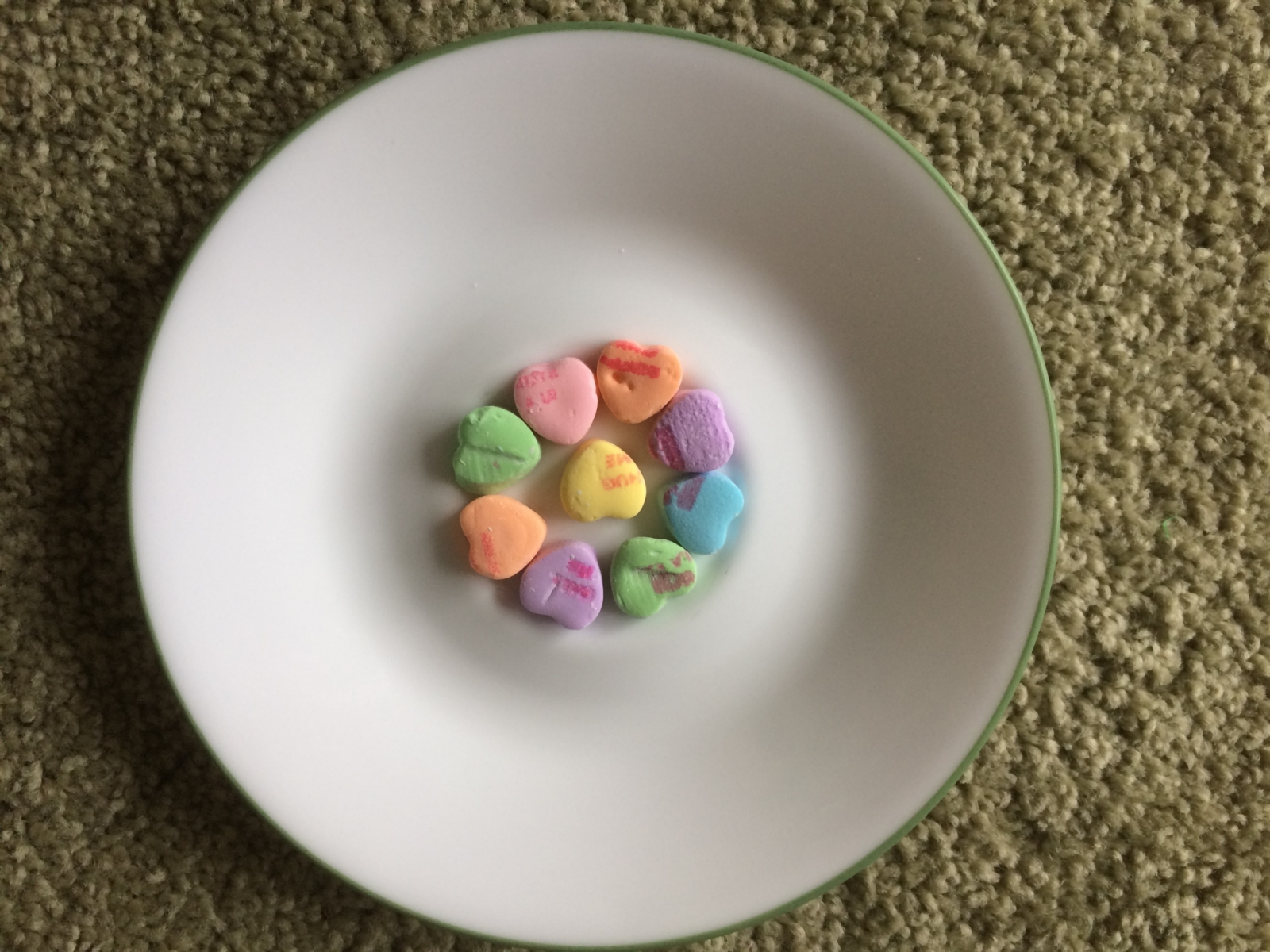
And how well do candy hearts succeed at being candy—that is, how do they taste? I bought the small Sweethearts because Sweethearts are made by the New England Confectionery Company, which makes NECCO wafers. I like NECCO wafers, and the hearts looked as though they were made of the same stuff, so I expected them to taste the same.
When I tasted the various colors, though, I wondered if they’d changed the flavors of their hearts. I don’t remember green being green-apple flavored, and the blue… did they even have blue hearts earlier? A quick check on-line shows that the flavors changed some years ago, which makes me wonder when I last bought Sweethearts. (They contain gelatin, so maybe not since my daughter went vegetarian?)
Since I don’t like the flavors very much, and certainly don’t need the extra sugar, I wonder if it wouldn’t be better to skip the candy altogether and substitute colorful paper hearts or wooden hearts with messages on the reverse. (I’m sure these must exist.) But then what does your friend or sweetie do when you hand them a suitably-messaged heart? Keep it forever? Smile appreciation and then toss it in the trash? (Or back in the bowl, if it’s a wooden heart?) There’s something to be said for being able to pop the message in one’s mouth after reading it.
Happy Valentine’s Day!
Till next post.
* Build-a-Bear uses a non-edible version of this trick.

The Versatile Bookmark


The other day a friend sent me an interesting bookmark. It is a cord with beads on either end for decoration. The idea is that you can leave it in the book as you read and it will not either fall out or make it difficult to turn pages, as paper bookmarks sometimes do. I’ve put it in a book I’m currently reading and am looking forward to trying it out.
Bookmark cord with beads on the ends inside a book on jewels
An appropriate book for a beaded bookmark
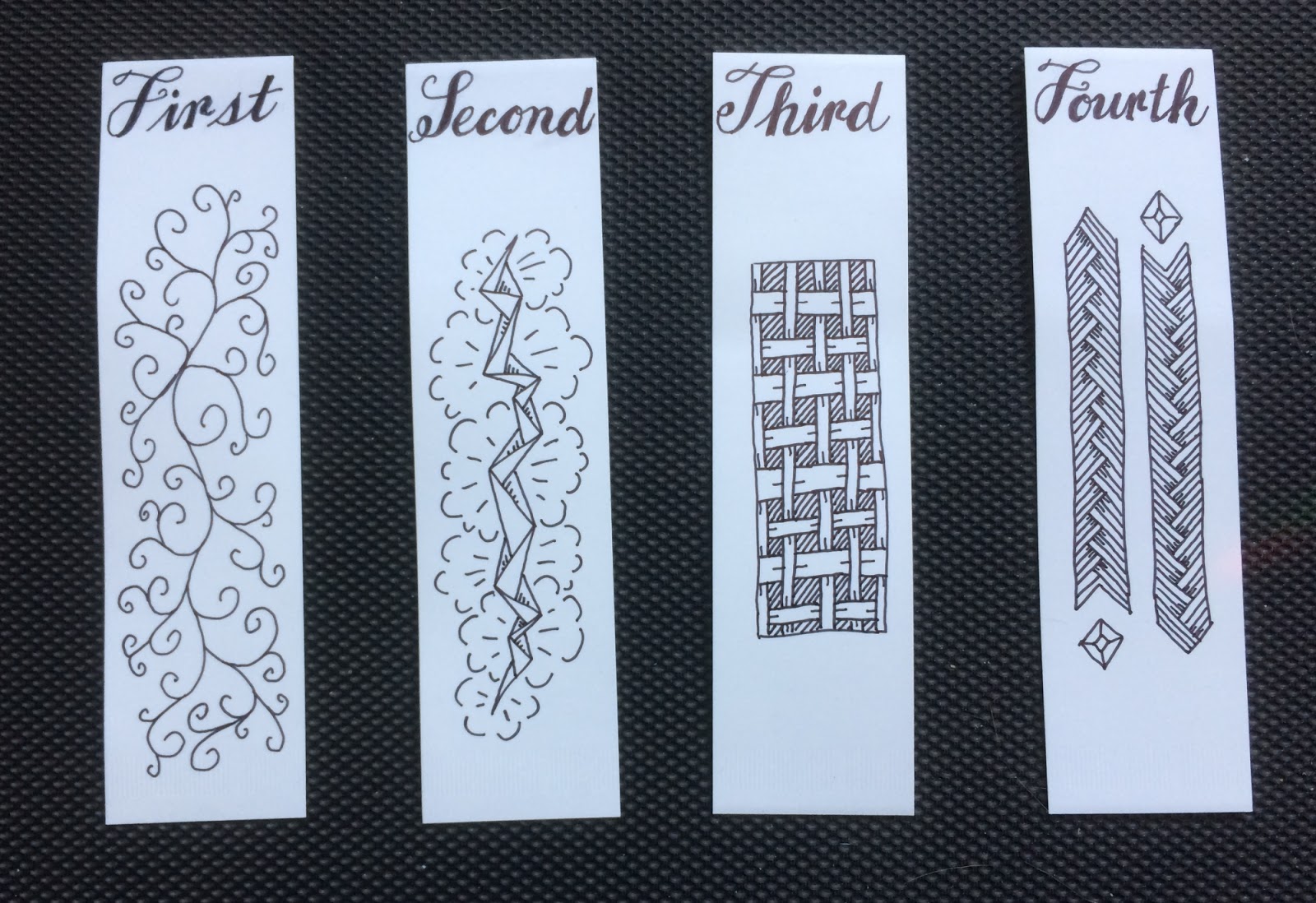
That’s one reason I’ve been thinking about bookmarks. The other is that every time I go to church, I am reminded that there there aren’t enough loose sheets in the program to mark all the hymns. If I don’t bookmark them, it takes me so long to flip to the correct page that I miss the beginning. So each time I say to myself, “I should bring some bookmarks.” Preferably with the words “First,” “Second,” “Third,” and so on at the top, so I know which one comes next.
I collected together all the bookmarks I could find and was interested to see that they fell into several categories.  The first and most obvious is that of standard-type bookmarks with beautiful pictures.
Paper bookmarks with beautiful drawings or photos on them
Decorative paper (mostly) bookmarks
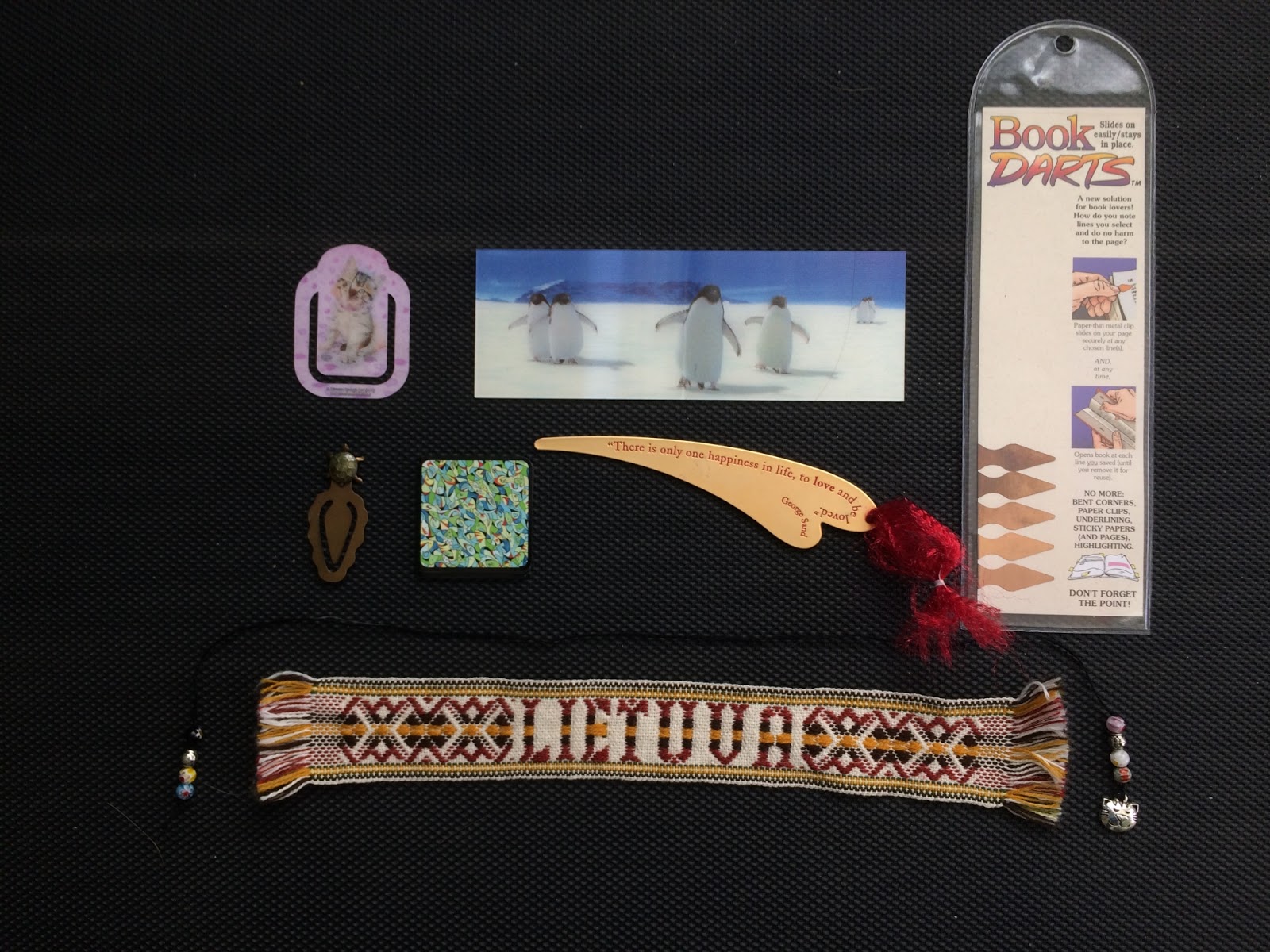
There are so many of these out there, and they are so much fun to look at! I really liked the Eowyn marker, because I think Eowyn is interesting, but the metal horse bead on the tassel unbalances it and tends to make it fall out of books. The fact that it is so glossy probably doesn’t help either (not enough friction.) That brings me to the second category—bookmarks that come in different shapes and materials, often in an attempt to improve functioning.
Bookmarks in metal, fabric, or with magnets
Bookmarks of various materials
So the magnetic bookmark (the small square) is designed to hold tight to your place, as are the book darts. They can be a problem in that they hold on so tightly, it takes longer to remove them to mark a new place. The two clip-shaped ones (the plastic kitten and the metal turtle) are also supposed to hold better, though I’m not sure they really do. If you look carefully, you can see the beaded string bookmark here—another one aimed at improved function as well as decoration.
The others are simply different materials–the lenticular (3D) bookmark, the woven bookmark (which also falls under the category of souvenir, although it was my parents that traveled, not me), and the metal one that is not a clip. Plain metal makes a terrible bookmark, by the way—it falls out of the book constantly.
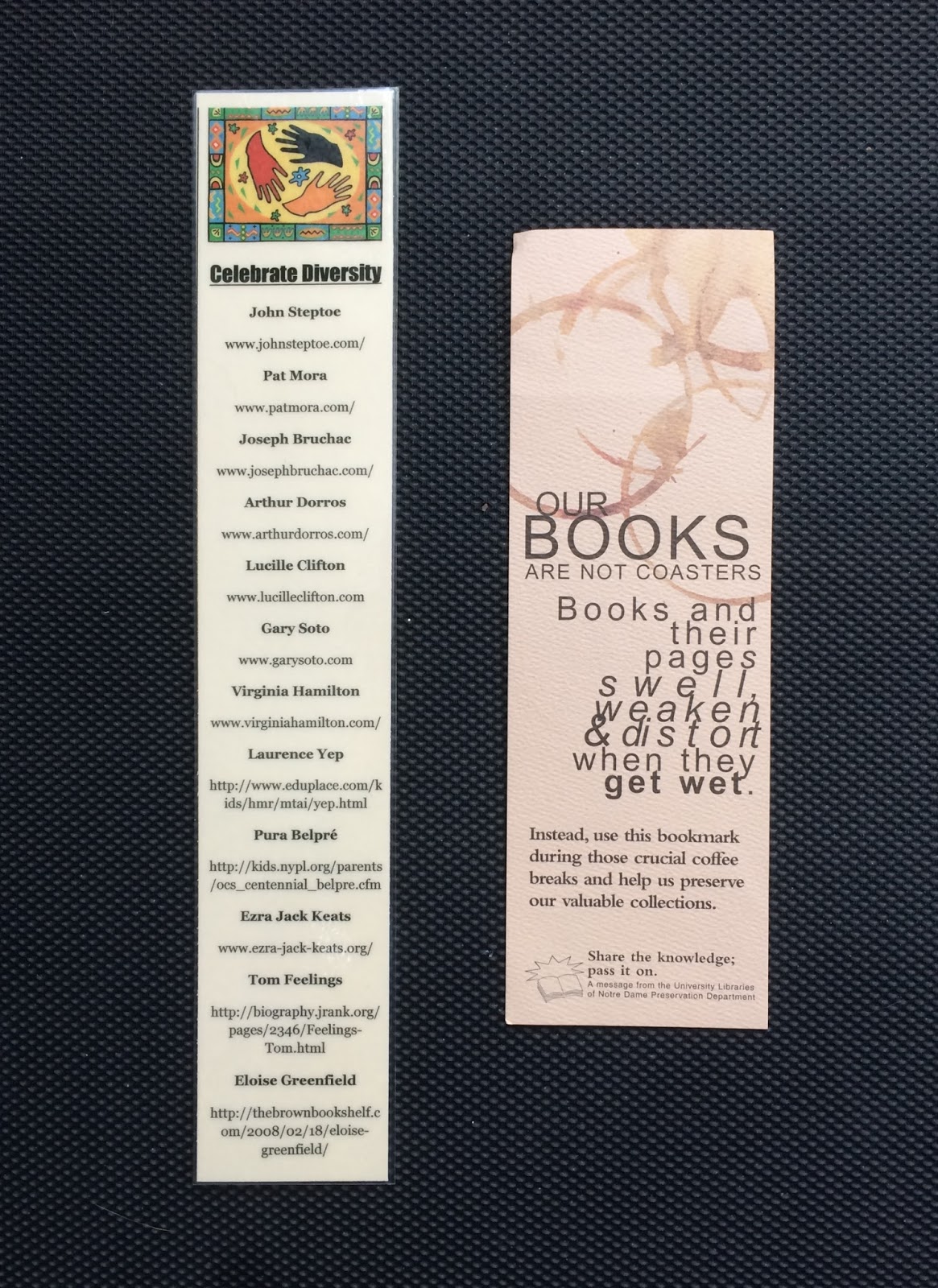
Paper bookmarks are an excellent medium for advertising and informational messages. After all, they’re just bits of paper and so are very cheap to make. Bookstores in particular use them for advertising (no surprise there). The fact that they are bookmark-shaped means that they are more likely to be kept around and not tossed. Sometimes they remain in books and are rediscovered years later.
Promotional bookmarks
Bookmarks can also be a handy way to hand out printed information–especially if that information is book-related.
Informational bookmarks
Despite having such a wealth of bookmarks, I sometimes use the plain strips of thin cardboard that come in boxes of Red Rose teabags. They’re the right size and thickness, and when I am reading a particularly interesting nonfiction book, I can make notes right on the bookmark. (Alternatively, they can be decorated by visiting children.)
Strips of paper used as bookmarks, with notes or drawings
Plain, picturesque, or with jotted notes.
That brings me to the last category—the hand-made bookmark, usually paper, though occasionally woven or made of other material. Strips of paper are easy to decorate, and the fact that it is a “bookmark”, not merely a strip of paper, makes it seem more “gift-y”. (When I think about this, I’m surprised I don’t have even more bookmarks than I already do.)
What a great opportunity to make something fun, for yourself or someone else!
Homemade ZIA bookmarks numbered First through Fourth.
And here are the numbered bookmarks!

Words and Character


It seems as though people are judging others more and more by their political positions—their stand on particular issues or even specific bits of legislation. While this is certainly one point of reference, it might be more useful to look at how they treat others, both in person and in writing.
What initially got me thinking about this was an article in The Atlantic (December 2017) tracing the personal history of a major neo-Nazi. The article included a discussion of what this man was like in high school. Some of it is perhaps not surprising—problems with drugs and destructive (and self-destructive) behavior. The surprising part was that his political positions seem to have been quite different.

“He often wore a hoodie with a large F[***] RACISM patch on the back…. [He] set up his own website, for a fake record label… that he used to dupe bands into sending him demo tapes. Here, his leftist leanings were on full display: He wrote posts encouraging people to send the Westboro Baptist Church death threats from untraceable accounts, and he mocked the Ku Klux Klan and other racist organizations.” (p.59)

The article doesn’t say whether he did anything of a productive nature toward reducing racism and homophobia—I’m inclined to doubt it. It sounds like his way of responding was to hurl threats at and mock the opposition.What interested me was that while his targets have flipped 180 degrees since high school, his way of treating them remains unpleasantly the same.
It seems to me that there has been an increase in the amount of public name-calling and general nastiness all around. One of the things we’re taught as we grow up is not to blurt out everything we think. Words can hurt. Treating others with respect requires that we consider the effect of our words before we speak.
Of course, there are some people who just don’t care whether they hurt others, and some people who positively enjoy upsetting people and making them angry (or frightened.)  That says enough about their character right there. The neo-Nazi in the article seems to be one of those.
But I would hope there hasn’t been a sudden increase in the number of people like that. I’m hoping that what is happening is that people are getting careless, writing messages and posts and comments and so forth while in the grip of white-hot rage, and sending them off into the world without taking a moment to calm down,  reread what they’ve written, and consider the likely effect of their words. Calling names will not change anyone’s mind. It can, however, lose you a lot of sympathy.
Could that be what’s happening? I started writing this, thinking that people can change their views on issues and even sometimes their prejudices (in both directions, apparently), but that maybe how they treat other people doesn’t change very much.  It would be interesting to find some data on this. But now I’m hoping that people can change how careful they are with words. Hopefully for the better.
Till next post.