Every November, I sign up for the National Novel Writing Month. Usually I start a new project. (Past experience has shown that NaNoWriMo is not a good way for me to do rewrites.)
It’s always exciting thinking of something new to work on. Actually, that’s probably the most fun part of it all–thinking up the idea and not yet having to write it. For this year, I’ve decided to try a YA fantasy. I’ve read some recently and not so recently, and it’s interesting how many female assassins there are, and how deadly the obstacles the heroines (assassin or not) face. I’ve enjoyed a lot of the books I’ve read, but as usual, it makes me want to put a different twist on things.
What if our young heroine is trying to join a group dedicated to peace and nonviolence? What sort of obstacles will she encounter? Who would the villains be? And can she still pair up/bond with some nifty magical creature who will somehow extend her powers and also surprise everyone in doing so?
Welcome to the Citadel of Truth and Order!
(For some reason, I keep wanting to say “Truth and Honor,” but that wouldn’t work as well for my story. So this is very much a provisional title.)
I really don’t know whether this premise is going to get traction, but I’m looking forward to giving it a shot. Six more days to go!
Till next post.
P.S. Some of the books I am thinking of are the following: Graceling, Divergent, A Throne of Glass, Fourth Wing, A Deadly Education, Death Sworn, Grave Mercy.
I’ve been spending a significant amount of time recently sorting through my parents’ photos. Most people who have accumulated photos–by which I mean actual printed photos, especially those taken with film–can sympathize with the whole “what do I do with all these, and how long can I put off dealing with it?” In my case, I have parents who took a lot of travel photos and a grandfather who was a photographer. As I try to figure out what to keep, what to scan then toss, and what can be tossed without scanning, I necessarily find myself wondering about the purpose of photos.
But first, another puzzle. When I say these are my parents‘ photos, this is a bit misleading. On the one hand, among the photos of my childhood and their later travels (and grandparenthood) are scattered photos from even earlier–photos of great-grandparents, other relatives of earlier generations, and unidentified people of long ago. Not my parents‘ photos, but someone else’s. Someone earlier. And on the other hand, there are the photos that I sent them–my photos–of myself and my family. So whose photos are these, really?
Back to the question of purpose. My father took a lot of photos during his travels, many of them from before he even met my mother. Some have notes on the back–“In this establishment I spent my first night in India,” Indonesian boy doing filigree work on a ring, Bali,” “Street traffic in Jaipur.” They are in one sense interesting–scenes of people in different lands, different cultures, with different landscapes. In another sense, they are of no interest. Who are these people to me? Why would I need random (to me) scenes of long ago?
It’s hard to let go of something that he took such care to annotate, and in fact, I scanned a lot of the ones with notes. But then I tossed them. There are so many other photos to look at with more meaning, there’s just no reason to dilute the collection with all this scenery.
Looking at the rest, what do I want the photos for? Those pictures of long-dead relations, why do I want to keep them? Partly I suppose it is scarcity–there aren’t all that many photos. Partly I suppose it is the novelty of their fashions, and partly the thought “Wow–that’s my grandfather as a baby! That’s my great-grandmother!” I’m not sure why that’s exciting, but I guess that’s how we are. We want faces to go with the names in the genealogy or, if we’re lucky, the stories we’ve been told.
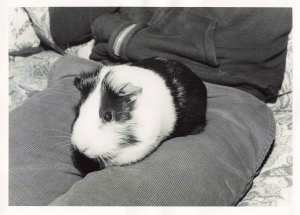
The photos from my lifetime, I want for the memories. I want to remember the people. My second cousins with us in the motorboat. My grandmere and grandpere at the table, smiling at us over a birthday cake. The kids in my sixth grade class. My guinea pigs.
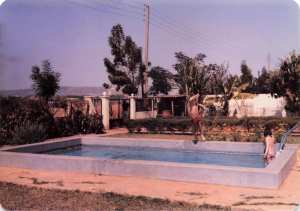
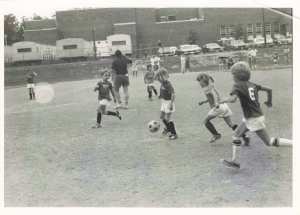
I want to remember the events, too. Swimming in that guy’s pool in Bamako–I can’t remember his name, but I remember that his cook thought lemonade was too strong for children. Playing Dungeon in the living room and joking about green slime jello and roasted rat. Drawing pictures during one of many long car rides. Attending one of my brother’s endless soccer games (during which I also drew pictures).
Also–and this isn’t something I anticipated–I want to remember some of the details about the places I’ve lived. How incredibly orange that one kitchen was, and the sky-blue ironwork grilles over the windows at that same house. The rubber tree in the back yard of the other place. The asterisk-like stars on the kitchen table at my grandparents’ house, and the Marimekko-style throw pillows at my other grandparents’ house. Some of these are details I would have said I’d forgotten–yet when I saw the photo, I remembered.
But this also means that many of the photos I save, so I can remember the people, the events, the little details of my past, will be meaningless to my daughter when I am gone. .What photos do I save for her, and how can I make them mean something?
I can take my own situation as a test. As I go through the photos, I show batches of them to my mom. Sometimes she can tell me who it is and even the address–apparently those photos stir her memory. Other times, it’s a mystery. For the ones she remembers fondly, what (if anything) would make them meaningful to me? The answer is a clue to what I should do for my daughter.
For starters, I could label some of the most important people, as (some of) my ancestors did for me (thank you, ancestors!) I could pull out or otherwise distinguish the photos that might be of interest to her later on, from those that are really only of interest to me. (Hmm, a lousy photo of mom in a swimming pool somewhere–wonder why she kept this?) I could write down the stories that go with them, though admittedly most of these are pretty thin and barely count as stories. Still, when it’s family, even a thin story is appreciated.
So that’s what I need to do as I go through these photos, or more likely, after I’ve gone through them. I need to pull the important ones, label them, and write their stories. After that, maybe I can tackle my own piles of old photos, languishing in the closet…
No, wait. I forgot about the slides. All those many, many slides….Aieee…!
Till next post.
Not the table with the asterisksOne of my sweet piggiesMr. X’s pool in BamakoPlaying Dungeon for the umpteenth timeOne of those many soccer gamesSo much orange!
Long ago (or so it feels) I discussed writing a mystery without a murder in it (Writing a Mystery Without Murder In My Heart). I said, at that time, that while I loved reading murder mysteries and watching them on television, somehow writing a murder felt different.
Later on, however, I made further attempts at writing a murder mystery, and eventually wrote Alibis and Aspidistras, a cozy (murder) mystery. Trying to work out the details of the fictional killing still feels awkward, but as long I don’t have to make the death too realistic, I can write it and enjoy it.
Why am I bringing this up again? Recently I had the opportunity to be interviewed by Meredith Rankin for her Substack on crime fiction. ( “Meet Author Samantha Cornwell” –I really should have posted this link last week–my bad.) One of the things that interests her is people’s attitudes toward writing and thinking about murder, as she discusses in a different post “My so-called obsession with murder”, and I found myself thinking hard about this question again.
I’ve heard it suggested that the reason mysteries usually involve a murder is because murder presents higher stakes than any other crime, and that probably is part of the reason. Still, the importance of any particular stakes in a novel depends a lot on the context–in a novel set in a college, plagiarism could loom large. In fact, almost all motives for fictional murders feel like high stakes to the villain–that’s why they’re willing to kill someone.
To have a mystery, though, there must be questions. Who did it? Why? How? Some crimes allow for this–who stole the ruby? How did they get it out of the house unseen?–while other crimes don’t offer much mystery once the crime is recognized. If a published article turns out to be plagiarized, we probably know who and how, though perhaps not why.
What about true crimes? I don’t normally read that, but in reading a book about poisons, I did read several accounts of deliberate poisonings. It was interesting in a sobering kind of way, a way that reminds me what people are capable of. I am sometimes too inclined to assume that people are basically okay, and shocked when something reminds me of how dark people’s actions can really be. Meredith makes the point (in the second post I listed) that thinking about crimes can make us more aware of how we might be vulnerable.
I wonder if I can make use of that–the idea that a story can make us more aware of our vulnerabilities–in my next story. What would I particularly like to warn someone about? Writing is all about gathering ideas and finding interesting ways to incorporate them. Thank you for that thought, Meredith.




 Ravens and Pears