Maps, Mystery, and Adventure—decorating with story


I have a pair of porcelain mugs decorated with antique map designs, and an out-of-date globe. What is it about maps, both real and fictional, that makes them so appealing as decoration?
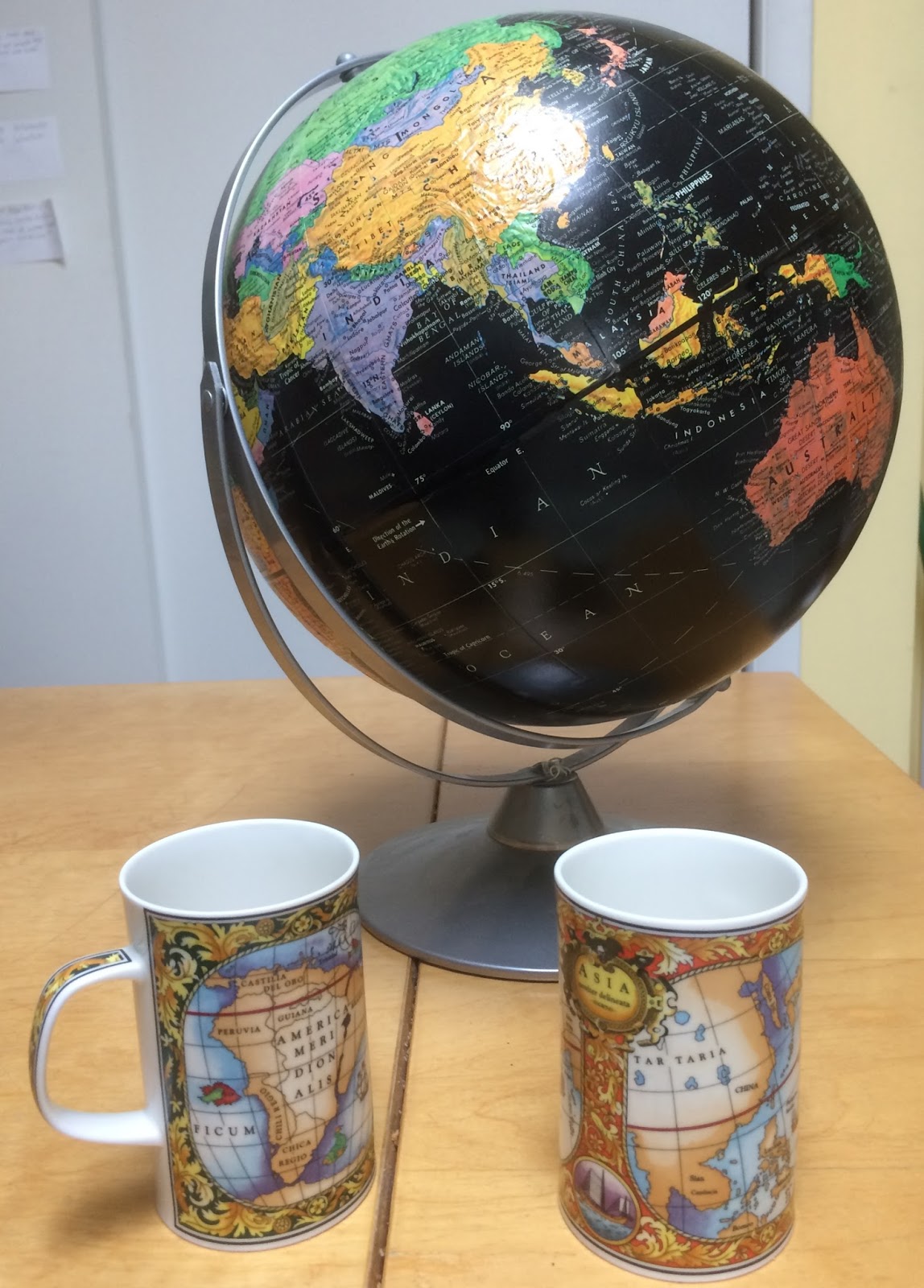
two mugs decorated with antique maps and an out-of-date globe
Decorative maps (globe used to be current)
Some maps are intended to be almost purely functional—the paper road maps in my car (still!) are like that. I have seen even these maps used for decoration, especially if they depict a familiar area (e.g. get a mug with a partial map of your hometown on it), but generally maps tend to be less functional as they get more decorative.
But why decorate something with a map rather than, say, flowers or cars or an abstract design?
Maps show us worlds. Worlds that are, worlds that used to be, and worlds that never were, except in imagination. The right kind of map suggests travel, stories, and adventures. Antique maps, with their limitations and inaccuracies, recall a time when the world was a mysterious place and explorers really didn’t know what they would find. There might be sea serpents, golden cities—even buried treasure, where x marks the spot. In fantasy novels, maps show a world that may really have all those things. Maps are sufficiently popular in fantasy that someone even designed a spoof of fantasy novel maps.
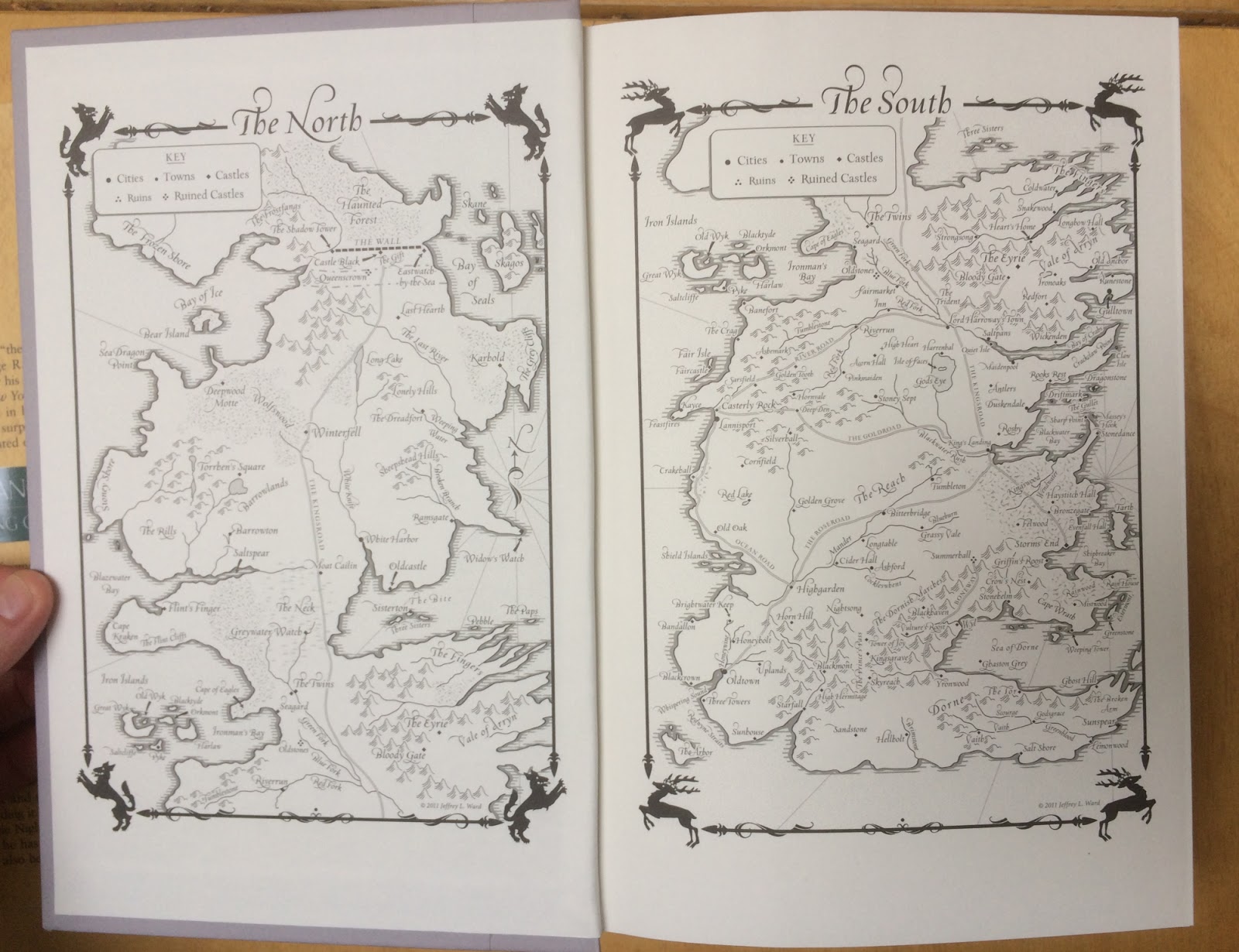
photo of westeros map
Westeros, from Game of Thrones (rather than using Middle Earth as an example)
Maps in mystery novels have a quasi-functional use. A house plan can help the reader track who was where and when–and how a secret passage might have allowed someone to be where they supposedly weren’t. In her mind’s eye, she can see different possible scenarios suggested by the layout of the mystery’s setting.
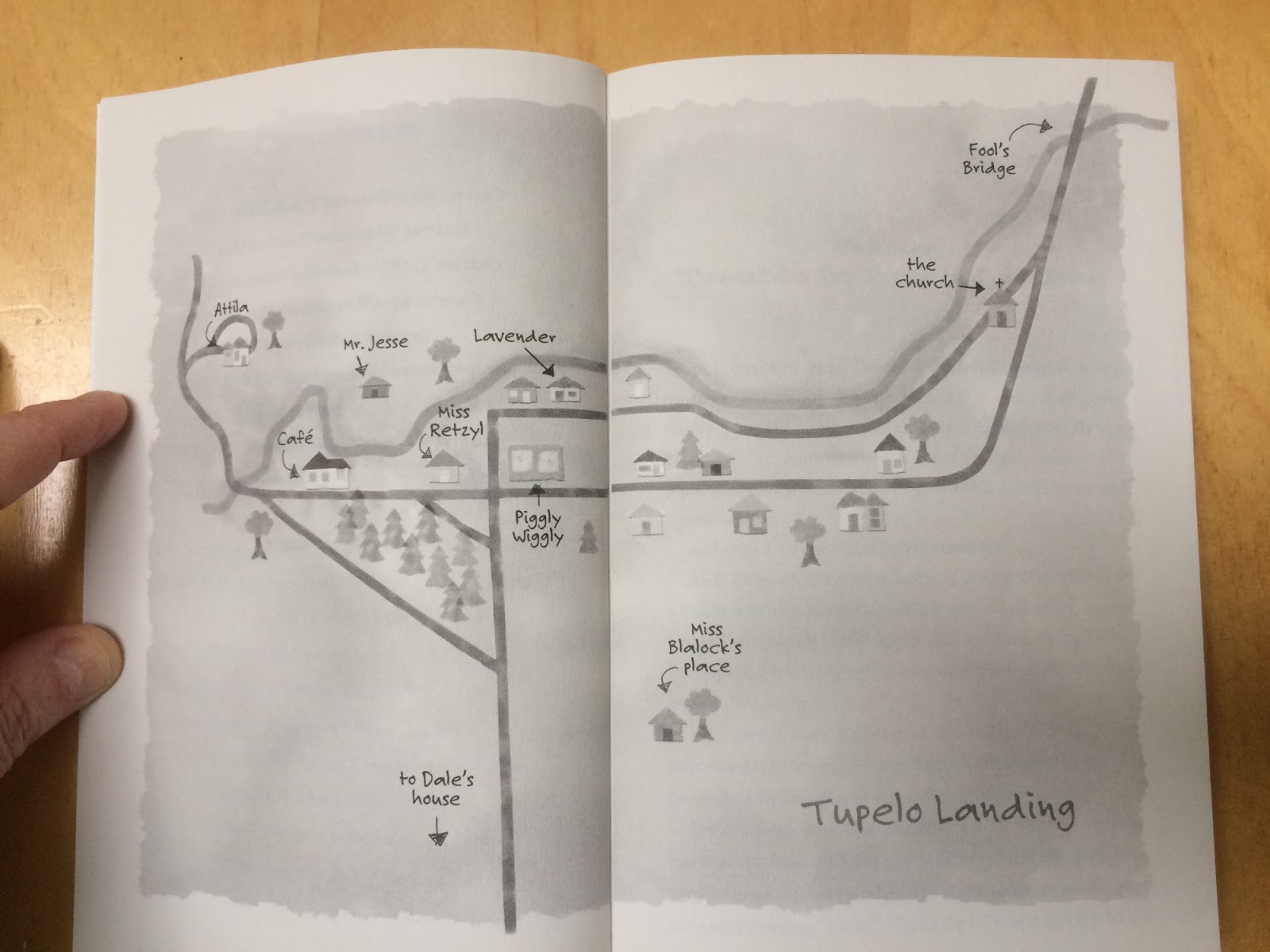
photo of tupelo landing map
Tupelo Landing, from Three Times Lucky by Sheila Turnage
Maps of the world we know don’t have to be purely functional, or even functional at all. Consider the maps that are sometimes designed as souvenirs of a town, where streets aren’t to scale and landmarks are amusingly caricatured. They’re fun, decorative, and sometimes sentimental, but hardly something that will help you navigate, if you should find yourself without GPS and Googlemaps.
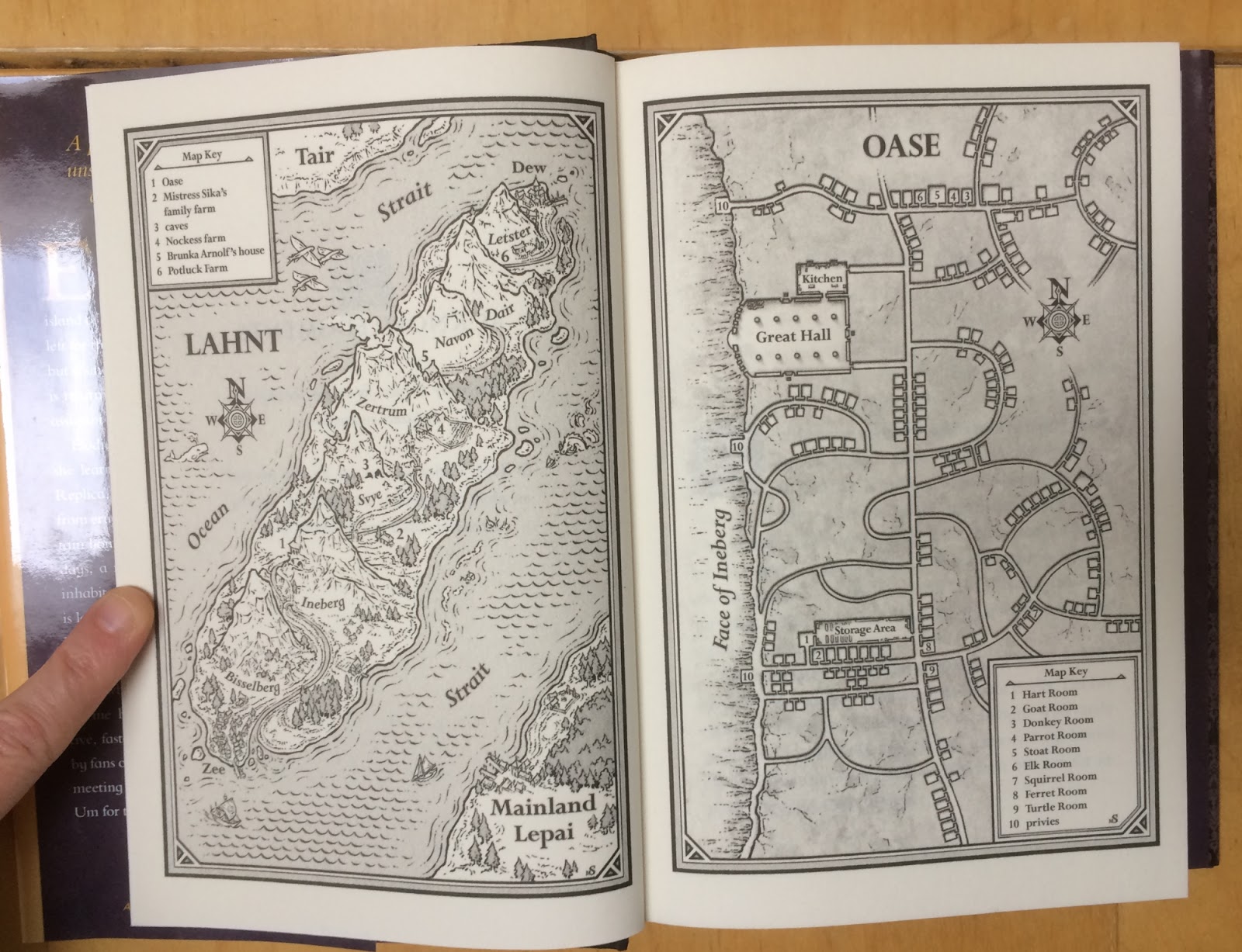
photo of map from Stolen Magic
Stolen Magic by Gail Carson Levine–fantasy and mystery both
In A Great Reckoning, by Louise Penny, an old orienteering map features heavily. But it isn’t a straightforwardly practical map—its maker clearly intended it to refer to landmarks in someone’s personal history. The map isn’t shown in the book, but it is described at various points.
“At first glance, it didn’t look like a map at all. While worn and torn a little, it was beautifully and intricately illustrated, with bears and deer and geese placed around the mountains and forests. In a riot of seasonal confusion, there were spring lilac and plump peony beside maple trees in full autumn color. In the upper-right corner, a snowman wearing a tuque and a habitant sash, a ceinture fléchée, around his plump middle held up a hockey stick in triumph.” (p. 35)
“Yes, it took a while to see beyond all that, to what it really was, at its heart.
A map.
Complete with contour lines and landmarks. Three small pines, like playful children, were clearly meant to be their village. There were walking paths and stone walls and even Larsen’s Rock, so named because Sven Larsen’s cow got stuck on it before being rescued.
Gamache bent closer. And yes, there was the cow.” (p. 36)
Finally, there is something intriguing about the names on a map, not just the images. Some place names are more interesting than others, and just giving an area a name somehow makes it special. Years ago, my daughter and I were at Great Wolf Lodge, a kind of hotel/amusement/water park. The hotel was set up so that the halls could be part of a game in which kids roamed around with electronic “wands”, which when waved at various items, caused them to do something or display something. In keeping with the magical theme, the halls and public areas of the hotel had names.  I should have written some of them down, but I think they were along the lines of “The Enchanted Forest” and such. I commented to my daughter that we should name the areas of our home something more interesting than “Hall Bathroom” and “Mom’s Study.”
(I did in fact name one area of our yard “The Fairy Garden”, and another area that happened to get planted in rosemary, lavender, chives, catmint, and butterfly bush, “The Purple Garden”.)
Having said all this, it is a curious truth that I have not had much luck making maps for the stories that I write. I have some general diagrams to help me keep straight left and right, north and south—but that’s about as far as it goes. And yet, I would love to have some pretty maps to illustrate them with. Maybe I’ll give it another try someday, allowing myself to emphasize beauty  and mystery rather than detail.
Here there be dragons.
Till next post.
Sparkle, Shine and Scarcity


And now back to shiny things…
Because the story I am writing involves the theft of a fabulous ruby necklace, I have been reading books about jewelry. One very entertaining book, Stoned: Jewelry, Obsession, and How Desire Shapes the World by Aja Raden, focuses on the role of gems in history.
I had heard the story about DeBeers and “A diamond is forever” before—even before my daughter informed me that Adam, who Ruins Everything, had ruined diamonds for her. Stoned provided more details: the relative unimportance of diamonds early in our history, the difference that improved cutting techniques made, and the way that DeBeers turned them into something everyone wanted with clever advertising and choke-hold on the supply.
I hadn’t heard the story about Spain flooding Europe with New World emeralds and drastically reducing the value of their own crown jewels. Nor had I realized just how scarce, and prized, pearls once were.
The relationship between scarcity and value is interesting. I am sometimes amazed at the things we can create now—the materials, the finishes, the new techniques. Beautiful things are widely available to us. In fact, we fail to notice quite how many treasures we have because they are so very available and cheap.
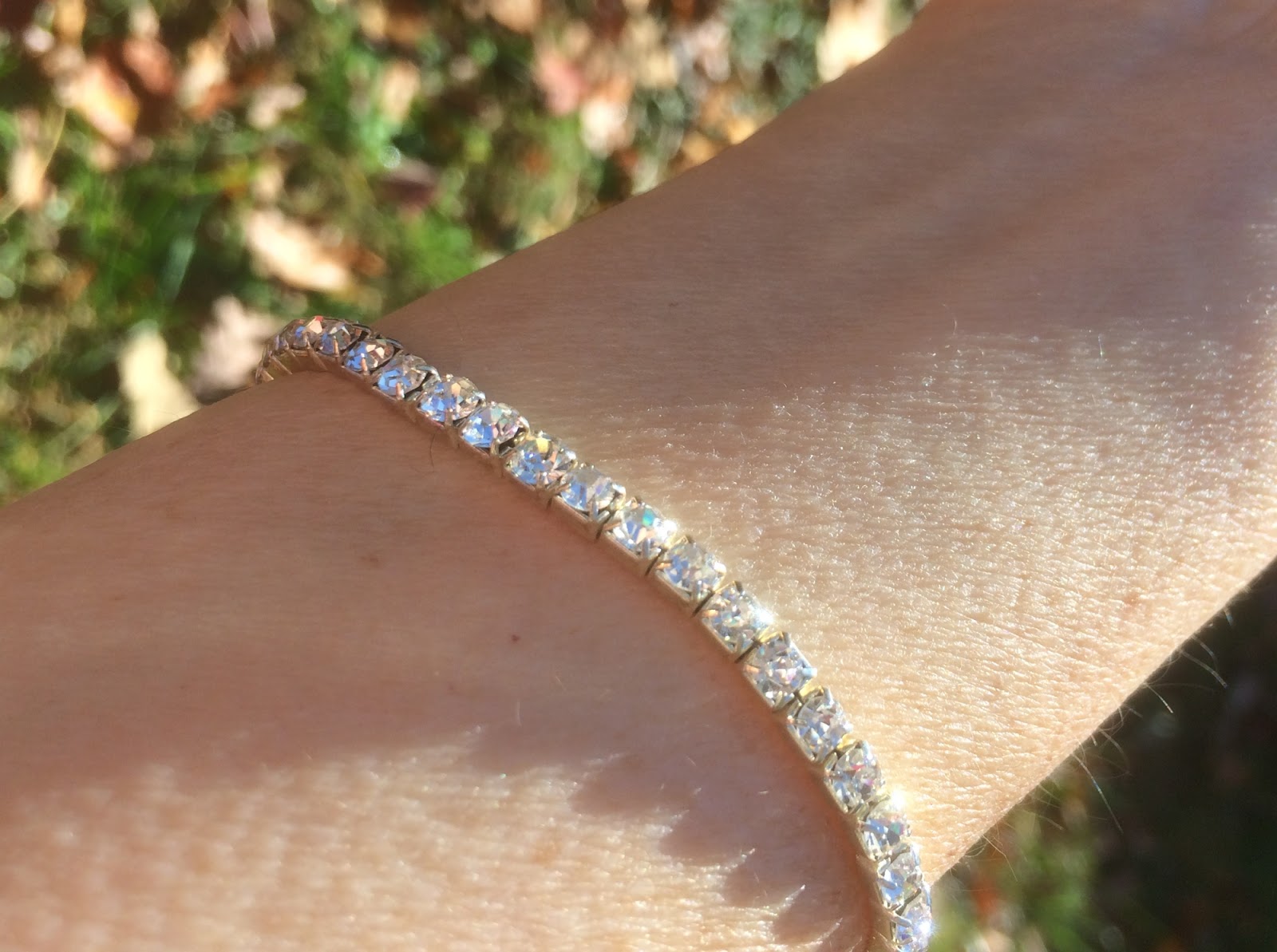
For example, I have a bracelet I like–stretchy, silvery, and glittering. Now, my mom isn’t into jewelry. She has very little of it herself and no idea what is currently in stores. She saw me wearing the bracelet and asked when I’d gotten it. From her tone, I think she expected to hear that it was a special anniversary present. Instead, I said, “Six dollars at Walmart.”
Sparkly stretch bracelet glitters like diamond in the sun.
Diamond tennis bracelet or kid’s costume jewelry?
Someone more familiar with today’s little girls would have recognized the style right away… but does that make the bracelet any less beautiful?
It’s not a rhetorical question. If you glance at it, think “cheap costume jewelry”, and look away… certainly you appreciate it less. But I think it’s fabulous. I hold my wrist up to the sun and watch it glitter. It isn’t durable (I’ve broken the stretchy cord on several already) but it is pretty. And what attracted humans to gems in the first place, if not their color, translucence, and sparkle?
And the bracelet is just the beginning! Little girls’ wardrobes are full of sparkle and shine that I would have begged for as a child, had it been available. (I did have shiny black patent leather shoes…)
We also now have the ability to synthesize precious stones—rubies, sapphires, diamonds. They are no less attractive for having been made in a lab, and there are many more of them to go around. Apparently some fancy watches have a crystal (the glass front of the watch) made of colorless synthetic sapphire! Imagine that—they can make a cylinder of synthetic sapphire wide enough for a watch face, and then slice off pieces of it. What else can they do?
Well, they can make a diamond ring. That is, a ring made of diamond, not a ring set with a diamond. It sounds like the sort of thing you’d find in a Richie Rich comic book. I couldn’t find out whether the diamond was natural or synthetic, but it seems like an odd and perhaps even wasteful way to cut a large diamond, which makes me think maybe it was synthetic.
It isn’t just gems that are shiny and beautiful and increasingly available. When I was in my teens, I bought postcards with what we would now call “holographic foil” on them at a science museum. I paid at least four times what regular postcards cost—maybe it was more than that. They were special! I taped them up on my wall for my friends to admire. Now I throw away used Christmas wrapping that would put those postcards to shame.
I could give further examples, but you get the idea. We have shine, glitter, and vivid colors enough for old-fashioned royalty.* Do we feel like royalty? Apparently not—everyone else is just as shiny, glittery, and colorful as we are.  And yet…wow.
Just…wow.
Till next post.
*Admittedly, we’re a little short on actual gold—never found that Philosopher’s Stone—but we have a lot of really good gold-colored paint and foil.

Sun and suncatchers–rainbows in my room


In winter, the sun shines into my study.
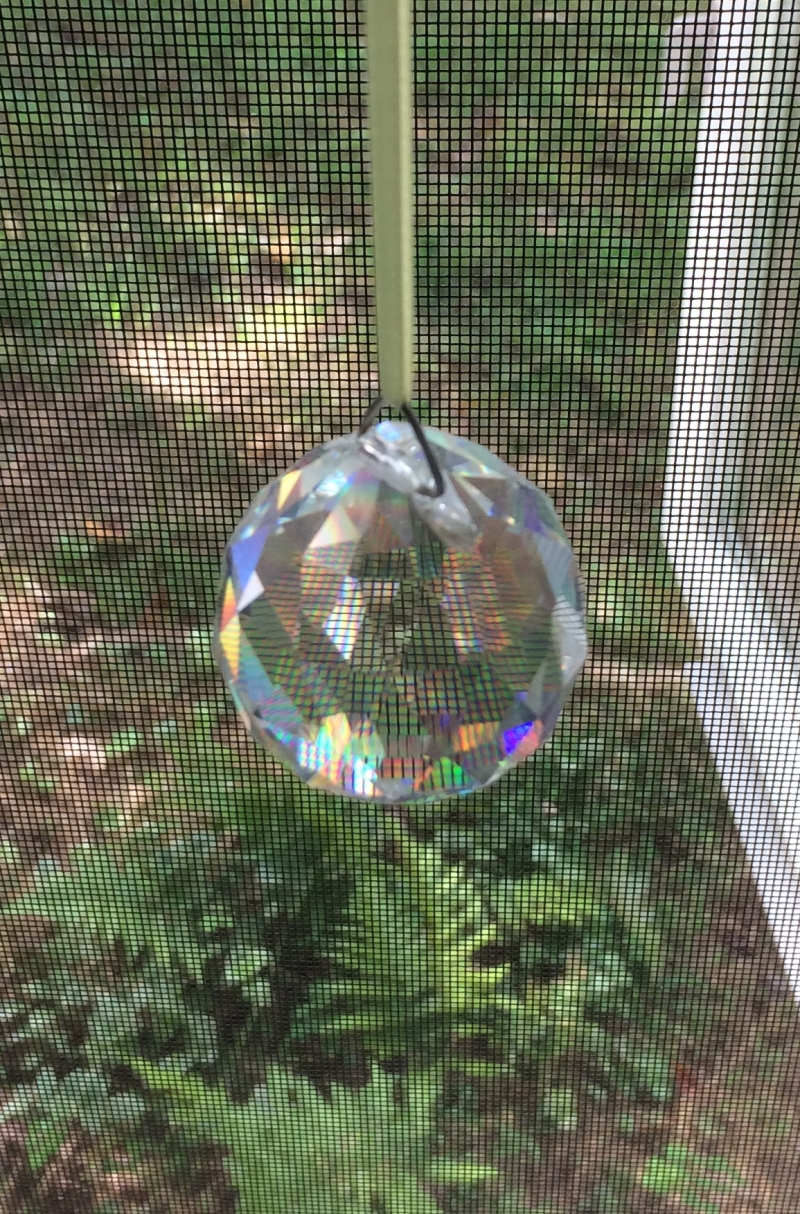
Chunky faceted crystal suncatcher in front of window screenIn my dreams, it shines on a room that is serenely uncluttered, where ferns and houseplants flourish, and where crystal prisms in each window cast drops of rainbow on the walls and floor.
In my dreams.
In fact, my study is so cluttered that I’m having trouble finding papers when I need them, and my houseplants are surviving tenuously on intermittent waterings. But I do have suncatchers in almost every window, and when the sun’s angle is right, my study is filled with tiny rainbows.
A glass ornament hung on a ribbon or plastic line isn’t going to stay perfectly still, and so the rainbows drift, lazily, around the room. If I nudge the prism, the rainbows jitter madly about for a moment, then race across the room, gradually slowing to near-stillness.
There’s a reason rainbows are associated with unicorns and fairies and other magical creatures. They are nearly magical themselves—sunlight split into colors. Sometimes, when I glance at a suncatcher from just the right angle, it lights up in a momentary blaze of color—green, maybe, or violet. I imagine that someone watching would see a tiny rainbow drifting over my face at that time, entrancing me.
The whole idea of rainbows brings out my whimsical side. Years ago, I lived in an apartment where I hung a suncatcher in the kitchen window. Mornings, I held my cereal bowl out so I could pretend I was flavoring my breakfast with rainbow. I still like the idea of rainbow-flavored cereal.
On the practical side of things, there are some difficulties in hanging chunky glass crystals (the best kind for rainbows) in a window. As I mentioned, they can swing if accidentally bumped into, and while I don’t know who would win in a contest between crystal glass and window glass, I’m sure it wouldn’t be good for either. A suncatcher on a shorter cord would be less likely to swing into the window, but it would also catch the sun less often. So most of my suncatchers hang in windows that have interior screens. The crystals would look better in windows without screens, but the screens provide extra safety for the windows.
The sun only comes through the crystals at certain times of day and only when it traces a more southerly path through the sky. But when I think about it, maybe that’s a good thing. If I had rainbows every day, all day, they wouldn’t seem as special.
Till next post.