What Is This Called? Quilt Patterns, Drawing, and Zentangle(tm)


A few weeks ago, I was browsing through images of Zentangle-inspired art and it occurred to me that here was a way to combine two things I like: interesting quilt block patterns, and tangle patterns. (Zentangle™ is basically a form of doodling using patterns that are broken down stroke by stroke so they can be comfortably learned and produced. It can also be a kind of meditative practice.)
I love quilts and quilting, but I haven’t made many because they are (for me) a big time commitment. I have a file full of quilt patterns that I would love to make some day. Now, nothing replaces actual fabric and thread, but perhaps in addition to working on a small number of these patterns in fabric, I could work on a larger number of them on paper. I wouldn’t be able to curl up under the results, but I could put them on the wall and look at them. After all, plenty of quilts end up as wall hangings, too—there are only so many beds in one house.
So I pulled out the file and selected a pattern I’ve very much wanted to use—Storm At Sea. I love the way the straight lines of the triangles and diamonds end up giving the illusion of curves, not to mention the effects possible through different choices of fabric colors. I made a slightly simplified outline and started filling in the spaces with colored pen and filler patterns.
I didn’t get very far before my frozen right shoulder let me know that I would pay for this activity. 
I should explain. I’m talking about adhesive capsulitis, which sometimes occurs for no apparent reason. My left shoulder was the first one to start freezing, back in July or even earlier. After getting quite painful, it moved from the “freezing” to the “frozen” stage and stopped hurting. That was in December. It is now, I hope, moving into the “thawing” stage, though I can’t be sure since it has only regained a tiny bit of its former range of motion so far. 
When one shoulder freezes, there is an increased chance that the other one will also be affected. The right shoulder started to freeze just as the left one stopped hurting, and I think it has probably reached the point of maximum pain and minimum movement about now. I’m hoping it will move on to the next stage before the month is out, but in the meantime, activities like drawing, writing longhand, as well as anything that involves repeated reaching (wiping counters, unloading dishes, etc), is liable to make my entire arm hurt. Filling in an entire quilt design with detailed patterns is out for now.
So I didn’t get far on my Storm At Sea design.
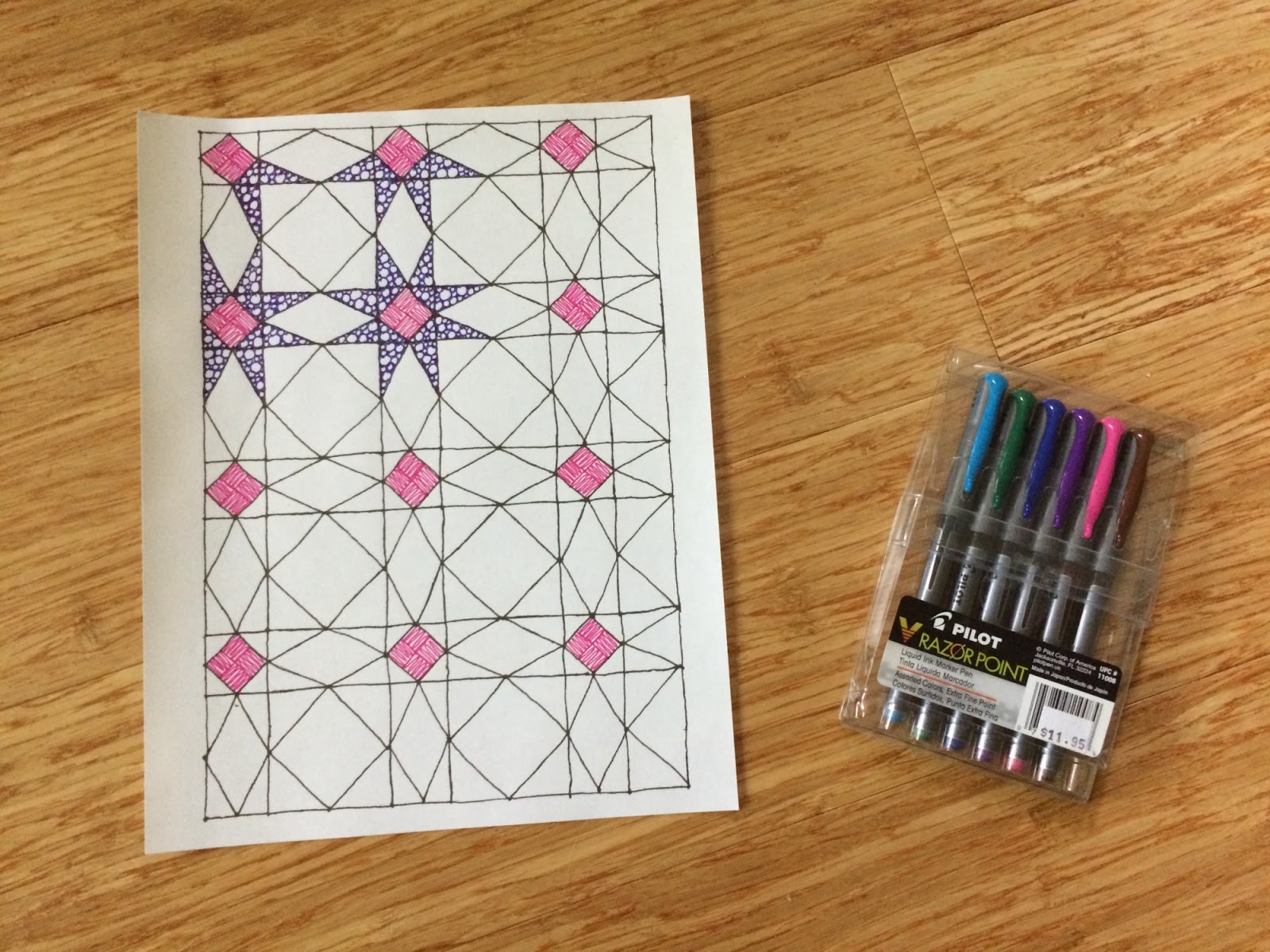
Well, at least I could look at images of designs that other people had done, right? Except… what is this kind of thing called? I started typing words into Google, trying to find out.
I tried “zentangle quilts”, and found actual fabric quilts made of black-and-white prints in patterns resembling Zentangle tiles. I moved to “zen quilt” and discovered a book called Zen Quilting, which deals with using tangle-type patterns in free-motion quilting on fabric. “Paper quilts” gave me collages of patterned paper cut into shapes and pasted down in imitation of traditional quilt block designs.
I tried other combinations of words, but could not find the magic phrase. I’m certain these pictures are out there. Quilting and Zentangle have much in common, and I can’t be the first person to think of using a quilt outline as a “string” (lines outlining the spaces to be filled in).
So what is this called? What is the word for using traditional quilt block designs but drawing them on paper and filling in the spaces with doodles or Zentangle-inspired patterns?
Anyone? Please?
Till next post.

A Letter Is a Gift in Your Mailbox


Getting a personal letter in the mail is like getting a surprise present. It’s all wrapped up and you’re eager to find out what’s inside.
Actual physical letters are rarer and rarer these days, though ironically the availability of beautiful and/or interesting note cards seems to be greater than ever, thanks to ease of printing small batches and all the special effects possible in print, not to mention on-line shopping at etsy, for instance.
Note cards come in an amazing variety.
So maybe you’d like to send someone a letter or card, just to give them a pleasant surprise in the mailbox. Why not have some fun writing it? There are so many options.
First, there’s the paper. Really, any paper will do. Notebook paper is fine, if you write better with blue lines to guide you. Otherwise, there are all those amazing cards to choose from, as I mentioned earlier, or nice stationery (though I suspect the choices in plain stationery have decreased.) If you’re feeling creative, you can always make your own card. Pen-and-ink, rubber stamp, colored pencil, cut-and-paste (actual or virtual), watercolor-over-crayon,… Making the card by hand is traditional when it is from child to grandparent, but there’s no reason an adult can’t make a card for a friend.
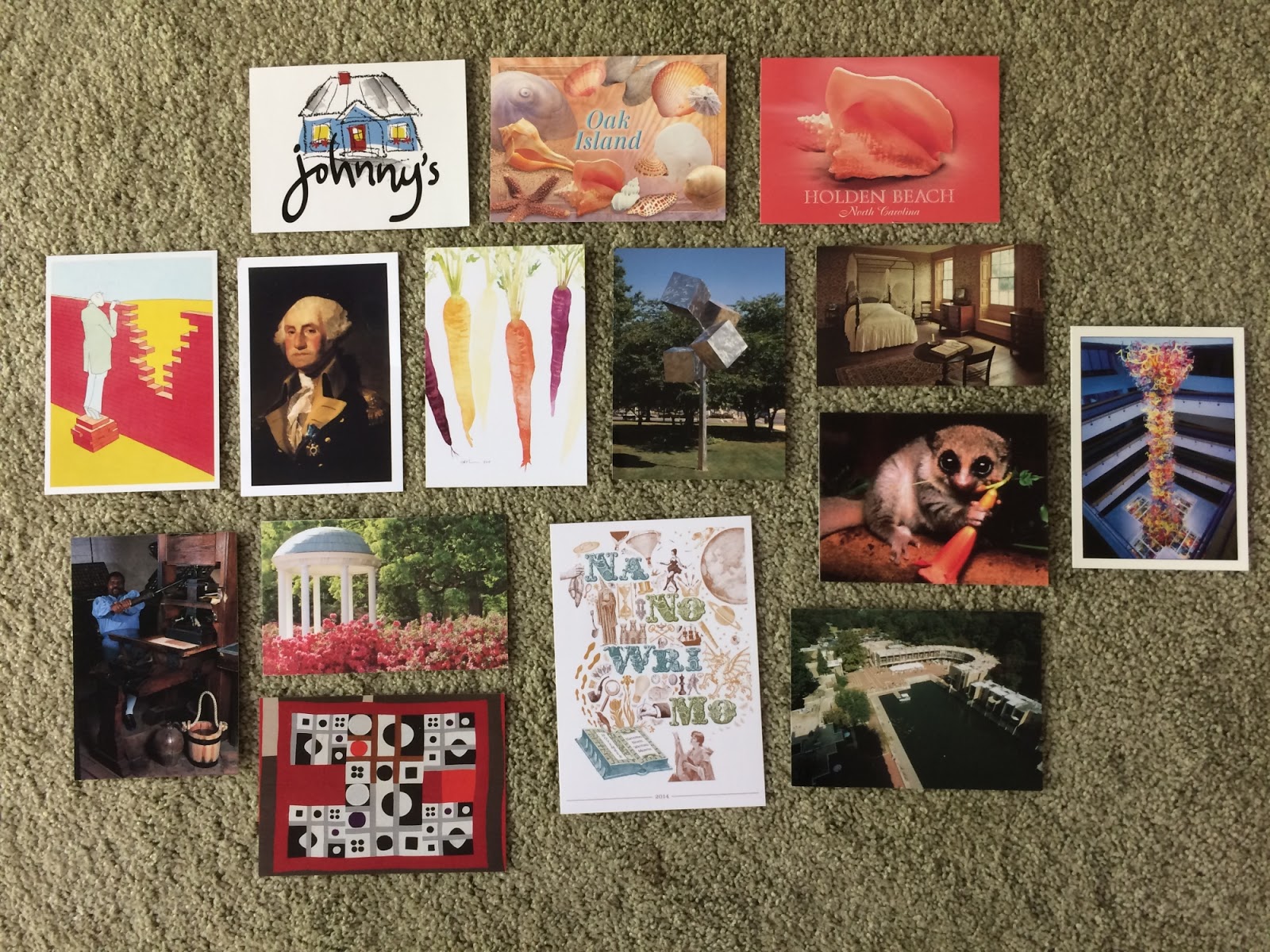
postcards from museums, living history museums, beaches, and art postcards
Postcards can indicate places you’ve been or seen, or not.
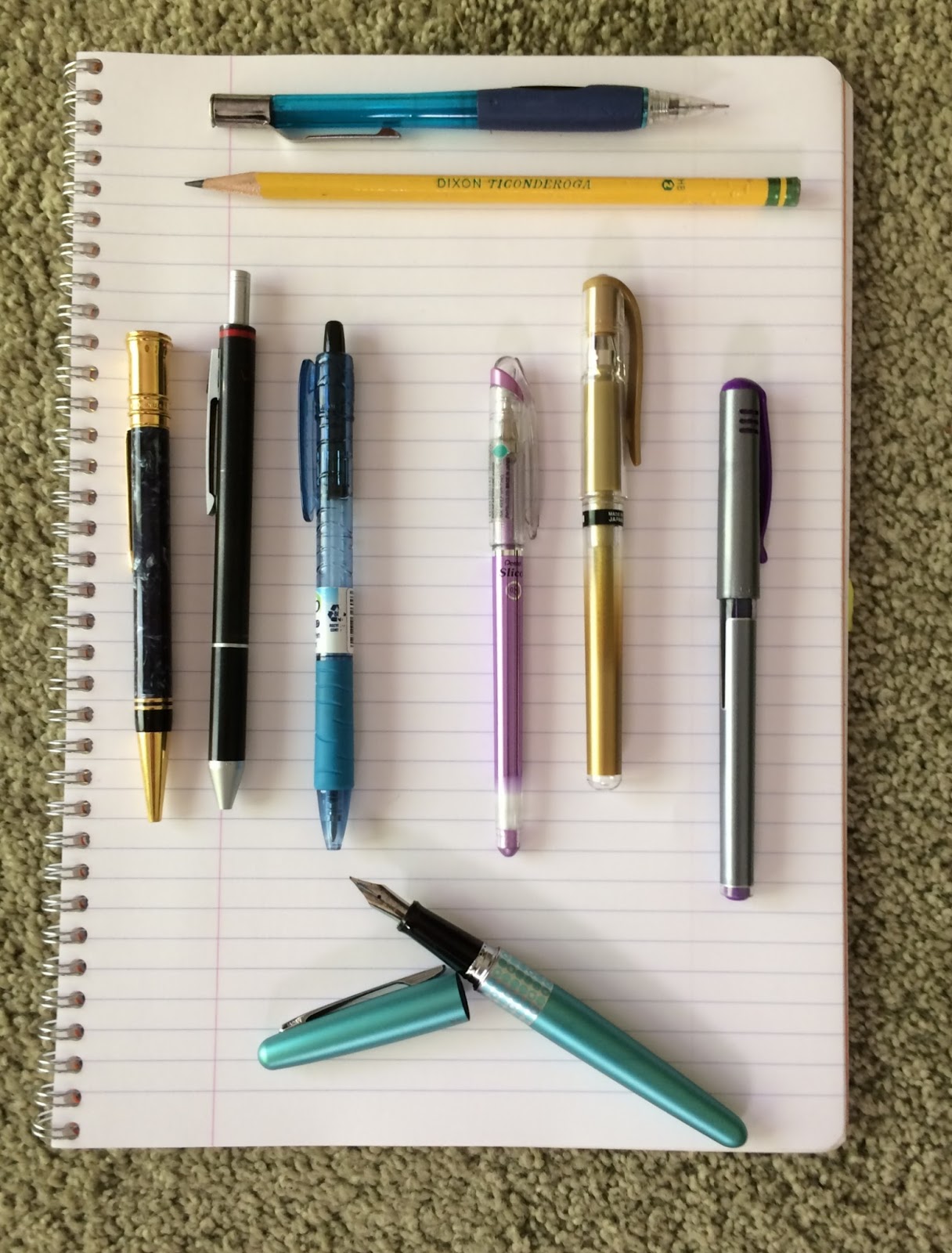
Then there’s the pen. The paper you are writing on may limit your choices. Fountain pen on loose-leaf tends to bleed. But there are still plenty of ball-points and gel pens, not to mention pencils, that are a pleasure to use on even the cheapest notebook paper. (Can you tell I love pens?) And if you are using nice paper, go ahead and use an elegant fountain pen (or a cheap, yet chic, one. Pilot MR, for instance.)
pencils, ball points, gel pens, and a fountain pen uncapped
Various pens and pencils
Of course, what stops most people is not a lack of pen and paper, but figuring out what to write. The first thing to remember is–given how rarely most people receive personal letters now, the bar is set fairly low. And while you may want to write a letter that is full of wisdom and will be treasured forever, letters like that have always been in extremely short supply!
(Letters used to be the main way to convey basic things like “Please send money,” “I miss you,”  “Your father has been ill,” or “We are very disappointed in your behavior,” going back to ancient days. So a lot of letters were probably not such a thrill to receive.)
So what will you write? There’s the usual “what I’ve been doing recently.” It may seem dull to you, but to someone you don’t see often, it’s still news. However, if this is someone you talk to on the phone all the time, you might want to write about something else.
What are you excited about? You must be excited about something. (If not, stop your letter and go work on your life instead.) For instance,
The latest season of “Death in Paradise” is now showing on PBS. I’m excited! Of course, they’ve replaced every character from the original except Dwayne, and if they replace Dwayne too, M and I may quit watching altogether.
The original detective inspector Poole was so delightful—why was that? Something about his grouchy, fussy, detail-oriented self was really entertaining. But the actor wanted to spend more time with his kids, instead of spending time in the Caribbean, and who can blame him for that?
You could be excited about something small, like a book or a movie. Or it could be an idea or a project you’ve started. Or maybe you are about to go on a trip, move, or change jobs. Even if the fact of it isn’t news to your recipient, some of your thoughts about it may be.
Maybe you talk to this person on the phone so often, you’re thinking, “What’s left to talk about?” Well, give it some thought. There may be things you didn’t have a chance to go into detail about, or you’ve thought about some more since the last conversation. Or maybe it would be fun to do something else entirely and just describe what is happening around you at the moment–set the scene for your reader, so they can share the moment with you, at long distance and delayed in time.
I’m sitting in my kitchen typing on my iPad. I don’t know why I often sit here instead of at my desk, or the little table I put near the window with the nice view, or out on the porch. Well, I sort of  know why. My desk is too messy, and right now it is over 80 degrees outside, so the porch is a bit too hot to be pleasant. Still, the seat by the window would be an improvement. Maybe after I make a cup of tea. (In this heat, I’m still drinking hot tea? Maybe I’ll make that iced tea with orange juice, instead. Or regular sweet tea.) The cats are lying around the living room, Pearl on the sofa, Conga sprawled on the floor (she was outside, and black cats do heat up on sunny days). I wonder if she would enjoy having a cool cloth laid on her. Probably it would be too strange a sensation for her.
If you’re up for it, you could send a riddle or a puzzle, or draw a doodle, or clip something out of the paper/magazine. (Yes, I know, that’s what Facebook is for. But getting an actual clipping in your mailbox is still more like a surprise present than seeing a post on Facebook.)
Having written, you enclose the note in its envelope. If you have stickers, you can put one on the back for decoration. Or stamp it with a rubber stamp, or draw a doodle on it. Or none of these, if doing so would delay you in getting the thing in the mail. Remember,
A plain letter that gets in the post is 100 times better than a great letter that never leaves the house.
gold ink doodle on the back of an envelope

Reflecting On Reflections–the stories inside the shine


I love things that shine, sparkle, or shimmer, just because they are beautiful. I also love anything that holds secrets or points beyond itself. Some things, in reflecting light, do both.
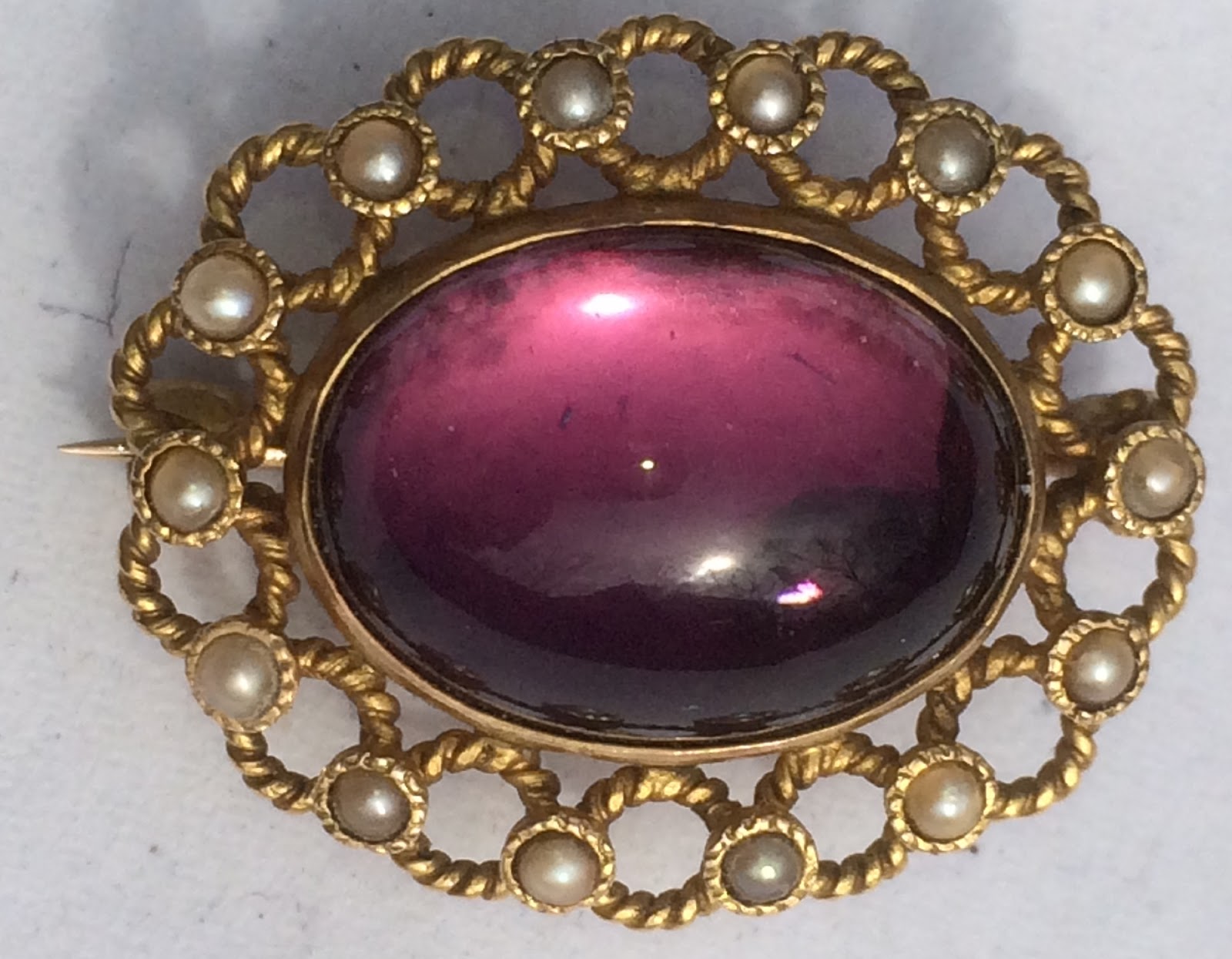
Recently I was fascinated by the way people incorporate drawings of cabochon-cut gems into Zentangle-inspired art. Cabochons are rounded and polished, not faceted, like smooth blobs of glass. In looking at demos of how to draw them, I was puzzled by the white highlight. Should the white spot be round, or a long bar? Where should it be placed? I looked at photos of cabochon-cut gems, using Google images (so useful for things like this!), trying to figure out how the bright spot works. In the photos, I saw reflections in the gems of… their light source.
Purple cabochon gem with reflected window.
Gem reflects window and potted plant.
Duh!
Some bright spots were shaped like windows, some like bars of overhead fluorescents, while others were merely a round bright spot (an incandescent bulb? the sun?). And sometimes there were multiple bright spots, because there were multiple sources of light.
But it wasn’t just the light source that I saw reflected in the gems. Was that the camera apparatus making the dark square shape? And the shop where this other photo was taken must have a whole bank of windows. In one gem, I even saw the silhouette of person sitting nearby.
Purple cabochon brooch with reflected trees.
Outdoors, you can vaguely see the trees as well as sky.
In each case, all I was looking at was a photo of a single gem, but the reflections told me more.
This shouldn’t have been news–we have mirrors in our cars precisely to give us information about things out of our line of sight. Reflections sometimes play a role in stories, too. I remember an Ellery Queen mystery (the TV series) where the lack of a reflection, where one was expected, revealed something important. And in Bladerunner, a reflection in a photo gives the detective a clue (at least, I think it was a reflection—it wasn’t entirely clear in the movie). A painting that includes something shiny, such as a silver teapot, might make a good clue in a mystery novel– the distorted reflection of a face could reveal that a third person had been present at the sitting and perhaps even who it was (by their distinctive hat, say).
Silver teapot with reflection of kitchen including two jars of peanut butter.
What kind of peanut butter do we buy? Two jars worth.
Reflections also show up in mysteries because of the misleading way they reverse the appearance of what they show. Someone who sees something in a mirror sees it reversed—information, and yet misinformation.
For the most part, shiny things are appealing because of the way that they play with the light, not because of what their reflections tell us. In fact, paying too much attention to the reflections in gems rather takes away from their immediate appeal. But I like knowing that if I want, I can see more than just the gem. I can see the world around it.

Till next post.

Purple cabochon brooch with reflection of two fingers.