So, above you’ll see another effect of light: sunshine through a faceted piece of stained glass in a bathroom window at Saint Andrew’s Episcopal Church, Haw River, NC. Did its creator anticipate the interesting constellation-like points of light it would cast?
One more surprise of the light. It’s hard to tell from this photo, but this dragonfly glistened gold in the sun as though someone (or Someone) had made it out of gold wire–a piece of jewelry for the grass. It amazes me how insect exoskeletons can create those metallic and/or iridescent effects. Imagine if our skins could glitter like that!
There are two kinds of people in the world: those who are more interested in the appearance of food, and those who are more interested in the taste. (Joke–there are two kinds of people in the world–those who divide the world into two kinds of people, and…)
Okay, it’s really more of a spectrum, but by way of illustration, every year I see magazines in the checkout showing clever ways to create cupcakes that look like spiders for Halloween, cookies that look like nests of eggs for Easter, and so forth. These are ingenious and very attractive comestibles, and I appreciate them as such, but I also can’t help thinking–do licorice whips really taste good with chocolate cake? Will the marshmallows work with pretzel sticks?
Partly for that reason, I’ve never been all that excited about making gingerbread houses, even though I love baking. I’ve always seen them as purely decorative–after all, surely pretzel logs and Necco wafers don’t taste as good combined with gingerbread. My husband, on the other hand, sees gingerbread houses as edible as well as decorative. His position is that one should enjoy it for a few days, then start picking candies off, then eat the cookie before it gets stale.
Still, I do like to decorate sweets, and I do like constructing things. This year, I had an urge to make a cookie house, possibly as a result of watching too many episodes of The Great British Baking Show. But did it have to be made of construction gingerbread? What other flavors might there be?
Brilliant! Not only were the little houses cute, but they had the following advantages over full-size cookie houses.
–I could make cookie houses and still enjoy fresh cookies from the rest of the dough.
–Each person could decorate their own house.
–It would be easier to cover the finished houses (to protect them from our cat who has been known to lick at them.)
–The cookies would not need to be quite so sturdy as the pieces would be smaller and subject to less tension and compression. (Thank you, Stephen Ressler of The Great Courses for the engineering vocabulary!)
–And finally, we could eat one while still enjoying the appearance of the remaining ones.
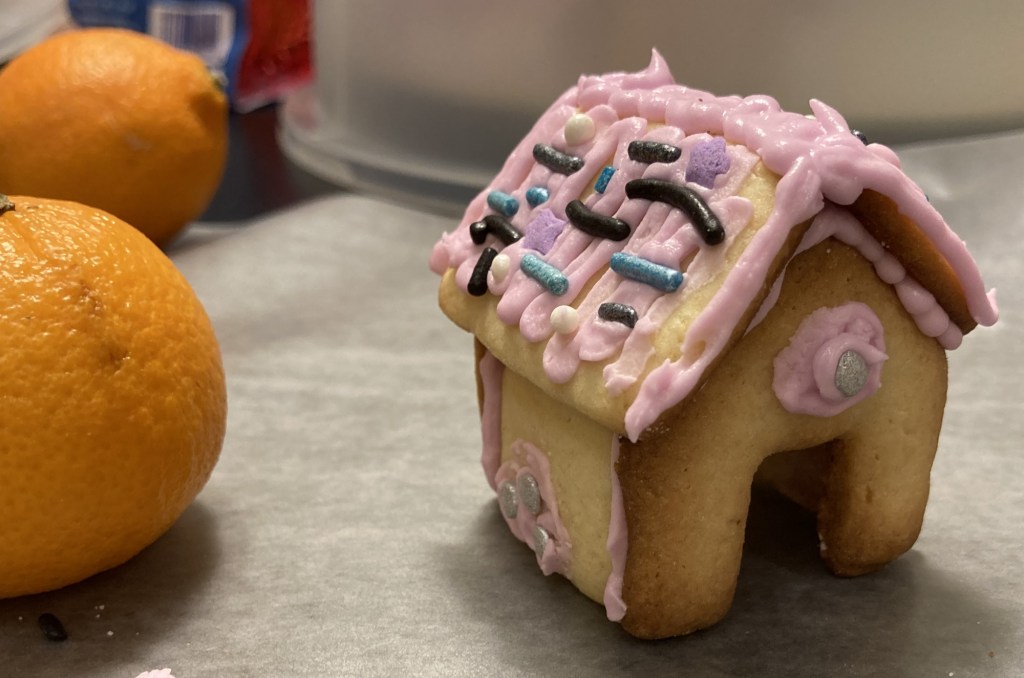
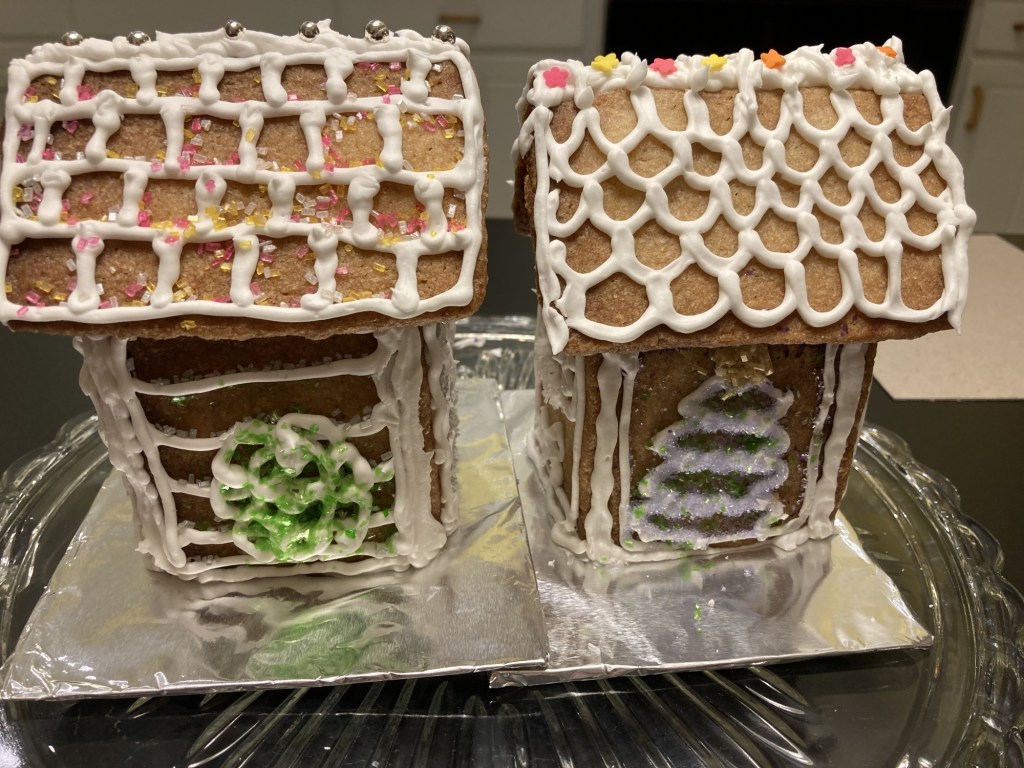
I tried two different doughs, and I tried cutting out my own small pattern (which was a bit of a pain) and then bought some ready-made cookie cutters for mini cookie houses. Photos below.
Cookie houses made from my own pattern.
Cookie houses made using purchased cookie cutters.
I’m not going to provide links to recipes, as the recipes I tried were okay but not thrilling. Better that you should scout around for recipes you find exciting and try those. (And then let me know, please, if you find a recipe you think is especially good.)
I will provide links to some of the cookie cutters, however, because they make it much easier. I didn’t recut my pieces after they were baked, which probably would have improved the results, but they stuck together all right anyway.
What is the mysterious appeal of lace? What makes lace so special among fabrics?
My current writing project, a cozy mystery sequel to Alibis and Aspidistras, centers on an incident at the Lacemakers’ Ball–an annual event in the fictional town of Grey Harbor. So, not surprisingly, I’ve been thinking a lot about lace. And how to create an air of mystery.
Lace itself has an air of mystery. On the one hand, it’s a fabric (or a trim). On the other hand, it depends as much on air and empty space as it does on substance. It teases, blocking your view, but only partially. It occurs to me that the appeal of lace is a bit like the appeal of reflections and shadows. Lace shows you not just itself, but a bit of something beyond.
Lace is mysterious in another way. How does that delicate network hold together?
There are different kinds of lace, of course. I understand crochet lace–how you can take one very long thread and make loops within loops to create a structure than doesn’t simply unravel. And years ago I took an introduction to bobbin lace and learned the basics of how threads and pins used together could create a woven web that remained even after the pins were removed–and how that web could be created in many varied patterns. But even having seen it firsthand, I find it amazing that it doesn’t just fall apart.
The sum total of my experience in bobbin lace.
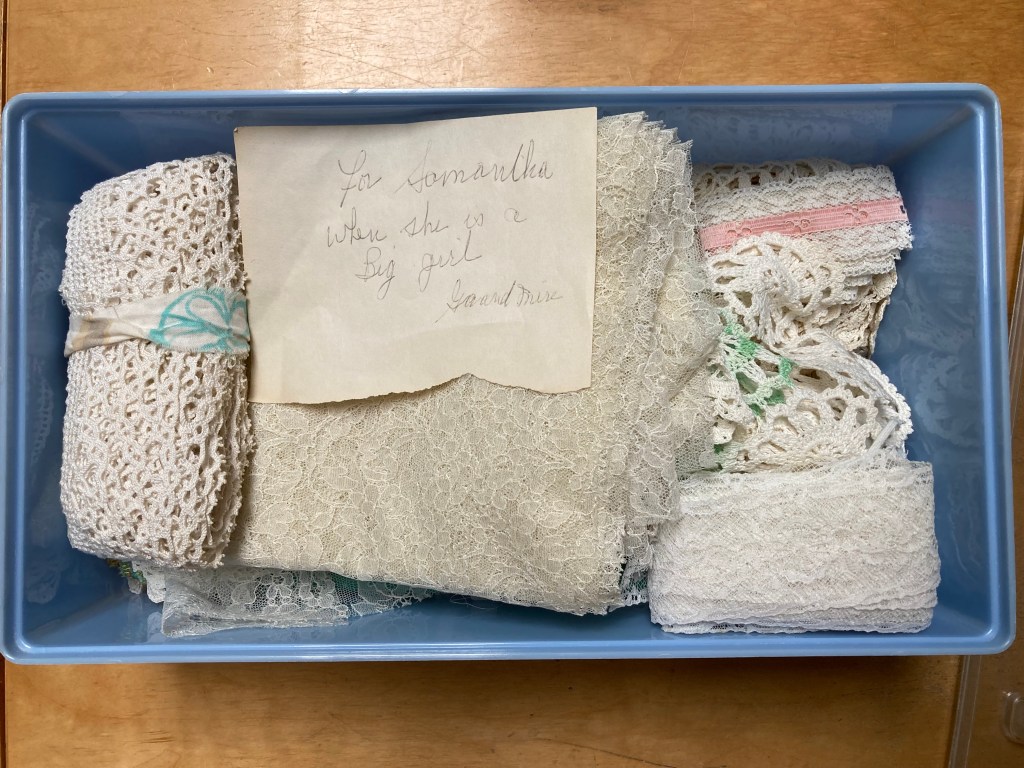
This brings me to more personal mystery involving lace. My grandmere–my paternal grandmother–left me a box of lace. She had it stored away in a plastic box with a flower-embossed lid and a note, “For Samantha when she is a big girl.” I loved frills and froufrou as a little girl, so she probably imagined me adding lace trim to my clothes and household linens, just as she filled her house with lacy runners and ribbon-trimmed drapes.
“For Samantha when she is a Big Girl”
Where did the lace come from? Were these all bits and pieces left over from her own projects? My grandparents were thrifty and she would have saved any remnants, and probably anything that could be salvaged from old clothes as well. Or perhaps some of it was for projects she never started?
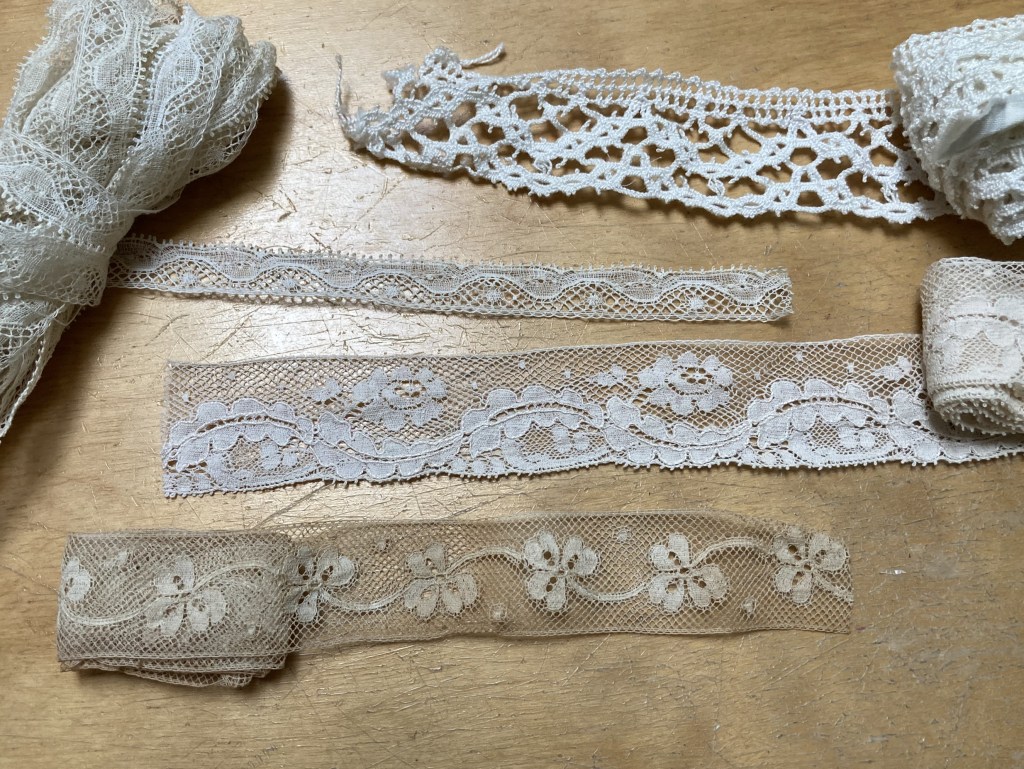
Some of the lace trim, designs from abstract to realistic
On the other hand, one of the pieces in the box was a runner made of crocheted doilies, very like the partially completed doilies that were in with her other things, so presumably that piece is one she crocheted herself. Looking at it, I realize that I know very little about my grandmere’s skills beyond cooking and sewing. She once demonstrated tatting to me, but I wasn’t especially interested at the time and never asked to see more. Somewhere I have a wisp of tatting in the same beige thread as the partial doily–what else did she create? And did her lacemaking ever extend beyond crochet and tatting?
Some of the lace is clearly machine-made, and probably the rest of it–other than the doilies–is too. But I wish now that I had asked her to tell me more about her skills, instead of taking for granted the things that she made us–the crocheted cushion covers, and the pillows with our initials embroidered on them. It’s too late now. It will forever remain a mystery.




 Ravens and Pears