Decorating Boxes For Flashcards — Zentangle and ZIA on tuckboxes

Two books on language learning that I’ve read in the past several years (or has it been longer than that?) recommend using spaced repetition with flashcards. “Spaced repetition” means that so long as you are getting a word right, you increase the length of time before you review it again, while if you get it wrong, you shorten the interval. The Leitner system is a spaced repetition system. It is a list of days and levels of words to review on that day. When you review a word, if you get it right the word moves up a level; if you get it wrong, it moves down.

There are lots of on-line flashcard programs, but I like actual cards. Actual cards take up space, though, and need to be contained so cards at different levels don’t get mixed up. So I’ve been making tuckboxes for my flashcards out of cardstock and decorating them.
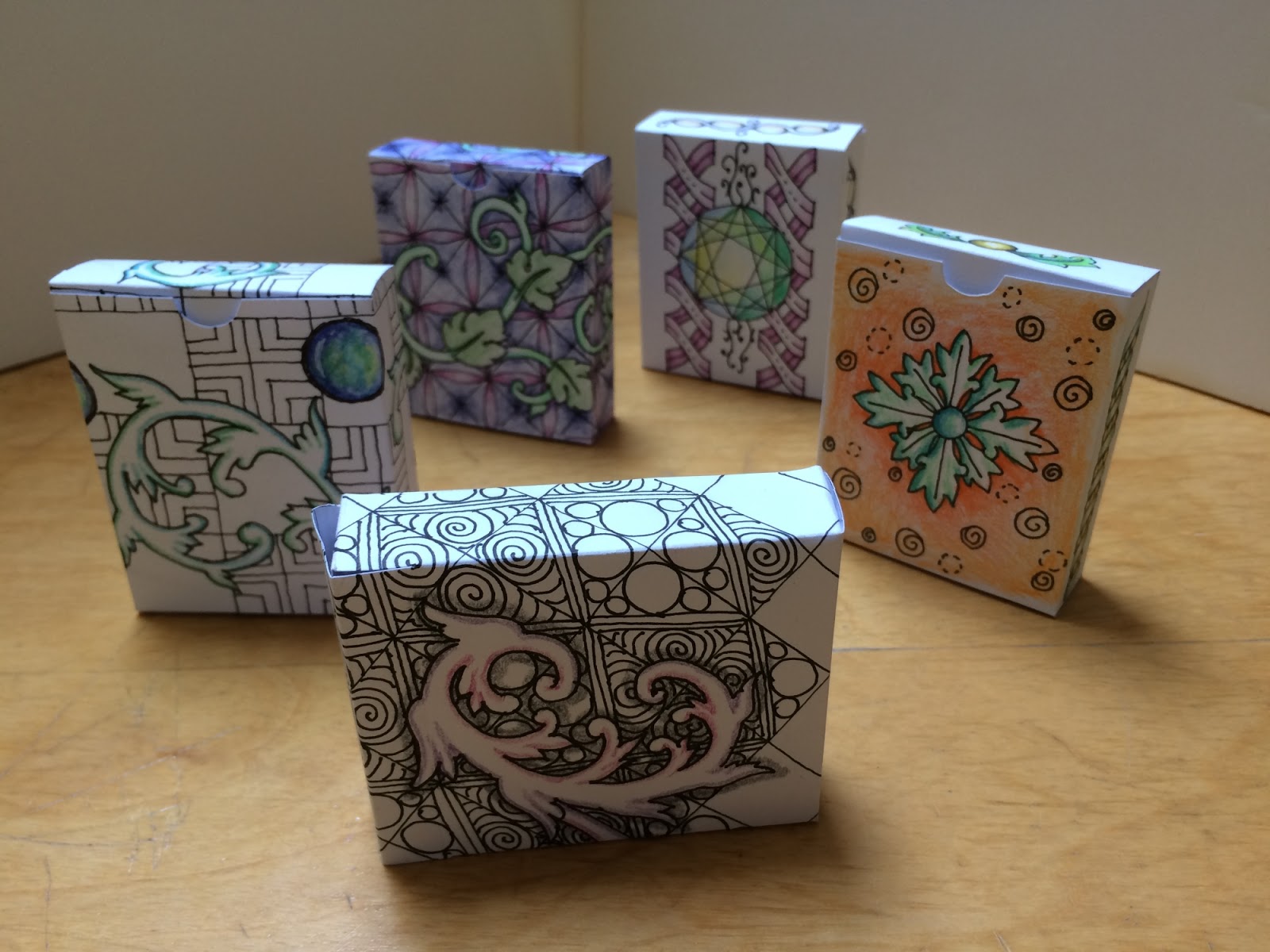
Tuck boxes for flashcards made from cardstock and decorated using Zentangle and ZIA
The earlier boxes.

I’ve discovered that you need more boxes for the later levels, as those cards accumulate while waiting to be moved up or down. Cards in level 1 get reviewed every day (if you’re being consistent about the system, which I admit I am not) and rapidly move to box 2, and fairly quickly to box 3. Cards start really piling up at level 4, which is only reviewed once a week or so.

Tuck boxes for flashcards made from cardstock and decorated using Zentangle and ZIA
Later boxes.

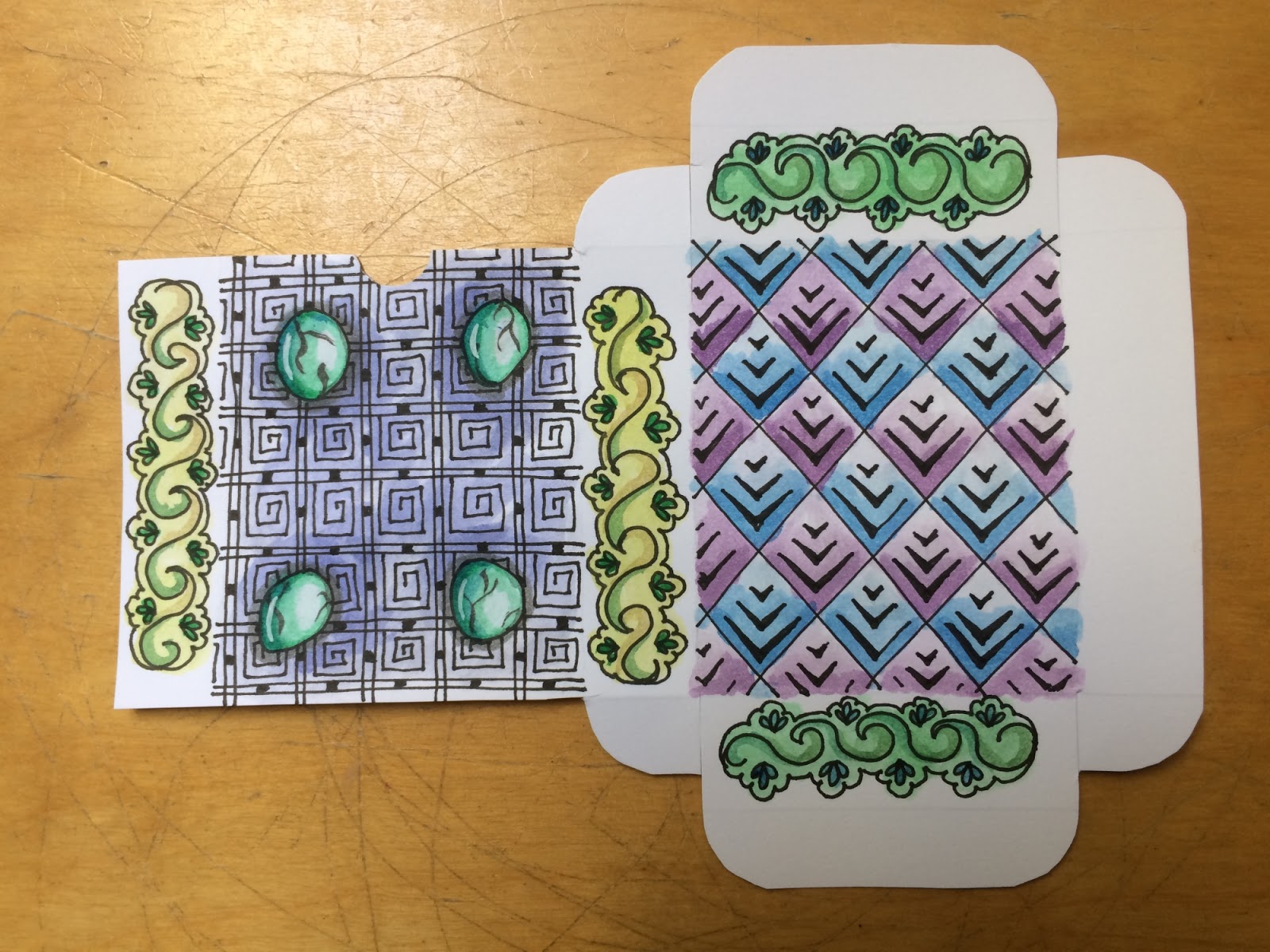
Although I’ve been using patterns from Zentangle (R), these designs are really Zentangle Inspired Art (ZIA) mixed with … whatever. I do use pencil guidelines for a number of these, especially the scrolls. I also use a lightbox so I can draw guidelines where the edges the template are on the other side of the paper. That way, I can decorate the box before I cut it out (especially helpful with watercolor.)

Decorated template of tuckbox for flashcards.
I already erased the pencil outline that shows me where the edges are.
Decorated template of tuckbox for flashcards.
A different box, cut out.

 I’ve been trying different media for coloring–Prismacolor pencils, watercolor pencils, and watercolor. One of the boxes is coated with ModPodge and glitter, which gives it an interesting feel.
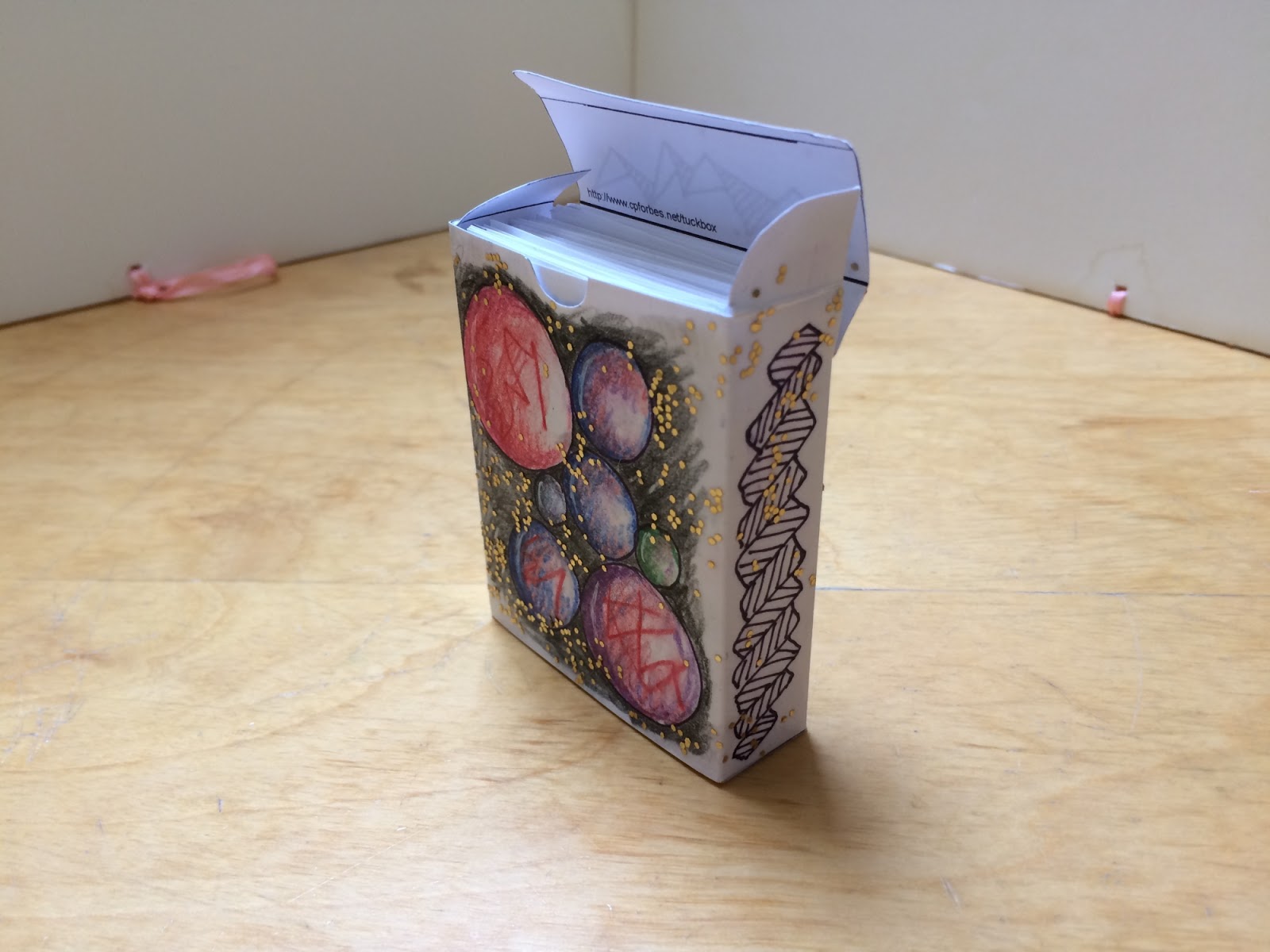
Box for flashcards decorated with ModPodge and glitter
ModPodge and glitter.

For three of the boxes, I wrote across the cardstock in calligraphy, then cut out the box. Can you identify the quotations?
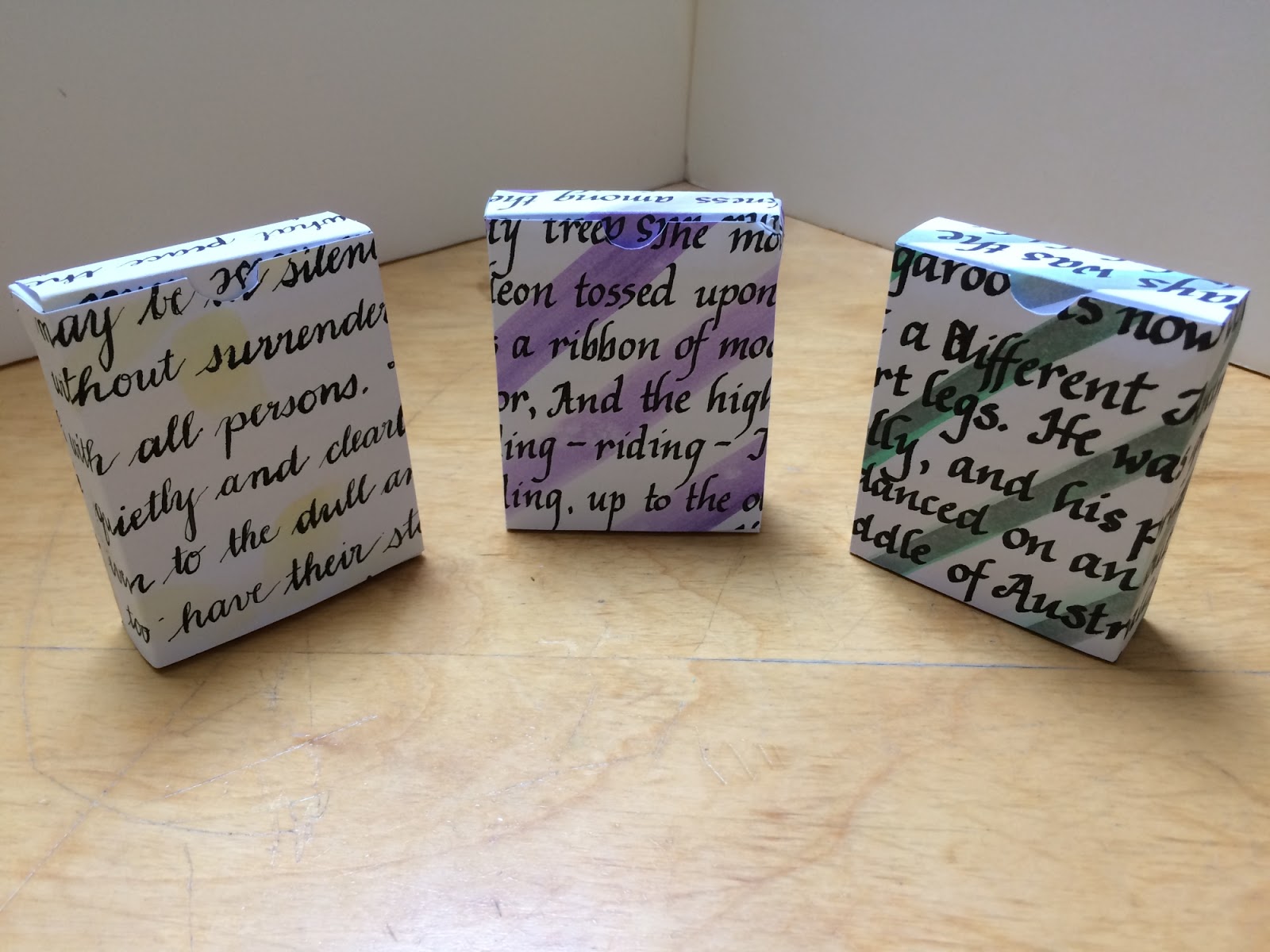
Tuckboxes for flashcards decorated with calligraphy.
Boxes with calligraphy.

The template for these boxes was generated using Craig Forbes’ tuckbox template generator. (I am having difficulty getting to the webpage now–hope that changes.) You can choose the dimensions of your box to suit the size of your flashcards. Be careful to select “actual size” when printing them, or your boxes may be unexpectedly too small.

Box (tuckbox) for flashcards decorated with tangle patterns

Happy vocabulary practice!

Playing With Ink

When I was about eight years old, my grandmother gave me a Parker 45 fountain pen and ink cartridges. I still have it and it still works, though it had to be repaired once. Since then, I have accumulated other fountain pens: some that can take cartridges of ink, and some that must be filled from bottles. So today I’m going to talk about the fun of playing with ink colors.
Ink cartridges usually come in a limited range of colors. Parker offers black, blue, red, and green. I think they once offered turquoise, but I may be misremembering. Pilot offers cartridges in black, blue-black, blue, green, red, purple, and sepia (brown), which is quite a variety.
The fun comes when you change from one color of ink cartridge to another without rinsing your pen. Your words slowly change in color as the old ink gets flushed out of the nib. (Sorry, no photo.) This is playing with ink without any mess and fun for kids. (Just remember to show them how to write with a fountain pen—gently, and holding the pen at an angle, not upright. Nib right side up, and both sides of the split in contact with the paper–don’t write with the side of the nib.)
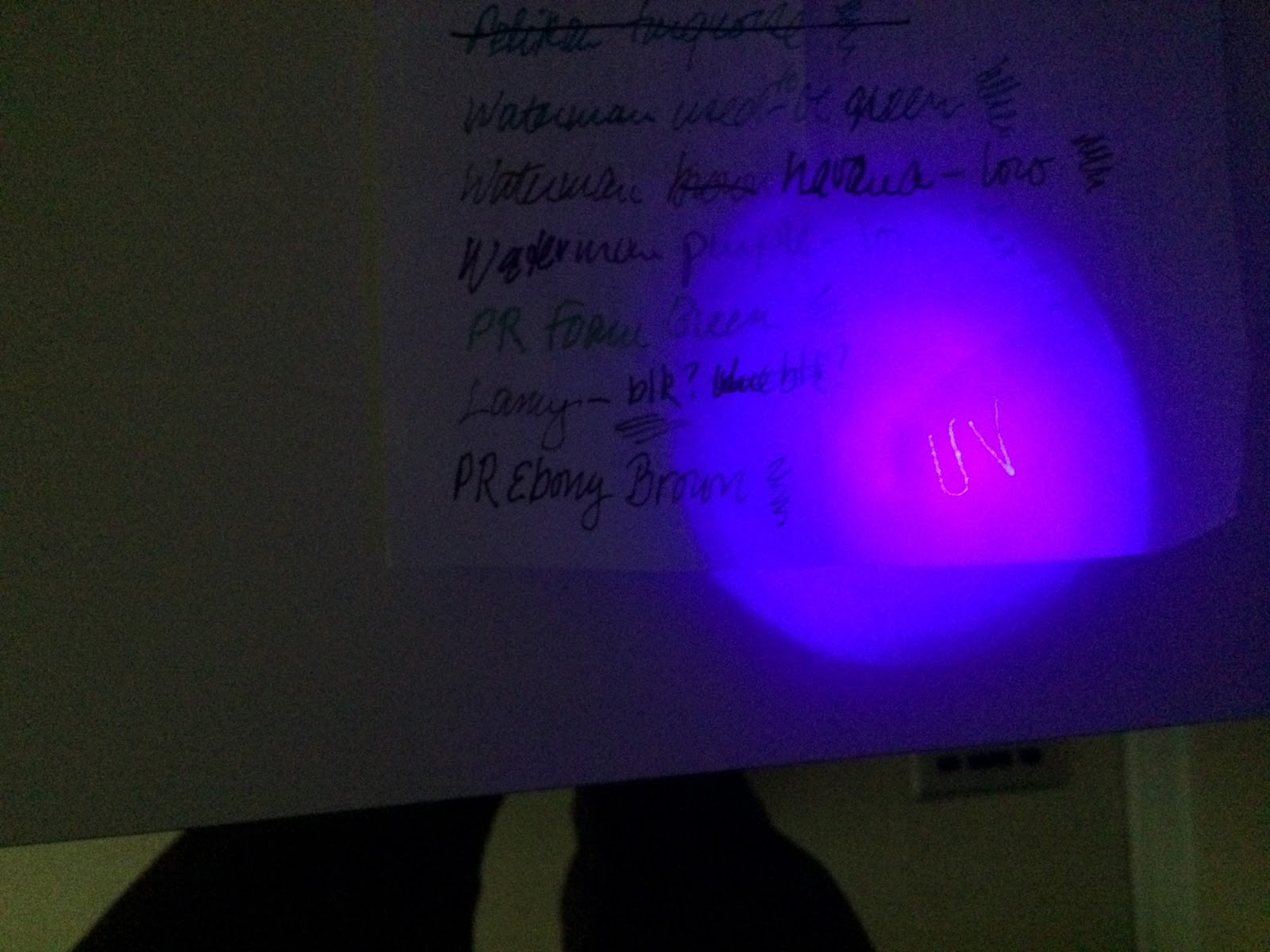
Bottled ink currently comes in an enormous variety of colors. I think most pen companies offer their own selection. Noodler’s Ink even offers an invisible ink that shows up under UV light. As far as I know, there is no need to match the brand of pen to the brand of bottled ink.
Ink bottles come in varied shapes as well as colors.
You can’t quite see it, but I tested the UV ink, too.
Here it is, with a black light shining on it.
Most of the cartridge pens can take a converter that allows them to use bottled ink. However, since you dip the pen into the bottle when refilling it, you shouldn’t go straight from one color to different one without rinsing out the pen. There’s way too much ink residue still in the pen, even if the pen has run completely dry. You don’t want to contaminate one color of ink with another. So you can’t do the same trick with bottled ink that you can with cartridges.
However, I just realized recently that writing with various dilutions of ink is also fun! I don’t know why it took me so long to try it. I started writing with a pen that had held violet ink and which I was trying to rinse clean. I had filled it for the umpteenth time with distilled water and it was still writing violet—but pale violet. (I think I needed to take the converter out and rinse the nib thoroughly.)
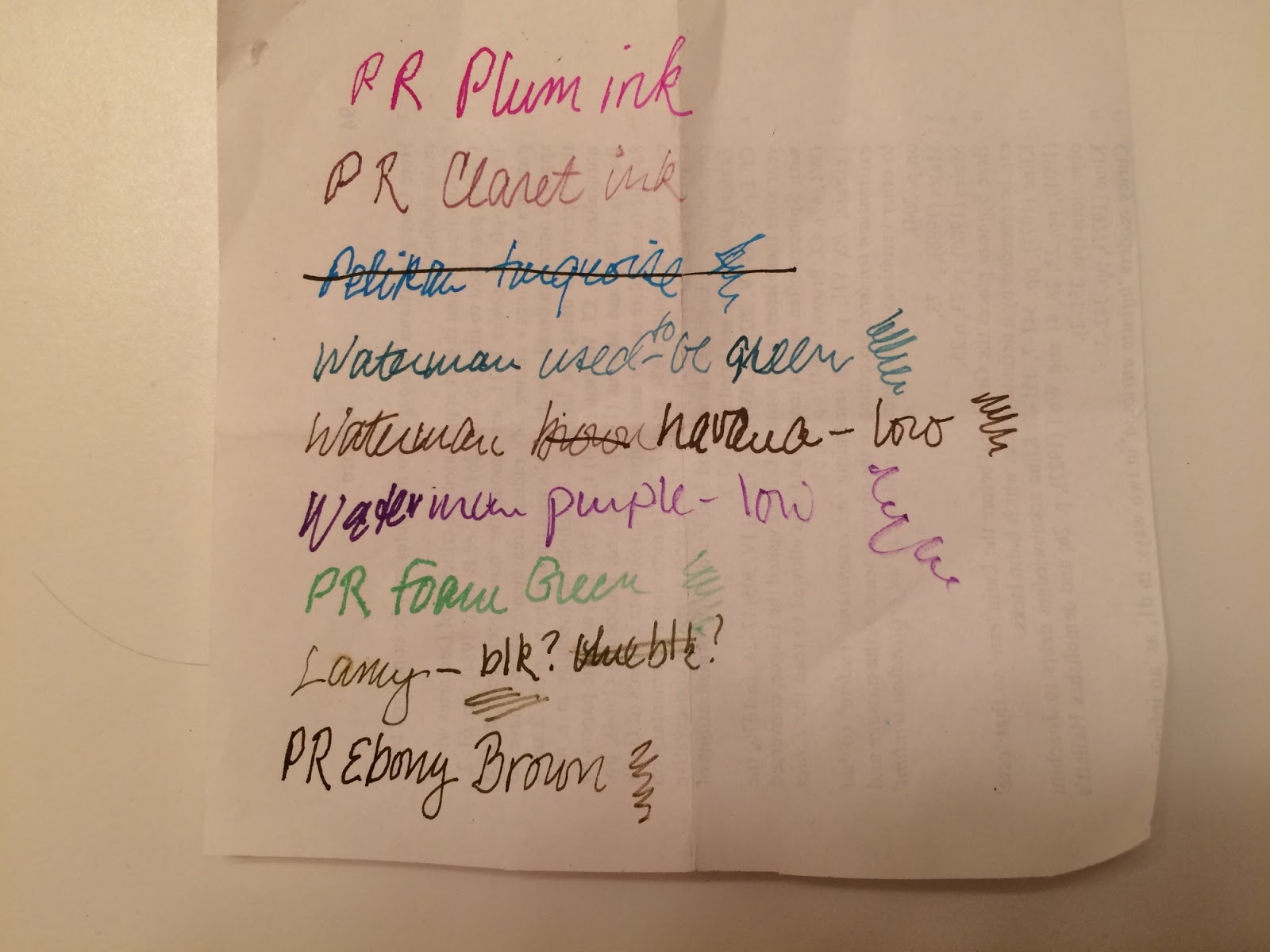
Testing various inks and pens.
Inks can do strange things when diluted, especially black ink. Probably you’ve seen the result of black marker on paper towel getting wet and spreading out in different colors that you didn’t realize were in there. For this post, I took two pens that I thought had been filled with black ink and refilled them with distilled water. Strangely, one started producing yellowish writing for a while, then darkened to a dilute black. The other behaved oddly (I should have taken a photo of the paper towel I was wiping it on), then settled down to a bluish black. Turns out I don’t even have a bottle of black ink. I must have filled one with Ebony-brown and the other with Blue-black.
I should also add that ink that has been diluted with water isn’t going to behave quite the same way as undiluted ink. I don’t know what other ingredients go into ink, but I am aware that there is more than just water in there. Probably there are ingredients that thicken it slightly, or help it flow or help it dry quickly… I don’t know.
Some people take playing with ink to higher levels. Some people mix ink colors and then fill their pens with them.  Other people refill cartridges from a bottle using a syringe. 
Maybe someday I will be one of those people. For now, I’m having enough fun swapping out cartridges to watch the color change, and writing with diluted ink en route to switching colors of bottled ink.
Till next post.

Pottery, Paper, and Post–letters from the past and present

Recently, I’ve been watching some video lecture series from Great Courses—one on ancient Mesopotamia (“Ancient Mesopotamia: Life in the Cradle of Civilization”) and one on ancient North America (“Ancient Civilizations of North America.”) Between the two of them, I’ve been wondering: if our current civilization were completely wiped out (without wiping out humanity), what would remain for future archaeologists to interpret?
You see, I am struck by the importance of pottery in these archaeological finds. In the North American case, pottery was something that endured (along with stone tools) and which could depict activities and important symbols of the time, in the absence of the written word. In the case of Mesopotamia, pottery was also the medium for the written word itself—cuneiform on clay tablets.
The interesting result of this is that quite a lot of very ordinary writing done in ancient Mesopotamia got preserved when clay tablets and clay seals on items got caught in fires and were… fired. A lot of these tablets recorded inventories, transactions, and contracts, but sometimes letters were also preserved. A particularly interesting lecture discussed king Zimri-lim of Mari, his queen Shiptu, and his various daughters, some of whose correspondence was preserved when the palace at Mari was burned down.
As I understand it, the letters between Zimri-lim and Shiptu concerned the management of the kingdom while he was away fighting, and requests that she consult the gods (via the priests) on various questions. Letters from his daughters, whose marriages were arranged for political reasons, included news from their region and sometimes requests. Two daughters told him how unhappy they were, how badly treated, and pleaded for help. Apparently at least one attempt to help was made and failed.
Nearly four thousand years later, I’m feeling sorry for the two daughters. I only know of them because their letters happened to be preserved.
More recent “old” correspondence is preserved on paper. Paper is a lot more perishable than baked clay, but much lighter and more space-efficient, not to mention easy to write on. From letters, we get a window into the lives of many famous people of the less-distant past–those who wrote the letters, and those mentioned in the letters. A nice book about this is For the Love of Letters, by John O’Connell.
A lot of today’s correspondence is via email, which is much easier to “send”, takes up almost no space, and is simultaneously potentially eternal and yet entirely perishable. It is potentially eternal in that it lasts so long as the encoded information remains encoded in some medium somewhere. There is no original to be preserved. Yet it is entirely perishable in that the data must be stored somewhere, and machines and media can degrade. Also, formats for files keep changing, so either the format must be updated as necessary or the old software must be maintained.
So if civilization as we currently know it were destroyed? The computers would no longer have power. Eventually, their parts would corrode. Even if future archaeologists could build a suitable device to read the old hard drives, the data would probably no longer be readable.
Some paper correspondence might last longer, if protected from moisture and pests in a vault. I assume paper would become exceedingly delicate over time, just as textiles in well-preserved ancient sites are delicate, and most of it would eventually decay.
And then there’s pottery. We think of pottery as fragile, so we make more use of other materials. Wood, metal, and plastic tend to be less breakable, and are usually lighter in weight as well. And yet… pottery endures. It doesn’t rot, it doesn’t rust, and it doesn’t degrade in strange and somewhat unpredictable ways as old plastics (which are less than a century old!) are now doing.
We don’t use pottery for many purposes, outside of the kitchen and the garden. So maybe those future archaeologists would conclude that our most important everyday thoughts were of  “Home Sweet Home”, “World’s Best Dad”, and “Flour,” “Sugar,” and “Tea.”
Till next post.