The Diva’s Challenge #373 and Diversifying One’s Hobbies


This week, the Diva challenged everyone to draw a tangle using their non-dominant hand. This was, admittedly, a bit frustrating. It’s so much easier to control a pen with my usual hand. The results are a lot better, too.
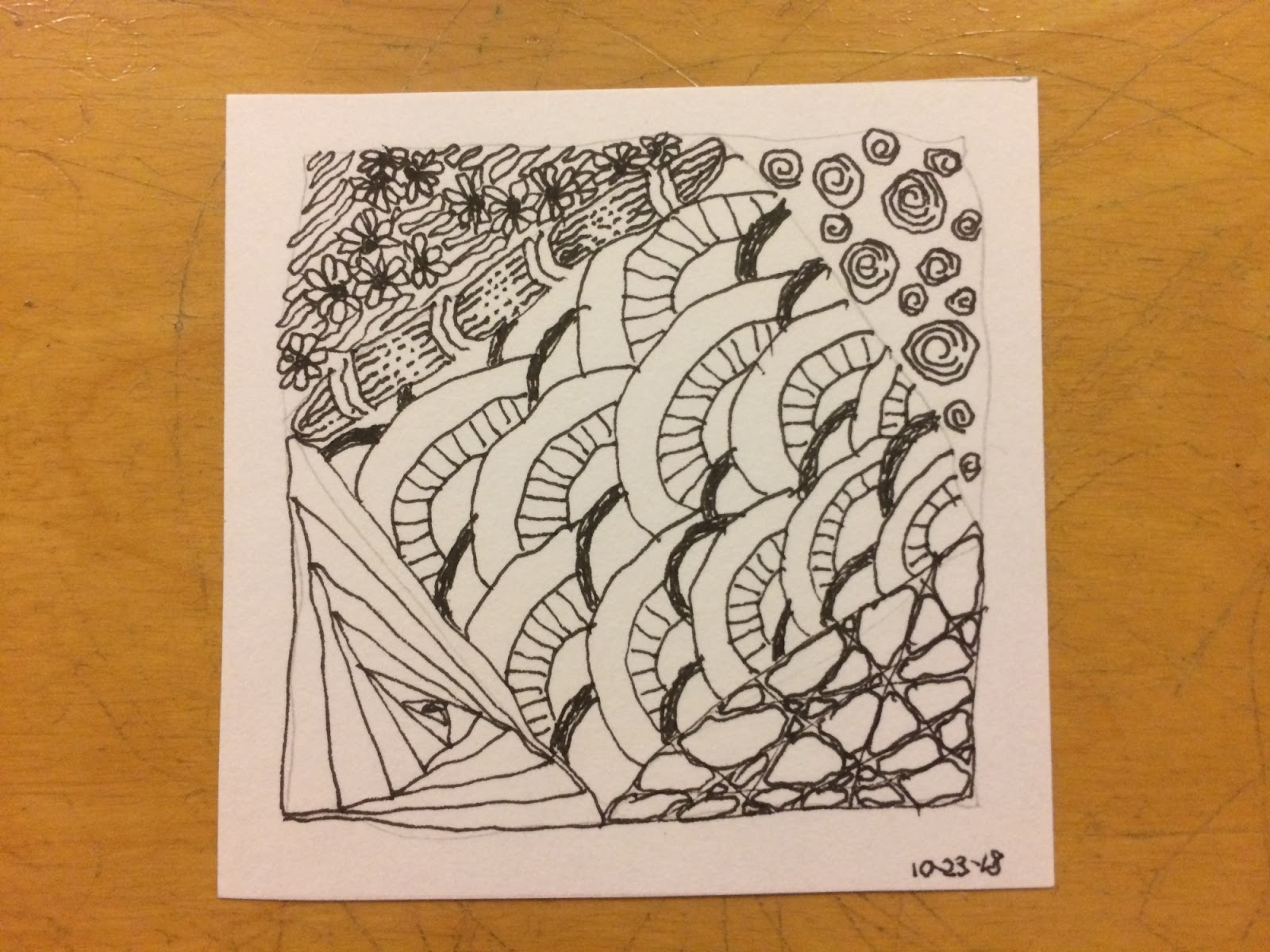
A Zentangle Diva's Challenge #373 done with non-dominant hand
The Diva’s Challenge #373
On the other hand, it reminded me of something that’s been on my mind off and on for several years. We don’t know what the future holds for us. More specifically, we don’t know what capacities we may lose as time goes by.
What if I lost the use of my right (dominant) hand? I would haveto use the other hand to draw. It’s good to know that I can manage some sort of drawing with my left, if I have to. But it would be very distressing, nonetheless, as so many of my hobbies involve work with my hands.
Most of my hobbies also involve my eyes. So I ask myself, if I couldn’t see very well, what would I do for entertainment? I like music, but it isn’t a big part of my life. I could still listen to books, thankfully, though I find listening to books slow and rather frustrating since I can’t flip back easily to check earlier details. (This is especially awkward for mysteries.) I could still go for walks and I could still enjoy gardening to some degree, since I’ve always been interested as much in the scents of plants as in their appearance.
Other people have different hobbies that require different capacities. For people who love to go hiking or rafting, being unable to use their arms or legs well would take away a source of joy. Other people would hate to lose music. And for people who love to cook, losing their sense of taste would also mean losing a favorite activity—how can you enjoy cooking a new recipe if you can’t taste it?
My point is that I would be wise to cultivate some hobbies that don’t use exactly the same capacities that most of my other hobbies do. Maybe I should cultivate more large-motor activities, in case my fine-motor skills deteriorate some day. Maybe I should take more of an interest in music, or in conversation, in case my eyes give me trouble.
There is also the possibility that some day my cognitive skills will deteriorate (may that day be FAR away.) I will still have time to fill. Perhaps, in that case, familiar, simple tasks would be soothing.
What might these be? Knitting an endless scarf in garter stitch? Doing simple jigsaw puzzles? Peeling potatoes, maybe, as I remember Grandpere doing when he was no longer capable of cooking on his own? It seemed to me that he felt better when he was contributing in some way. Perhaps I should find out what activities people can generally manage in this situation and cultivate some of them. You can’t peel potatoes automatically if you haven’t peeled a whole lot of potatoes beforehand with attention.
Someone whose name I can’t remember came up with a chart that categorized activities as high- or low-energy, and high or low in sociability. His point (I think it was a he) was that people should cultivate some activities that fall into each of these four groups. Sometimes people’s energy levels will be low, in which case reading (low sociability) and doing jigsaw puzzles with other people (high sociability) might be good options. Or their energy levels might be fine, but there aren’t a lot of people to do things with, so they need some activities they can do by themselves, like going for a walk.
The recommendation was aimed at older people, but when you think about it, it’s a good idea at any age. I’m suggesting here that it just doesn’t go far enough.
Till next post.

"The Poisoner's Handbook" and Reading About Real Evil

Recently I read The Poisoner’s Handbook: Murder and the Birth of Forensic Medicine in Jazz Age New York, by Deborah Blum. I was originally looking for information on poisons for a possible new mystery novel, but got caught up in the stories of poisonings, both accidental and deliberate, and the development of techniques for detecting them—not to mention the story of Prohibition in New York, and the politics that was inevitably involved along the way.
It was a very good book, but there was nonetheless something sort of creepy about reading an interesting story about a poisoning and remembering, suddenly, this really happened. Mary Frances Creighton really did kill first her brother, then a friend, with arsenic. A group of three people really did take out insurance on an old drunk, and then kill him with carbon monoxide after several attempts to kill him in other ways failed. Some people—too many—really are capable of doing evil things.
This brought to mind an incident from years ago, in college. Our class had been assigned a reading on pornography by someone whose name I have now forgotten. She described in impassioned terms some incredibly degrading images and corresponding attitudes toward women. Seriously, to say that these people were treating women as objects fails to recognize how much more carefully and gently we treat most of our inanimate possessions. It was extreme.
A number of us were sitting on the steps outside, waiting for class. One young woman started talking about the article, basically saying that it had seemed kind of over-the-top to her. “Who really thinks like that? None of the men I know,” she said.
An older student in the class, a soft-spoken man in his late twenties or thirties, heard her. “I’ve known men like that,” he told her. “They’re out there. Believe me.” I think everyone went quiet for a while after that.
So now I’m thinking maybe I should read about people who do horrible things, if only to remind myself that some people are capable of knowingly and willingly inflicting terrible suffering on others.  I do read about terrible things in the newspaper, but there’s a difference between reading about, say, dictators, who deal in evil on a scale that’s hard to comprehend (and often dealt out through intermediaries), and reading about quite ordinary individuals carrying out quite specific and describable crimes.
I’ve been lucky enough not to have had to deal with anyone really evil. Even people who are merely very unpleasant have generally been on the fringes of my life, not a daily part of it. As a result, perhaps, I tend to look for a charitable explanation for people’s actions.  
Often this is a good thing. But as the cases in The Poisoner’s Handbook show, sometimes there’s no room to wonder whether a person’s intentions were misunderstood or their actions excusable. Killing someone for insurance money makes one’s attitude toward other people quite clear. Sometimes, people really are just that bad.
It’s something to keep in mind.
Till next post.

Arguing About Gun Control—conflicting intuitions and the need for good research

Between the shooting at the concert in Las Vegas and the Parkland school shooting, people have had compelling reasons to talk about gun violence and how we should respond to it. We all have an interest in our own safety and the safety of our kids. And yet, people still come to drastically different conclusions about how to approach this.

One group of people finds it intuitively obvious that making it harder for people to get their hands on guns, especially guns that can be fired many times without reloading, will reduce deaths in school shootings. If the shooter has to keep stopping to reload, he won’t be able to shoot as many people before someone stops him.

Another group finds it intuitively obvious that having more armed adults at schools will reduce deaths in school shootings because it takes someone with a gun to stop someone with a gun. Having armed personnel on hand will mean shooters are stopped faster, before they can kill a lot of people. Therefore, they think, we should make it easier for teachers and staff to bring guns to school.

The first group, on the other hand, thinks that it is intuitively obvious that having a lot of guns and a lot of kids in the same building is a recipe for disaster.

The problem with intuition is that what seems blindingly obvious sometimes isn’t. This is well known to people involved in medicine and is the reason that new treatments have to prove themselves in trials, no matter how plausible they seem. So in making decisions about gun policies, one thing we desperately need is good research on guns and safety. The RAND Corporation recently published a review of available studies on the effects of gun policies, and one of their conclusions is that there are big gaps in the research available. They also noted that changes in the way information is collected could be tremendously useful.

I would hope good research would also try to control for different circumstances. For instance, when it comes to guns and self-defense, does it matter where you live? Whether law enforcement is five minutes away or an hour? Whether there are large predators in your area? What about your domestic situation?

I’m not saying that better research will end the arguments over gun policies. There will be conflicts of interpretation. There will probably also be some trade-offs to be argued about–personal freedom versus public safety. However, better research would give people something more concrete to argue about and something to test their intuitions against. That’s worth funding.

I have one more thing to add. When I showed the draft of this post to my husband, I said that I thought the most important part of it was the link to the RAND report. He said he doubted it made any difference–that most people have already made up their minds and won’t consider research except insofar as it supports what they already believe. Please, people, prove him wrong. When you read about research results, consider them with an open (but critical!!) mind. Consider the source, the reasoning, and who, if anyone, has reviewed it. Don’t judge it by whether it matches your “intuition”.

Till next post.