Sewing, Knitting, and (Un)happiness


This week I’ve been sewing myself a pair of pants. Loose-fitting, double-pleated pants in emerald green, feather-weight corduroy.

It is a fact about sewing (and pretty much any other craft) that I cannot complete a project without mishap. I only use one pattern for pants, but I always seem to be making some minor change—trying to deal with their distressing tendency to split in the seat, or else fiddling with the waistline yet again to keep it current with my own.
Even when I don’t run into trouble with the changes I’m making, there’s usually a piece that gets sewn wrong-side out, or a seam that extends where it should not. Or something completely different—this time I spent over half an hour searching for my seam ripper, which eventually turned up under a sofa cushion. It’s frustrating.
So why am I sewing pants instead of buying them? Granted, stores don’t carry pants that meet all my criteria. (Double-pleats, loose-fitting, not too tight at the waist but not too loose in the seat, soft fabric, useful pockets…) Still, I could probably pay a sewing pro to stitch up a pair to my specifications. I could even get them to finish the seams properly, which I haven’t done for this pair.
Maybe it’s the same as my reason for trying to make French bread. It’s the challenge of the thing.
That’s probably part of it, but I don’t think the situation is quite parallel. At any rate, while thinking about this, two other things kept coming to mind. The first is a comment that my husband made. It echoes something in a book by Stephanie Pearl McPhee, the Yarn Harlot. If I could remember which book, I would quote it, since she puts things so wonderfully. But I can’t, so I’ll have to approximate.
Knitting projects, like sewing projects, often go awry. Knitters end up ripping out mistakes and having to re-knit chunks of their project. Other times, they discover that the size small sweater has somehow turned out to be a giant’s size small. And so forth. Unless the knitter is restrained and keeps her frustrations to herself, at some point her spouse may inquire, “Do you really enjoy knitting?”
It’s a reasonable question, given the amount of grumbling.
And the answer is, “Yes, I really do enjoy knitting.” Even if this blasted hat won’t go around my head…. Grumble grumble.
It’s easy to see how sewing projects and knitting projects are connected. Less clear is why I kept thinking of a section from a book I had recently looked at, The Pursuit of Unhappiness: The Elusive Psychology of Well-Being, by Daniel M. Haybron. The part that struck me actually comes right near the beginning of the book. First, the author comments on an experience that led him to the topic of the book. He used to spend summers on a small fishing island as a child, and remembers it as being a very different world, a good place to be, “the only place I’ve ever felt like a fully developed human being.” Later, he compares two hypothetical societies, A and B, and describes them like this:
“Consider then, two communities, A and B. A typical member of A, on a typical day, is in more or less the following condition: at ease, untroubled, slow to anger, quick to laugh, fulfilled, in an expansive and self-assured mood, curious and attentive, alert and in good spirits, and fully at home in her body, with a relaxed, confident posture. A denizen of B, by contrast, is liable to be: stressed, anxious, tense, irritable, worried, weary, distracted and self-absorbed, uneasy, awkward and insecure, spiritually deflated, pinched and compressed. The differences, let us suppose, owe mainly to difference in the prevailing ways of life in these communities.”
A bit later he says,
“Notice that the descriptions of A and B made no explicit reference to happiness or unhappiness. But it should be reasonably apparent that, nonetheless, happiness is precisely what they were about: what A has in its favor is that its residents tend to be happy, whereas the people of B tend not to be.”
What has this got to do with my experience sewing pants? I’ve just said that sewing includes a significant amount of time spent fussily trying to adjust the pattern and then discovering that I’ve messed up and must rip out some seams, all of which tends to produce frustration and anger. The author’s description of society A involves people feeling good in various ways, while it is society B that is described as habitually tense and frustrated.
But then I thought about the origin of his example—the island community that he described and the hard work of its inhabitants—and the fact that they undoubtedly had moments of similar frustration in making things work, but also presumably moments of great satisfaction with their work and its results. I thought about the fact that I genuinely do enjoy sewing, and what that means, and I’ve come up with two possible connections:
1.  Enjoyable activities don’t always look enjoyable.
2.  “Difficult” doesn’t equal “not happy-making.”
I’m stuck for a conclusion here. It seems trite to conclude simply that worthwhile activities involve some work, some parts that aren’t fun—but isn’t that what I’m saying? Or is there something more?
Maybe if I reread the book, which I don’t remember very well, I’ll have more to say. Meanwhile, I’ve got a nice new pair of pants.
Even if they do make me look nine weeks early for St Patrick’s Day.
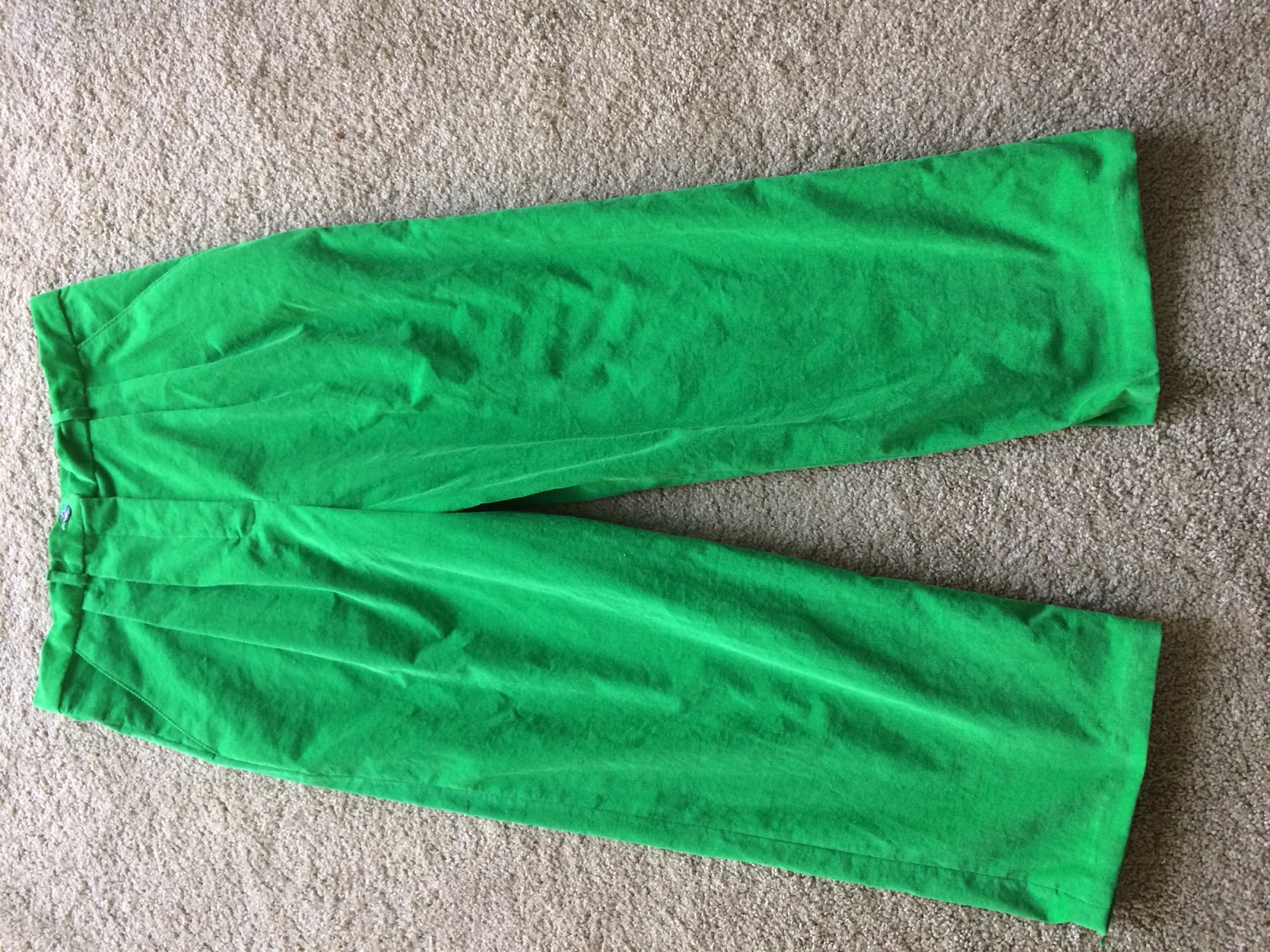
green corduroy pants with two pleats sewn at home
Add caption

Till next post.

Everyone Should Have a Party Trick


In The Breakfast Club, Molly Ringwald’s character, Claire, is asked what she can do. All the other kids in detention have started making claims about what they can do—one says she can write with her feet, another that he can make spaghetti. Claire says she can’t do anything, and someone replies that everybody can do something. So she reluctantly—but still with some pride—demonstrates her ability to apply lipstick (messily) without using her hands.
We should all have some sort of trick that we can show off on such occasions. Some people have actual magic tricks—you may have run into someone who can pull a quarter from your ear, then make the coin disappear and reappear again elsewhere.  That’s impressive. It’s especially good for astounding visiting children.
Other people can casually take up three clementines and start juggling them. I’ve noticed that people are impressed by even a very limited ability to juggle (unless they themselves can juggle, of course.) Juggling is also contagious—once someone juggles something, everyone starts trying to juggle. This can be dangerous if the objects used are breakable or messy, but clementines are pretty sturdy.
There are people who can square off discarded candy wrappers and fold them into beautiful cranes. Instead of a piece of trash, you have a decoration. Part of what makes it special, though, is watching the transformation.
Being able to play an instrument can be a party trick when the instrument is there in your pocket. My father-in-law is known for pulling out his harmonica on any occasion and playing a suitable tune.
Not all party tricks require props. My husband can pretend to inflate his hand. He blows “into” the thumb, the hand slowly opens up, he pinches the thumb “closed”—then he lets go and his hand goes hissing and spinning crazily about as it “deflates”. I’ve seen it many times and I’m still amused.
Reciting a poem is, or should be, a party trick as well. I think the most effective poems for this purpose are those that tell a story, such as “The Raven” by Edgar Allen Poe, or “The Highwayman” by Alfred Noyes. So I recommend memorizing one long poem to have on hand when you need it. I started memorizing “The Raven,” but didn’t get beyond the first couple of stanzas. I also only know about half of “The Singsong of Old Man Kangaroo” by Rudyard Kipling (perhaps not technically a poem, but it recites like one.) I still remember parts of “The Tale of Custard the Dragon” by Ogden Nash, which I had to memorize in sixth grade.
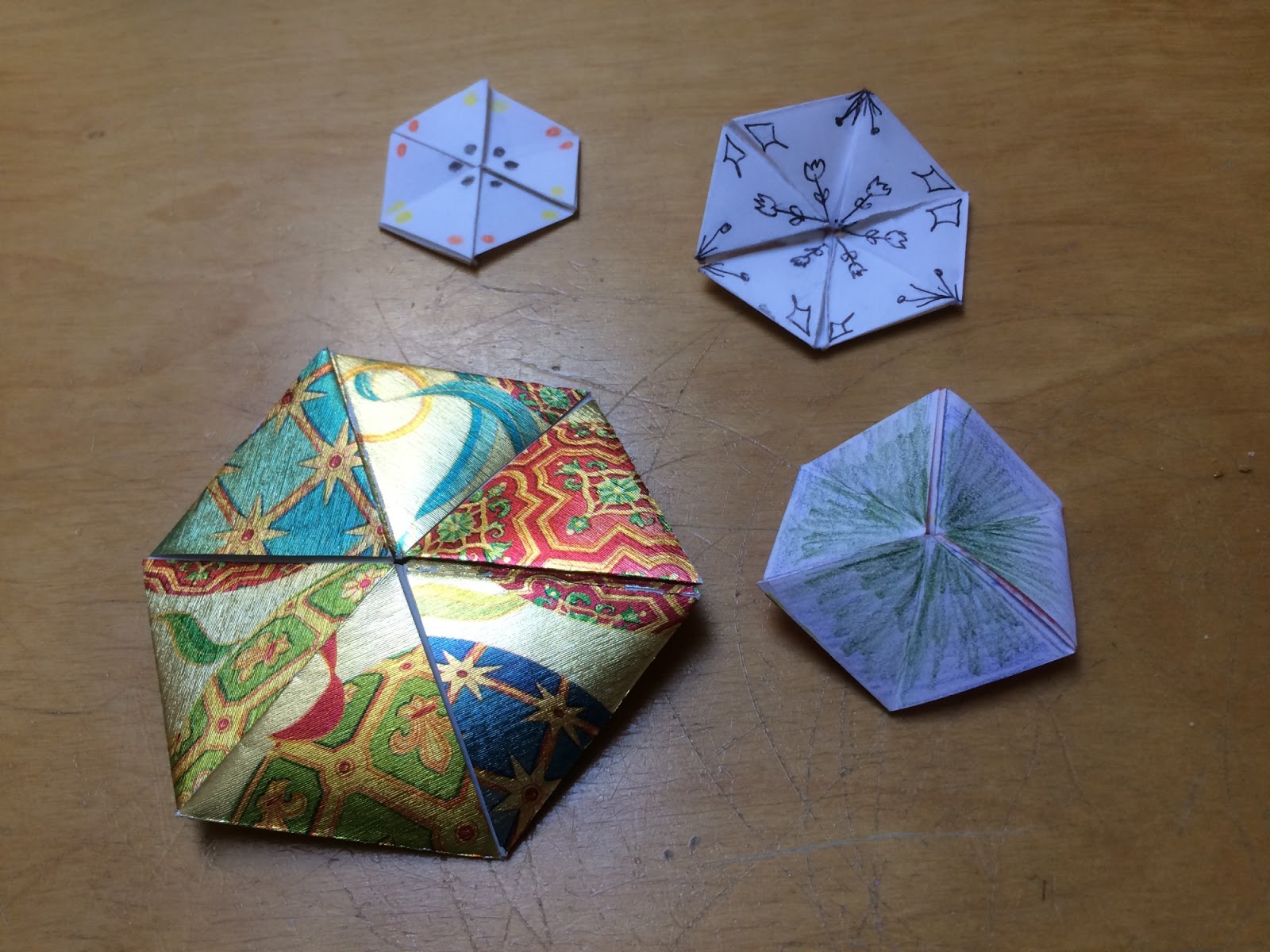
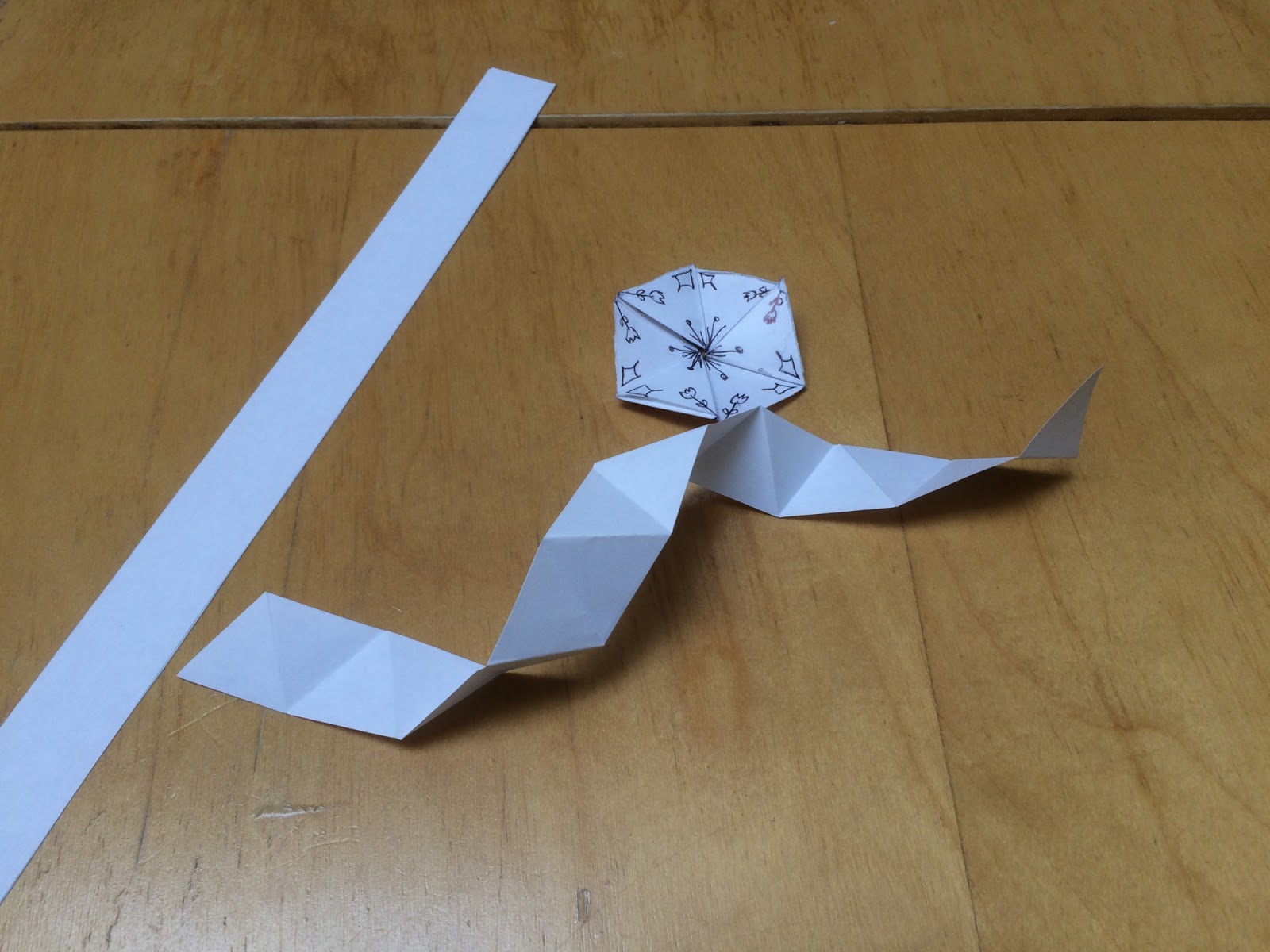
What brought all this to mind was my daughter’s showing me a hexahexaflexagon that a friend of hers had made. She was trying to remember how to fold one from a strip of paper. The first problem was how to get a series of equilateral triangles—she was sure there was a trick to it, and she was right. When she consulted her friend, she found out that she needed to fold the paper strip at an angle, trying to match edges in the same sort of way one folds a letter into thirds.
Having learned all this, she pointed me to a good (and entertaining) Youtube video. (I had been vainly trying to fold an equilateral triangle.) I was able to make my own hexahexaflexagon, and it occurred to me that this is a good party trick of the sort I mentioned earlier. It’s a bit like making a paper crane, but instead of leaving your audience (victim?) with a decorative sculpture, you leaving them madly flexing a hexagon, trying to find all the sides and looking baffled when a new one pops up after they thought they had found them all.
Hexahexaflexagons, one made of shiny wrapping paper
Hexahexaflexagons, one made from wrapping paper.
So there’s my early New Year’s recommendation—figure out what your party trick is, and if necessary, refresh your memory of it. Clearly I need to do so, since my cranes have been coming out deformed, my poems incomplete, and after a year of “frozen shoulder”, I’m out of practice at even the most limited juggling. Maybe I should get into hexahexaflexagons instead…
strip of paper folded ready for making a hexahexaflexagon
Hexahexaflexagon in process
Till next post.
P.S. The same friend who showed her the hexahexaflexagon also gave her a photocopy of a chapter from a book detailing the history of hexaflexagons and some of their properties. The most important bits are also revealed in the Youtube video series of hexaflexagons by Vihart, esp. “Hexaflexagons 2” which I HIGHLY recommend to anyone who wants to create one, and even those who don’t.

On Communicating With the Government–I ponder different methods as I write to the FCC


This week there was considerable fuss, first about the FCC’s proposal to repeal the net neutrality rules, and then about the emails they received in response—in particular, those emails that appeared to have false or temporary addresses or to have originated from Russia. This started me thinking about our communications with our government more generally. Since we are usually communicating with our legislators about bills (rather than sending comments to the FCC), I’m just going to talk about that.
The point of communicating with your congressperson is to influence his/her decisions and change his/her behavior. There are three ways a communication (letter/email/call/visit) could do this.
(1) The content of the communication could be reasons for or against the bill in question.
(2) People’s communications could arrive in such profusion that it causes chaos and makes it impossible for the legislator to ignore the fact that people are concerned about the bill, and maybe also impossible to conduct the rest of his/her business.
(3) The communications could give evidence of grassroots opinions—that many people are very concerned about the bill.
The first possibility, that the communications will give the legislator reasons to change his/her mind, seems fairly unlikely. Probably by that point, he/she has already heard most of the reasons given by both sides, has made up his/her mind to some degree, and isn’t likely to even see, let alone be influenced by, any single communication. (Other people are opening the mail and answering the phone anyway, especially if the legislator is getting tons of mail and phone calls.) Still, that doesn’t mean the communication doesn’t need to offer any reasons. If nothing else, it will give the office workers who tally people’s positions a general sense of people’s reasons.
The second possibility, that the sheer volume of communications is what matters, suggests that politics is a matter of beating your legislator into submission, which is a pretty cynical view of things, though maybe with a grain of truth to it. Maybe we want the letters to be disruptive enough to get the legislator’s attention, but surely not so much that it prevents him/her from doing other useful things, or thinking about other forthcoming bills. Otherwise legislators won’t be able to do anything most of the time, and why would we want that?
The third possibility seems the strongest. If lots of people hold a particular opinion on a bill and hold it very strongly, then not only should the legislator, as representative, be concerned about representing their view, but the legislator’s vote on the bill could have an effect on his/her chances of re-election. And that’s a powerful motivator.
How much is his/her vote on the bill likely to affect his/her re-election? Well, how many people are for it, and how strongly do they feel? Both matter. If lots of people support the bill but only lukewarmly, the legislator could probably get away with voting against it. If only a few people support it, it doesn’t matter how much they care, they still only have a few votes to give.
So what kind of evidence do the various forms of communication give of these things? Long ago, when I was an intern in Congressman Whitehurst’s office*, I was given the relatively unimportant job of looking up the addresses of people who had signed their names to form postcards. Form postcards were, I think, supplied by political organizations and probably dropped off by them as well—I don’t think the individuals who signed the cards had to actually mail the cards themselves. But they did have to sign their names and maybe give their town. I was to look up the full addresses so the office could send them a form letter in response.
Remember, this was before most people had personal computers, and well before there was a world wide web. No cutting and pasting letters (except in the very literal sense) and no email. So there were form postcards, regular letters, phone calls (long distance was still expensive), and personal visits. Form postcards were the least important, because they took the least effort and expense on the part of the sender.
Now emails make communicating with your legislator easier, but as this week’s kerfuffle makes clear, there is the problem of knowing whether the email represents a particular individual, or if it has been sent by a bot, or if one individual or sneaky organization has sent many emails, and whether the sender is even an American and eligible to vote.
On top of that, emails can be sent with very little effort, especially if they are pre-written and addressed by an organization, so that the individual has only to enter his or her email address and click a button. So the emails don’t do a good job of showing just how much the sender cares about the issue. Is this a make-it or break-it issue for them, or just one among many concerns?
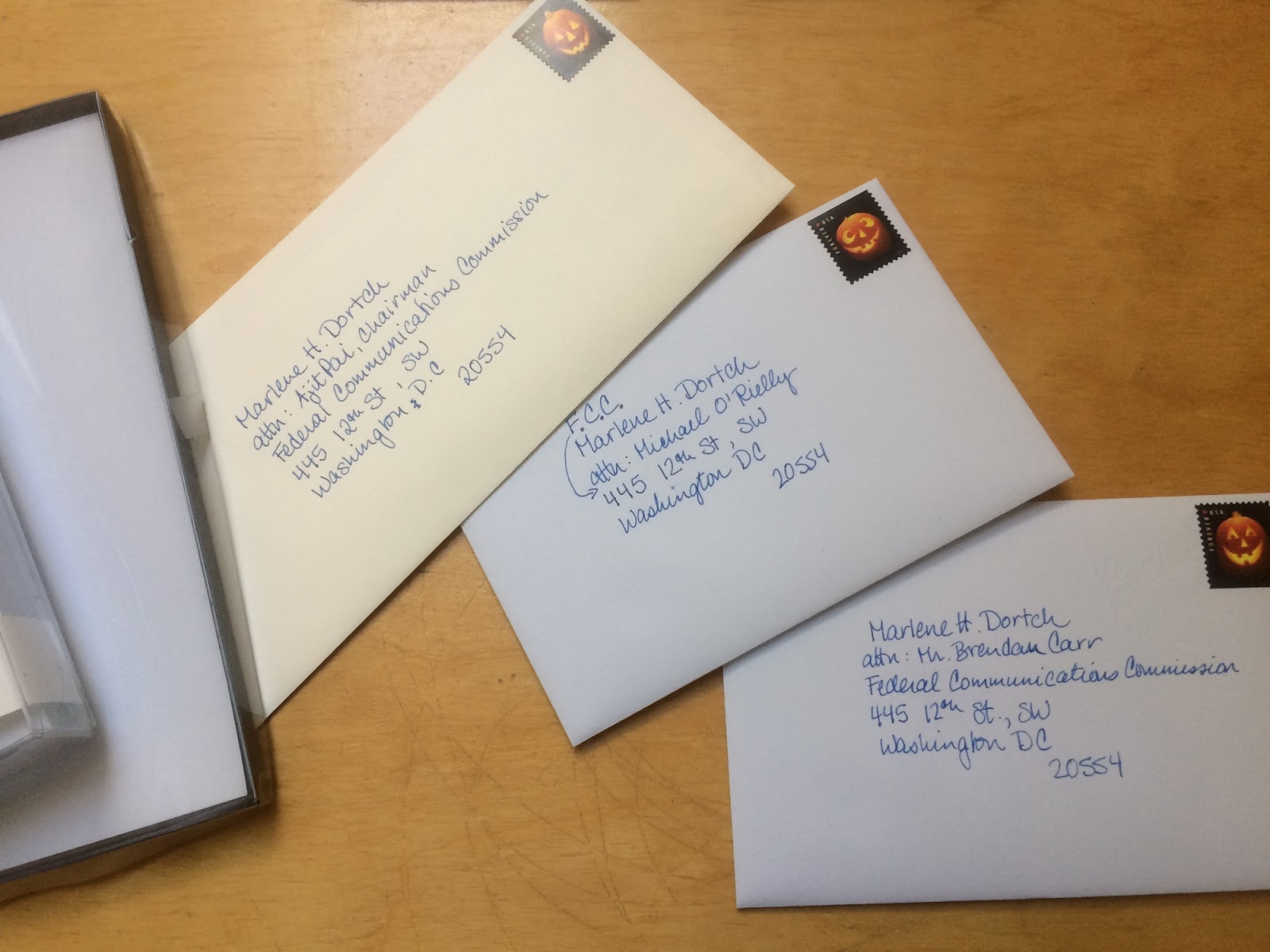
So I’m sending the FCC chairman and commissioners hand-written letters that will arrive with my local postmark on them. I doubt hand-written letters are a solution long-term. If people take to writing their letters by hand, some sneaky group may find a way to fake them. On the other hand, it costs 49 cents apiece to mail them, so maybe no organization will find it worth the money.
Hand addressed envelopes to commissioners of the FCC
On reflection, I should have sent a single letter to the FCC in general.
Till next post.
*I was politically apathetic in high school, but we were required to intern in a congressional office junior year. I had no idea where to start, so I took the suggestion of the program director and asked to intern in G. William Whitehurst’s office. They were lovely people, but I don’t remember ever actually trying to find out what their positions on any issues were. I’m not sure what most of the issues of the day even were, other than nuclear arms policies. I find it funny now, to think that I, who even then counted myself at least vaguely a Democrat, did my internship in a Republican’s office. I really had no idea what I was about. Fortunately, they were very patient.