“Fresh Fruit Cream Cake”–even the name sounds delightful

The kittens rampaging through my house knocked an old issue of Cook’s Illustrated off a shelf–May/June 2024. I flipped through it, on my way to reshelving it, and stopped at a recipe for Fresh Fruit Cream Cake.

Something about the phrase “cream cake” just sounds irresistable to me, so I read (or re-read) the article and discovered the author Andrea Geary started with a cross between a castella cake (which I hadn’t heard of) and a chiffon cake. The technique sounded different–and interesting! I decided I must try it and find out what it was like.

I suspect the reason I didn’t make the cake when I first got the issue is that I am not really a fan of fluffy things with fruit on top. I have always looked dubiously at recipes for pavlova, for instance. But I do like strawberries with shortcake and whipped cream, and I thought that the right cake would be just the thing for strawberry season.

(It isn’t strawberry season now, obviously. I’m just thinking ahead.)

So I tried making a half recipe. This was a bit complicated since the cake is meant to be tall, but I worked it out by using a 6″ round instead of a 9″. It was close enough. I also didn’t bake it for quite as long.

Yes, it’s so tall it needs a collar.

I’m not going to give the recipe, since I don’t feel right copying out a recipe from a magazine. However, I’m going to tell you that there is only a cup of cake flour per six eggs. The recipe relies on whipped egg whites, uses a water bath in the oven, and bakes for around an hour. The result is a very fine-grained, fluffy, spongy cake (all those eggs). Not dense like pound cake, and not crumbly-delicate like most butter cakes. This one is flavored with vanilla.

I’m also going to tell you that the whipped cream that fills and tops the cake is made with 5 tsp instant pudding mix (it MUST be instant) per 2 1/2 cups of heavy cream. There is also some sugar, and I added vanilla extract as well because I didn’t think the pudding would add enough vanilla flavor. I found the pudding mix did not incorporate as well as it should have–there was a yellow sticky smudge on the side of the bowl–but I think it did help keep the whipped cream from oozing.
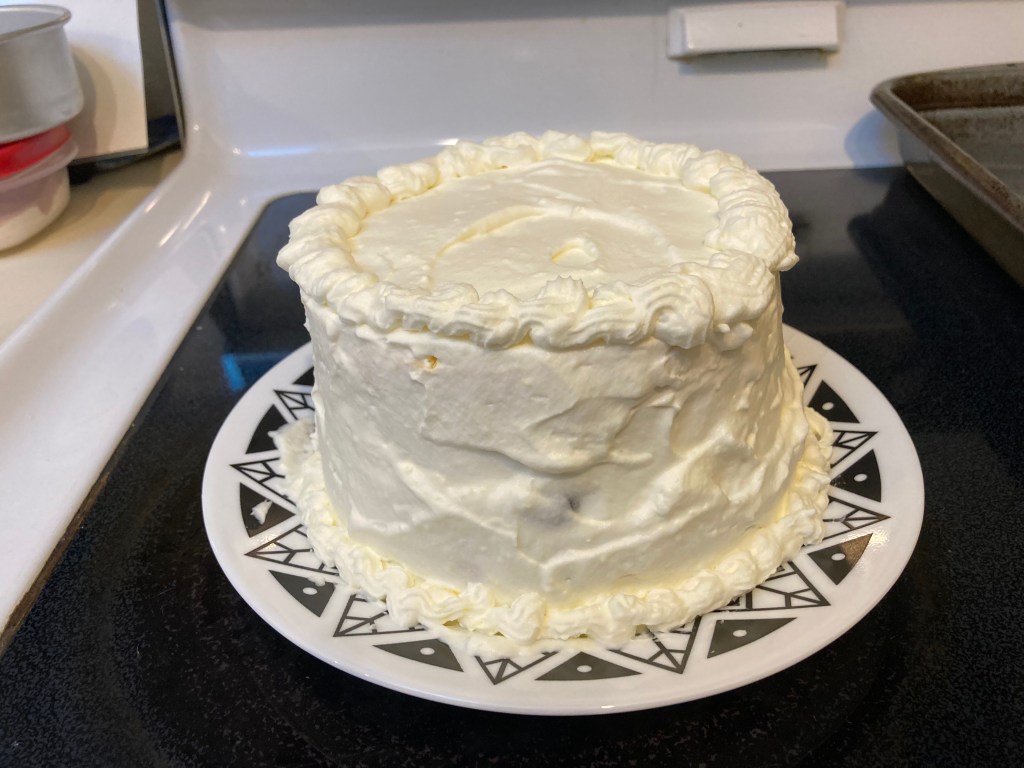
I could have taken more time with the frosting…

I enjoyed trying something new. The cake was pretty good and will probably make a really nice strawberry cream cake come April. But I’m pretty sure it isn’t going to displace any of our preferred birthday cakes.

Blueberries taste good with whipped cream, but are not attractive when cut in half.

“I’m a little teapot, here’s my spout”–a close-up of a family teapot

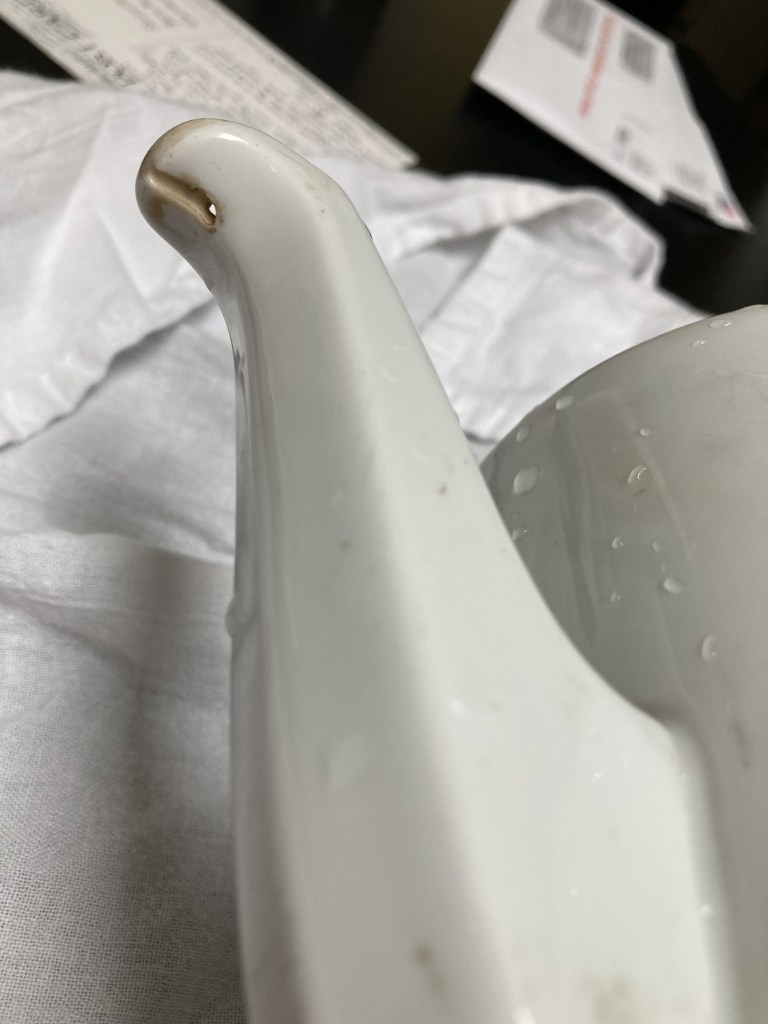
Above is a photo of the family teapot.

This is the teapot that traveled with my family since… I’m not sure when my parents bought it, but I’m currently sifting through family photos so possibly I will have a better answer later on. The steel part is a sort of tea cozy that fits over the plain white pot. No need to worry about the lid tipping off when you pour.

I love tea paraphernalia, and I have several teapots of my own. Some are inherited (silver with scallops, white with blue-and-gold); some were chosen (spring green, spring flowers). I like teapots with pretty designs or in appealing colors. I don’t like pots that are made to look like something else, such as a cake or a rabbit. That just isn’t my thing. I do like some teapots with simple, modern shapes, like this one. But there’s also one other important thing.

It has to pour well.

You’d think this would be required for any teapot, but I guess a lot of the really decorative teapots are bought by collectors and don’t get much use. (Mine don’t get much use, and I only have seven or eight! Imagine trying to use all of forty or so teapots!)

What makes a teapot pour well? I don’t know the answer. I do know that my parents’ teapot has a very unusual spout, and I can only assume it was meant to help it pour. I had never really looked at it, despite all those home-for-break teatimes, until now.

As you can see, there’s a small channel that runs down from the tip of the spout, and it is pierced.

And there’s a channel inside the spout that starts right at the hole. Is the drip meant to go back inside? Does this actually work? Did someone really do all this work to create a teapot that doesn’t drip? Surely this is more than is required.

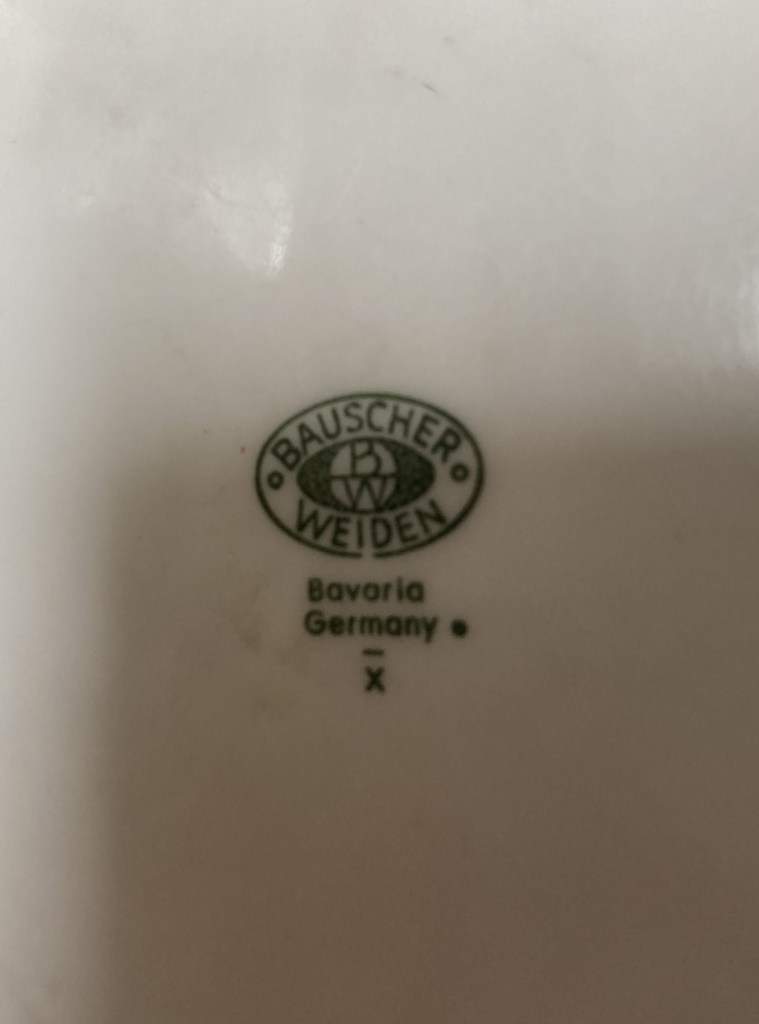
I just looked up this company. It appears that other pouring vessels they made in the past, such as coffeepots, did have pierced spouts. I couldn’t find out if this was true of their current products. I would love to read more about this feature, how it compares to other spout shapes, and who came up with it. Maybe someone out there can point me to an article?

Till next tea-time–and next post.

Vegetarian Steamed Dumplings

America’s Test Kitchen put out a book in 2022, Cooking With Plant-based Meat. That is, 75 recipes using the latest, best versions of fake meat that are in the stores. One of the recipes is for dumplings/pot stickers. Since I really like dumplings and my recipe uses ground turkey (not suitable for vegetarian off-spring), I was interested in trying theirs.

I’m not going to give the recipe or go into any detail about making it. I’m just going to comment that we thought it was quite tasty. Also, that squeezing the juice out of shredded Napa cabbage feels kind of weird. That’s a lot of cabbage juice down the drain.

And photos! I do want to include a photo of the results.

Hmm, I thought I had some photos of dumplings lined up and waiting to be cooked. Apparently not.

Regarding the sauce–I recommend soy sauce and rice vinegar (maybe 3:1?), with a bit of sauteed green onion and garlic. Maybe also a dash of ginger, powdered or otherwise. But I admit, I’m lazy. By the time we were done cooking, I probably just used soy sauce and vinegar.