Trying an Old Family Cake Recipe and a New (To Me) Frosting

My Grandpere, my father’s father, was a baker. When we celebrated birthdays while staying with him and Grandmere, he always produced a cake. Not a chocolate cake, though. I’ve never actually known what sort of cake it was, other than that it had two layers, a sort of whipped cream filling, sliced almonds patted onto the sides, and–for my birthdays–a glossy, smooth, pink frosting.

I do remember that it was delicious, even if I’m not sure what it was flavored with.

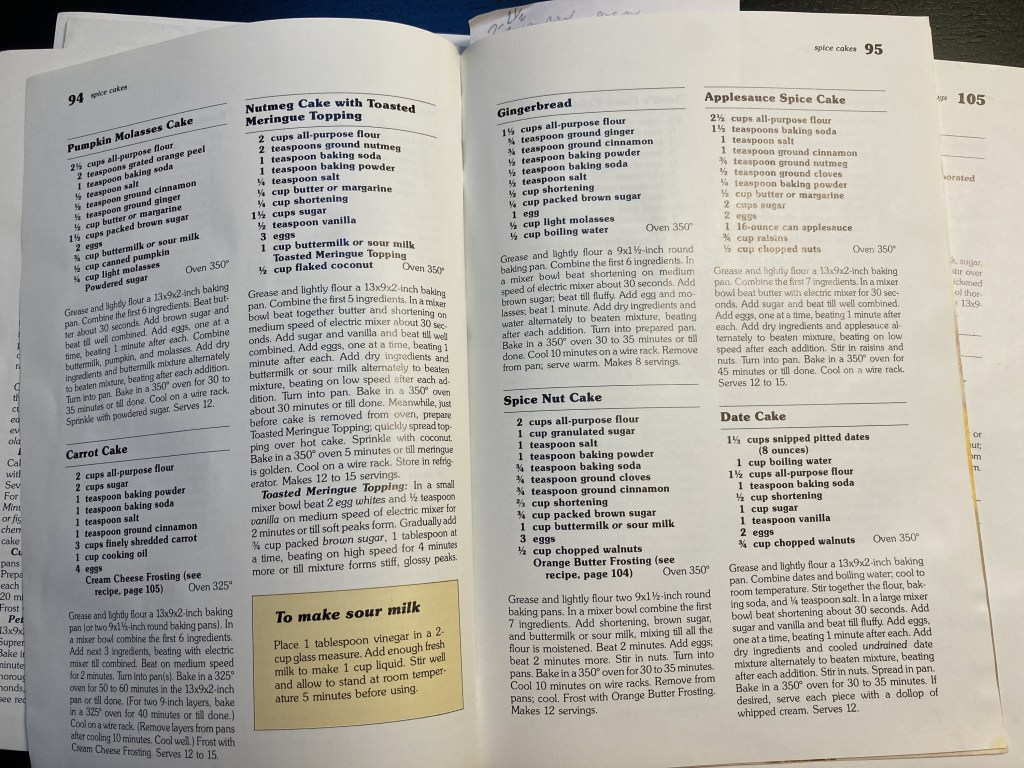
I have one of my Grandpere’s cookbooks, Cakes For Bakers. It’s clear that he used it, and it’s full of scraps of paper with recipes. I say “recipes,” but “lists of ingredients with a title” is a better description. I know I’ve looked through them before, trying to find out what cookie recipe he used, but this time I was curious about the cake recipes. “Mace” showed up several times, particularly in connection with something called “wine cake”, but also in a few other places. What would it be like to flavor a cake with mace?
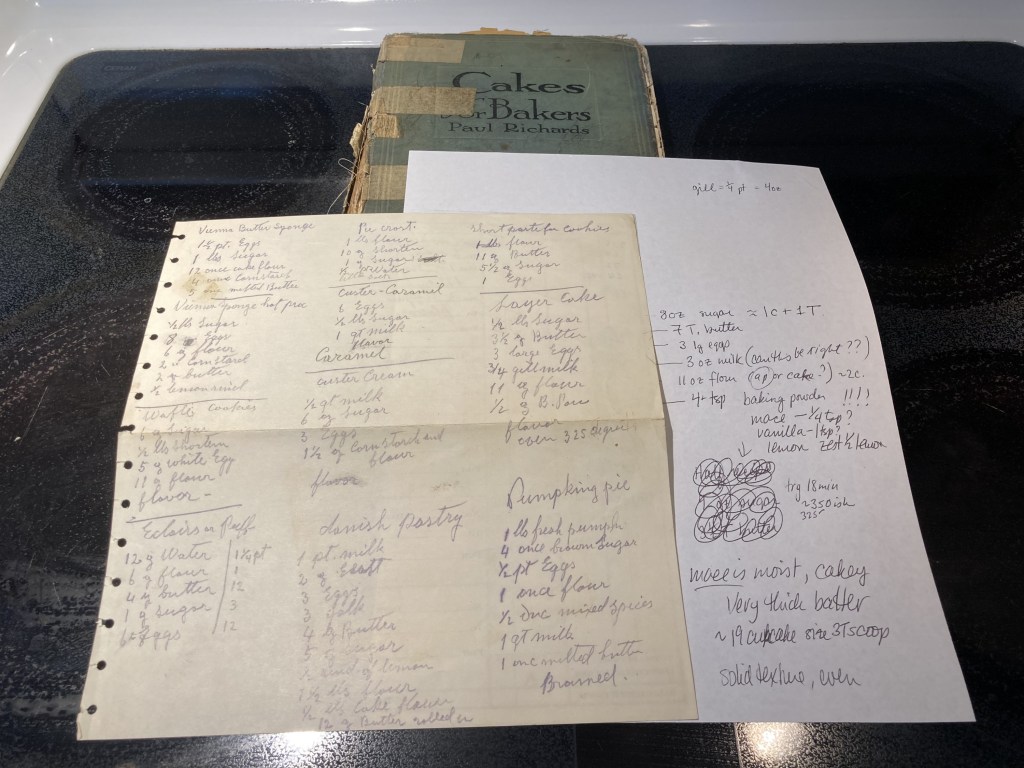
One of the recipes says “layer cake.” I decided to try that, but add the “mace, lemon, vanilla” that shows up in the context of the wine cake. Mace is similar to nutmeg, and I already know that nutmeg and lemon are a nice combination.

However, I didn’t want to end up with us having to eat a whole cake, so I decided I would make the batter into cupcakes so I could freeze some for later.

At the same time as I decided to try the cake, I also decided to try a new and unrelated frosting that I’ve been curious about–Ermine Frosting, which involves boiling milk and flour together. (It also has a lot of butter.) So, not one but two experiments–perhaps not as tightly linked as they should have been.

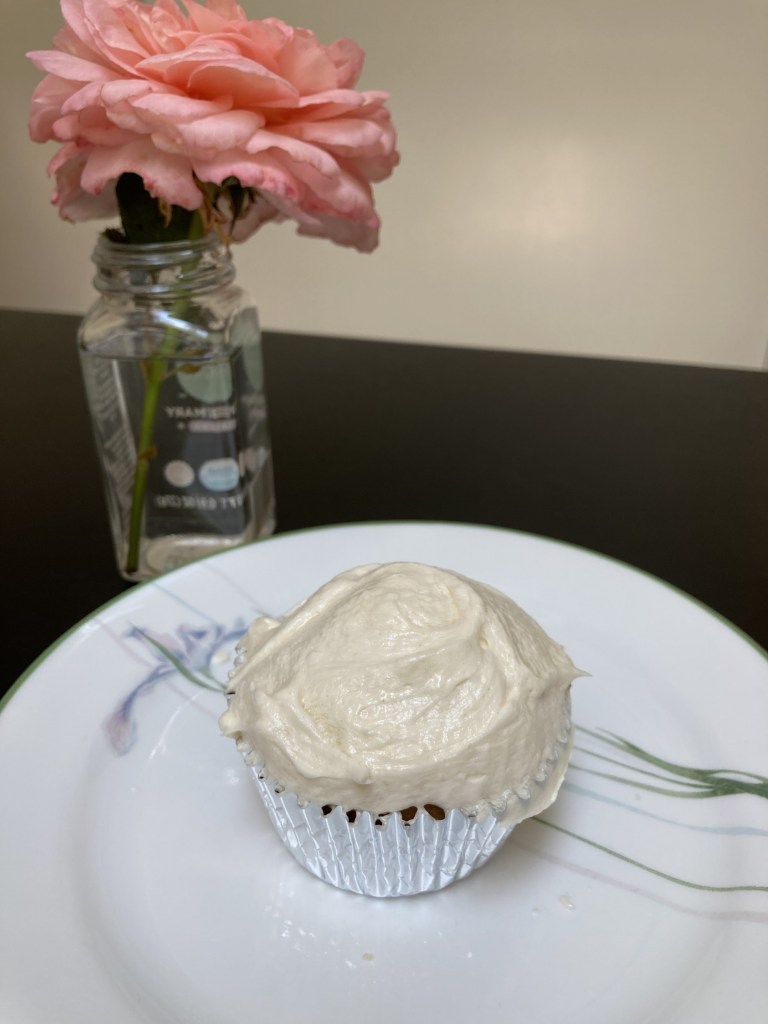
First, the cake. I deciphered and “translated” the measurements (what’s a gill?) and tried using the standard approach for a butter cake, creaming the butter and sugar, adding eggs, then alternating the flour mixture and milk. I guessed at suitable amounts of mace and lemon and vanilla. The result was a thick but tasty batter, and cupcakes with a fairly firm but good crumb. The flavor of mace was pretty strong–perhaps I should have gone heavier on lemon and lighter on mace.

The ermine frosting was intriguing. Some methods have you beat the butter and add the thickened milk/flour mix to it, while others have you add the butter to the thickened, beaten milk/flour mixture. I used the recipe from King Arthur Flour’s website, and heated milk with flour and sugar to make a cooked paste, then beat it till it cooled down some, then added butter. The texture is very smooth and buttery (no surprise that it is buttery) and I think it would be good with flavors besides vanilla. It reminds me of the texture of the filling that Phoenix Bakery in Pittsboro, North Carolina, uses in their doughnuts–silky with butter.

However, vanilla ermine frosting doesn’t seem a good match for these cupcakes. I’m not really sure what would be–something citrusy? Cinnamony?

This brings me back to the fact that the flavors–mace, lemon, vanilla–seemed to be connected to wine cake. In the cookbook and in the notes, the recipes for wine cake do not contain any wine. Is it so named because it is accompanied by wine? Or is there supposed to be wine involved later on?

When I looked up “wine cake” on-line, every recipe I found did in fact include wine as an ingredient (and often, cake mix and pudding mix.) So why is this cookbook’s “wine cake” so different? Why can’t I find out anything about the origins of this wine cake?

The internet can tell you a lot, but some mysteries resist easy answers. I should have asked more questions of my Grandpere, but I wasn’t interested in baking back then. I should have asked more questions of my father too, when I started baking, though I’m not sure how many more answers he could have provided. Maybe he didn’t ask those questions of his father either.

If you know anything about a “wine cake” that doesn’t contain wine but does contain mace, I’d love to hear from you.

Till next post.

Gingerbread–the cake, not the cookie

Gingerbread with whipped cream

I was recently reminded how tasty gingerbread can be. While looking at other people’s posts on cookie houses, I ran into a post by Come July about gingerbread–the cake, not the cookie–which showed a photo of one of MY COOKBOOKS. Well, not the very cookbook on my shelf, obviously, but the page looked just like mine, only with some water damage.

Better Homes and Gardens, c. 1981, printed 1987

That got me thinking about gingerbread. And whipped cream, because whipped cream is what really makes gingerbread good, in my opinion. My husband really liked a gingerbread with lemon sauce that he had at a restaurant, so adding some warmed lemon curd sounded like a good idea too.

The recipe I’ve used is actually from a different cookbook, The Fannie Farmer Cookbook. It may or may not be the same recipe my mom used. I made a gingerbread last weekend (the version with extra spices), and it was good, but now I’m thinking about trying a different recipe, just to see how it compares.

The All-New Fannie Farmer Boston Cooking School Cookbook, c. 1959, printed ?
Fannie Farmer, continued.

The other thing I realized is that while lemon curd is good with gingerbread, I actually like it better with just whipped cream. Some combinations are like that. Some people like apple pie with vanilla ice cream. I like both pie and ice cream, but I prefer to eat them separately. Same for apple pie and cheddar cheese, which some people like together. I don’t think the combination is as good as either of its components.

The serving suggestions in Fannie Farmer (seen above) just go to show the variety of ways in which people apparently enjoy their gingerbread. Applesauce sounds possibly familiar, but grated cheese folded into whipped cream??

I have no particular point to make in this post. I’m just enjoying the world of traditional desserts.

Till next post.

Gingerbread with whipped cream and lemon curd

Cookie Houses–smaller is better

There are two kinds of people in the world: those who are more interested in the appearance of food, and those who are more interested in the taste. (Joke–there are two kinds of people in the world–those who divide the world into two kinds of people, and…)

Okay, it’s really more of a spectrum, but by way of illustration, every year I see magazines in the checkout showing clever ways to create cupcakes that look like spiders for Halloween, cookies that look like nests of eggs for Easter, and so forth. These are ingenious and very attractive comestibles, and I appreciate them as such, but I also can’t help thinking–do licorice whips really taste good with chocolate cake? Will the marshmallows work with pretzel sticks?

Partly for that reason, I’ve never been all that excited about making gingerbread houses, even though I love baking. I’ve always seen them as purely decorative–after all, surely pretzel logs and Necco wafers don’t taste as good combined with gingerbread. My husband, on the other hand, sees gingerbread houses as edible as well as decorative. His position is that one should enjoy it for a few days, then start picking candies off, then eat the cookie before it gets stale.

Still, I do like to decorate sweets, and I do like constructing things. This year, I had an urge to make a cookie house, possibly as a result of watching too many episodes of The Great British Baking Show. But did it have to be made of construction gingerbread? What other flavors might there be?

In looking up recipes, I found some blogs with pictures of miniature cookie houses: Pretty Petunias and For the love of butter, among others.

Brilliant! Not only were the little houses cute, but they had the following advantages over full-size cookie houses.

–I could make cookie houses and still enjoy fresh cookies from the rest of the dough.

–Each person could decorate their own house.

–It would be easier to cover the finished houses (to protect them from our cat who has been known to lick at them.)

–The cookies would not need to be quite so sturdy as the pieces would be smaller and subject to less tension and compression. (Thank you, Stephen Ressler of The Great Courses for the engineering vocabulary!)

–And finally, we could eat one while still enjoying the appearance of the remaining ones.

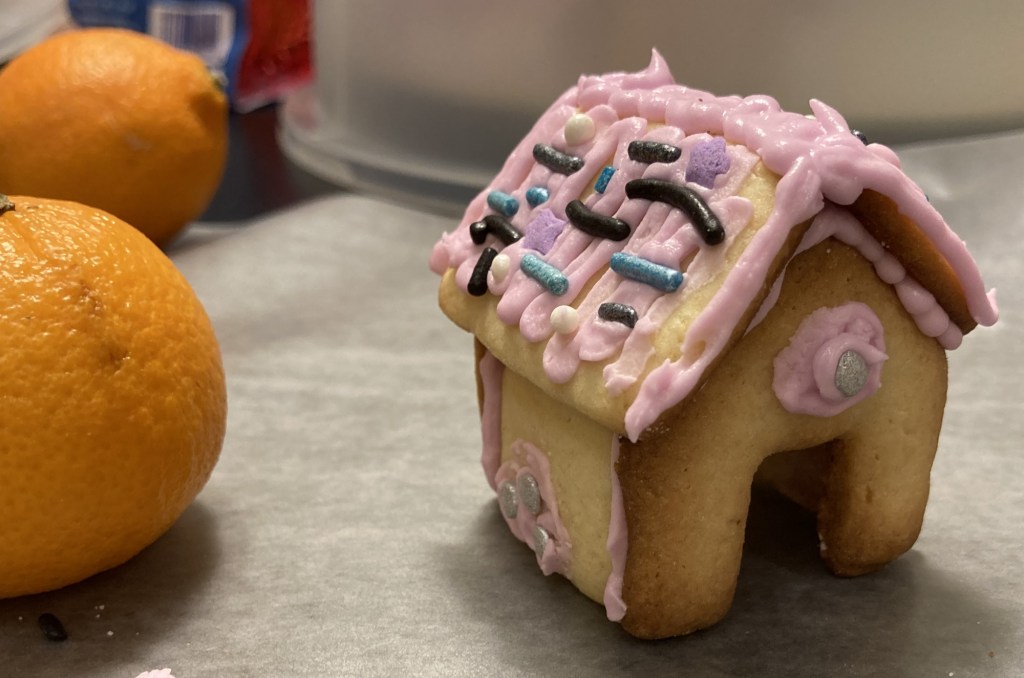
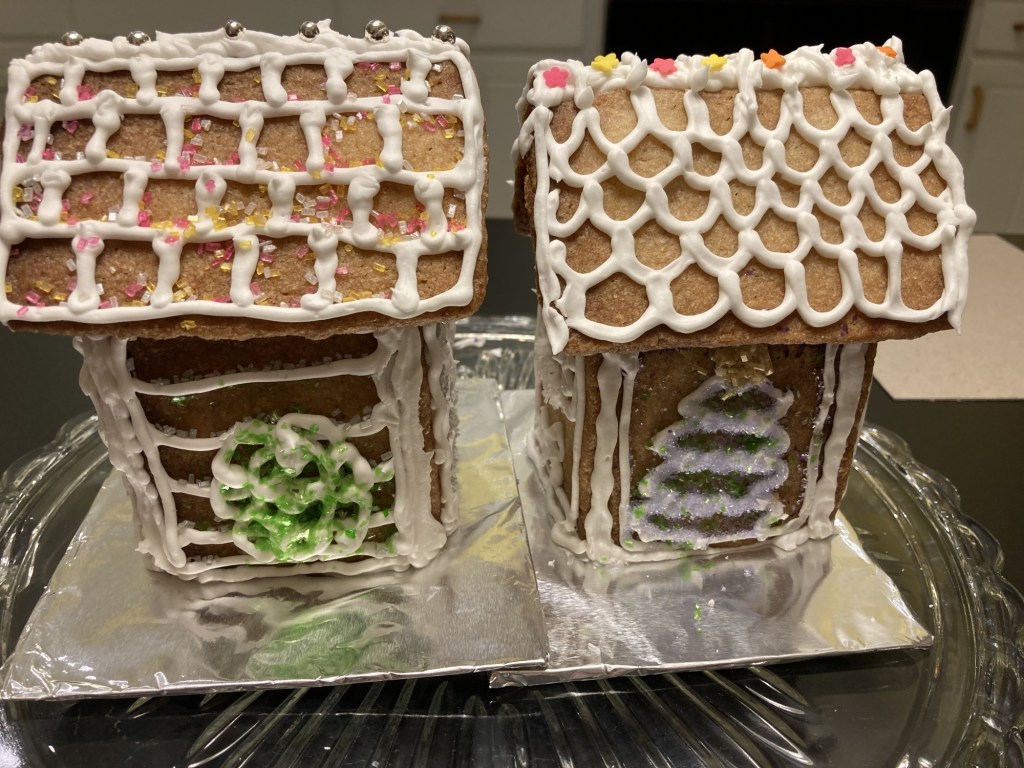
I tried two different doughs, and I tried cutting out my own small pattern (which was a bit of a pain) and then bought some ready-made cookie cutters for mini cookie houses. Photos below.

Cookie houses made from my own pattern.
Cookie houses made using purchased cookie cutters.

I’m not going to provide links to recipes, as the recipes I tried were okay but not thrilling. Better that you should scout around for recipes you find exciting and try those. (And then let me know, please, if you find a recipe you think is especially good.)

I will provide links to some of the cookie cutters, however, because they make it much easier. I didn’t recut my pieces after they were baked, which probably would have improved the results, but they stuck together all right anyway.

These are the cookie cutters I bought:

Fox Run Christmas Village

and this mini set which seems to come from several different sources. There is also one that cuts out all the pieces at once, which I didn’t try.

Till next post.