Mandarin Eggnog Custard—puzzling over clementines and thinking about my favorite flavor combination

In November, a family’s fancy turns to clementines. These cute, peelable oranges are bright and festive, not to mention Santa’s trademark (at least according to the Dr Who 2014 Christmas special.) So perhaps it makes sense that I have been thinking about them recently.
Clementines used to come in nifty wooden crates that were so iconic that the comic Rhymes With Orange had a strip about them. Now they show up in mesh bags labeled “Halos”, or “Cuties”, and seem to be around for a longer time. Sometimes the clementines are very, very good, and sometimes they are not. Are these all the same fruit?
My husband and I used to think maybe it was their origin. Some of the best ones seemed to come from Spain. Or was it the time of year that mattered? Right around Thanksgiving was the time for the best clementines. And what is a clementine anyway?
After browsing online, I discovered that (a) clementines are a kind of small mandarin, along with tangerines (which might be a catch-all term for larger mandarins) and something called a satsuma. I also discovered that (b) there are many varieties of small mandarin, and the bags labeled “Halo”or “Cutie”, which come from California, may contain different varieties depending on the time of year.
Good to know! I’ve been enjoying the Halos after being disappointed by Sun Pacific (?) early on, but apparently by February the Halos will actually be a different variety of mandarin from the ones I am getting now. I wonder if that is the reason they seem so good early in the season, and disappointing later on. Perhaps I like the earlier varieties better. Also, perhaps the Sun Pacific mandarins wouldn’t have disappointed me had I tried them later on when they were a different variety.
Last post, I described making a braided bread based on a hot cross bun recipe using (one of ) my favorite flavor combinations: orange, lemon, cinnamon, and nutmeg. I was thinking about this flavor combination when I was doing laundry this week. The laundry soap I was using was Indigo Wild’s Sea Salt, and I started wondering if the scent had a hint of nutmeg in it. (It also reminded faintly of Coca-Cola and A-1 steak sauce, which I swear have something in common, even though my family doesn’t notice any resemblance.)
So I decided to take just part of my favorite flavor combo and work on an orange and nutmeg pudding. Nutmeg is a big part of the appeal of eggnog, which is a seasonal flavor, and clementines also go with Christmas (and I still had some in the house), so it could be a festive Christmas pudding (only not in the British sense.)
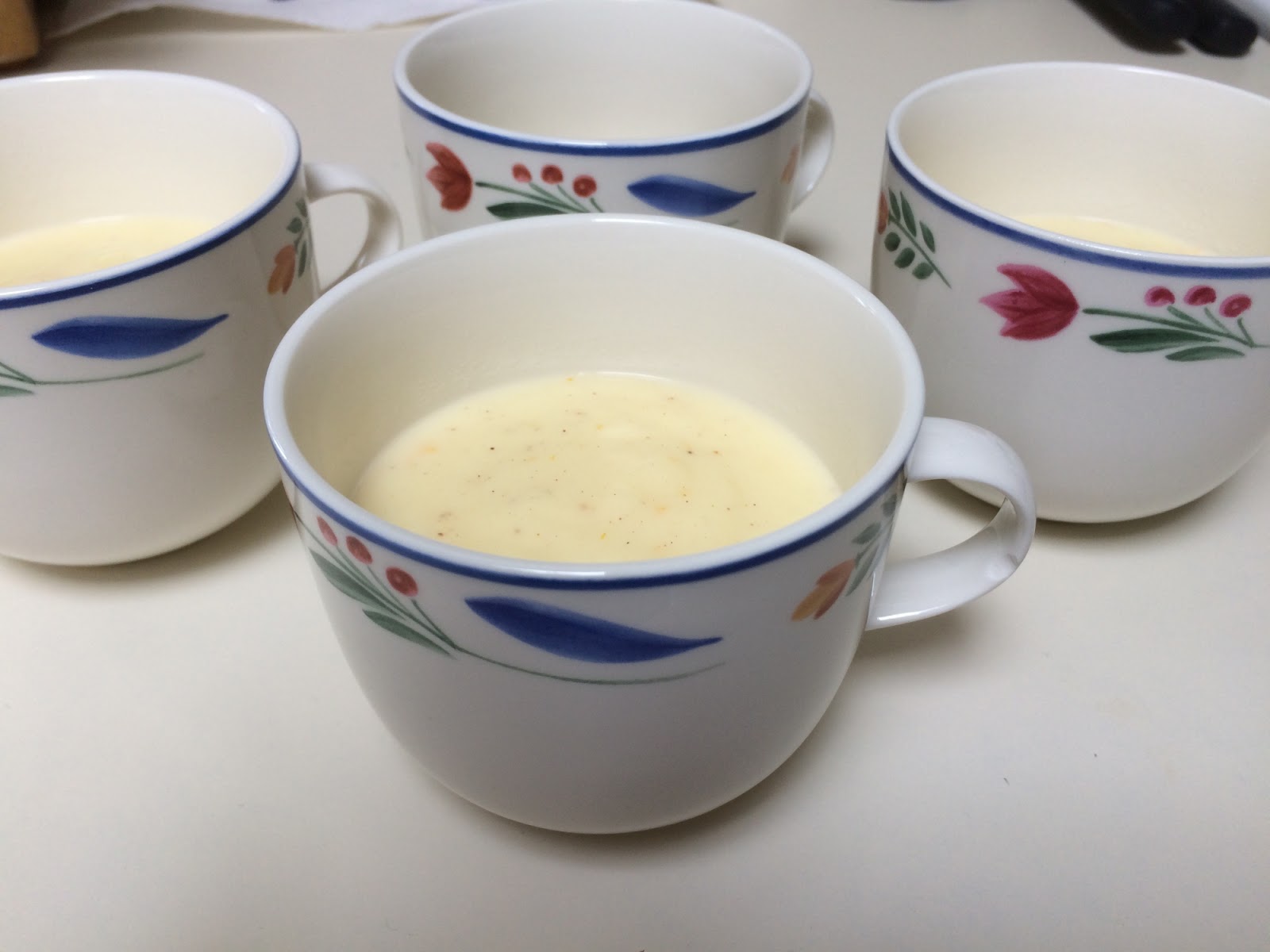
Mandarin-nutmeg custard in teacups
Mandarin-nutmeg custard in cups
The first version was a regular cornstarch pudding with mandarin zest and nutmeg, but it looked and tasted a bit thin for something that was supposed to be festive. Also, without eggs, it wasn’t really eggnoggy. So I tried a custard version, combining elements from microwave vanilla pudding and Dangerously Easy Vanilla Custard, to get a Mandarin Eggnog Custard which was pretty good.
The recipe is as follows:
Stir together in 4-cup glass measuring cup
  • 3 Tblsp cornstarch
  • 3 Tblsp sugar
  • ¼ tsp nutmeg
  • 2 cups milk
  • 2 egg yolks
  • 1 Tblsp heavy cream (if you have it)
(I prefer to mix the dry stuff, mix in some of the milk, mix in the eggs, then add the remaining milk and cream. But suit yourself.)
Then zest and set aside the zest of
  • 1 clementine/small mandarin
I love my microplane grater!
Microwave 1 minute, then for 20 seconds at a time, stirring with whisk after each till it thickens.
When mixture thickens, add the zest and microwave 10 seconds more before pouring into bowls or cups and allowing to cool.
Mixture before microwaving
Mixture after microwaving
This makes a very thick custard. If you want it thinner, try adding less cornstarch. I probably didn’t need to add quite so much.
I haven’t yet tried adding vanilla. If you try a mandarin-nutmeg-vanilla custard, let me know how it works.
Till next post.
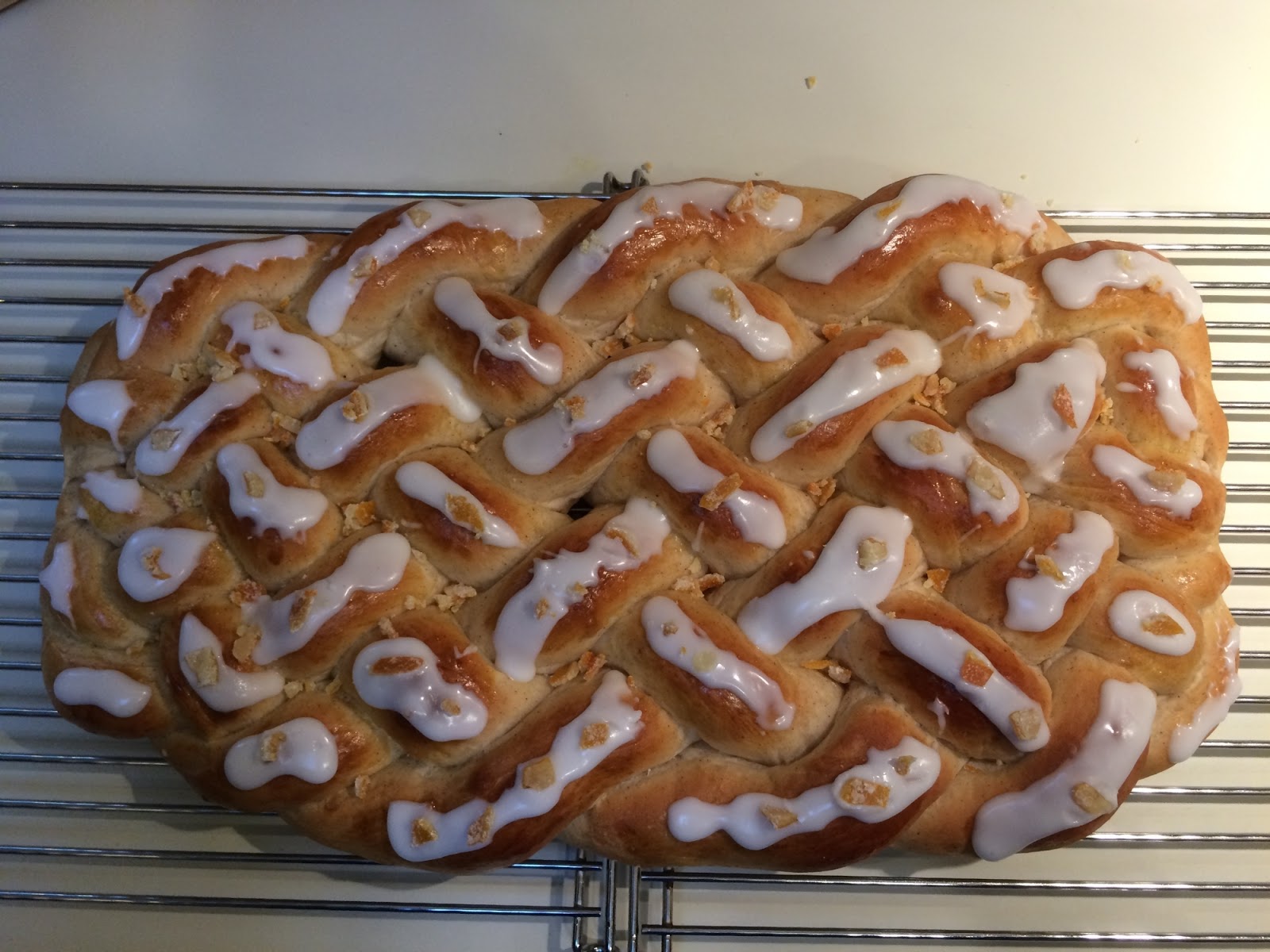
New Year's Festive Braided Bread–except it's really woven bread

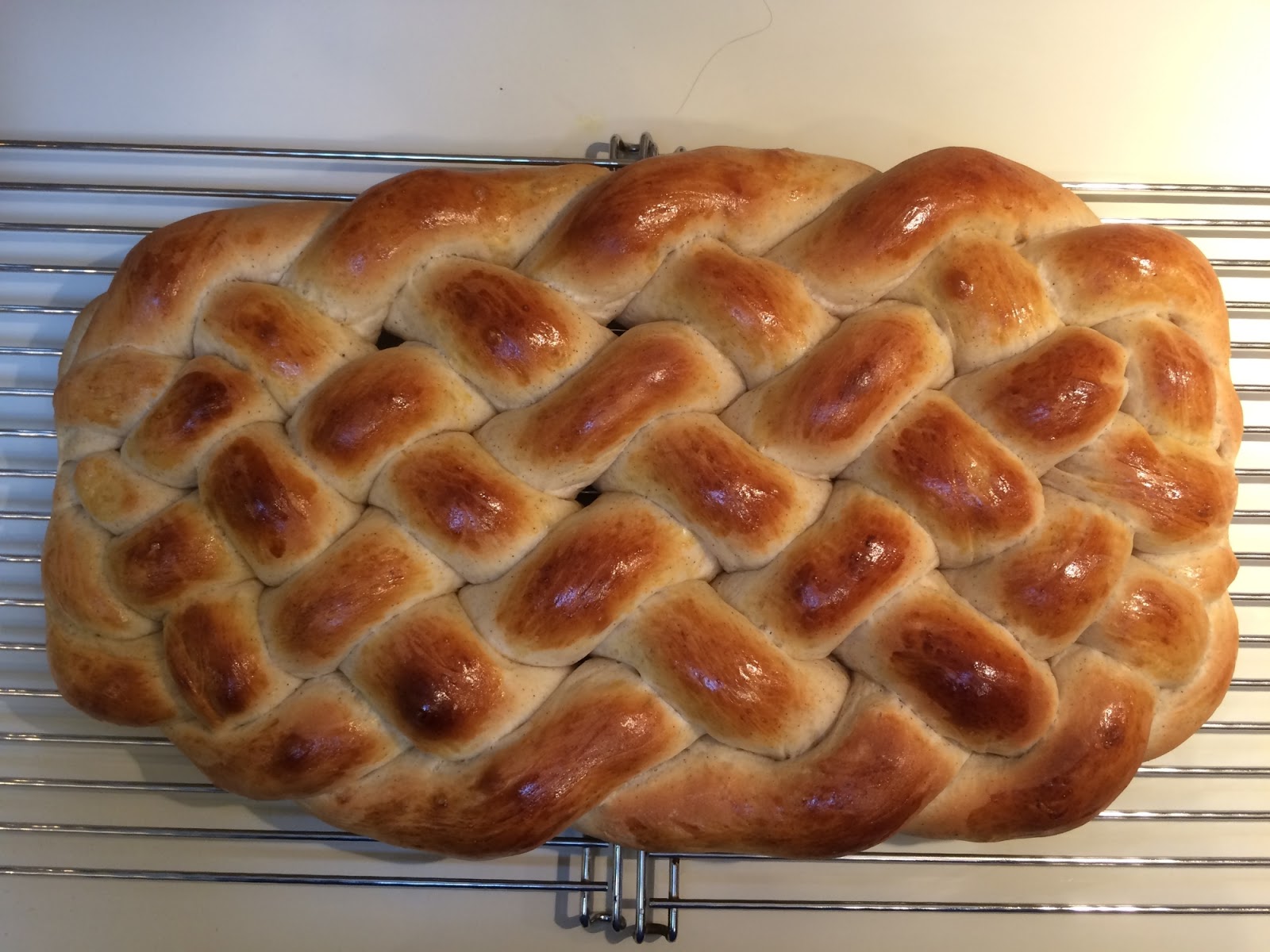
I wanted to make a sweet, festive bread based on my hot cross bun recipe, and dress it up for New Year’s. Here it is–a citrus and spice bread with lemon icing and a sprinkle of candied mandarin peel.

The recipe is approximately as follows:

Heat together

1 cup milk
1/4 cup sugar (plus one teaspoon, explained later)
~1 tsp orange zest (about half an orange’s worth)
~1 tsp lemon zest (about one lemon’s worth)
1/4 tsp salt
3/4 tsp cinnamon
1/4 tsp nutmeg
2 Tbsp butter

Note: I used the extra tsp sugar because I like to mix the spices and zest with something dry so they don’t clump in the milk and I forgot to do so before adding the sugar to the milk. I doubt it matters in the long run, since they get kneaded in, and in any case, I think I’ll start adding the dry spices to the flour instead. Still, the extra tsp of sugar tastes good, so maybe I’ll keep it.

The disadvantage of adding the spices to the flour would be that when I dip a (clean) finger in to see if the milk mixture has cooled enough to add to the yeast, it won’t taste as incredibly yummy. Oh well.

(If I were making hot cross buns, I would put 1/4 cup of raisins in with the milk to soften.)

When milk mixture is lukewarm, mix together

2 1/4 tsp yeast (or one packet)
2 Tbsp warm water .

(I think I can skip this step, actually, given the bread machine yeast I am using, and just put the yeast in with the flour and add 2 Tbsp water or milk to the milk mixture.)

Then add the milk mixture to the yeast mixture, and mix in

15 ounces all-purpose flour (a bit less than 3 cups).

I used 15.5 ounces this time, and had to add some extra liquid. Ideally the dough should end up a bit sticky, and this one wasn’t. So don’t add all the flour right away–you may not need all of it. I kneaded it with the kneading attachment on my stand mixer, about five minutes.

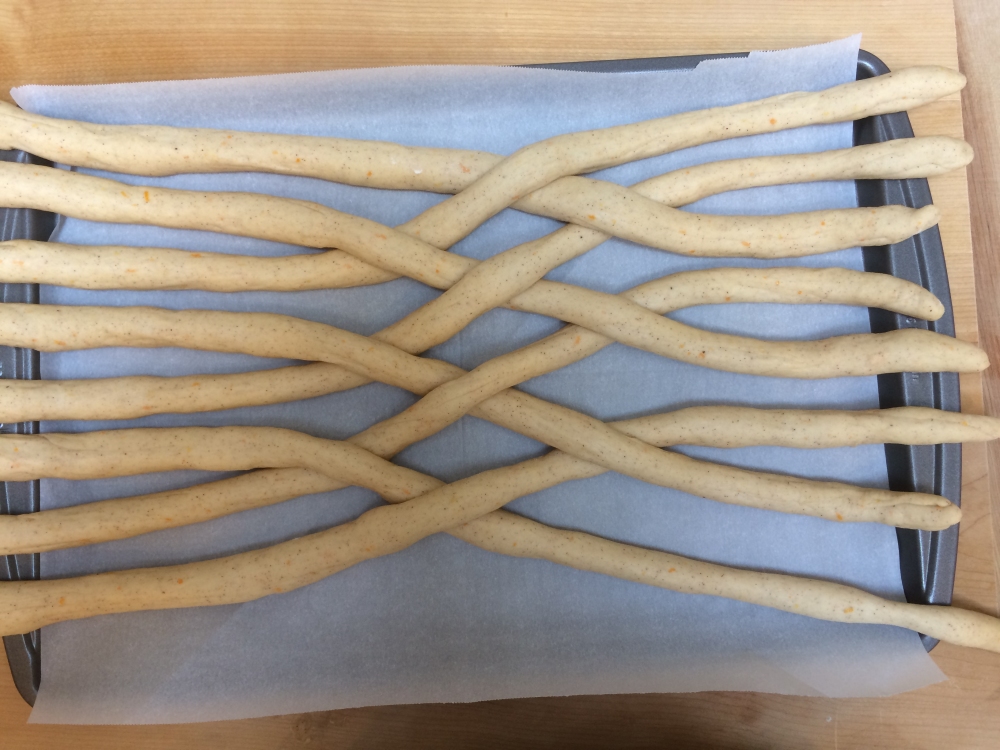
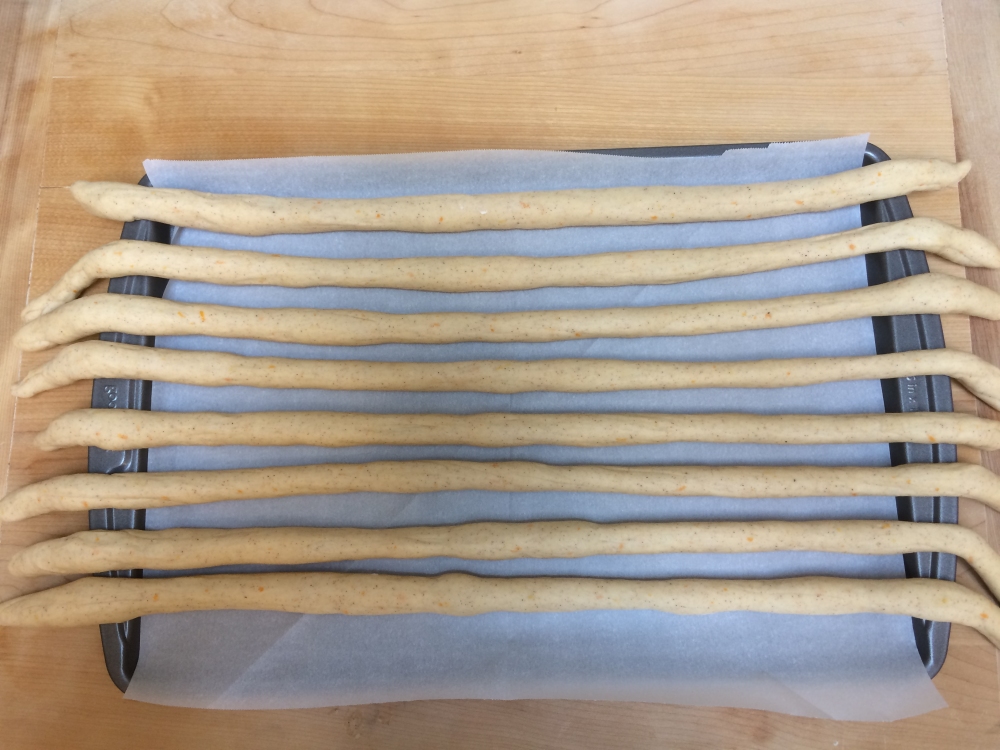
Coat with some melted butter and put in bowl to rise, covered, 45-60 minutes. Then divide into 8 and shape. I think rolling the strands is the hardest part of this whole thing.

These strands came out pretty well!

First, cross each pair of strands going in the same direction. I decided to start in the middle of the loaf.

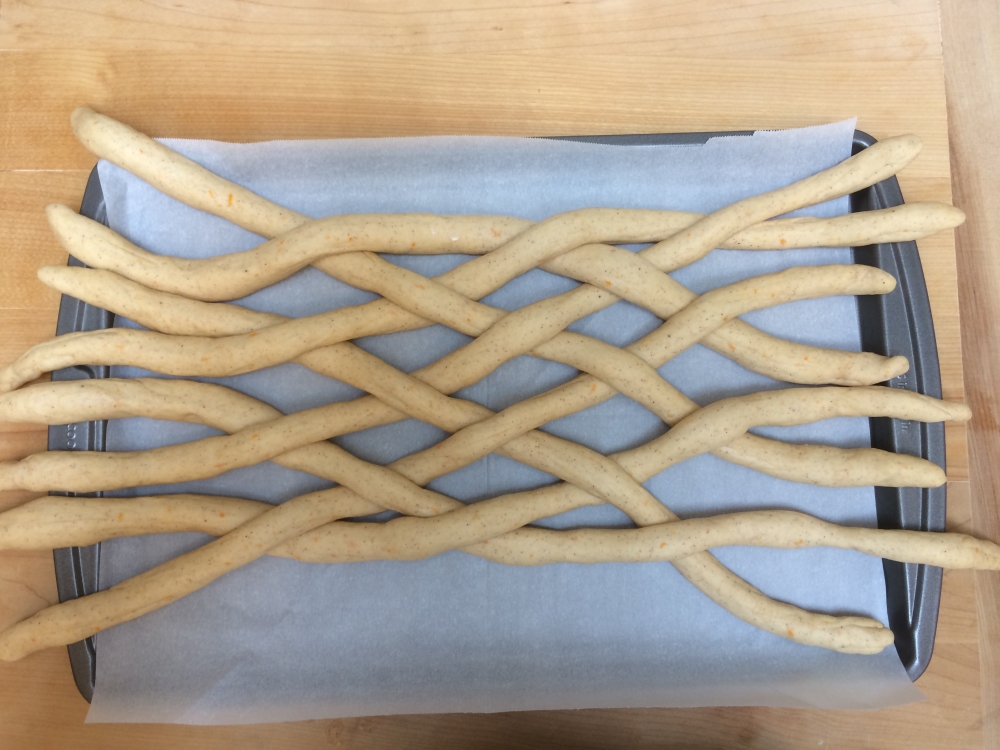
Then, ignoring outermost strands, cross strands again in reverse direction. Here I did this on each side of the initial crossing, working toward both ends.

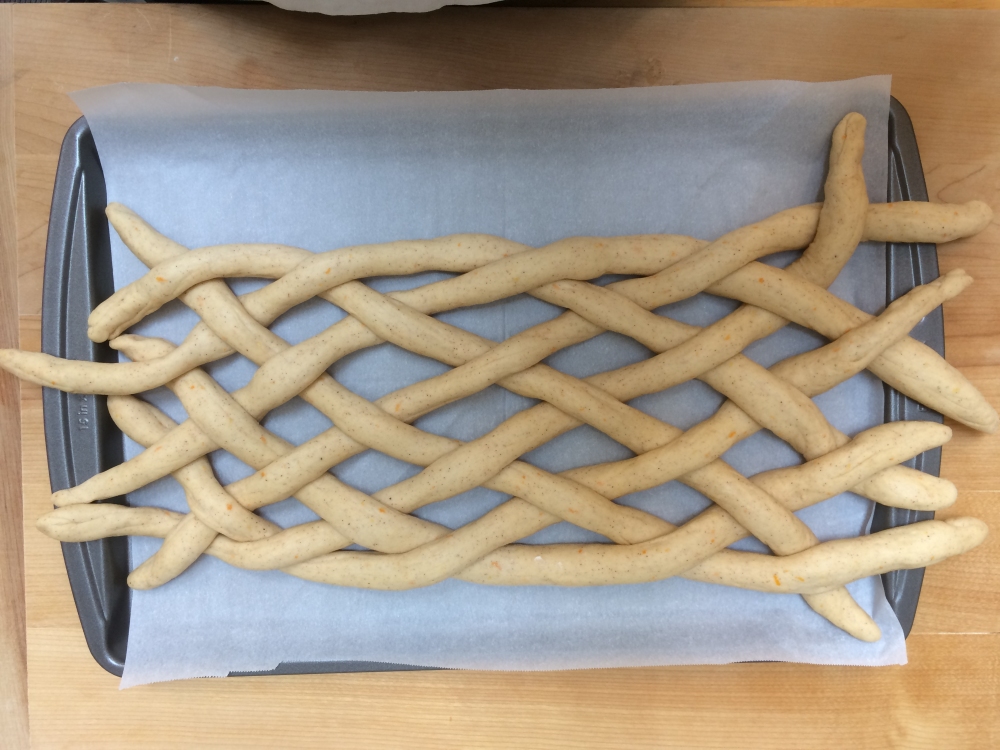
Starting with the outer strand again, cross each pair again as you did the first time. Aim for diagonally woven bread–each strand alternates going over and under.

Keep going, weaving the strands over and under by crossing pairs of strands in one direction, then different pairings in the other direction.

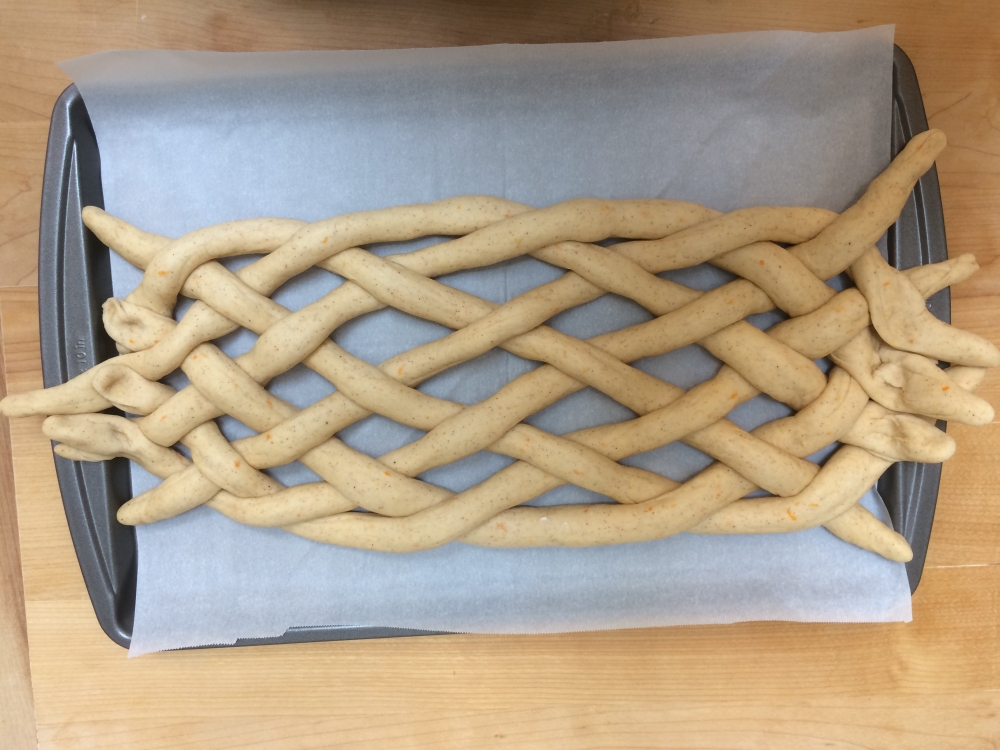
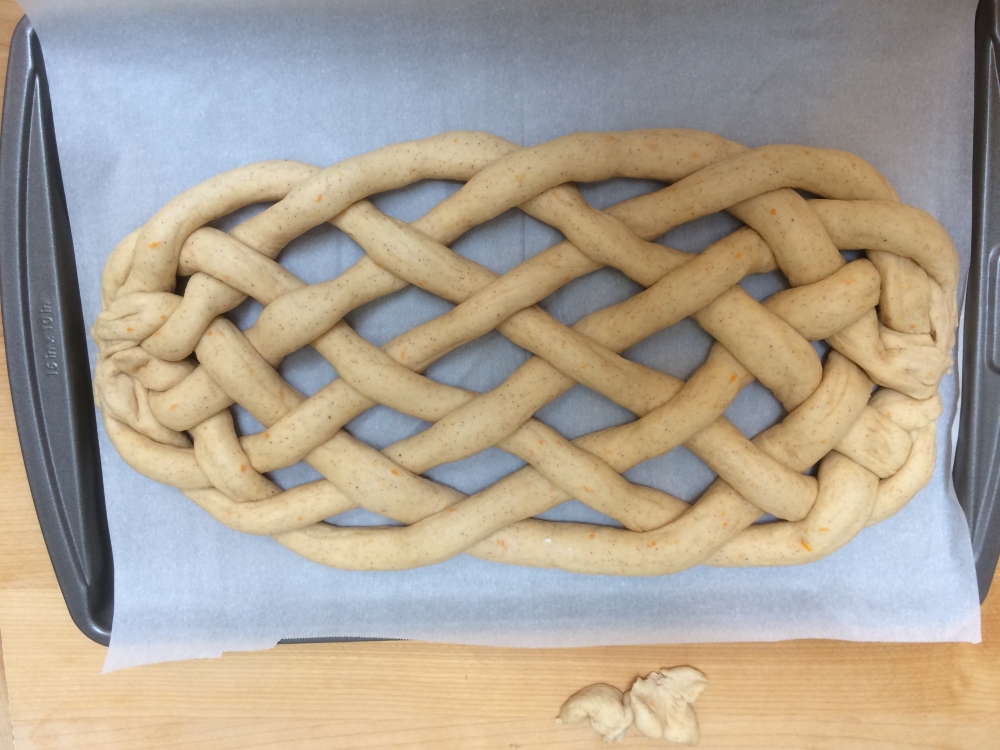
Then squish the ends together and tidy the whole thing up till you like the way it looks.

Ends pinched together and weave tidied up.

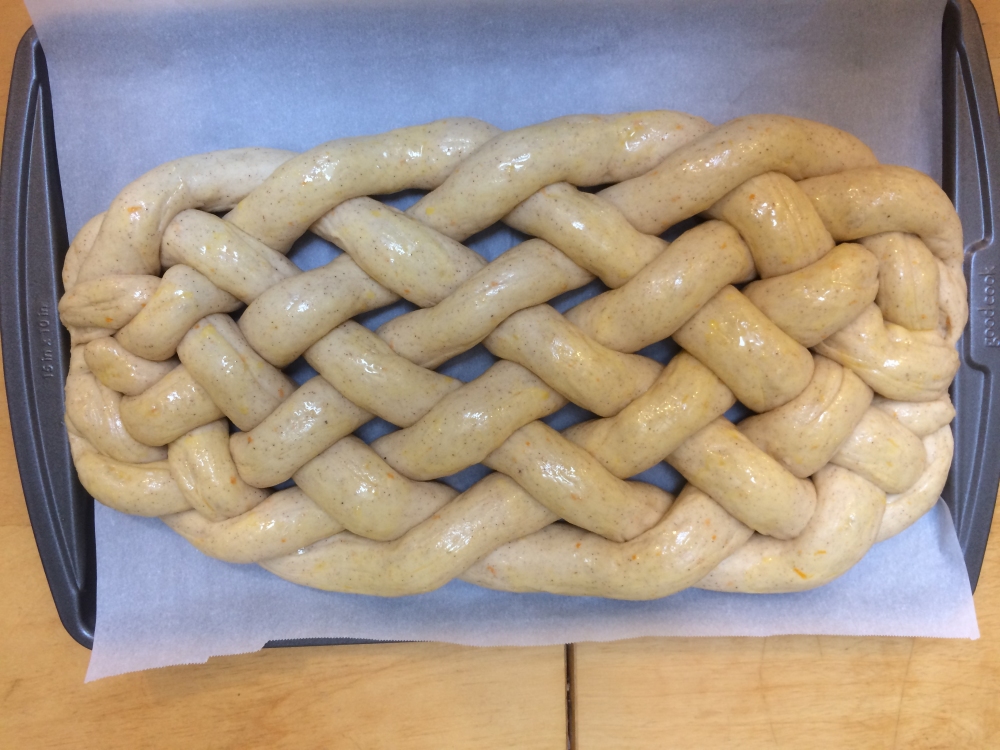
Then let rise again, covered, about 30-40 minutes.

I decided to brush it with beaten egg for a shiny finish (also, I was making scrambled eggs at the time.)

After rising, brushed with beaten egg.

Bake in preheated 375 oven for 10 minutes or a bit more, till browned.

The icing is

1/2 cup powdered sugar (plus some more)
2 tsp milk
1/8 tsp lemon extract

Mix, warm up in microwave, add more powdered sugar as needed till it is spreadable/gloopy when warm, but stiffens up as it cools. However, while thicker icing makes the bread less smeary for eating, it had the unexpected effect that when I sprinkled chopped candied mandarin peel on it, the bits either bounced off or lodged in the crevices of the bread. They wouldn’t stick to the icing. We had to press them into the icing to make them stay.

So you might want to keep the icing thinner and stickier. Your choice.

While I called this a braided bread, I think it is actually a woven bread, or a lattice. “Braid” suggests something more rope-like, more like the 8-stranded braid on The Great British Baking Show that originally inspired me to try this, but which is much less lattice-like.

Eight-strand Braided (Plaited) Bread, Inspired by The Great British Baking Show

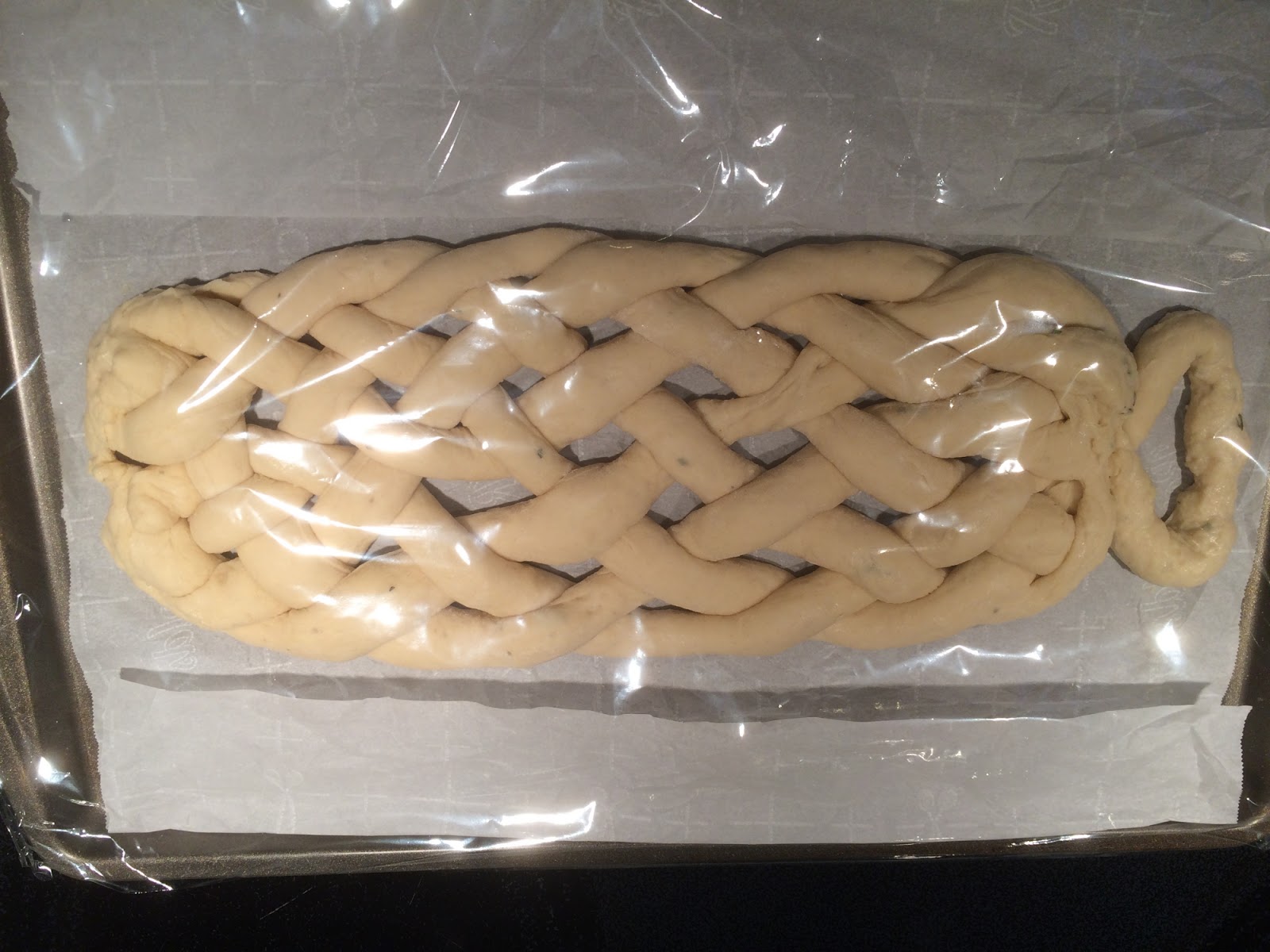
After watching an episode of the Great British Baking Show in which the bakers faced a technical challenge that involved an eight-strand braided bread, I was inspired to try to figure out how to do an eight-strand braid. After watching the Masterclass version, I don’t think my solution is the same as Paul’s. Actually, I like mine better. Here are the photos.

An eight strand braided bread
The finished loaf
Eight strand braided bread before rising.
Before rising. Note that I left gaps between strands.

You may have noticed that I made a mistake in the braid at one point. I didn’t notice till it was halfway through rising. I’m still pleased with it. I used a pizza dough and spritzed it with oil rather than use Paul’s recipe and brush it with egg. Next time, I’ll try a sweet dough with an egg wash.

For those of you who have tried signing up for email notifications via the email notification gadget on the right side of the page, above the pears and below the green banner, I hope it worked.

Till the New Year. (Unless I have other photos I want to share.)