Drinking Tea During NaNoWriMo

It’s November, a time for pumpkin-flavored everything, Thanksgiving, and National Novel Writing Month. I think the originator of NaNoWriMo was probably not hosting Thanksgiving, as he seems to have thought that having the holiday would actually help people achieve word count.

However, I can’t blame my poor word count on the holiday. The fact is, I’m writing a mystery (again) and my plot has run into constant problems (again). It is possible that I was never meant to write mysteries, only to read them. I haven’t actually given up yet, though. I’m at 27,000 words with six days left. It isn’t actually impossible that I reach 50,000–just really, really (really!) unlikely. It probably requires a sudden blast of inspiration and the discovery that the woman who has gone missing is not actually being held captive by her no-good brother but has actually engineered some kind of elaborate plan to run off with the lonely rich man’s most valuable possessions.

Nope. Sorry. Doesn’t work. She’s not a con artist at heart. Sigh. I’ll have to keep searching.

I do drink a lot of tea, as I have mentioned before. This is even more true when I am trying to write. So, instead of more complaints about my meandering mystery, I’m going to share an interesting tea experience.

Some weeks ago, my area had a water emergency. A watermain (?) right near the water treatment facility developed a serious leak and we received a succession of messages: “Please conserve water,” “Please restrict water use to drinking and personal hygiene,” “Water levels have dropped too low for safety–please boil all drinking water and continue to restrict water use.”

Fortunately, I still had jugs of water left from preparations for hurricanes, so I didn’t have to rush to the store. It did remind me how precious water is, and how convenient it is to have running potable water. But on to the tea story.

Making tea during the water emergency, I kept thinking the tea looked darker than usual. Had I steeped it longer by accident? Unlikely, since I usually set a timer. When the water came back on, I did a comparison: tap water tea versus the jug I was using. Sure enough, the tea did look different. After adding milk, it still looked different, with one being grayer and one redder. I couldn’t actually detect a difference in flavor, but some days my sense of taste is less sensitive than others, so I’m still not convinced that it was just a difference in color.
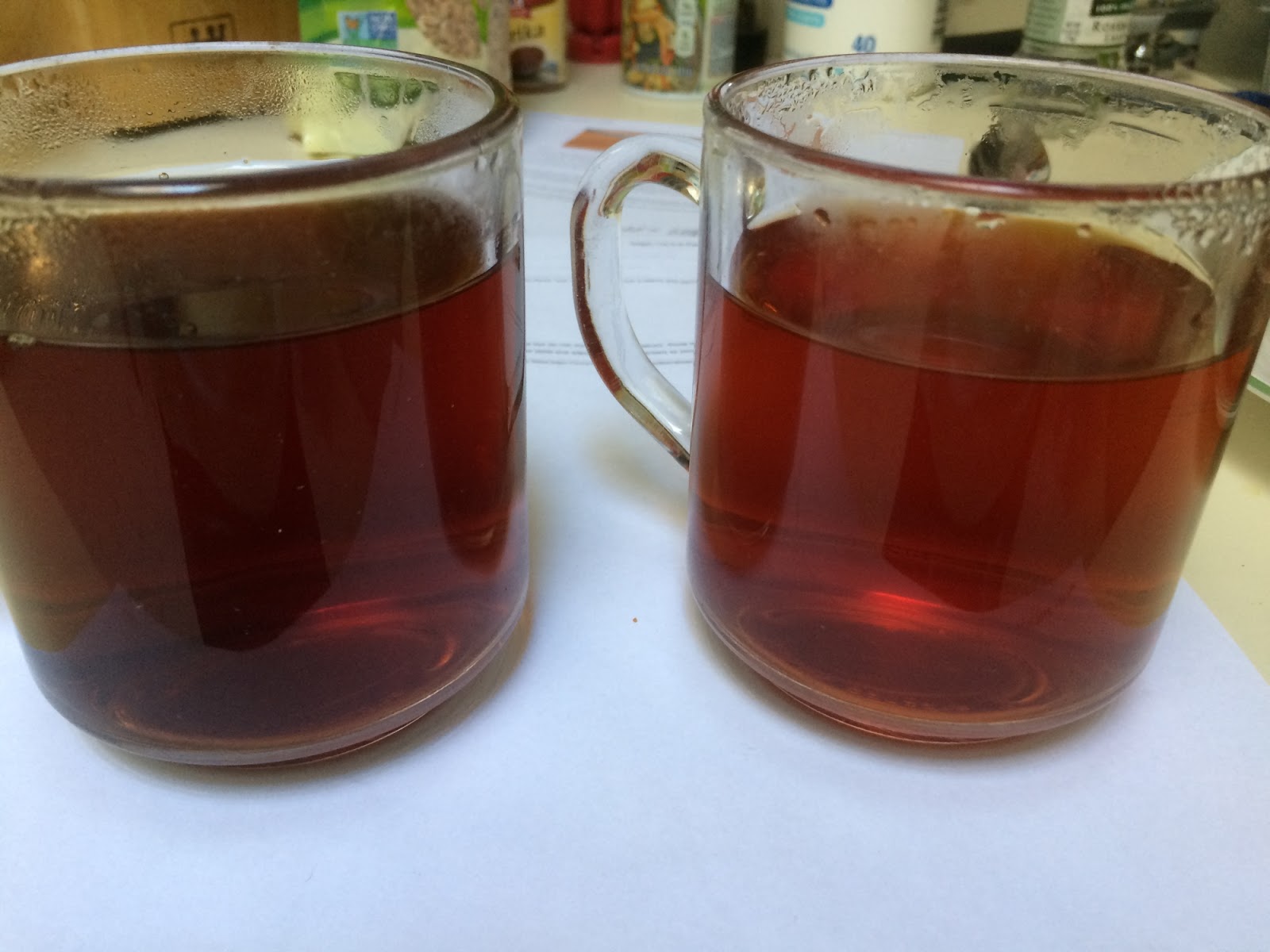
I read the label on the jug. It was a supermarket brand, filtered and ozonated. Ozonated?? Was that the difference?

Well, there’s only so much time I have for experimentation, so I didn’t then go on to test different varieties of water for tea making. I did look it up, and maybe someday I will do an actual taste test of different waters. (I sometimes use a Brita–how does that compare? What about those waters with added minerals?) I did think it was interesting, though, and I preferred the appearance of the tap-water tea over the ozonated one.

Now to the real announcement, which is that I’m not going to try to write any more blog entries until the New Year. There’s just too much other writing that I want to do, and all the usual holiday stuff. So…

Till next post in 2019. Happy Holidays.

Sugar, Sugar, Everywhere–the many names and kinds of sugars in our food

Years ago, a woman at my daughter’s daycare commented favorably regarding some sort of fruit-leather-ish snack, “And it doesn’t have any sugar.” At the time I thought, “I seriously doubt that,” suspecting she just hadn’t recognized some form of sugar in it. Unfortunately, it wasn’t a good moment to delve into the actual ingredients and discover just what sort of sugar was actually involved, so I let it pass.

To be fair, sugars come in so many varieties and are known by so many names (sometimes the same sugar has more than one name) that it’s hard to keep up with them all. So I’ve been doing a little research (mostly online) so I can present a list of different kinds of sugars and a little information on each, as well as some information on common sweeteners such as honey and corn syrup.
First, there are the simple sugars. I’m not a chemist and this isn’t meant to be a chemistry lesson, so I’m just going to say that the simple sugars we’re interested in have six carbon atoms and some hydrogen and oxygen atoms in various configurations, and other sugars are built from them. The simple sugars we typically hear about or see listed are the following:
Glucose: Diabetics have to keep track of the levels of glucose in their blood. Glucose that is added to foods sometimes goes by the name of “dextrose”. Glucose is somewhat less sweet than sucrose, apparently.*
Dextrose: See glucose.
Fructose: Known as fruit sugar, it is commonly found in fruits, but is also used as a sweetener sometimes. Sweeter than sucrose.
Galactose: I’m listing this one mostly because it is a component of lactose. Less sweet than sucrose.
Second, there are the disaccharides, which are sugars made up of two simple sugar molecules bonded together. Here are some of interest:
Sucrose(white sugar, table sugar): Made of a glucose molecule bonded to a fructose molecule.
Lactose(milk sugar): One glucose molecule bonded to one galactose molecule. Some people no longer have enough of the enzyme to break it down, in which case the lactose gets used by bacteria much farther down the intestinal tract with uncomfortable results. Lactose is apparently only mildly sweet, which maybe explains why lactose-free milk (in which the lactose has been broken down into glucose and galactose) tastes sweeter than regular milk.
Maltose: one glucose bonded to one glucose. Maltose is apparently significantly less sweet than sucrose, but sweeter than lactose. I should add that the properties of substances made of two or more sugars depends a lot on how the sugar molecules are bonded together—longer chains of glucose, depending on length and kind of bond, can be starches or cellulose. More on those later.
Alpha-gal: One galactose molecule bonded to another galactose molecule. Some people have a tick-bite induced allergy to alpha-gal, and react to beef and other meat from mammals. As far as I know, alpha-gal doesn’t get used as a sweetener and I have no idea if it tastes sweet.
Finally, there are longer chains of sugar molecules. In particular, there are starches and cellulose.
Starches are long chains of glucose molecules. Our bodies can break these down into glucose when we eat them.
Cellulose, on the other hand, we cannot break down. Cellulose molecules are very VERY long chains of glucose. They are found in plants and help give them structure. They also provide us with “fiber” as they go right through our system. Cows, rabbits, termites and other animals that have a diet heavy in grass (or wood)  have systems that can break down cellulose. I think most of these systems involve special bacteria.
So what sugars are actually in the various alternative sweeteners out there? I had to look this up, as I have never really been sure what is in honey or maple syrup, let alone agave syrup.
Honey: Apparently it contains both glucose and fructose, but separate from each other, not bonded together to form sucrose. At least, that was my understanding from what I read.
Maple syrup: Sucrose. Okay, that’s simple.
Corn syrup (not high fructose corn syrup, but Karo corn syrup that you cook with): Glucose. It sounds like this is roughly the same as the “glucose syrup” that shows up in British recipes.
High-fructose corn syrup: This is the one that gets added to a lot of processed foods. It contains both glucose and fructose. Hmmm, does that make HFCS a lot like honey, except for the flavor? Or does honey contain other interesting things that change how it affects us? I do not know. They sound pretty similar, sugar-wise. Another interesting thing: The HFCS industry is trying to persuade people that since high-fructose corn syrup contains the same molecules as sucrose, they should be no more concerned about it than they are about sucrose. But since how molecules are bonded together sometimes makes a difference in how they affect us, I’m suspicious of this reasoning.
Agave syrup: Apparently this is very high in fructose.
Also, concentrated pear juice and concentrated grape juice are sometimes added to foods for the purpose of sweetening them. These may have high levels of fructose.
I didn’t list stevia because it is something else entirely and not made of sugars.
To repeat, I’m not a chemist (I took organic chemistry in college, but that was more years ago that I care to admit). So if I have said something misleading by mistake, please comment with a correction.
Till next post.
 *I wasn’t able to find out if the comparisons of sweetness were weight-for-weight, or by volume (unlikely) or for comparable concentrations of molecules. I don’t think this information is very useful without knowing this. I’m guessing it was weight-for-weight.

Peach Kentucky Pudding—very easy, very tasty

Some of the best desserts are the easiest ones. Earlier I posted recipes for vanilla and chocolate custards that could be made in the microwave. Today I’m going to give you “Kentucky Pudding”, a cross between a fruit cobbler and Indian pudding.

I had never heard of Kentucky Pudding until I ran across it years ago in the Woman’s Day Encyclopedia of Cooking. I’ve never come across it since, which makes me wonder whether they made the name up for the cookbook. I can’t remember why I tried it in the first place, since I don’t usually get very excited about fruit desserts, but I do remember that I made it with peaches from a tree at work. They were soft, slightly wrinkled, very juicy peaches, and they needed to be used right away. They made an excellent Kentucky Pudding. And that is the key—use good fruit. This is the dessert to make when you find you’ve bought slightly too many strawberries or peaches at the farmer’s market or produce stand, but not so many that it’s worth making jam.
I ended up modifying the recipe, as it seemed to use way more butter than was necessary (about 6 tablespoons, as I recall.)
This dessert tastes wonderful, but it doesn’t look very impressive, so no photos. I recommend serving it warm in a bowl with some milk poured over it—or better yet, half-and-half. It reheats well.
Yum.
Kentucky Pudding
Fruit mix
2 cups diced or sliced fresh fruit (peaches, strawberries)
½ or more teaspoons sugar, depending on sweetness of fruit
Dry mix
¼ cup cornmeal
¼ cup all-purpose flour
1/3 cup sugar 
3/4 teaspoon baking powder
1/8 teaspoon salt
Liquid mix
1 egg
3 tablespoons milk
¼ teaspoon vanilla
For the casserole
2 tablespoons butter
½ teaspoon cinnamon
Preheat oven to 400. Melt butter in a round 1-quart casserole, coating the sides, and sprinkle cinnamon over it. (You may not have a round 1-quart casserole. An 8×8 glass casserole dish works, or even a large, oven-safe pottery bowl. If you use the 8×8 or other shallow pan, check the time early. It may not take much more than 20 minutes.)
Mix cut-up fruit and sugar and set aside. Note: you can leave the skin on the peaches. It won’t hurt.
Mix dry ingredients and liquid ingredients separately, then mix together. Add fruit and mix it in. Scoop it into your prepared casserole. Put it in the oven.
Bake for 20 minutes at 400, then reduce heat to 350 and bake an additional 15-20 minutes or until firm. It may not need the full time.
Cool slightly, then scoop into bowls and serve with whole milk or half-and-half. Makes about 4 servings.

This recipe works well with either peaches or strawberries. I haven’t tried this with plums, but it should be good with other berries. However, if you use blueberries, I suggest leaving off the cinnamon and adding a bit of lemon zest to the batter instead.

Till next post.