Candy Hearts and Conversation Sweets


Valentine’s Day is nearly here. Shelves in stores are crowded with red and pink containers. Much of the space is taken up by chocolate in heart-shaped boxes, but there are also a lot of bags of what is basically heart-shaped sugar. The most Valentine’s-y of these are the candy hearts.
Candy hearts are so appealing that you can find them depicted on fabrics, wrapping paper, and cards. I guess Hershey’s kisses show up once in a while, but candy hearts are a much more popular Valentine’s Day icon.
What’s so appealing about them? I think it’s the messages. Without messages, candy hearts would be just another heart-shaped candy that isn’t chocolate. Boring.
But what is it about the messages that makes candy hearts fun? After all, they aren’t exactly poetry. Mostly candy hearts offer a random assortment of sentimental cliches and catch-phrases, nothing particularly interesting or original.
I think what makes them fun is the very fact that you get such an assortment. You can pick through the hearts till you find just the right message to hand to a particular person. It might be a compliment: “Shining Star”, “You Are Nice”, or “Dear One”. It might be a request: “Be My Friend”, “Let’s Talk”, “Dance With Me.” It might even be a question: “Will You Marry Me?”
Alternatively, you can draw one at random and be surprised. It’s a bit like a fortune cookie.
It occurs to me that, like many other things, candy hearts lend themselves to stories. What if someone pulled a candy heart out of a jar, just for a quick mouthful of sugar, and discovered that it said something really unexpected?
 “You are being watched.”
 Or: “She’s lying.”
Or: “Look up.”
In fact, candy hearts (or something like them) do show up in stories. In Mary Poppins Comes Back by P. L. Travers, Mary takes the children to a very odd store where she asks for “an ounce of Conversations.”
“‘Are those the Conversations?’ asked Jane, pointing to the Jar. ‘They look more like sweets.’

‘So they are, Miss! They’re Conversation Sweets,’ said Uncle Dodger, dusting the jar with his apron.”
Jane gets “a flat star-shaped sweet rather like a peppermint” with the words “You’re My Fancy.” Michael pulls out a shell-shaped one with “I Love You. Do You Love Me?” The twins, John and Barbara, are given “Deedle deedle dumpling” and “Shining-bright and airy”, but Mary Poppins’s sweet is shaped like a half-moon and reads, “Ten o’clock to-night.”
Naturally, Mary Poppins explains nothing, and equally naturally, strange things happen that night at ten o’clock.
The tales of Raggedy Ann also involve a candy heart, if I remember correctly. A disaster leads to Raggedy Ann being restuffed, and the woman repairing her puts in a candy heart that says “I love you.” Later, Raggedy Ann falls in some water, and she tells her friends that since the candy has melted, the “I love you” is now spread throughout her insides.*
But enough about stories. Setting aside the content of the messages for the moment, how well do candy hearts succeed at being Valentine decorations? The colors are fine and so is the shape, but I have mixed feelings about the way they are printed. I like the large ones from Brach’s because they have longer messages, but the words look like they came from a bad dot-matrix printer. On the positive side, I suspect whatever technique they are now using allows them to vary the messages more, which is all to the good. Maybe the quality of the print will improve over the coming years. The Sweetheart brand small hearts have a long way to go—they are often barely readable.
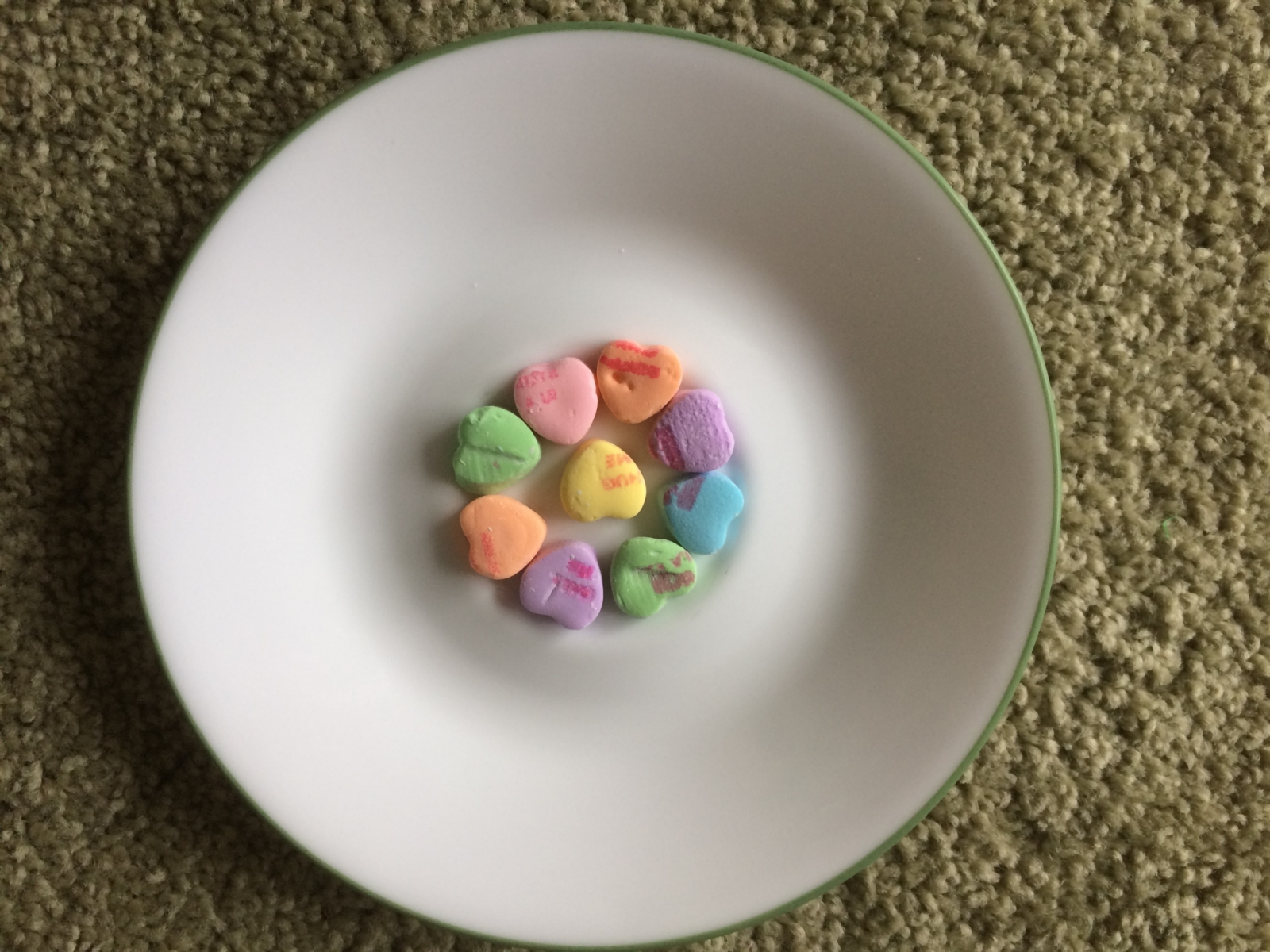
And how well do candy hearts succeed at being candy—that is, how do they taste? I bought the small Sweethearts because Sweethearts are made by the New England Confectionery Company, which makes NECCO wafers. I like NECCO wafers, and the hearts looked as though they were made of the same stuff, so I expected them to taste the same.
When I tasted the various colors, though, I wondered if they’d changed the flavors of their hearts. I don’t remember green being green-apple flavored, and the blue… did they even have blue hearts earlier? A quick check on-line shows that the flavors changed some years ago, which makes me wonder when I last bought Sweethearts. (They contain gelatin, so maybe not since my daughter went vegetarian?)
Since I don’t like the flavors very much, and certainly don’t need the extra sugar, I wonder if it wouldn’t be better to skip the candy altogether and substitute colorful paper hearts or wooden hearts with messages on the reverse. (I’m sure these must exist.) But then what does your friend or sweetie do when you hand them a suitably-messaged heart? Keep it forever? Smile appreciation and then toss it in the trash? (Or back in the bowl, if it’s a wooden heart?) There’s something to be said for being able to pop the message in one’s mouth after reading it.
Happy Valentine’s Day!
Till next post.
* Build-a-Bear uses a non-edible version of this trick.

The Idea of Soup


It’s cold outside and there’s a thin layer of snow on the ground. January. My mind is filled with The Idea of Soup.
Really, I should say it is filled with My Idea of Soup. Yours may be quite different. My Idea of Soup tends to be filled with chunks of vegetables, possibly also with beef but not chicken, and garnished with chopped parsley. I don’t think I ever actually garnish soup with chopped parsley—I rarely remember to add parsley at all. But in My Idea of Soup, there is fresh green parsley.
My Idea of Soup. Where did it come from? I can think of several sources.
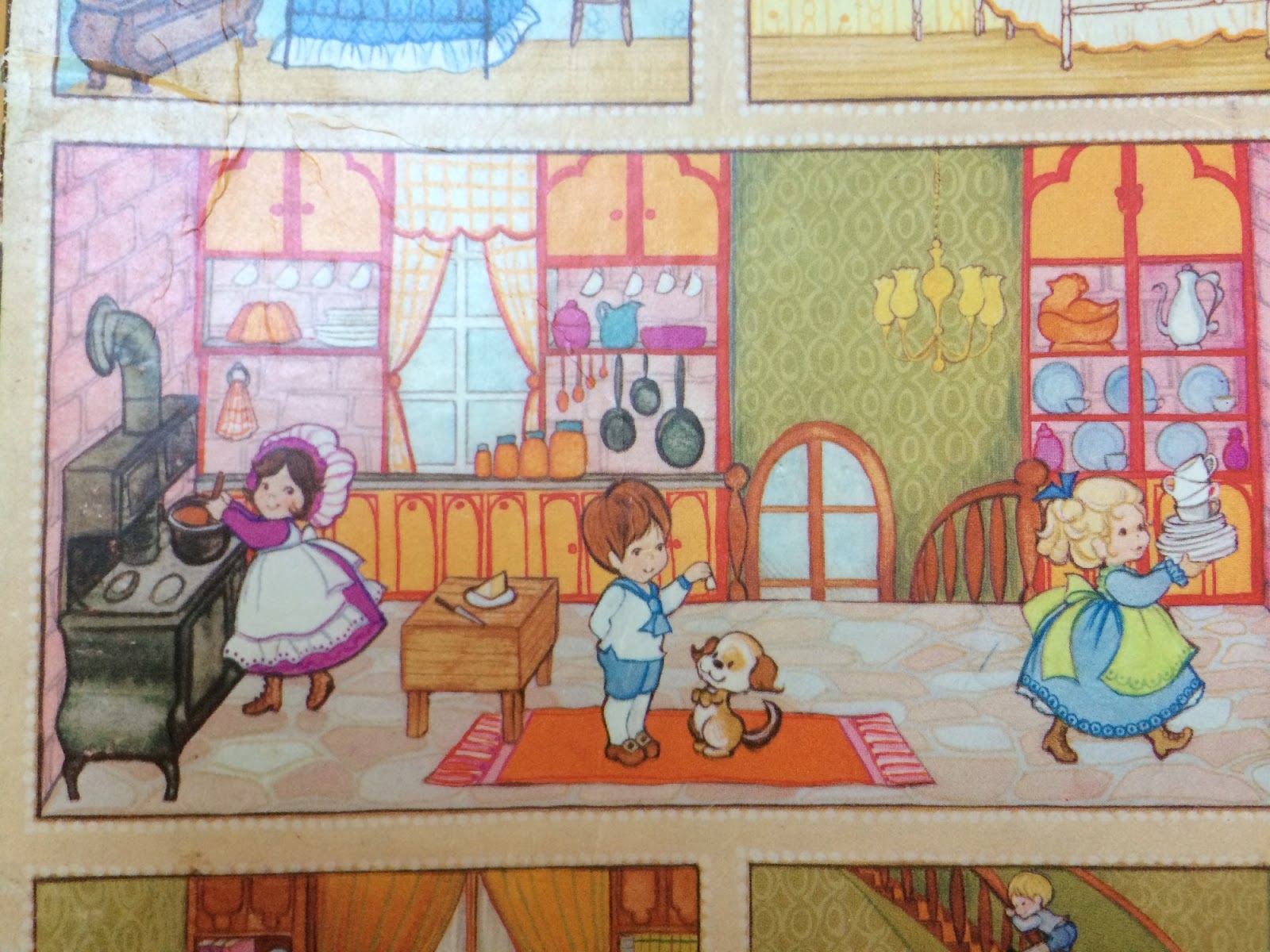
One is my favorite jigsaw puzzle, “Cubbyhole Cottage.” I was six or seven years old when I received it—my younger brother got a 60 piece puzzle with a jet plane on it. We used to have competitions to see who could put their puzzle together faster.
Cubbyhole Cottage jigsaw puzzle by Springbok
Cubbyhole Cottage, by Springbok
I liked to imagine myself as one of the people living in this old-fashioned house. Most often, I imagined myself as the girl in the purple dress and cap—the one stirring the soup. She seemed like the most important person in the house, as she was making the meal. The others were tidying, or setting the table, or watering the flowers, or just playing. Not nearly as important. Also, I liked the girl’s ruffle-edged apron.
Close-up of kitchen in Cubbyhole Cottage jigsaw puzzle
The hearth is the center of the home, even if not quite the center of the puzzle.
Another source for My Idea of Soup is a story by Margaret Wise Brown, “Mister Dog”, in a book of bedtime stories from long ago. The illustrations are by Garth Williams, one of my favorite illustrators.
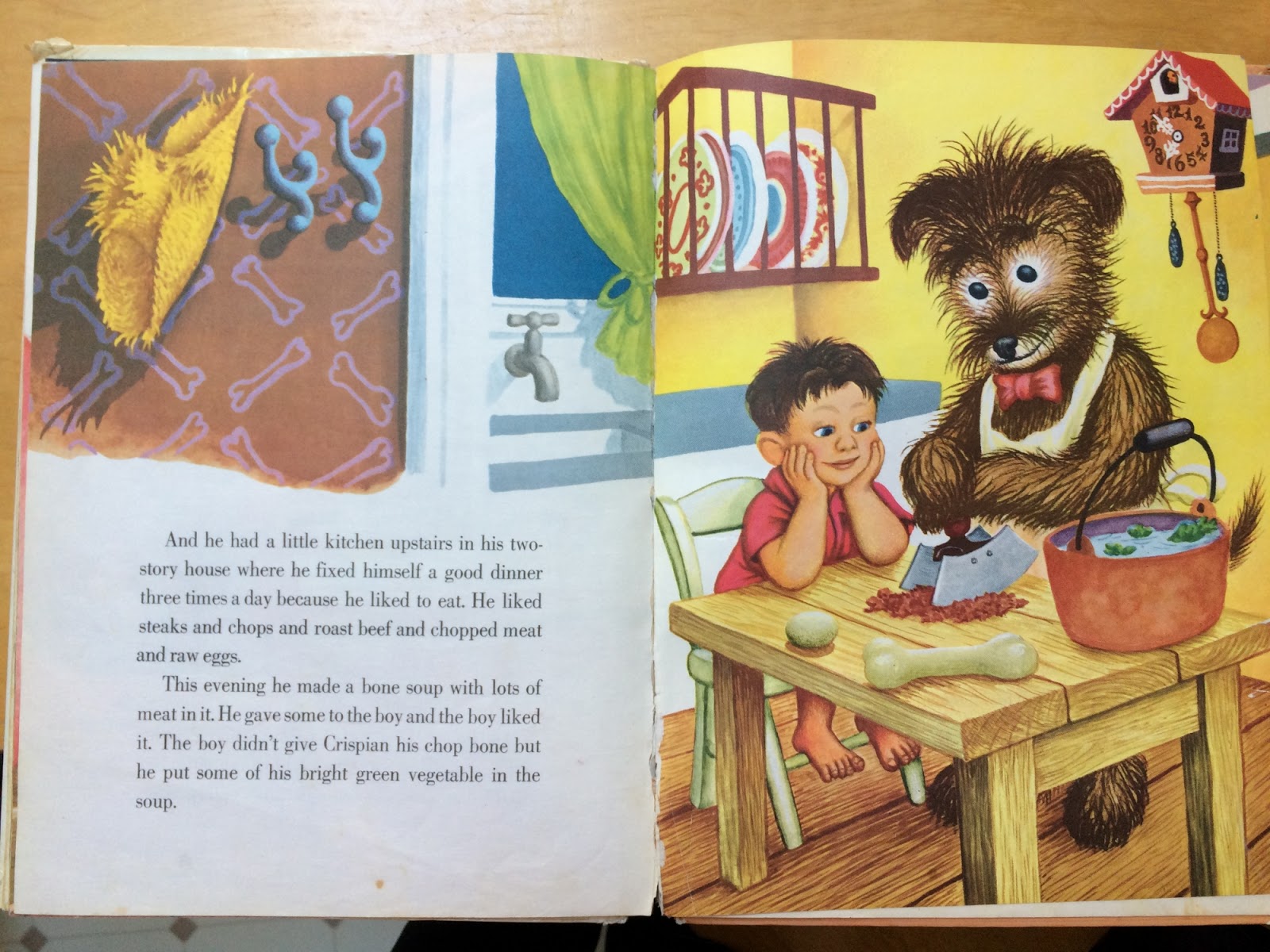
The story is about Crispin’s Crispian, a dog who belongs to himself. One day, after various adventures,  he meets a boy who belongs to himself and invites the boy to come live with him. They stop by the butcher shop on the way home, and the dog buys a bone while the boy gets a lamb chop and “a bright green vegetable.” The dog makes soup and gives some to the boy, who contributes some of his bright green vegetable to the soup.
Page from Mister Dog, showing boy and dog with soup and green vegetable
See the bright green vegetable in the soup? Also, I love the cuckoo clock.
And now you know why My Idea of Soup is garnished with fresh parsley.
Finally, there is the old story of Stone Soup. There’s something appealing about all those people contributing a bit of this or that to the pot, and ending up with a tasty, nourishing soup “from a stone!” I love that idea.
Alas, in practice I’ve found that adding random vegetables to my soup tends to work about as well as mixing a lot of random paints together. The result is muddy and not particularly appealing. Even when I try to stick close to basics, the results are variable. However, the following ingredients generally work for a “Parsley, Sage, Rosemary and Thyme” soup (except that as I said earlier, I tend to forget the parsley.)
·         Some chopped onion, usually sauteed in a bit of oil first
·         Bite-size stew meat, dusted in flour and browned a bit before adding liquid (now cooked on the side so the rest of the soup can be vegetarian—but add some broth to the meat to take advantage of the browned bits on the pan)
·         Canned diced tomatoes with liquid
·         Carrots, diced or bite-size as you wish
·         Water as needed
·         Potatoes, in bite-size pieces
·         Salt and pepper
·         Sage, rosemary, and thyme
·         Parsley, either dried with the rest of the seasoning, or fresh and added at the end
Sometimes I add a bay leaf or a splash of soy sauce. Sometimes, if it doesn’t need to be vegetarian, I add a dash of Worcestershire sauce. I’ve tried adding mushrooms, but results vary. Sometimes I add some broth along with the water, but I don’t like the way a lot of vegetable broths taste and I’m not sure whether they help the soup or not. Basically, I keep messing with it, but I haven’t been keeping accurate records so I don’t have a good sense of what’s working.
So I guess that’s what I should do, to fulfill My Idea of Soup. I should keep records the next time I make some vegetable (and beef) soup. Maybe I’ll even make some tonight. After all, it’s freezing outside and my husband has a cold.
Coziness and caring. Isn’t that what soup is all about?

Chocolate Tofu Mousse–a foamy chocolate tofu for you


Today I’m going to give you a recipe for Chocolate Tofu Mousse.
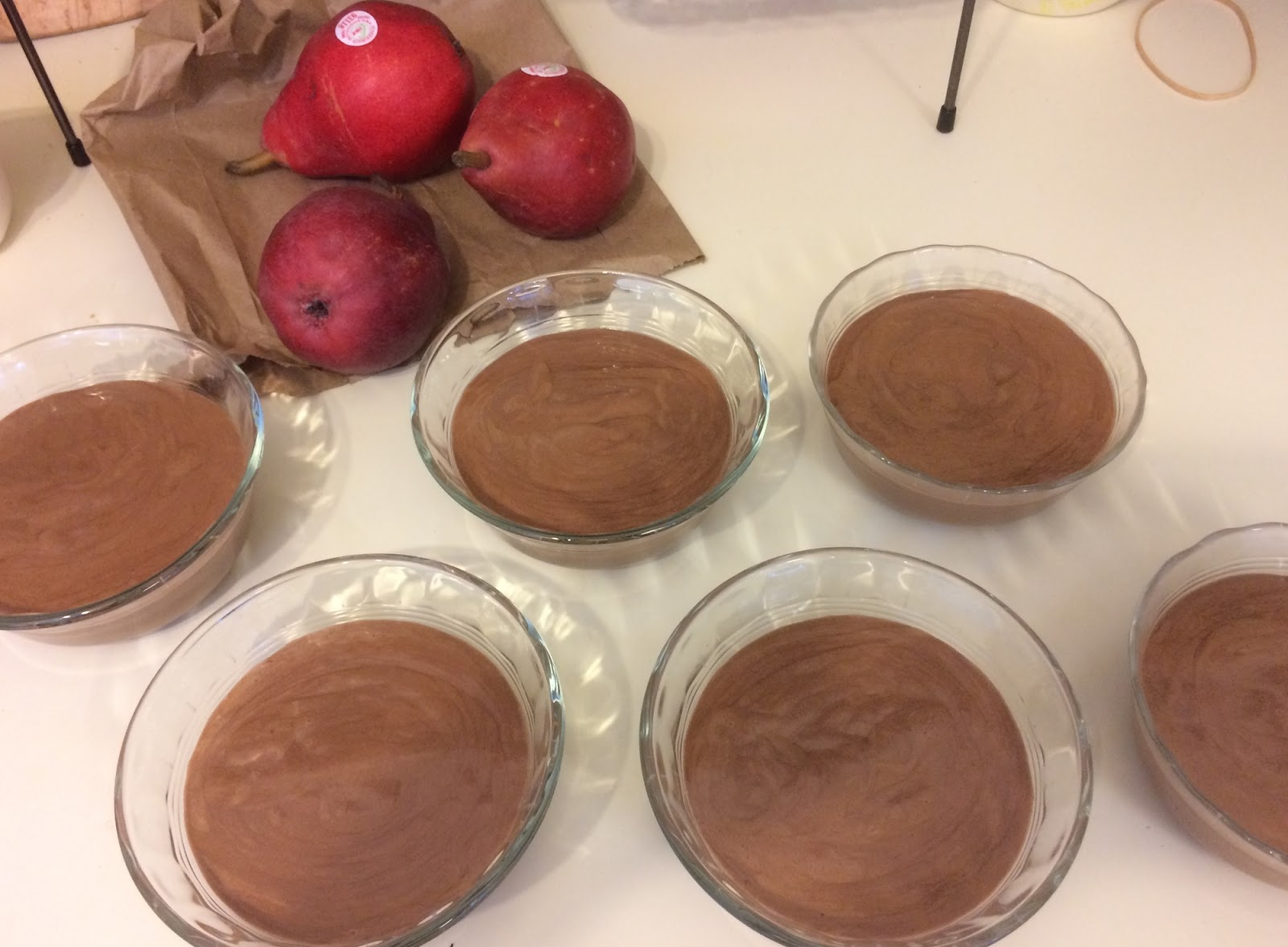
Six bowls of Chocolate Tofu Mousse
Why would you want a recipe for Chocolate Tofu Mousse? Good question. There are plenty of delicious recipes for chocolate mousse that use wonderful rich cream instead of tofu. There are even recipes that don’t use any dairy at all, without using tofu. And I’m not going to tell you that you won’t taste the tofu. My daughter claims not to be able to taste it, but she likes tofu so much that she eats silken tofu right out of the package. Unless you like tofu as much as she does, you’re going to notice a slight tofu taste. It takes a little getting used to.
One possibility is that you are looking for a dessert with protein. Between the egg white and the tofu, this mousse does have some protein. But beware! This is not a health food. It has sugar and chocolate. It contains no vegetables, and probably has negligible fiber. If you want something really nutritious, make a fried tofu dish with lots of veggies, or a veggie-filled omelet! Those can be tasty, too.
It is possible that you are looking for a dairy-free mousse. Sorry, I use milk chocolate in this (although you don’t have to—the original recipe uses three ounces of bittersweet chocolate.) Alice Medrich has a dairy-free mousse in Bittersweet (I had the wrong title earlier) Chocolate and the Art of Low-fat Desserts, and I even made it once, though that was twelve years ago. I remember it as being tasty, if rather intense.
You might be looking for a dessert that will boost your calcium intake. I am still checking to see if there is a silken tofu that is high in calcium. The brand I used for this recipe turns out to use a different coagulant, apparently, and so has little calcium. I don’t know if that’s a feature of silken tofu more generally, as compared to the non-silken type used for frying.
It’s probably pretty safe to say that it has less fat than more typical versions of mousse involving heavy cream. It doesn’t taste as rich either—you wouldn’t want to serve a cream-based mousse in the portions I show here. You’d get indigestion. I’m not sure whether “can be eaten in larger quantities” is actually a selling point, but there you are. A foamy chocolate dessert that is lighter than a cream-based mousse.
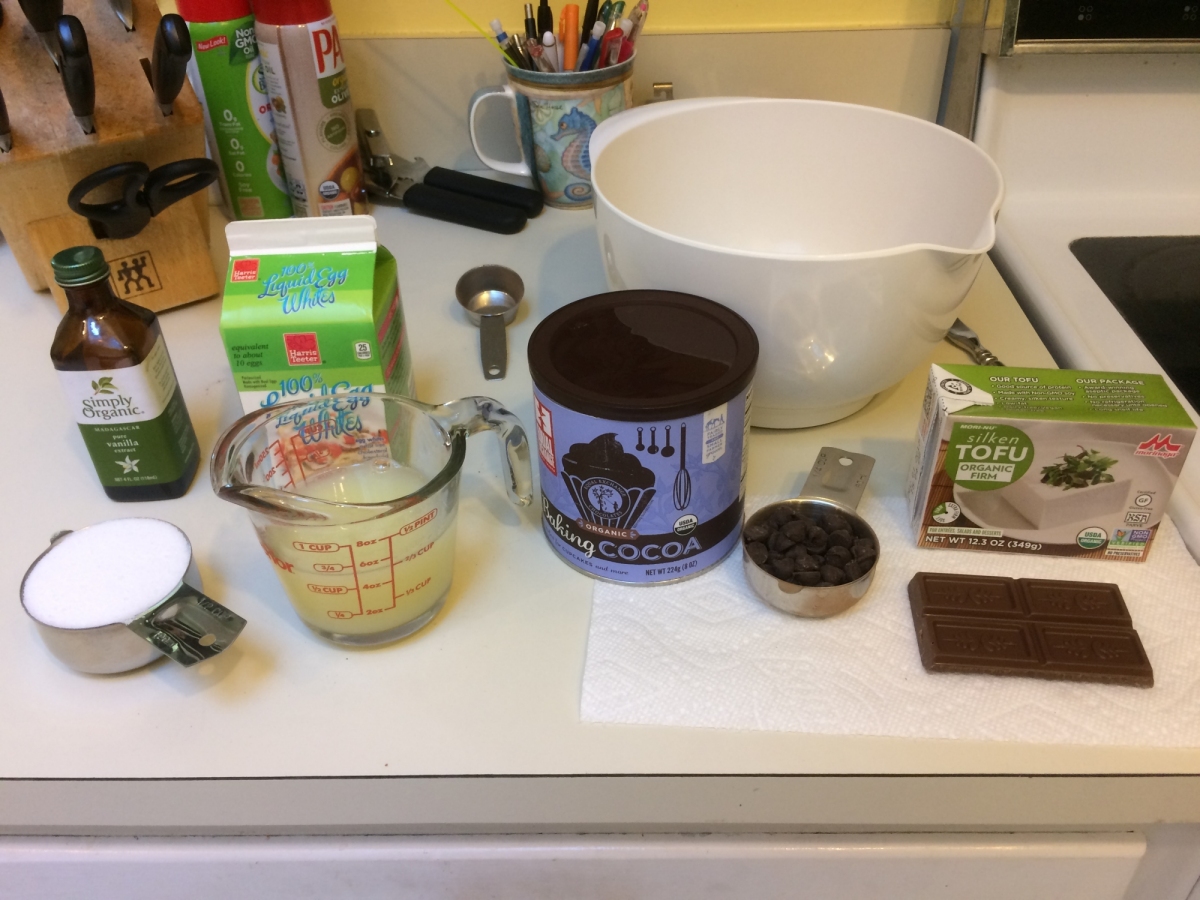
Chocolate Tofu Mousse (6 generous servings or 9 discreet ones)
12.5 oz silken tofu (the kind in aseptic packaging is unrefrigerated till opened)
3/8 cup Dutch-process cocoa
2 oz milk chocolate, chopped
1 ½ oz semi-sweet chocolate chips (about ¼ cup)
3/8 cup boiling water
1 ½ tsp vanilla extract
9 tablespoons liquid pasteurized egg white
½ cup sugar
Bring measured pasteurized egg whites to room temp or thereabouts if possible. They will not whip as well as regular egg whites, so give them every advantage. Also be sure that the measuring cup, mixing bowl, and whisk are all free of oil or grease. (Note: you want to whip egg whites around room temp, whereas you whip cream when it is good and cold.)
Ingredients
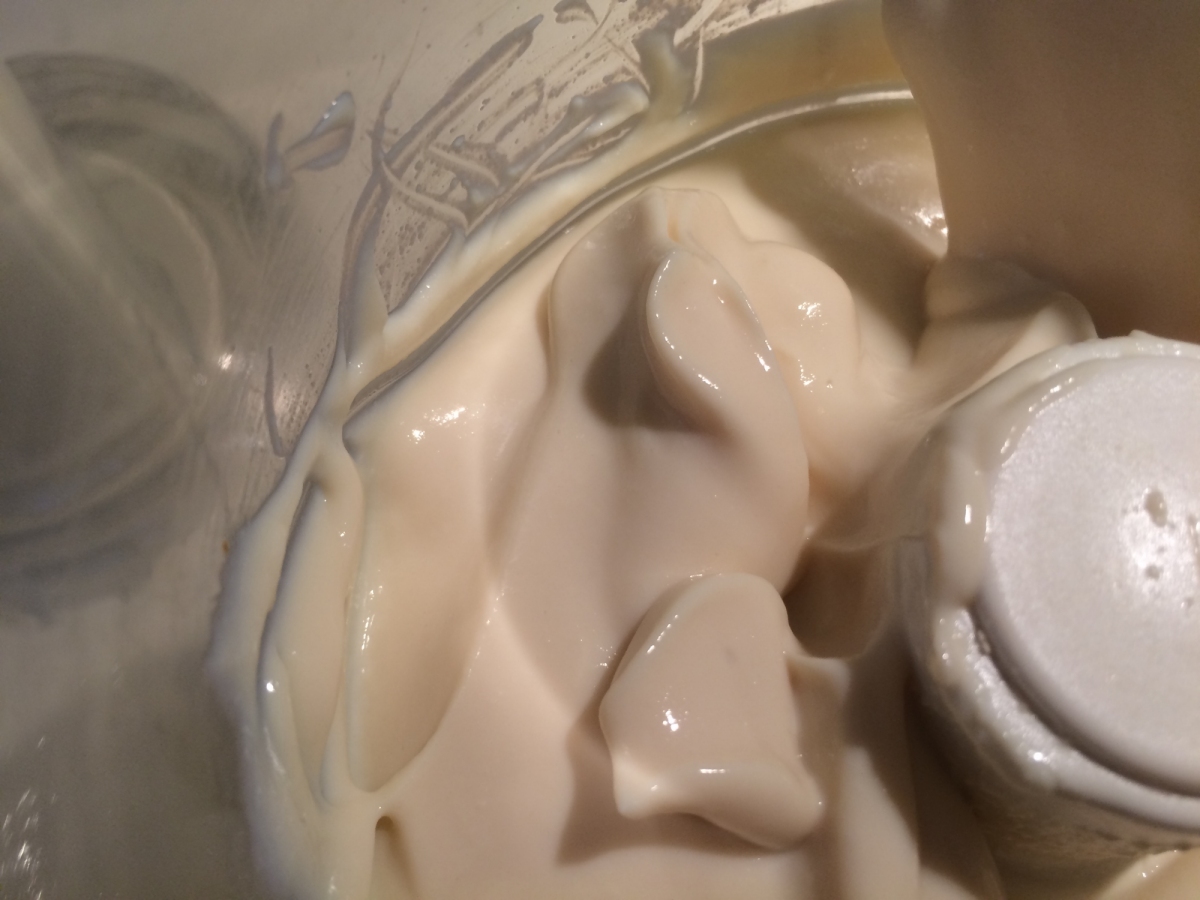
Puree the tofu in a food processor until it is velvety-smooth, perhaps 2 minutes.
Velvety smooth silken tofu
Combine cocoa and chopped chocolates with boiling water in medium bowl. Stir till smooth. Then I like to add the chocolate to the food processor, along with the vanilla, and really mix it into the tofu. But you could also put the pureed tofu in the bowl and stir there, I expect.
Rinse bowl (if you did as I do) and then scoop all the chocolate mix back into it.
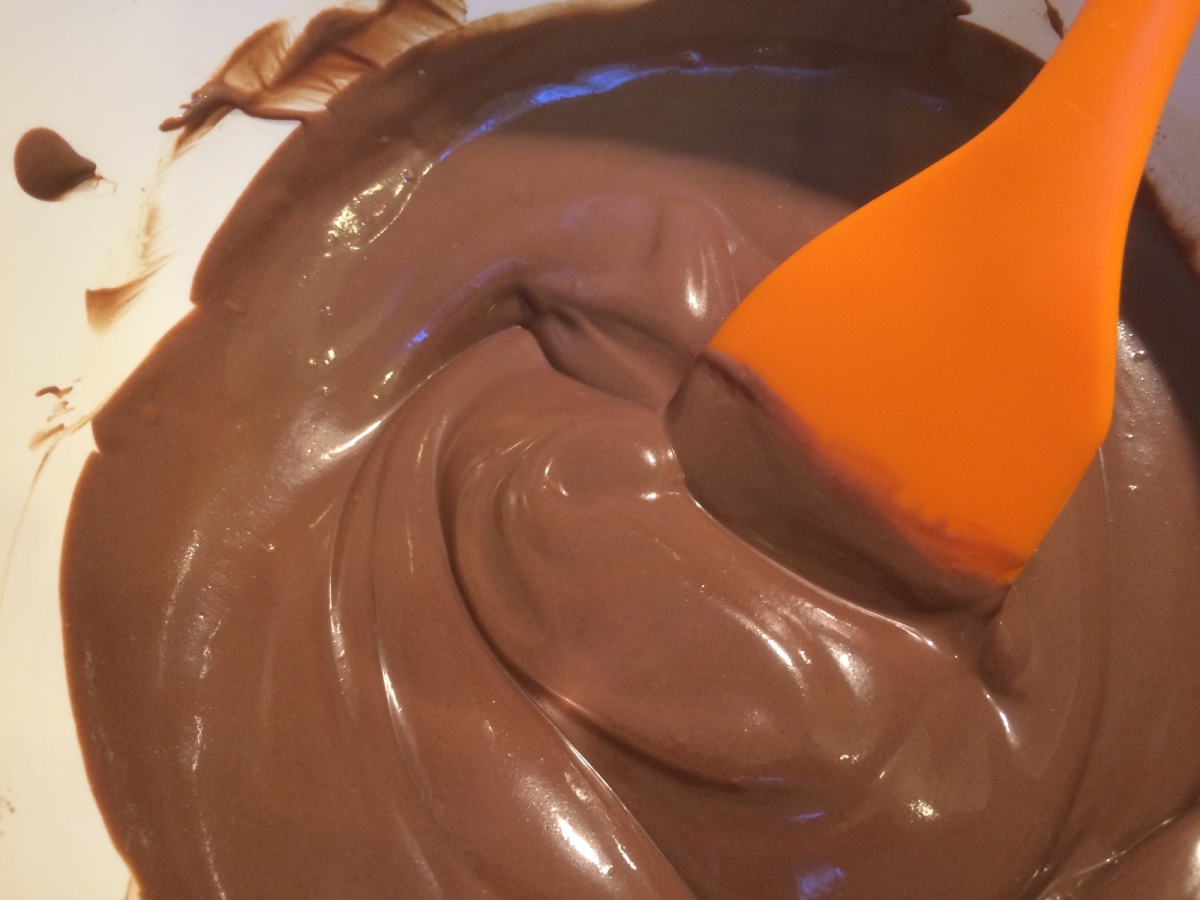
Chocolate mixture blended with silken tofu
Be sure to wash or at least thoroughly rinse all parts of the food processor before the tofu dries on it.
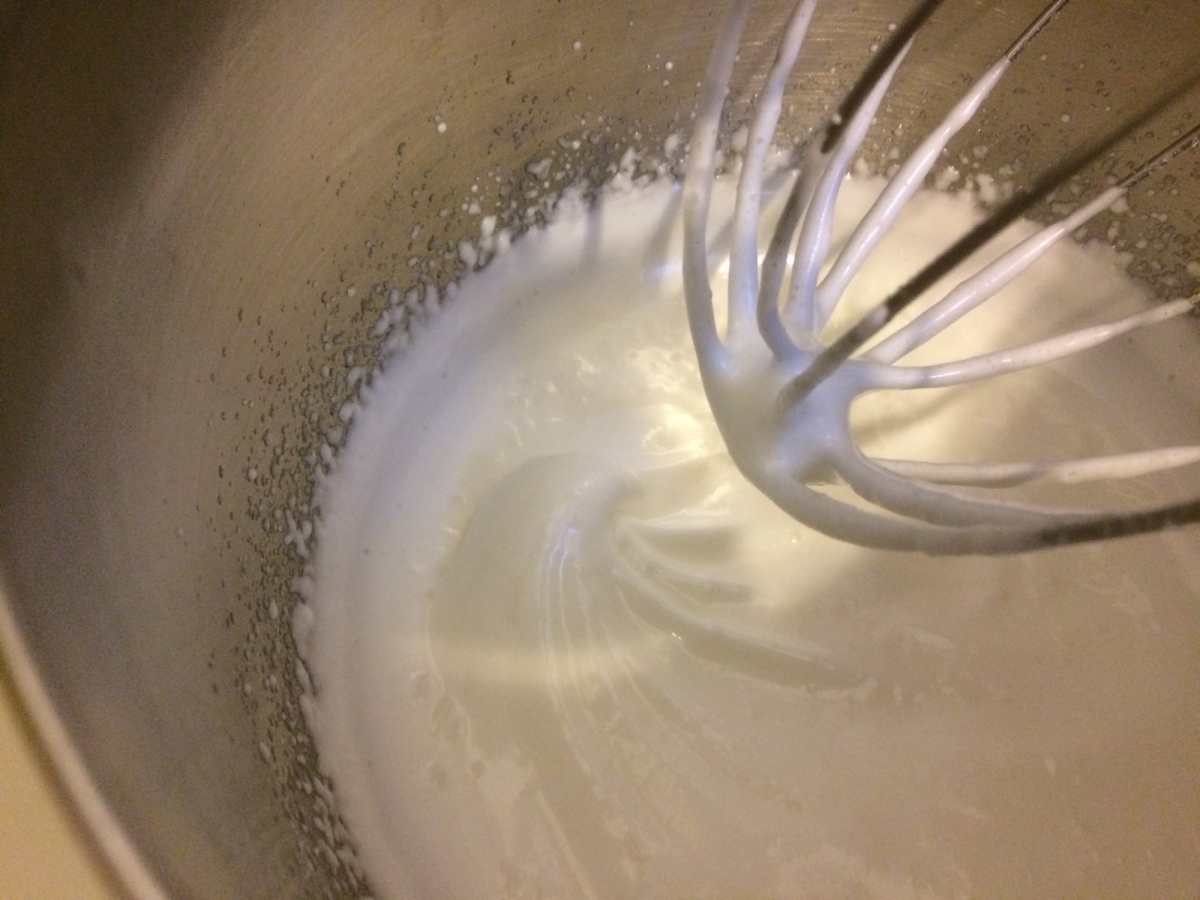
Now whip those eggs whites. Start in stand mixer (if you have one) with a whisk on medium. After they get a bit frothy, start adding the sugar. Increase the speed to high. It takes a while, maybe ten minutes, to get soft droopy peaks. Maybe if you continued, you could get it stiffer—I chicken out at this point since I’m not confident pasteurized egg white can whip that stiffly. Soft peaks still works for this mousse.
Whipped egg whites
Gently fold about a quarter of the whipped egg white into the chocolate mix to lighten it. Then add the lightened chocolate mix to the bowl of egg whites and fold till just blended. Spoon or pour mixture into dessert cups. Cover with plastic wrap (plastic should not touch mousse) and refrigerate three hours or more before serving.
 
The original recipe for this (from Weight Watchers Magazine) was for a mint-chocolate tofu mousse that used only bittersweet chocolate and cocoa, and added 3/8 tsp peppermint extract. You can use 3 oz bittersweet chocolate instead of the mix of milk and semi-sweet, for a more intense chocolate flavor. I would not recommend more than 1/8 tsp peppermint, though.
You can use powdered egg white and water instead of liquid egg whites. It would probably whip better. I just don’t like the extra step of hydrating the egg.
Till next post.