The Mystery of Lace

What is the mysterious appeal of lace? What makes lace so special among fabrics?

My current writing project, a cozy mystery sequel to Alibis and Aspidistras, centers on an incident at the Lacemakers’ Ball–an annual event in the fictional town of Grey Harbor. So, not surprisingly, I’ve been thinking a lot about lace. And how to create an air of mystery.

Lace itself has an air of mystery. On the one hand, it’s a fabric (or a trim). On the other hand, it depends as much on air and empty space as it does on substance. It teases, blocking your view, but only partially. It occurs to me that the appeal of lace is a bit like the appeal of reflections and shadows. Lace shows you not just itself, but a bit of something beyond.

Lace is mysterious in another way. How does that delicate network hold together?

There are different kinds of lace, of course. I understand crochet lace–how you can take one very long thread and make loops within loops to create a structure than doesn’t simply unravel. And years ago I took an introduction to bobbin lace and learned the basics of how threads and pins used together could create a woven web that remained even after the pins were removed–and how that web could be created in many varied patterns. But even having seen it firsthand, I find it amazing that it doesn’t just fall apart.

Photo shows three small samples of bobbin lace from introductory lesson, and a set of bobbins.
The sum total of my experience in bobbin lace.

This brings me to more personal mystery involving lace. My grandmere–my paternal grandmother–left me a box of lace. She had it stored away in a plastic box with a flower-embossed lid and a note, “For Samantha when she is a big girl.” I loved frills and froufrou as a little girl, so she probably imagined me adding lace trim to my clothes and household linens, just as she filled her house with lacy runners and ribbon-trimmed drapes.
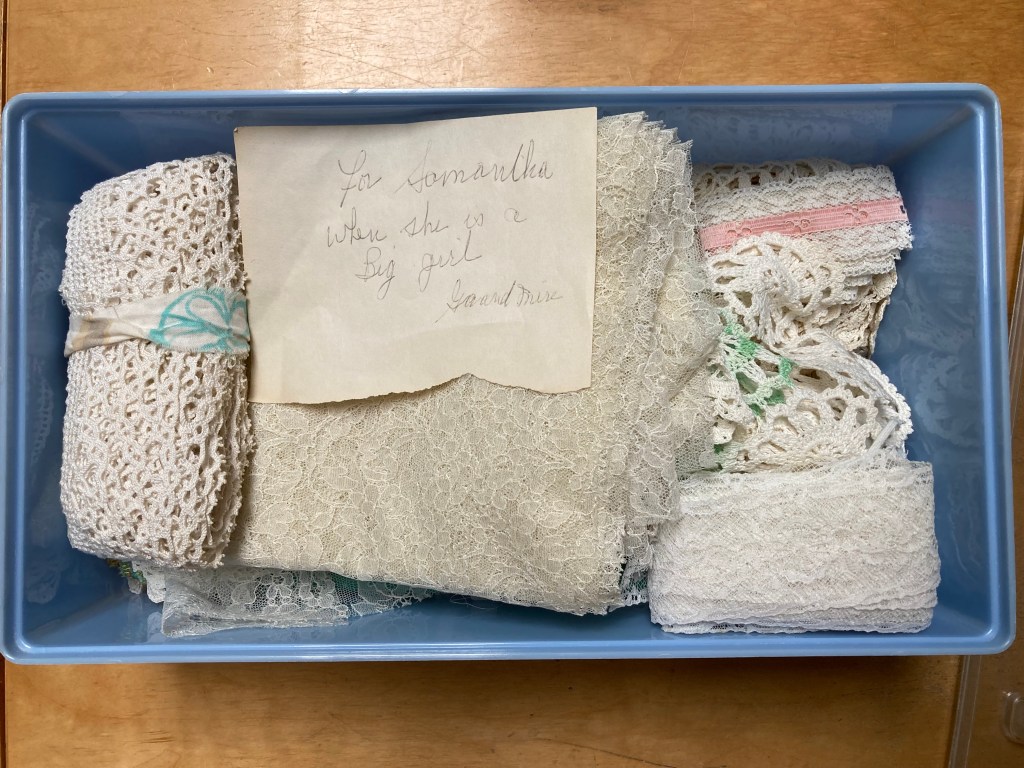
Photo shows box containing assorted kinds of lace and a handwritten note: For Samantha when she is a big girl, signed Grandmere.
“For Samantha when she is a Big Girl”

Where did the lace come from? Were these all bits and pieces left over from her own projects? My grandparents were thrifty and she would have saved any remnants, and probably anything that could be salvaged from old clothes as well. Or perhaps some of it was for projects she never started?
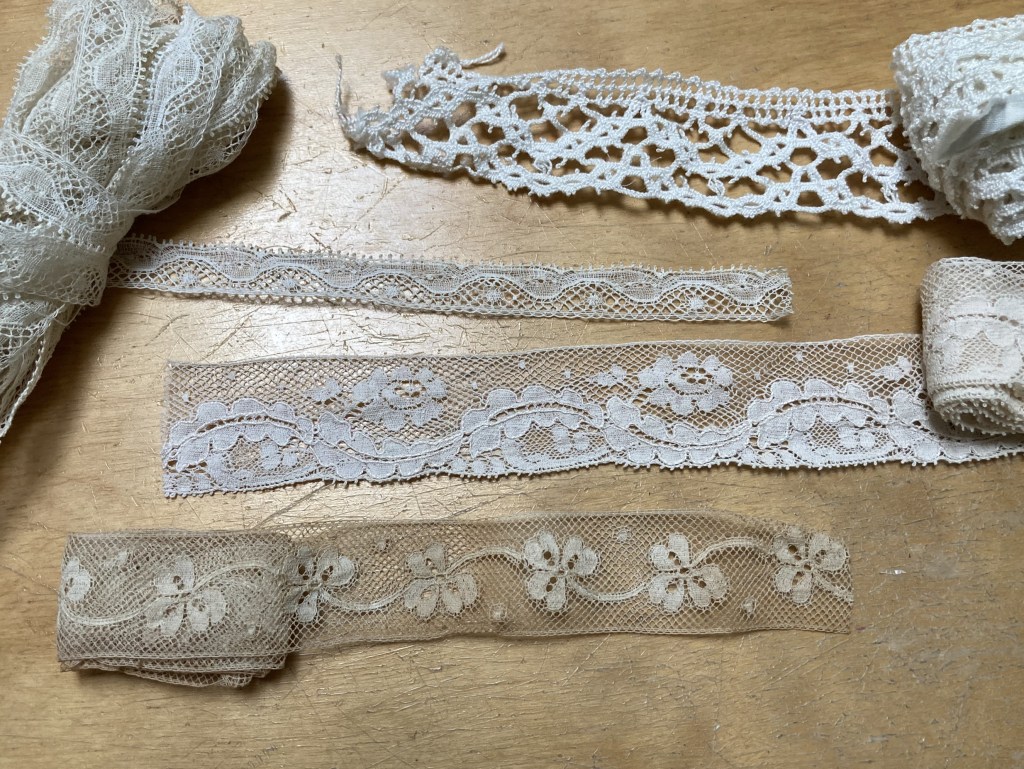
Four samples of lace: two abstract and two with realistic designs (cloverleafs and flowers).
Some of the lace trim, designs from abstract to realistic

On the other hand, one of the pieces in the box was a runner made of crocheted doilies, very like the partially completed doilies that were in with her other things, so presumably that piece is one she crocheted herself. Looking at it, I realize that I know very little about my grandmere’s skills beyond cooking and sewing. She once demonstrated tatting to me, but I wasn’t especially interested at the time and never asked to see more. Somewhere I have a wisp of tatting in the same beige thread as the partial doily–what else did she create? And did her lacemaking ever extend beyond crochet and tatting?

Some of the lace is clearly machine-made, and probably the rest of it–other than the doilies–is too. But I wish now that I had asked her to tell me more about her skills, instead of taking for granted the things that she made us–the crocheted cushion covers, and the pillows with our initials embroidered on them. It’s too late now. It will forever remain a mystery.

Till next post.

Virtual Versions of Real-world Activities–tidier, simpler, safer…but no substitute

Is there any danger that parents will let virtual versions of activities edge out the originals, perhaps in the interests of ease and tidiness? I hope not. The things kids learn from doing things in the real world cannot be replaced by virtual activities.

Let me start with some examples of virtual versions of real-world activities.
First,  consider “Cooking Mama”, a video game in which one follows procedures to “cook” various dishes. My daughter enjoyed this game when she was younger, and incidentally learned a few things about what ingredients go into what. That’s fine. But I would hate for anyone to regard this as cooking practice. Chopping pretend carrots is very different from chopping real ones. Safer, of course, but chopping real carrots gives a child practice in dealing with the physical world–in handling a knife, he judges how to position food for safe chopping, how much pressure to use, and how to keep his fingers out of the way. Similarly, while a child can’t get burned sauteeing virtual onions, neither will he learn how to judge doneness by sight and smell, nor discover that it matters how much oil is in the pan and how high the heat is.
Second,  consider computer art programs, which have gotten very good at imitating the appearance of paint, charcoal, and other media.  Digital art is a medium in its own right, with its own unique possibilities, and worth doing for itself. But it uses skills different from those required when applying actual pigment to a surface. Using a paint-tip in an art program does not require a child to judge whether there is enough—or far too much—paint on the brush. You cannot break a stick of virtual charcoal by pressing too hard. And while art programs include techniques not available with physical media such as paint, they also restrict the child in other ways.  She cannot mess around,  applying paint with toothpicks, sponges, or other objects at hand, discovering new effects in the process. Of course, she also can’t get paint all over her clothes, the table, and the bathroom sink.
My third example is pets, which is what prompted this post. When my daughter was young, Webkinz were popular, and Tamagotchi, and there seemed to be many games that let you “keep” a virtual pet. We also had real pets, and I kept noticing the differences between a virtual pet and a real one. Real pets are messy—sometimes very messy!—and the consequences of neglecting them more serious. Real pets are also much less predictable, and this is both good and bad. Good when they do clever, funny things that we never expected, like meowing when someone sneezes. Bad when they decide to go outside the litter box, or lick the frosting off the gingerbread house. Our real pets had personalities and quirks that slowly revealed themselves—one cat bold and forever searching the floor for crumbs, the other timid and prone to chewing on things, whether pencils, fingers, or plastic bags. Virtual pets are tidier, cheaper, and don’t scratch, but they aren’t nearly as interesting.
Having considered some of the ways in which virtual activities differ from their originals, why do I think it matters?
I think it matters because we all need practice in basic skills in dealing with the physical world. We never know when we will need them. As adults, we sometimes need to pour a glass of juice without spilling. We sometimes need to stick things together (tape isn’t always the answer!). Knives are useful for all sorts of things. We may need to help a friend paint a room without dripping paint off our brush.
It also matters because any simulation is a simplification of the real world, and we need to learn to deal with complexity. Even if we follow a cake recipe strictly, we need to be prepared to deal with real world factors that don’t show up in the recipe. Some ovens run hot. Different cake pans may lead to more or less browning. The baking powder might be old.
In the case of pets, there is additional difference between virtual and real. Real pet care has consequences for a creature other than oneself.  In Sherry Turkle’s book Reclaiming Conversation, she touches briefly on robot companions and pets, as well as A.I. therapists—on virtual relationships, you might say. Her concern seems mainly that conversation with computers may take the place of conversation with actual people, resulting in less practice in conversation skills (and so less conversation between people). Pets don’t talk, so conversation skills isn’t what I’m concerned about. But there is a relationship between a real pet and a person. Pets have their own needs, their own preferences, and part of taking care of them is respecting that. They are also vulnerable—we put them in situations where they cannot take care of themselves. The guinea pigs can’t get their own water and greens. The dogs can’t go hunting. Taking care of a pet is exercising responsibility and practicing some kinds of relationship skills.**
I started this by asking whether there is any danger of virtual versions of activities taking the place of their real-world originals. People are spending a lot more time with computers, but that doesn’t necessarily mean the real-world activities are being replaced. There also seems to be a trend toward making activities simpler, easier, and with less clean-up—packaging art activities with pre-cut bits and easy instructions,  offering meals that are half-way prepared to save time and effort—but even simplified, those are still real-world activities. I don’t know. I guess time will tell.
Till next post.
**I’m not suggesting every kid needs a pet, any more than every kid needs to practice painting or cooking. Besides that, the idea of giving a kid a pet to teach them responsibility leaves out the fact that parents need to step in as well, lest the pet suffer. Nor is this the reason people have pets—pets are fun! Pets are (sometimes) cuddly!

I Trust My Cat, and My Cat Trusts Me

Sometimes when I am sitting with a cat on my lap, watching Netflix, I am amazed that this creature trusts me enough to fall asleep there. I am certainly big enough to do her harm.
The trust works both ways, of course. She may be small, but I know how sharp her claws are. But I don’t even notice when she settles down mid-movie, though she could, if she wanted, shred my face.
Why do we trust each other? We certainly don’t have any contract with each other, enforceable or otherwise. We don’t even speak the same language. What we do have is our past experience with each other, and a strong need to trust.
I mention our need to trust because past experience alone isn’t enough. Bertrand Russell, in The Problems of Philosophy, points out that the chicken gets fed every day, right up until the farmer decides on a chicken dinner. How can my cat be sure she isn’t in the same position? The fact is, she can’t. But living with continual suspicion of each other—suspicion not based on anything in particular–would be an exhausting and unhappy way to live. We need to trust each other so we can relax and enjoy each other.
In the case of my cat, she is trusting me not to harm her. She also seems confident that I will put out food every day. It’s a fairly uncomplicated relationship, given that we can’t communicate well enough to set up rules. Otherwise I’d feel betrayed, rather than annoyed, when she scratches the sofa or climbs up on the table.
People have much more complicated motives than cats, and it’s harder to know when to trust them. Our lives together are full of rules, written and unwritten. Our decisions about whom to trust are still based on our shared past experience, though we can also consider what motives they might have. We can worry about the possibility that we are chickens being fattened up. But we desperately need to trust at least some people in order to be able to live and work together.
Sitting with my cat reminds me how important trust is to our sense of security, and oddly, how basic it is. It’s about expecting not to be harmed by the other. Maybe with a little food and treats thrown in.
Till next post.