Woodsmoke, Kayaks, and My Dad

Last weekend, my daughter camped out with other members of her mountain bike team on the night before the race. We dropped her off at the campsite before heading for our own, cozy hotel room.
The family camping area was packed to capacity. Kids ran around yelling; someone had a campfire going. The trees, the smell of woodsmoke, and the noise brought me back to the times my dad took us all camping, and my brother and I were the ones running around playing loud games. I vaguely recall helping out with the tent—something about poles that fit inside each other, perhaps matched by color? Sleeping bags, of course, and maybe air mattresses that had to be blown up? And Cutter’s, of course, to keep off the mosquitoes.
You can tell I didn’t really take to camping, since I haven’t camped for years. Still, standing there smelling the woodsmoke, I thought about my dad and was glad that he had taken us.
I thought about my dad a month or so earlier as well, when my daughter was going kayaking with members of Boat Club.  They needed another adult on the water. So I rented a plastic kayak along with the others and got in awkwardly. Once on the water, though, I really enjoyed it. I watched the kids messing around and wished that my dad could be there to see his granddaughter on the water—and to paddle his own kayak again.

Girl in plastic kayak
M out on the water in her kayak
I remember helping him put together the kayak when I was a kid. It came in several heavy canvas bags. Wooden pieces had to be slotted together, poles had to be inserted along the sides, and then the two ends had to be pushed into the rubberized hull before they could be locked together and the seat backs put in place.
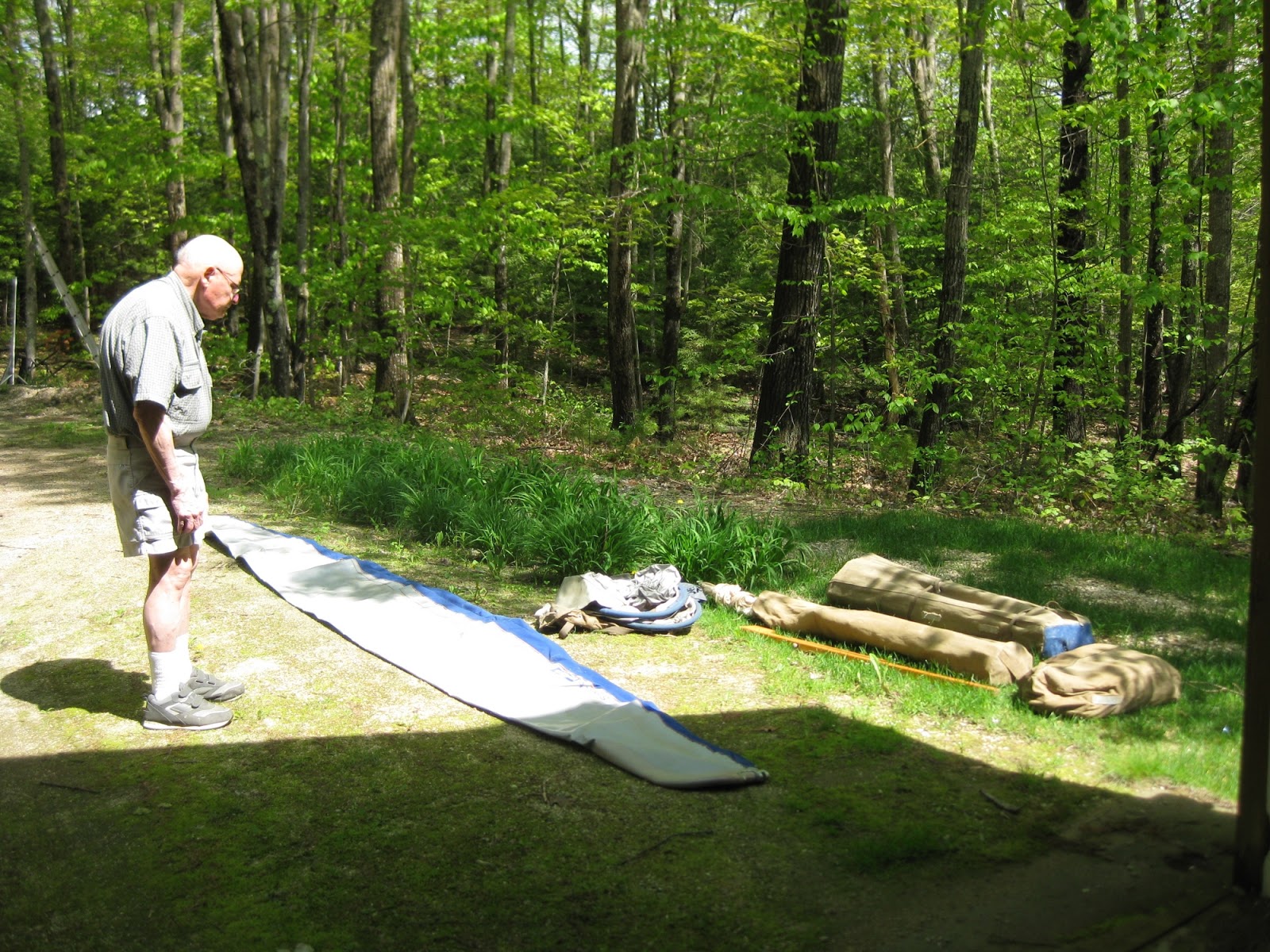
Collapsible kayak Klepper Aerius in bags
Taking a last look at the Klepper Aerius.
Then we would go out on the quiet lake and paddle around the edges. 
There are other things I learned from my dad. He liked to make things, sometimes from kits. I remember a down parka, a paper clock with a pendulum, and of course the electric organ, which took forever with all those wires to solder. I learned some basic skills from him as he carried out his projects—how to use the sewing machine, and how to cut and score paper. (I didn’t get into electronics, though he let me try soldering some wires.)
He also had a great interest in the latest technology and insisted on getting a computer back when it seemed like a crazy idea. I mean, who had a computer in their home?
But he got a Sinclair and it had so little memory that you could easily type in a Basic program and run out of room before you were done. And what do you know—he was right about computers being interesting. Now everyone has one.
He liked to garden as well, but since he also liked to travel and we moved every two years, his gardening was limited. I, on the other hand, was determined to live in one place when I grew up and have a really nice garden. But we shared a love of home-grown tomatoes. I always try to have tomato plants, even in years when the rest of the garden is in sad shape.
Girl in front of light-box with lettuces and other plants
Me as a kid in front of his light-box for growing plants
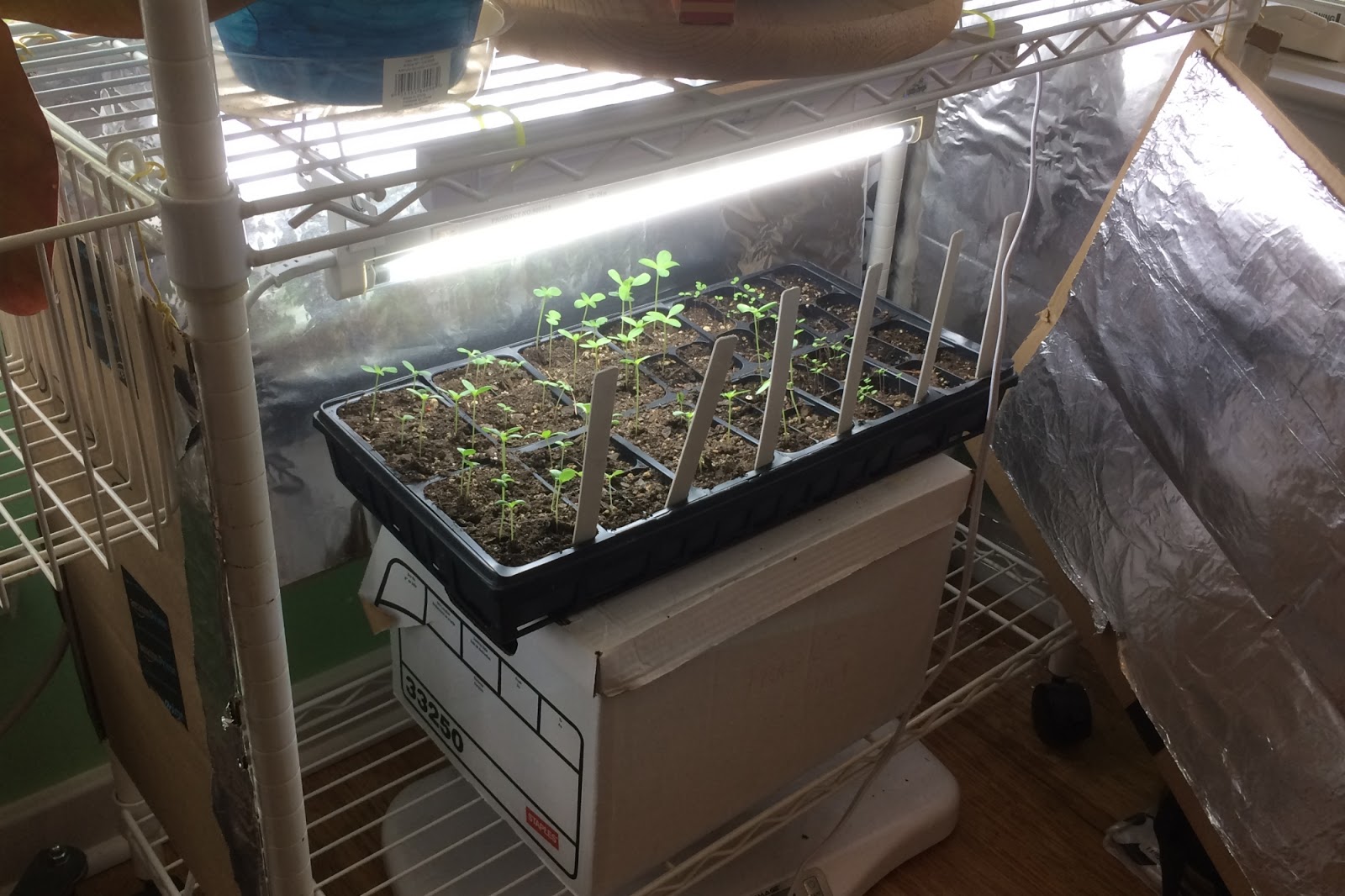
Light-box made from wire shelving with cardboard and foil for starting seedlings
My own attempt at a light-box for starting plants
There were things my dad didn’t like, certainly. He was scornful of “ya-ya music”, which is what he called rock, and probably most music that followed it. (Did he get the term from the Beatles’ song “I love you, yeah, yeah, yeah, I love you, yeah, yeah, yeah”?) He abhorred the practice of having a TV in the living room (never in our house) or watching TV during meals. Really, he disliked most TV shows except documentaries.
And he could have the most irritating little smirk when he felt he was winning an argument.
Overall though, he had a lot of enthusiasm and a lot of interests. I wish that he could be here to share them with his granddaughter.

"For Instant Human, Add Coffee"–are we really that tired?


So, I’m looking at a paper napkin in a popular coffee shop and it has a picture of a mobile phone that says “Download the mobile app” and the words “Because at 7 a.m. you can barely tie your shoes, let alone count money.” I laugh at image it conjures up.
Wait, what?
Caribou Coffee paper napkin with joke about lack of sleep
Do we really live in a world where lack of sleep is so pervasive, so ordinary, that the thought of people trying foggily to count their change makes us laugh? If I were thinking straight, I would take this as a compelling reason never to drive anywhere near a coffee shop before 10 a.m., lest I run into these people (literally).
But of course, I’m not thinking straight. I’m here for the caffeine, too, albeit in the form of tea. And I already knew that we lived in this world—jokes about coffee and cranky grown-ups abound. You can find them on t-shirts, magnets, and, of course, coffee mugs.
How in the world did this become normal?
There are some people who are painfully aware of how precious sleep is—people with insomnia, or chronic pain, or perhaps a new baby. No doubt they would trade all the coffee in the world for a good night’s sleep. There are other people who can’t keep their eyes open past nine p.m. and who awaken in the morning… well, who awaken. As opposed to crawling out of bed still half-asleep. They probably wonder what the big deal is with morning coffee.
Back to the question—how did being tired become normal for so many people?
Electric lighting surely helped. It’s a lot easier to stay awake if you have bright lighting. (I was going to bring up slide shows and people falling asleep in the darkness, but does anyone do slide shows any more? I think Powerpoint “slides” might be a lot brighter than typical photo slides.)
Not only is it easier to stay awake, there’s a lot more you can do. You can easily read, play cards, make model planes, etc. That’s before we bring in television, then videos, then computer games and Netflix. Now you can be highly entertained twenty-four hours a day. If you do fall asleep, it won’t be from boredom.
Or you could work, if your work involves using computers, answering email, reading professional journals, or anything that doesn’t require you to be on site. You could try to catch up on the endless list of tasks.
Going to bed is boring. Reading or watching a movie is fun. Going to bed means putting yourself that much closer to having to get up again and go to work.Staying up playing a computer game squeezes in a couple of hours more enjoyment before the whole work cycle starts again. No one wants to let go of those precious evening hours.
The consequences are many and varied and have been written about at length (so I’ll be brief). Impaired driving. A tendency to road rage. Short tempers with family members and friends. Accidents, both major and minor. Foggy thinking, and all that follows.
I can tell I’m really tired when I hit myself opening cabinet doors and start dropping things. I snap at whoever is around. I am not a happy camper. Admittedly, I may deal with fatigue worse than some people, but the sneaky thing about being overtired is you can’t always tell how much you are affected, because your judgment is affected as well.
The point I’d like to make here is that this is not merely a health problem, or an inconvenience, but a moral problem as well. Even if you don’t endanger anyone by driving when tired, if lack of sleep leads you to bicker, yell, or fail to pay attention to your family when you should, then it is contributing to your behaving badly.
I have no solution to offer. Saying “Well, just put down the phone/turn off the TV/close the book and get to bed earlier” is like saying “Eat less sugar and starch, exercise at least a half hour daily, and drink enough water.” It’s true, but it doesn’t help us do it. By now, most people who aren’t getting enough sleep are probably well aware of the problem. We have reasons to change, but no urgency. Next week is soon enough for an attempt to change our bedtime. Or next month… And it’s hard to make any change that feels like a sacrifice (“But I don’t wanna go to bed yet!”)
Maybe the right routines would help. I know, for instance, that I shouldn’t start reading a new book after dinner, unless it is very short. It’s easier to avoid starting a book than it is to put the book down when I’m halfway through. Still, sometimes I just want to read.
Maybe we need some collective agreement, some kind of peer pressure? I don’t know. But the problem doesn’t seem to be going away.
Till next post.

Good Children's Books–good for grown-up or child?


This week I was thinking a lot about picture books and early reader books and what makes some of them better than others. Then I asked myself, better for whom? The grown-up or the child? Is there a difference?
There seems to be. Some of the books my daughter liked and wanted read repeatedly were not books that I liked or would have chosen myself. For instance, some of the books she enjoyed were DK board books—basically, pages of thematically related photos with captions. She had a Halloween book, a book about colors, and I just found the Baby Faces book she adored. These books were incredibly boring to read aloud. There are only so many times that I can point to pictures of spider cupcakes or pink balloons and find something to say about them. “Those would be fun at a party.” But she clearly enjoyed the books.
More interesting to me as a grown-up (though still somewhat difficult to read aloud) was Children Just Like Me. I liked looking at the children from different countries, reading the central text about them, and then examining photos of their favorite meals, toys, drawings, and so forth. Reading this book aloud still involved a lot of pointing at photos, reading the caption, and commenting, but at least it was something more interesting (to me) than spider cupcakes or pink balloons.
On the other hand, there were books that I really enjoyed but which which probably had less appeal for my daughter. In particular, there was a book called Five Minutes’ Peace by Jill Murphy, which was about a mother (elephant) who just wants five minutes to herself away from her rambunctious and demanding children. It was funny and it rang so true for me as an adult, but I always wondered what my daughter was getting from it. After all, she was a child and the mother in the story, patient though she was, really wanted time away from her kids. Did she think it was funny because parents do say things like that? Or funny because of the way the kids hopped in the bathtub with her and made waves and splashed and were naughty children? (Naughty children are the most entertaining kind.)
I also really enjoyed the Commander Toad books by Jane Yolen, but these are most entertaining if you are old enough to appreciate the puns and have enough familiarity with Star Trek and Star Wars to catch the references. Since they are early reader-type books, it seems likely that the grown-up doing the reading is going to get more of the humor than the child being read to. Still, the books have enough adventure and uncomplicated humor to be fun for the child as well, and it’s good to be dipped into wordplay early on.
Probably most of the really good books appeal equally to children and adults. I really liked Bread and Jam for Frances as a child—Frances’ rhymes are fun, and I could understand the situation of someone really, really liking a food more than anything else until suddenly they don’t. I can’t say the book inspired me to “practice with a string bean”, but I did love to hear the detailed description of  Albert’s lunch and later, Frances’s lunch. I still like this book, and for the same reasons.
I don’t remember how I felt about Frog and Toad as a child, but I love them now. The situations are mostly universal ones: not wanting to get out of bed, being reluctant to try something new, wanting more cookies than is good for one, running into unexpected problems with a task, and getting all upset about something that turns out to be silly. The characters are clearly defined. Toad is the one who worries, who is reluctant, who is sometimes quite silly, but who, it must be said, retreats with dignity when his pride is offended. Frog is easy-going and a loyal friend. He never gets mad at Toad, even when Toad is being especially silly or stubborn.
The conflicts in the stories are clear, too. Frog wants Toad to share spring with him, but Toad wants to sleep. Frog and Toad both decide to make a nice surprise for the other, but the weather foils them. Frog sends Toad a letter to make him happy, but the snail takes too long to get it there. Toad prepares to rescue Frog from imagined dangers, only to find Frog safe and sound.
And then there’s The Cat In the Hat. It has beautifully smooth rhyming, a frantic fish who is worried about the children’s mother coming home, and a mischievous cat who likes to play games—games that are dangerous in the “you’re going to break something!” kind of way, not the “someone’s going to get hurt!” kind of way.
My daughter enjoyed The Cat In the Hat, but did she like it as much as I do now? I don’t know. I do remember that she enjoyed it. Maybe part of the reason I like these books so much now is that I have gotten pickier about books over the years, so the ones that still read well (to my grown-up self) stand out as especially good.
Fortunately, we had plenty of opportunities to read aloud when she was young, so we were able to try a lot of different books, some better for her, some better for me. (Thank you, public library!!) And it’s possible that the occasional reading of Five Minutes’ Peace gave me the patience for yet another reading of the Halloween book.