"They Spoke French"–how stories get lost between generations


The stories you think you’ve passed on to your children are not necessarily stories they know.
Earlier this year, I was talking with my daughter about who-knows-what, something to do with languages, and I said that since my grandmere and grandpere always spoke to each other in French, and usually spoke in French to my father as well, I had grown up thinking it perfectly ordinary that grown-ups sometimes spoke to each other in a language the kids didn’t understand.
“What!” She nearly fell off the sofa. “They spoke French? I didn’t know that!” She had assumed that they spoke Italian, which would be a reasonable thing to assume if I hadn’t told her otherwise. My grandparents had come over from Italy, after all. Just… a French-speaking part of Italy. At least for Grandmere.
“I’m sure I told you!” And I probably had. Once. When she was very young. And apparently never again.
So she hadn’t known, and hadn’t had the slightest idea that her own Granny and Grampy could also speak French (though they didn’t normally speak it to each other, and probably hadn’t spoken it for years.)  Had she known, she said, she might—might—have considered taking French in school instead of Latin.
Suddenly things were clearer. I had wondered a little about her choosing Latin. I had offered good reasons why French or Spanish might be more fun (including that fact that I knew some of both and we would be able to talk together), and in the back of my mind I had wondered that the family connection didn’t seem to enter into her decision. But I’d never actually said, “Why don’t you take French? Your great-grandparents spoke French and your grandparents would probably be delighted.” No, I just assumed she’d considered that fact and decided that Latin would be more fun, especially since she already knew the Latin teacher and liked her.
And she did get a series of very fun Latin teachers. Later she went on the Latin Club trip to Italy, so the family connection did come in, sort of.
But how had I failed to pass on such an important bit of information? What else had I failed to tell her?
“You know Grandpere was a baker?” Yes, she did know that. Good.
“And Grandmere worked as a maid?” Yes, and now that my daughter knew Grandmere had spoken French, the story that Grandmere had passed herself off as a French maid, not Italian, made more sense. (Apparently French maids were desirable back then—Italian maids, not so much. Prejudice has a long history, though the groups involved change.)
But she had a question for me. “What did my other great-grandpa do?”
Uh.
Photography, though I don’t know whether he made any money at it. Some acting, apparently. And my mom always says that there was a brief spell when he sold used cars. And…uh…
I need to go back to my mom and ask more questions, I think. I wonder what stories she told me that I have now forgotten?
At any rate, this discovery led to a discussion of the family tree, a search for the two books I have relevant to that side of the family (though one is mostly a photo book), and the conclusion that we really ought to get a genealogy program and sort this all out. And, as my daughter said, we should write down all the stories I can remember, and all that Granny can tell us, so that my daughter can pass them on to her own children some day.
Maybe they’ll decide to take French in school.
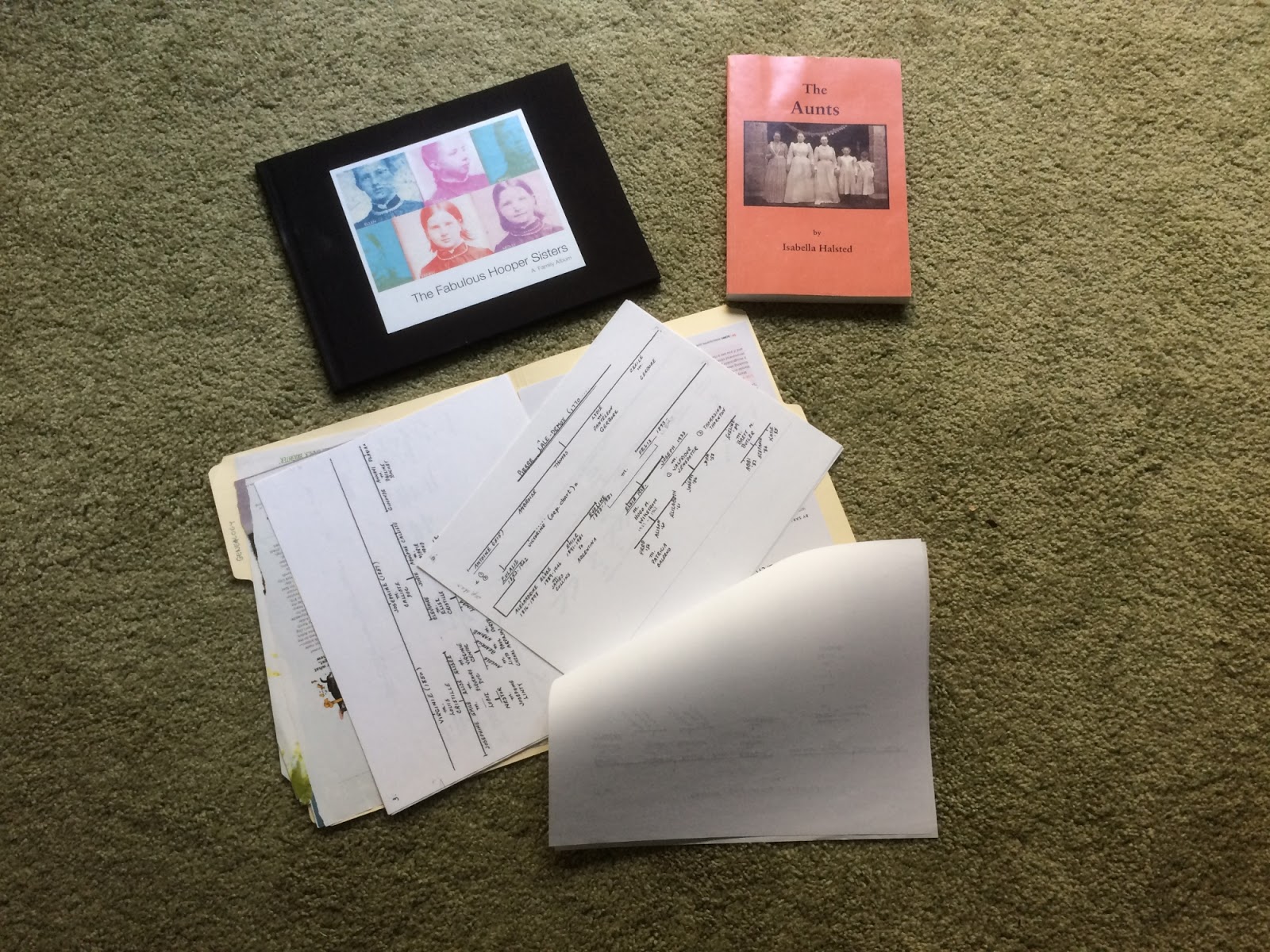
The Aunts by Isabella Halstead, The Fabulous Hooper Sisters, and assorted genealogy papers
Till next post.

The Dangers of “Updating” Your Décor


In the newspaper awhile ago, I saw an article titled: “Seven Ways to Update Your Décor”. And I said to myself, “Why on earth would I want to ‘update’ my décor?”
It makes sense to update things like computers and cell phones and smoke detectors—newer models are likely to have improved functioning. The same can’t generally be said for the latest thing in flooring or countertops or furniture. Mushroom-colored walls work about as well as walls that are off-white or hyacinth blue. So why “update” your interior?
The implied contrast is a “dated” look. Think of a room with wood paneling, a burnt-orange shag carpet, macrame plant hangers, … do I need to say more? Dated. But why is it “dated”?  Because at one time—I think it was in the seventies?–everyone had wood paneling and orange shag. This also explains why “dated” is a negative word. Like a song that gets played too many times on the radio (ooh—a dated simile, too!), the sheer overexposure burned people out on it.
Therein lies the problem. If you “update” your old flooring and counters to something that is currently popular, then in ten years (or less), your current choices will look “dated.” They will be “so terribly 2017”. So you’ll feel a need to “update” yet again.
Your décor should please you, the person who has to live with it. Admittedly, as a person living at a certain point in history, what pleases you is likely to have some similarity to what pleases other people at that point in history. Maybe your group is all madly into Dr. Who, or Game of Thrones, or a certain rustic look, or whatever.  Okay, take advantage of the availability of blue time-box prints and heraldic signs if you want. Understand that some of your tastes will change over time, and so will some of the things you surround yourself with. Maybe you really like light gray paint, or ice blue. If so, this may be a good year to get out the brushes.
But don’t change your décor simply because it’s fallen out of fashion. If you’re planning to sell your house in the very near future, that’s another story. Then you aren’t doing it for yourself at all. But otherwise, why step onto the “update” treadmill in the first place?

Reflecting on "Howl's Moving Castle" (the book, not the movie)–cleaning, fictional characters, and scented steam


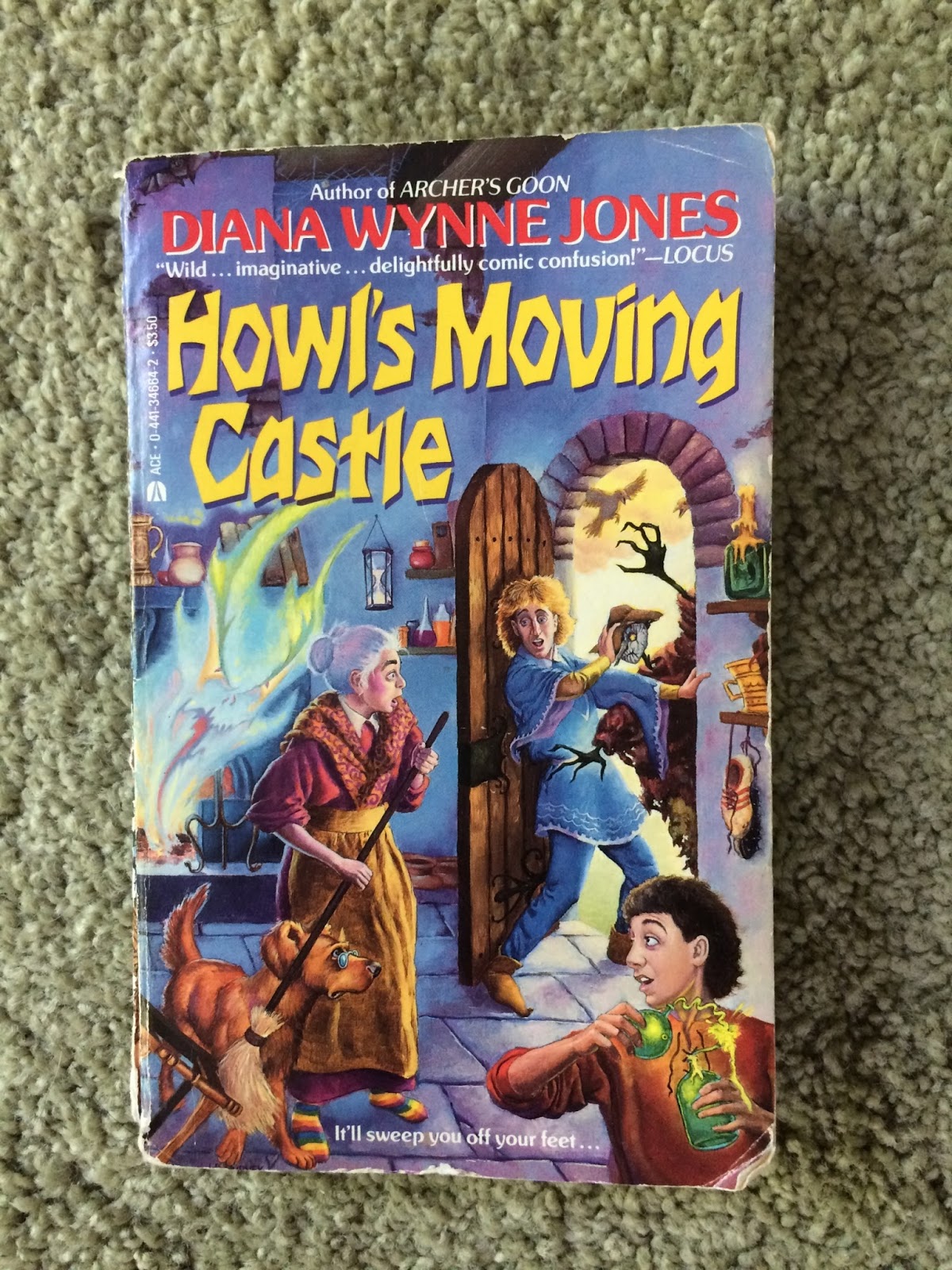
Yesterday my daughter was writing quotations from Howl’s Moving Castle (the book, not the movie) to post on the pantry quotation wall. She told me that thinking about Sophie, the main character, inspired her to clean her room. That, in turn, inspired meto think of many things: cleaning, the touches of everyday life in books, and the way fictional characters motivate us to imitate them.
Howl's Moving Castle paperback

Sophie Hatter certainly does do a lot of cleaning in this book. She cleans remorselessly. (I love that phrase.) The dirt and spiderwebs don’t stand a chance. Nor does Michael.
“I wish you’d stop,” said Michael, sitting on the stairs out of her way. (p.43)
She doesn’t necessarily do her cleaning in the right order, however.
[Calcifer] crackled with mean laughter when Sophie discovered that soot had got all over the room and she had to clean it all again. That was Sophie’s trouble. She was remorseless, but she lacked method. But there was this method to her remorselessness: she calculated that she could not clean this thoroughly without sooner or later coming across Howl’s hidden hoard… (p.44)

Cleaning is a way of poking around without being obvious about it. It’s also a good way to tell whether you’ve searched someplace already, as I’ve discovered in the Great C&C Easter Egg Hunt. Diana Wynne Jones’s books often have some wonderful detail that makes me think, “Yes, exactly!” and this is one of them.

The word “method” also reminds me of a story my mother tells, about my grandmere coming to visit us in Geneva when I was a toddler and being disturbed by my mother’s housekeeping. “You have no method!” she complained. Apparently I inherited this lack and so have something in common with Sophie.
There are other lovely details in the book, like the description of the bathroom before Sophie gets to cleaning.
 
Sophie winced from the toilet, flinched at the color of the bath, recoiled from green weed growing in the shower, and quite easily avoided looking at her shriveled shape in the mirrors because the glass was plastered with blobs and runnels of nameless substances. The nameless substances themselves were crowded onto a very large shelf over the bath. (p.33)                                                                                 
This is one of the few areas in which I must say the movie did a good job. They really made that bathroom look terrible. Some years ago I commented on Facebook that M had gotten face paints for her birthday, and our bathroom sink looked like it belonged in Howl’s Moving Castle. I wish very much that I had taken a photo, but apparently I didn’t.
The bathroom is important, given Howl’s vanity. Every time I pass our bathroom right after M takes a shower, I think of Howl emerging from the bathroom in a cloud of hyacinth-scented steam. Of course, in our house it’s more likely to be lavender, or frankincense-citrus, or some other really interesting Zum soap combination.
I said earlier that I was thinking about the way fictional characters inspire imitation. It’s obvious with kids and cartoon heroes, but does it stop there? When I was taking t’ai chi classes, I sometimes imagined myself as a movie ninja, to feel that state of relaxed alertness that movie ninjas display. I want to deduce like Sherlock Holmes, read tracks like Jim Chee, maybe even quote poetry like Inspector Gamache. I’d like to sing like Aza of Fairest, or recite epics like Meryl of The Two Princesses of Bamarre. And I mean not just that I’d like to be good at it, the way they are, but that when I read those books, singing with others and reciting poetry suddenly seem like appealing activities. Even if I’m not particularly good at them.
I can’t conclude a post about Howl’s Moving Castle without a word about the movie. The movie is totally unlike the book. It is visually amazing and having Sophie’s appearance continually change is clever, but the characters are very different and so is the plot. Whether you liked the movie or not, consider reading Howl’s Moving Castle by Diana Wynne Jones. Just remember—the castle doesn’t look anything like the mechanical contrivance of the movie.
Side note: when did the English start saying “different to” instead of “different from”? I’m sure the British-authored books I read when I was young didn’t do this. I meant to look for an example in this book while I was re-reading it, but I got too caught up in the story.
Second side note: I have included quotations, which I think counts as Fair Use since this is sort of a review of the book and sort of educational (if you stretch the point a bit.) And everyone quotes little bits of this and that on the internet—not that that really proves anything.