Why I Drink So Much Tea


I drink rather a lot of tea. I start the day with a cup of tea, and then maybe another, probably one around lunch time, and when four o’clock slips around, well… that’s tea time, isn’t it? I’m talking about black tea, by the way, with milk and sugar. I’ve never really gotten to like green tea, and I only occasionally drink herbal “tea” such as peppermint. And while I’ve come to like the sweet iced tea that is simply called “tea” in my now-home state, that’s not the version of tea I’m discussing here.
I haven’t always drunk so much tea. In high school I had some sort of orange-spice herbal tea, and I don’t remember drinking much tea at all in college. Maybe the rise of the coffee shop, with its pastries and convenient tables for studying, had something to do with it. Or maybe it was something else. At any rate, I believe it was an acquired taste. I really like the flavor of a good cup of tea, and yet tea isn’t delicious the way chocolate is, or ripe strawberries. So why do I drink so much of it?
I’m convinced that part of what makes tea so appealing is its associations, both cultural and personal. Consider the contexts in which cups of tea make their appearance in books and pictures. Tea and books. Tea and flowers. Tea and chocolates. Tea served in beautiful china cups off a tray, perhaps in a garden. Tea in the company of friends. Tea accompanying a notebook and pen. Tea-time as a moment of peace and quiet in the day. It’s hardly surprising that I like the idea of tea.
Teapot and cup in Wedgwood pale green china
A lovely cup of tea
There are personal associations, too. When I was small and had a cold, my mom would settle me on the sofa with a blanket and a cup of tea to chase away the sore throat or sniffles. I still believe in drinking lots of hot tea when I have a cold, though in the interests of not overdoing the caffeine, I also drink hot water with lemon, and maybe peppermint with honey. 
Also, as a grown-up going home for the holidays, I really liked tea-time. As four o’clock neared, someone would suggest putting the kettle on, and whoever was home at the time would gather at the table to eat cookies or panettone while talking about whatever came to mind. Tea with company, tea with cookies, tea with pretty cups.
And there are so many really, really lovely teacups out there!
And now, the reality of tea. The reality is that I rarely use my good china, though I do have some nice mugs in frequent use. The reality is that sometimes I make myself a cup of tea and take sips of it while trying to simultaneously empty the dishwasher and feed the cats. The reality is that any tea purchased at an airport and served in a paper cup is almost always lousy (but I drink it anyway.) The reality is that I have a wonderful husband and daughter, but they just don’t care for hot tea, so I’d be better off filling my teapots with iced lemonade if I want a cozy family gathering. 
Mug of tea at a cluttered computer desk
The reality of tea
Why do I drink so much tea? Because I live in hope—hope that the hot liquid will magically create peace, leisure, beauty, flowers, chocolates, and company, even though it is just a cup of water with dead leaves in it. I guess that’s not a bad thing, but maybe this summer I could try serving lemonade on the porch in my good china.

The Great British Baking Show and Grandpere's Recipes–the technical challenge of a dimly remembered cookie

Last year, M and I discovered The Great British Baking Show. I don’t generally watch shows where contestants get eliminated each episode until only a few are left, but the British Baking Show felt different. For one thing, the contestants weren’t voting each other out—they were competing to produce the best baked goods in a given category. For another, they treated each other well, giving their fellow competitors a hand on those occasions when two hands just weren’t enough. And then, of course, they were producing delicious-sounding, highly inventive and often beautiful creations.

In case you haven’t seen it, there are three parts to each show: the Signature Challenge, the Technical Challenge, and the Showstopper Challenge. For the first and last challenges, they plan their own version of whatever has been assigned (“please make Paul and Mary sixteen perfect petits fours, in two flavors”, e.g.). Some contestants come up with very unusual flavor combinations, which makes me wish I could taste their results as well as see them.
The Technical Challenge is different. The contestants are all given the same recipe and ingredients, and left to do the best job they can. Usually the recipe is for something that few of them have ever made before, and sometimes it’s a pastry that none of them have even heard of. On top of that, the recipe is deliberately skimpy on details—the temperature for the oven, but not the baking time, for instance. Recipes for yeast-raised dough tend to leave out rising times, and sometimes parts of the recipe just say, “Make a custard” or “Prepare fruit”, leaving the contestant to fill in the gaps with their own knowledge of baking (and some on-the-spot guesswork.)
A cookbook: 1920s edition Cakes For Bakers by Paul RichardsAnd that’s why I love the Technical Challenge. It’s a test of their overall baking know-how. The more broadly they have experimented in baking and the more they have read about different baked goods, the more likely they are to know something about baking the assigned item. Being practiced  in common techniques helps when the recipe leaves out the details. Even being inquisitive in sampling pastry can pay off— if the contestant has eaten the pastry in question, at least they have some idea how it should turn out.
Now onward to Cakes For Bakers, a cookbook for the professional baker, copyright 1923. This book belonged to my Grandpere, who was, indeed, a professional baker. The book in interesting for a number of reasons. It’s old and refers to things like “pastry butterine” and whether the damper should be closed while baking. The selection of recipes is unlike my household cookbooks—it includes “Monte Carlos”, “Stork’s Nests”, and various kinds of Zwieback and honey cake, for example. It offers suggestions on pricing, decoration, and display of goods, and discusses the use of ammonium carbonate in leavening cookies.
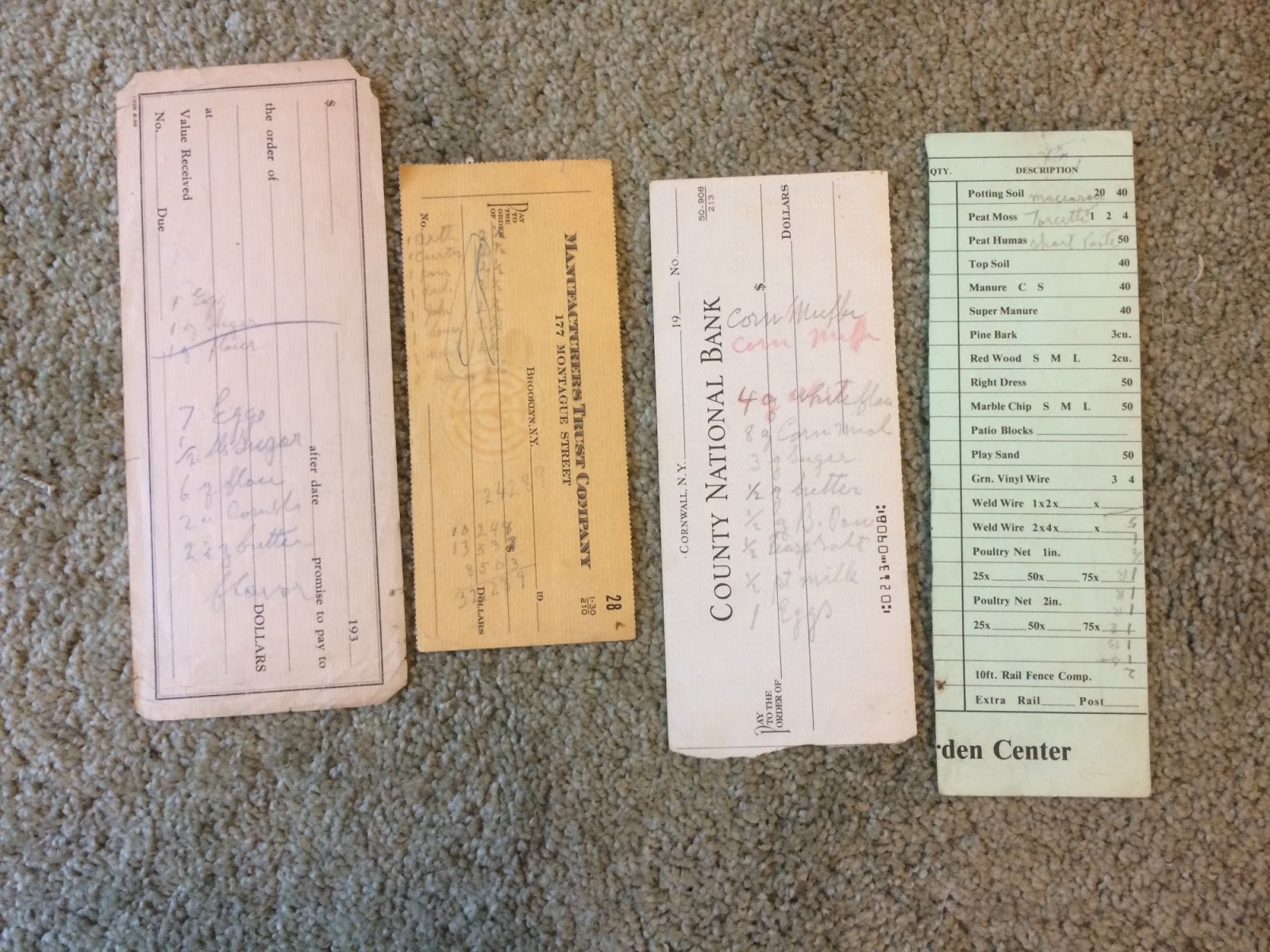
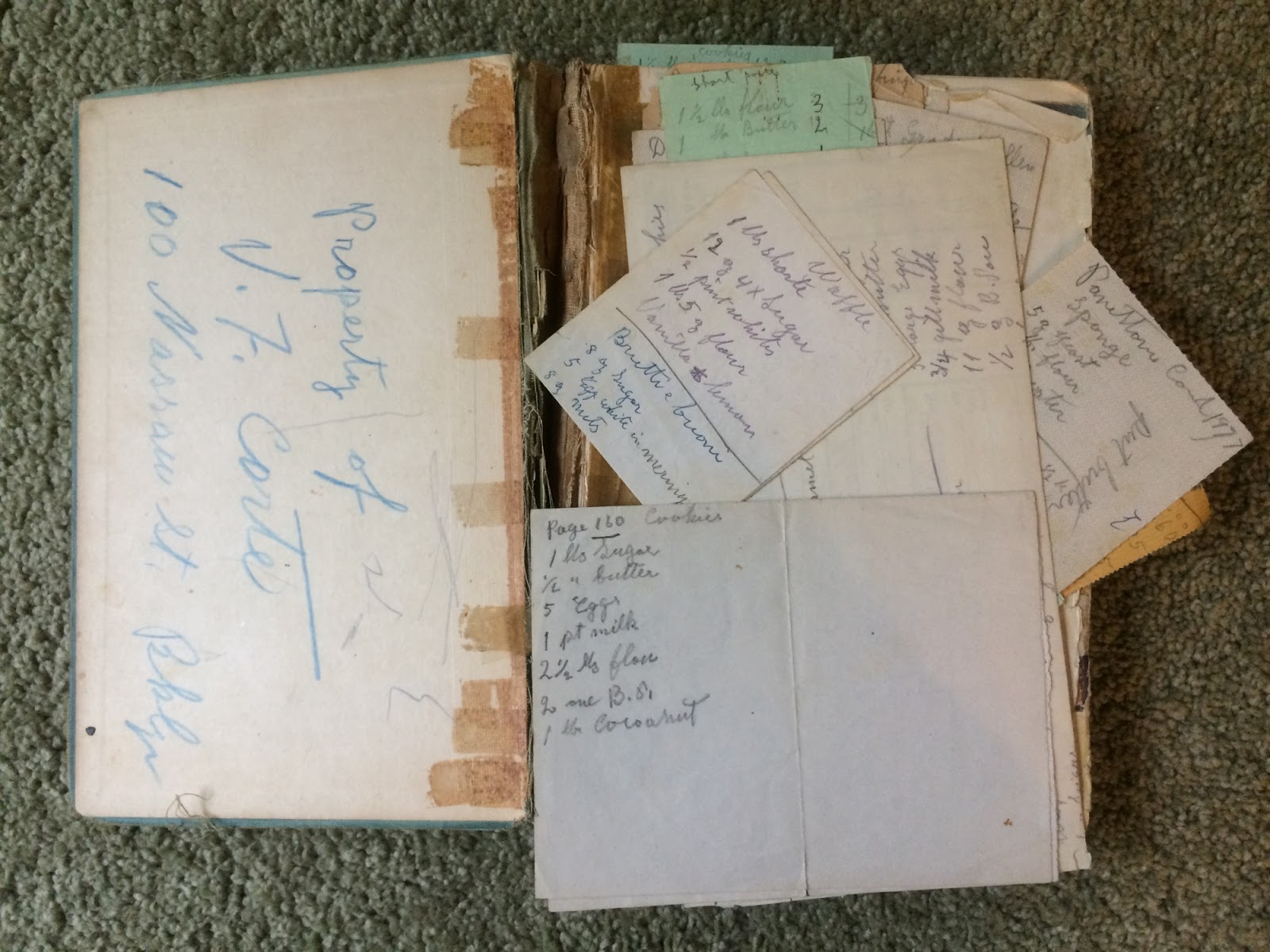
Handwritten recipes on scraps of paper in an old cookbookThe most interesting part of the book, however, is not the book itself but the multitude of scraps of paper that have been tucked into it. Scrawled in pencil on the backs of old checks and garden store forms are recipes—lists of ingredients, really—with no explanation of their existence. In at least one case, my grandfather appears to be copying out a recipe from the book for a butter cookie, but with less lemon. Are these notes on how to vary existing recipes? Recipes from other books? Some appear to be calculations for making a different size batch.
Recipes scrawled on old checks and scratch paper
One thing is certain—there is no explanation of  how the listed ingredients are to be mixed and baked. To use these scrawled recipes, a person would either have to know the technique, or look up a similar recipe and work from its instructions.
For a long time before I had this book, I was trying to find a recipe for a certain kind of cookie that Grandpere made. All through my childhood, when we stayed with them, we ate these cookies which were stored in an old coffee can. There were crescents, ovals with scalloped edges, and leaf-shapes, but they all seemed to be basically the same cookie with different toppings—chopped nuts, tiny chocolate chips, whole cashews, or red candied fruit. My father said much later that they were butter cookies, but the butter cookies I tried never tasted quite right.
Eventually I found a butter cookie recipe with a bit of almond flavor that seemed right—but by then it had been so long that the flavor of the cookie was a dim memory. Still, it seemed possible that the cookies might have had a touch of almond—he put almond in the apple pastry and sliced almonds on the sides of cakes. (I wish I had asked my father whether Grandpere was especially fond of almond flavor. It’s too late now.)
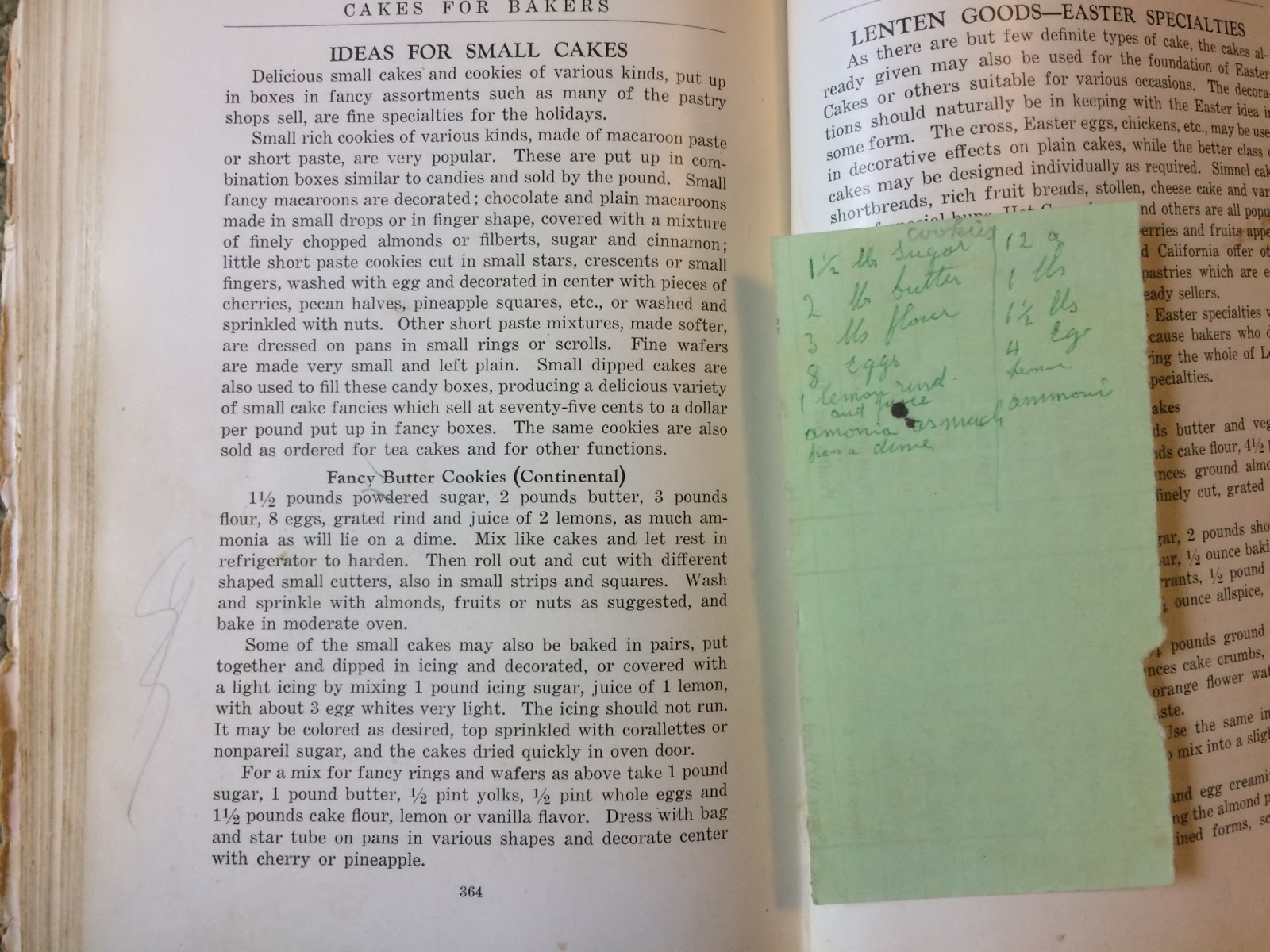
So I was excited when I discovered the cookbook some years ago with its scraps of recipes. Could the answer be here? Maybe the recipe for the butter cookie with lemon? (Though I don’t remember any hint of lemon in the cookies he made.) At least that list of ingredients matched with a recipe in the book, which would help with mixing directions.
Page from Cakes For Bakers, showing fancy butter cookie recipe, with handwritten versionThe recipe in the book, however, was less than detailed. “Mix like cakes?” How much is “as much ammonia as will lie on a dime?” (I had to look up bakers’ ammonia and an equivalent in baking powder.) Finally, I guessed at the temperature of the “moderate oven” and the time.
The result, as I recall, was not remarkable. The failing could be in the recipe or in my memory of the cookies or both. But the challenge was an interesting one, and I think about it sometimes when I watch the contestants on the Baking Show attempt to figure out their sketchy instructions, and again when Paul and Mary survey the assorted results and compare them to the picture-perfect version they’ve just been sampling in another tent.
If only I had a Chock Full O’Nuts can filled with Grandpere’s cookies for the purpose of comparison, I could figure out that recipe yet.

Till next post.

From the Annual Easter Egg Hunt to My Favorite Children's Books–five books I remember fondly


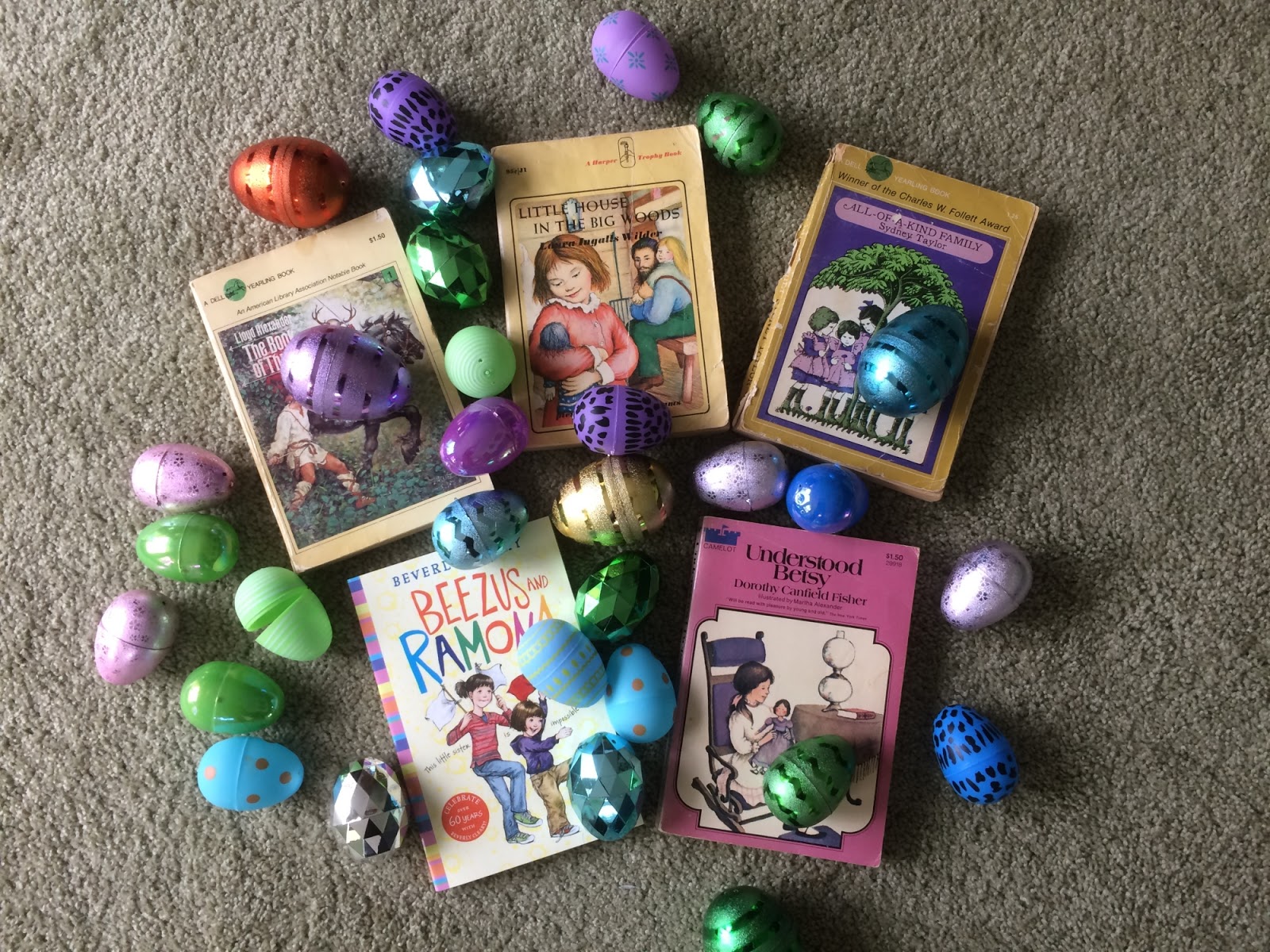
Very shortly, as soon as we get our trinket-prizes collected, the Third Annual C&C Easter Egg Hunt will begin. This egg hunt is not a casual look for hard-boiled eggs in the grass, but a serious week- (or more) length search for plastic eggs cleverly hidden around the house. Each of us will hide ten of these–blue, purple, or green–and then hunt for the others whenever we have a bit of spare time.
I love this event. I love the clever hiding places (my husband is the master of hiding eggs in plain sight, and my daughter tucked some away that could have stayed hidden for months if we hadn’t begged to know where they were) and I love to seek. Systematically.
The Great Easter Egg Hunt is also when I do some of my most thorough cleaning. After all, if I pull everything off a pantry shelf and wipe it down and then replace everything with careful attention, I ought to be quite confident that there are no eggs hiding on that shelf, right?
This hunting-cleaning invariably makes me think of the chapter “Dusting Is Fun” in All-of-a-kind Family (by Sydney Taylor). Mama, tired of constantly having to remind her daughters when it is their turn to dust the front room, hides ten buttons in the room and tells them they are going to play a game. The game is find the buttons, obviously, but while dusting. It’s Sarah’s turn, and by paying attention to all those difficult-to-reach spots, she finds them all.
Mama is wise enough not to make the game permanent. After everyone has had a turn, she only puts the buttons out occasionally, without warning, and in varying numbers. And once–a penny! A whole penny! (And for them, a penny buys a significant quantity of candy.)
Just recently, I was making a list of books from my childhood that I particularly liked and wanted to give to a friend’s daughter. (See also my post on books, nostalgia, and death.) After settling on Little House in the Big Woods (Laura Ingalls Wilder), Understood Betsy (Dorothy Canfield Fisher), Beezus and Ramona (Beverly Cleary), The Book of Three (Lloyd Alexander), and the aforementioned All-of-a-kind Family, I started wondering: why those books? How had those books influenced me, and how might they have influenced my writing?
It struck me that all the parents and guardians in those books had a streak of practicality, a kind of matter-of-fact common sense.  Mama handles chore-shirking, lost library books, bouts of stubbornness, and scarlet fever with admirable calm (which I admire even more now that I am a mother myself). And though I always thought Laura’s Ma was a touch too proper, she not only knows how to make everything from rag dolls to butter to straw hats, she also occasionally loosens her rules, allowing the girls to mold their cooked pumpkin into shapes, though normally they aren’t allowed to play with food, or (in a later book) declaring that they will play games instead of studying when she knows they are desperately worried about Pa and in need of distraction.
The Putney cousins, in Understood Betsy, are the calm contrast to devoted but fluttery Aunt Frances. They say almost nothing about to Betsy about how upsetting it must be to be whisked away from her family to a strange place, but it’s easy to imagine that Aunt Abigail is thinking, “Poor mite. What would make her feel better?” just before she scoops up the kitten and drops it in Betsy’s lap. And a few words from Aunt Abigail at bedtime, “do you know, I think it’s going to be real nice, having a little girl in the house again,” makes it clear that she is welcome.
The Book of Three is set in Prydain, a land of high kings, evil lords, enchanted swords, and deathless warriors. But Taran is frustrated that his life is far too ordinary—“I think there is a destiny laid on me that I am not to know anything interesting, go anywhere interesting, or do anything interesting. I’m certainly not to be anything. I’m not anything even at Caer Dallben!”. His guardian Coll obligingly responds by giving him the title of “Assistant Pig-Keeper” to Hen-Wen, the oracular pig. Taran is to “see her trough is full, carry her water, and give her a good scrubbing every other day.” When Taran points out that he does all those things already, Coll says, “All the better, for it makes things that much easier.”
Beezus and Ramona was not, strictly speaking, one of my childhood favorites. I read a lot of Beverly Cleary’s books and enjoyed them, but I didn’t fully appreciate them until I read the Ramona books to my daughter. Ramona’s world is the most similar to mine of the five books, and yet Cleary manages to make it incredibly entertaining by focusing on the little things–how a bored but imaginative younger sibling can interfere with baking, or the way the first bite of something is somehow the best–and turning them into adventures. Ramona is a definite challenge to the adults around her, as well as her sister, but they find practical ways to deal with her (buy a cake rather than try for the third time to make one, don’t mention the apple incident as it would feed her desire for attention, and—oh—why not make applesauce out of those apples?)
Am I making too much of this? Perhaps all childhood books are like this, especially those for younger children. After all, it is reassuring to think that parents are wise and calm. Probably most stories have some character with that quality. But not all children’s books feature the parents particularly (Secrets of Droon, for instance) and not all parents are good (Matilda, for a rather drastic exception).
At any rate, did reading these books lead me to be a sensible and matter-of-fact parent? It left me with the aspiration, certainly–I think I yell too much and get flustered too easily to actually qualify. In my defense, I’m not a fictional character.
I suspect the fondness for sensible parent/guardians does show up in my writing, though. In Persephone, Aunt Sarah and Aunt Mira are both practical in their own different ways. In Adrift, Aunt Kenata manages new babies and bad dreams, in contrast to the easily-upset Aunt Visala and taciturn Utanu. And I think Nana Sylvie might qualify as the common-sense influence in The Slipper Ball, though time will tell.
Till next post.