Boredom Is the Mother of Invention


I’ve hardly been bored at all for the past fifteen years.

On the face of it, that sounds great. Admittedly, for the first of those years, M was very young. There were not a lot of boring moments. On those occasions when I was on my own with nothing to do–say, waiting in the dentist’s office—I enjoyed blissful peace and quiet. Enjoying peace and quiet is not the same as being bored.
But even now that M is a teenager who is busy with her own life and isn’t hanging around saying, “Mommy, play with me,”, I am still not bored.
I would like to take credit for this and pretend that it is a mark of superiority, but the fact is—is anyone bored any more?
Okay, that’s going too far. Students trapped in an unusually dreary class and employees stuck in a long meeting may indeed be bored. Various kinds of work may be boring, more or less. But is anyone bored on their own time? Entertainment is just a smartphone away.
Given a connection, the internet has something for everyone. Music. Music videos. Netflix, if you have a subscription. Youtube and a selection of TV shows from broadcast networks if you don’t. Blogs. News articles. Pretty pictures. Classics in e-book format, no library visit required. 
One of my pastimes is typing semi-random terms into Google and seeing what I get. For instance, I just tried “quilting leaf print” and got a lot of listings of available fabrics and a couple of quilters’ blogs, complete with some nice photos of their projects. “Mints garden formal” didn’t give me much of interest, but “garden mint projects” gave me a recipe for mint-flavored sugar, among other things.
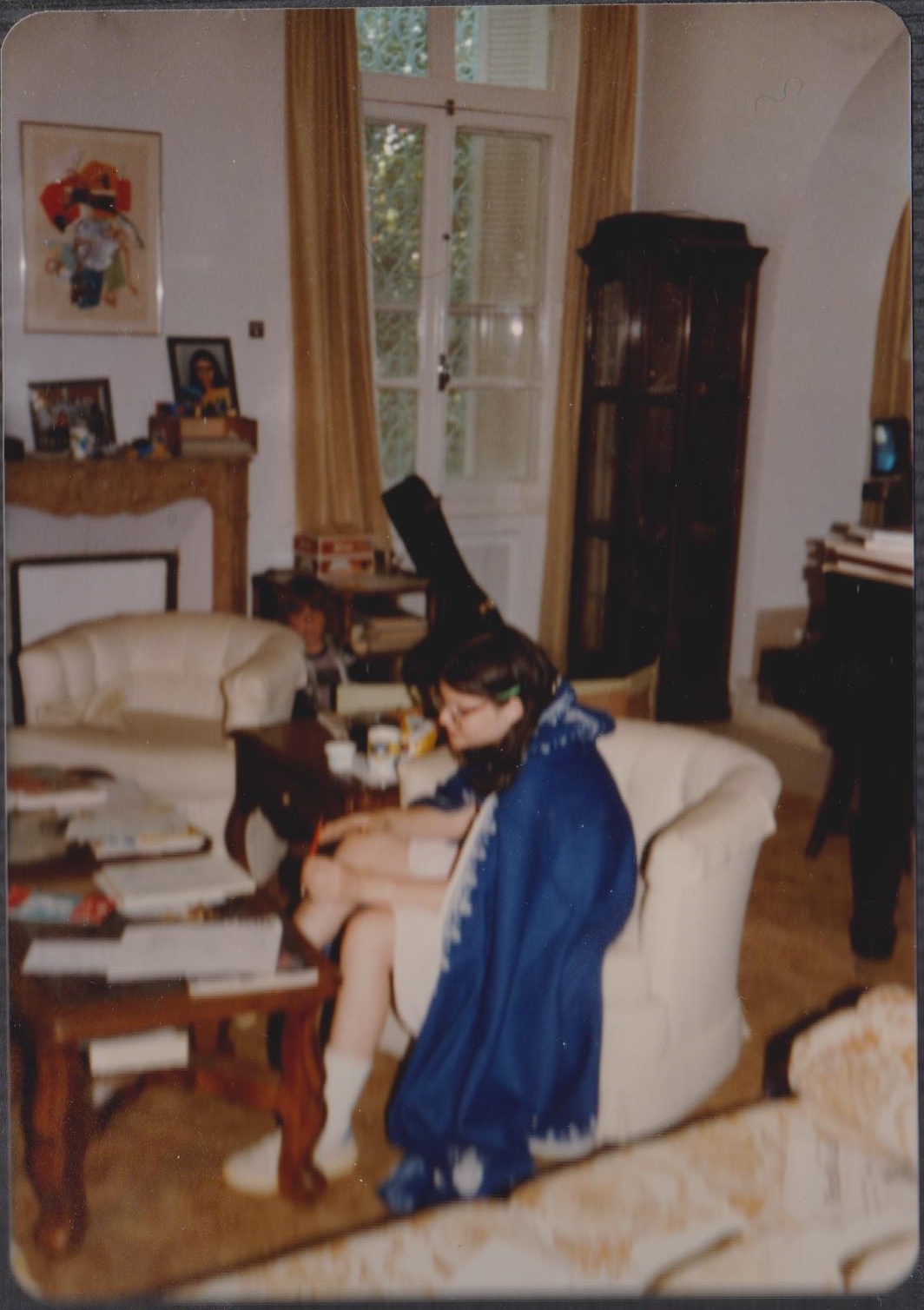
black and white photo of girl drawing in the car

So I am rarely bored. But is that as good as it sounds? Perhaps a little boredom is motivating. Instead of entering terms into Google, or watching “The Finder” on Netflix, I could be messing around with actual mint leaves or working on one of my existing quilt projects. It’s just a lot easier to surf the web.
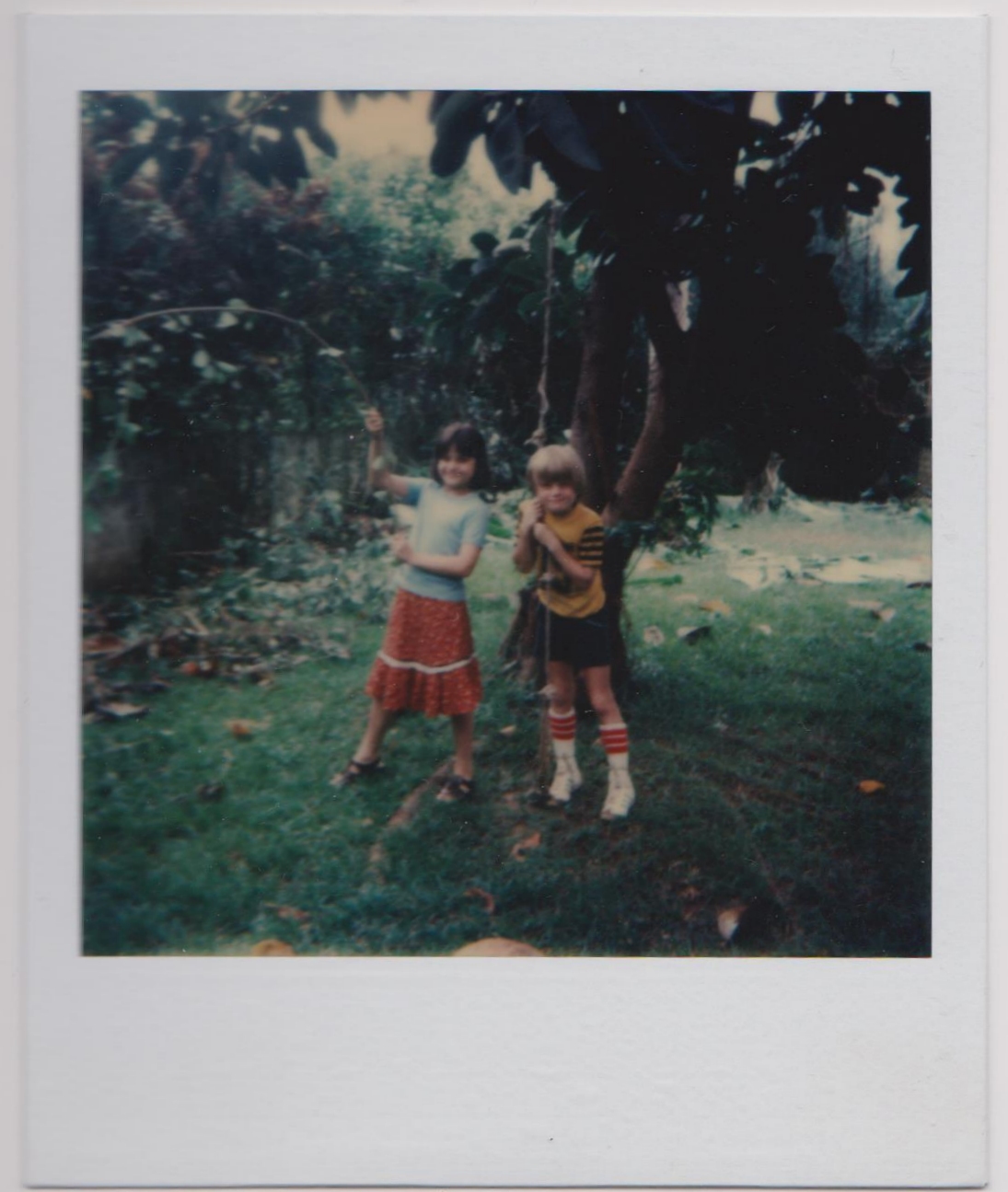
kids playing by a tree with a rope tied to itEntertainment wasn’t always so accessible. From age ten to fourteen, I was overseas with my family. There was very little available on television, and most of it was in French. I had my books, but the only real library I could use was the one at school. I read a lot, and re-read, and browsed the kids’ encyclopedia the way I now browse the internet, but I also drew, wrote, sewed, played games with my brother, tried to make moccasins out of fake leather, tried to make fake leather from cardboard and soap (remember neather, G?), and swung on a rope from a rubber tree till the knot slipped (fortunately it was close to the ground.) Sometimes I was bored and pestered my mom while she was trying to read—“I’m bored!”—and then dismissed every suggestion she made (poor mom!), but eventually I would find something to do. A kid can only be bored for so long before something starts to look interesting.
I guess this is a roundabout way of saying that maybe I’m spending too much time browsing the internet, and maybe also too much time flipping through magazines and newspapers without really taking time to digest what I’m reading.
Maybe, if I find myself opening up my browser with no real purpose in mind, I should stop and let myself be bored for a little while. I doubt I’ll be able to stand it for very long without finding something to do.
 
Boredom is the mother of invention.
Till next post.
…..
 

Listening to Music–Old songs, new songs


“Make new friends, but keep the old;
One is silver and the other gold.”
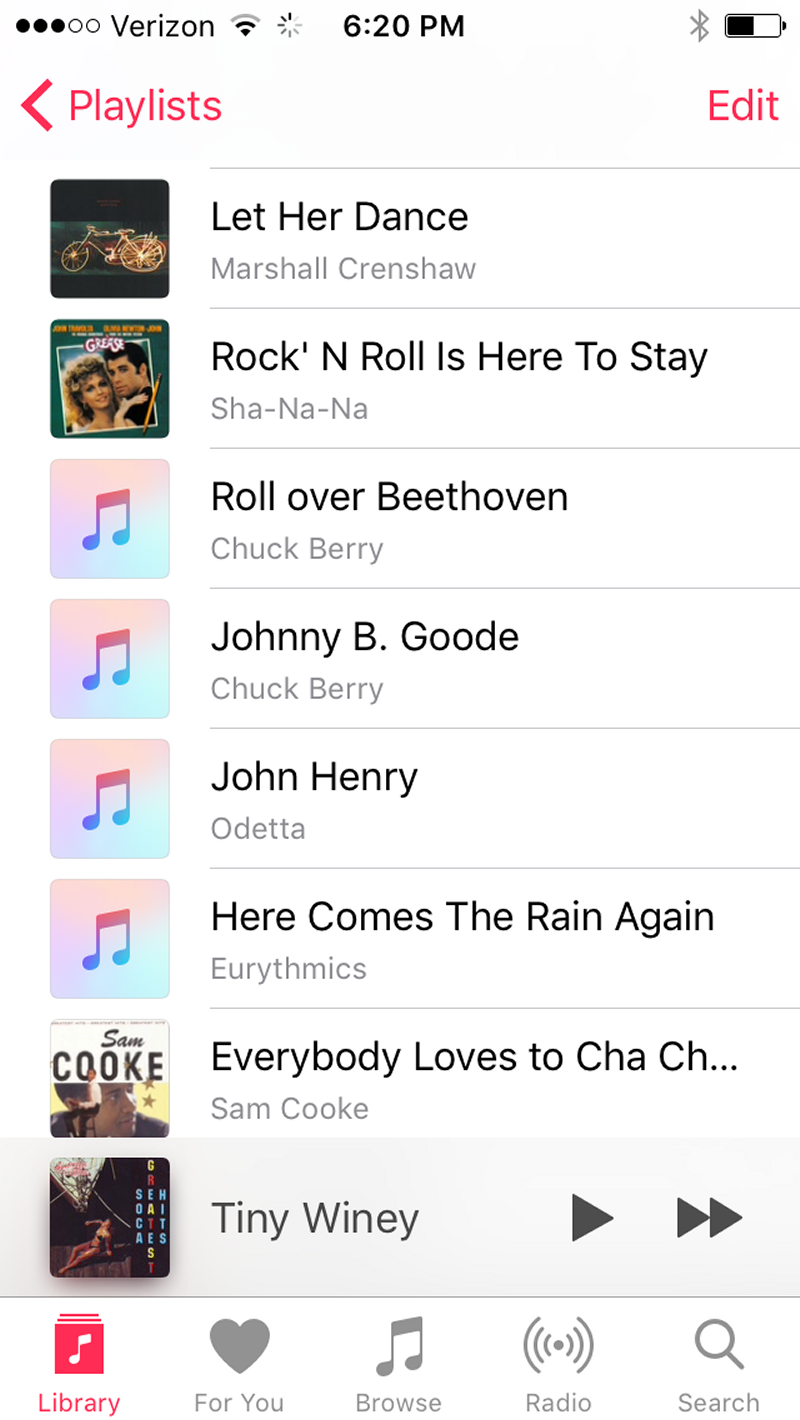
I had put on an old playlist yesterday as I unloaded the dishwasher, and was really enjoying the songs. Many of them had been my favorites long ago, such as “Fame”, “The Sound of Silence”, and “Johnny B. Goode.” That started me thinking about balancing time spent listening to familiar music versus time spent listening to music I haven’t heard before.
This is really a dilemma that applies more broadly, such as to movies and books, but maybe it is more vivid in the case of music because so much of listening to music is re-listening. We don’t even bother to call it “re-listening”, though we often say we are “re-reading” a favorite book, or (less often) that we are “re-watching” a movie we’ve seen.
When we start life, it’s all new. “Twinkle, Twinkle, Little Star”, “The Itsy-bitsy Spider”, “The Wheels on the Bus”—it’s all wonderful new stuff to learn and sing over and over (and over and over and over…). For quite a while, we get flooded with new music to enjoy, even as we love to repeat our (still few in number) favorites.
Somewhere along the line, the situation changes. We already know a lot of songs, have long lists of things we like to hear, and spend less and less time listening to new ones. Obviously some people, especially people who are very into music, still spend a lot of time listening to new stuff, but people like me hear remarkably little of it. (The situation is exacerbated in my case by the fact that I rarely turn on the radio.)
One source of new songs is other people, but here technology has interrupted the proper passing on of musical knowledge. So many people listen to music on headphones—I’m referring of course to teen-age daughters—that although parental ears are spared a constant barrage of Someone Else’s Music and especially What Are They Listening To Now?, it also means fewer opportunities to make new discoveries.
I think my mom quite liked some of those Billy Joel songs.
The song on the playlist that brought this particular fact to mind (remember, I said I was listening to an old playlist) was “Mean”, sung by Taylor Swift. It was on my playlist because at the time my daughter was listening to Taylor Swift, she didn’t have a cellphone (smart or otherwise) and all the music ended up on my hard drive. For some reason, I really liked “Mean.” I doubt I would have heard it if not for her.
But as fun as “Mean” is, I owe a much greater musical debt to my daughter.
Hamilton.
She was walking around the house for weeks—or was it months?—earbuds plugged in, humming happily, before I said, “Maybe you could play it for me while I’m sewing.”
The first listen-through was confusing and I hardly understood any of the words, but the second half sounded promising. Some music needs more than one hearing to be appreciated, and the second listen-through was the charm, in this case. I’ve been playing it in the car for months now, I think.
So how should I balance re-listening versus trying new music? At this point, I’ve heard enough music in my life (including all the stuff that was playing when I was in high school and college, whether I remember it vividly or not), that I could probably get thro

ugh the entire rest of my life just listening to things I already enjoy. Why make an effort to hear anything new?

I say again, Hamilton. (Really, I cannot recommend it enough.) I could easily have missed Hamilton entirely, because most of my accidentally-discovered new music comes from movies (“Try Everything” in Zootopia) or TV (“Tiny Winey” in Death in Paradise) and occasionally my husband (when he discovers someone new, which isn’t all that often—Paul Thorn, e.g.)
And without Hamilton, my life would be that much poorer.
So what’s the take-home point of all this? Nothing surprising. Just that it’s worth trying something new, sometimes, even when you’re happy with the tried-and-true. In the case of music, the song about friends I quoted doesn’t really even apply. The mere fact that you’ve been enjoying a song for decades doesn’t confer gold status on it, and not all new songs are mere silver by comparison.

Labels in the kitchen—how old is this mustard anyway?


For my first try at a household hint (hello, Heloise!), I’m going to discuss labeling food with the date it was opened. There are two categories of foods that particularly benefit from labeling—leftovers and condiments.

Leftovers are the most obvious candidates for a date-label. You don’t want them to sit around so long that they become unsafe. But how long has that leftover casserole actually been in there?
When I put a plastic container of leftover soup in the fridge, I can’t imagine forgetting that I made soup on Monday. But perhaps Tuesday I go out for dinner, and maybe Wednesday I don’t remember the soup till I’ve already started something else, and Thursday I don’t even think about it. On Friday I pull it out and cudgel my brain. Was it Monday or Tuesday that I made soup? I wasn’t here Tuesday—wait, was it over the weekend? No, surely not. It couldn’t have been last week—or could it?
The situation is even worse in the freezer. I’ve pulled things out only to realize they’d been in there two years (and I know this only because they were labeled.) Not only does it help to put a date on leftovers before freezing them, it also helps to write down what they are. After a few months, vegetarian soup and chicken cacciatore start to look a lot alike. Even pizza sauce and strawberry puree have a vague similarity when frozen.
Condiments usually have a long life compared to leftovers, but in a way, that’s part of the problem. Condiments that don’t get much use—say, plum sauce–can sit in the fridge for quite a long time without getting used up. After a while, it’s hard to remember if that plum sauce has been there for six months, or eighteen. Or thirty-two. Even if it hasn’t gone bad, it isn’t going to be good.
An example: Many years ago, when visiting my parents, we needed dijon mustard for some recipe.
“Oh, I don’t think that mustard can still be good,” my mother said. “It’s been there for ages.”
“It looks okay.”
“Really, I think it’s been years.”
But it was mustard, after all, and it didn’t smell bad. So we used it (and nothing bad happened.) But since my mother had insisted it was old, we bought a new jar of dijon to replace it. We brought it home, opened it, and compared the jars.
It was shocking! The new dijon was brighter in color, with a sharper, more dijon-y smell and taste. The old jar was clearly long past its prime.
In focusing on leftovers and condiments, I don’t mean to suggest that dates can’t be helpful on other food products. When I was single, I didn’t eat much peanut butter, and the longer I’d had the jar, the less I liked the peanut butter and the less I ate of it. Then some reason would come up to buy a new jar, and I’d suddenly discover that peanut butter was actually delicious! I had similar problems with corn meal (a fresh bag made really good corn muffins) and olive oil.
So if you find yourself pulling containers out of the fridge and wondering just how long that lasagna has been in there, and whether the cooked rice is from Monday’s stir-fry or the chicken and dumplings the week before, try labeling your food.
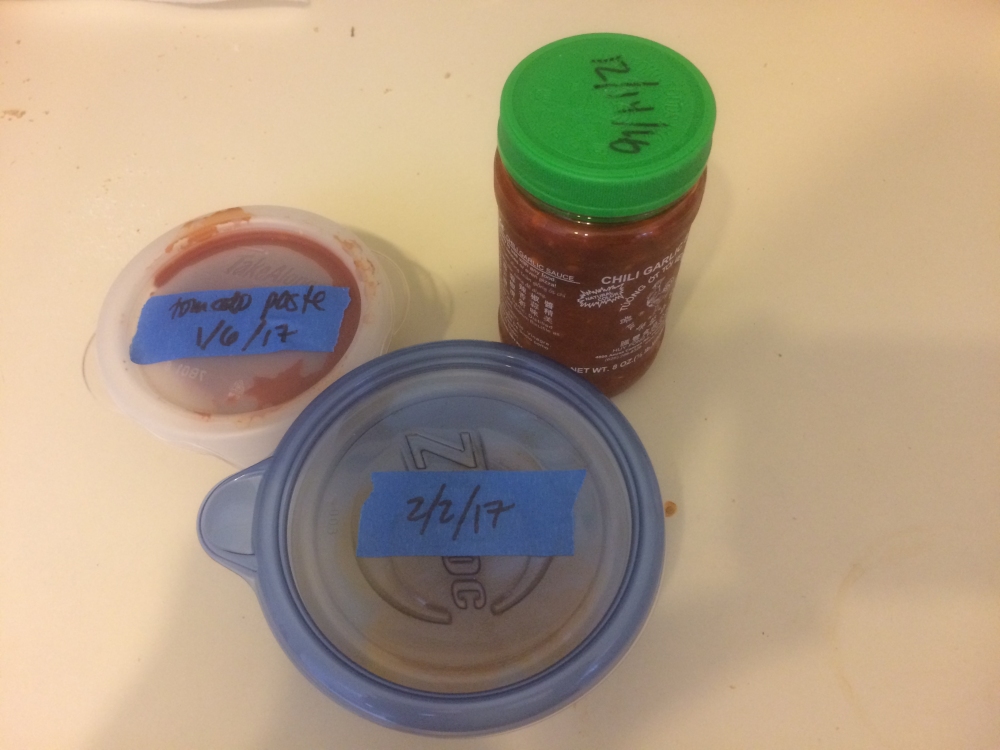
As far as how to label food, I like blue painter’s tape and Sharpie. It’s easy to spot, easy to write on, and comes off plastic containers with no trouble. It also works well on many other food containers, but sometimes it’s just as easy to use Sharpie directly on the label or jar top.
Till next post.