She Spies Shells By the Seashore–identifying shells on a North Carolina beach

It’s the last full day of beach week. Before I return my interesting assortment of shells and shell fragments to the shore (I really don’t need to bring them home, where they will sit ignored on a shelf), I try to identify them using two guides I have brought along.

The guides aren’t the only nature-related books I’ve brought–I also have a book on plants and one on the beach itself (How to Read a North Carolina Beach by Pilkey, Rice, and Neal). I’ve looked at plants before, though the only one I reliably remember is pennywort, with its peltate leaves like little umbrellas. (I had to look that up–“umbellate” is for flower clusters. Also, to be more specific, “beach pennywort” or Hydrocotyle, since pennywort is the name for a variety of plants.)

Back to the shells.

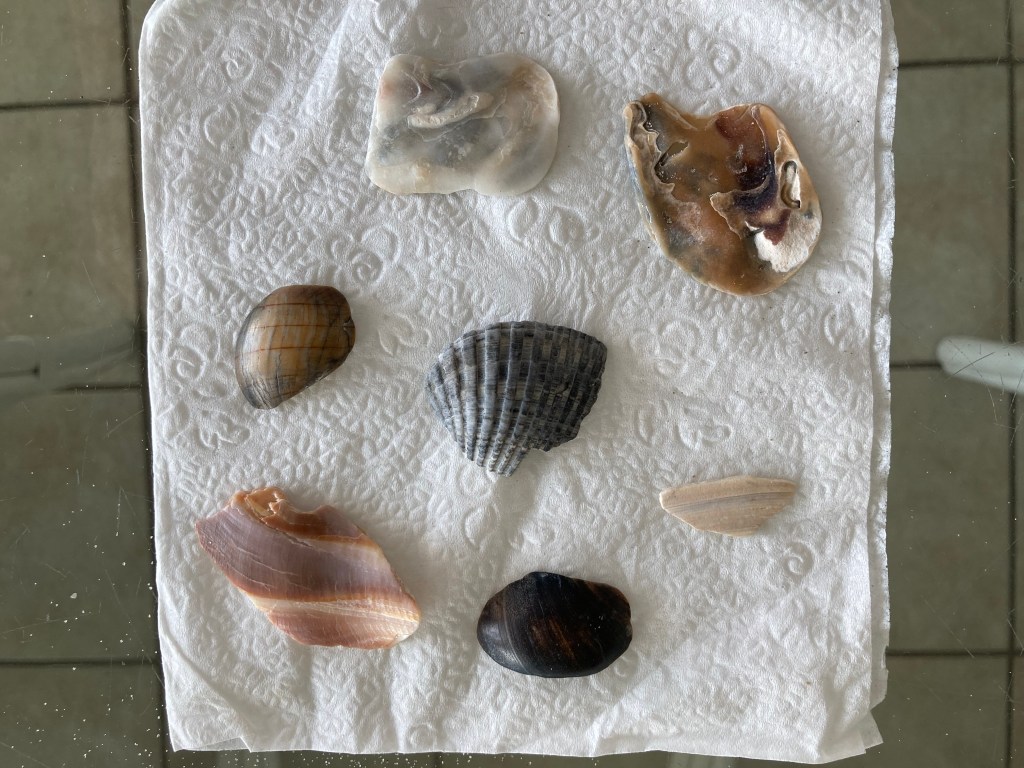
I didn’t reduce the size so you can zoom in for more detail.

The pretty gold and silvery bits turn out to be jingle shells (or parts thereof.) I recognize the coquinas from previous years of looking at my beach books. Slipper shells turn out to have a distinctive underside, and ark shells (turkey or otherwise) have a very straight hinge with little toothy marks on it.

But why do the turkey ark shells have those rune-like markings on the flat part? When I picked up the first one, I thought someone had etched those on–how interesting–but clearly they are natural. Some seem to have more than others. Are they a part of the shell, or a sign of something that attacked it?

The book about North Carolina beaches clears up one thing that has puzzled me–the black shells that look like other shells, only black. According to the book, those shells were once buried in the mud of a lagoon. In those low-oxygen conditions, “the iron in the shells turns into iron sulfide, which gives them their black color.” Islands migrate over time, and eventually the shells end up on a beach by the ocean. The take-away–they aren’t a different kind of shell, just colored by conditions.

The stripes and streaks and swirls of color lead me to pick up bits and pieces as well. I don’t try to identify them. I just appreciate the variety of color and texture.
Time to shut down this computer and sit on the deck, enjoying the view of dunes and sea. The waves are sparkling out there.

But first–speaking of sparkling, last night my daughter showed me something amazing. In parts of the beach, stomping through the wet sand caused tiny lights to appear. Some kind of bioluminescent creature in the water. I’d never seen it before, perhaps because I almost never go out on the beach after dark.

Till next post.

EDIT: An article in the Chapel Hill magazine mentions the White Baby’s Ear Moon Shell. I think the white shell I have labeled with a “?” in the photo fits the description. What serendipity, to find the shell listed in an article when I was just flipping through the magazine at random.
Fight With a Foxtail Fern

When I decided to move the foxtail fern out of the house, on the grounds that it is apparently toxic to cats and sheds a lot of needles even if kept out of reach, I did not realize what a fight I would have to reclaim the pretty pot I had planted it in.

First I tried to wiggle it out of the pot dry. It resisted–strongly. So I thought perhaps watering it would help ease it out. That may have been a huge mistake. The plant continued to remain firmly fixed in the pot, despite my sticking wooden skewers along the edges and wiggling them in an attempt to loosen the roots. I pulled. Not the slightest movement.

I got my husband involved. He stuck a sharp trowel in, moving it around as I had done the skewers, trying not to scrape the glazed interior of the nice pot that I wanted to save. But the trowel wouldn’t go in very far, so finally he pulled out the weapon of last resort–a butcher knife with a slightly curved end–and proceeded to cut the plant out. (By this time I was mainly concerned with saving the pot, not the plant.)

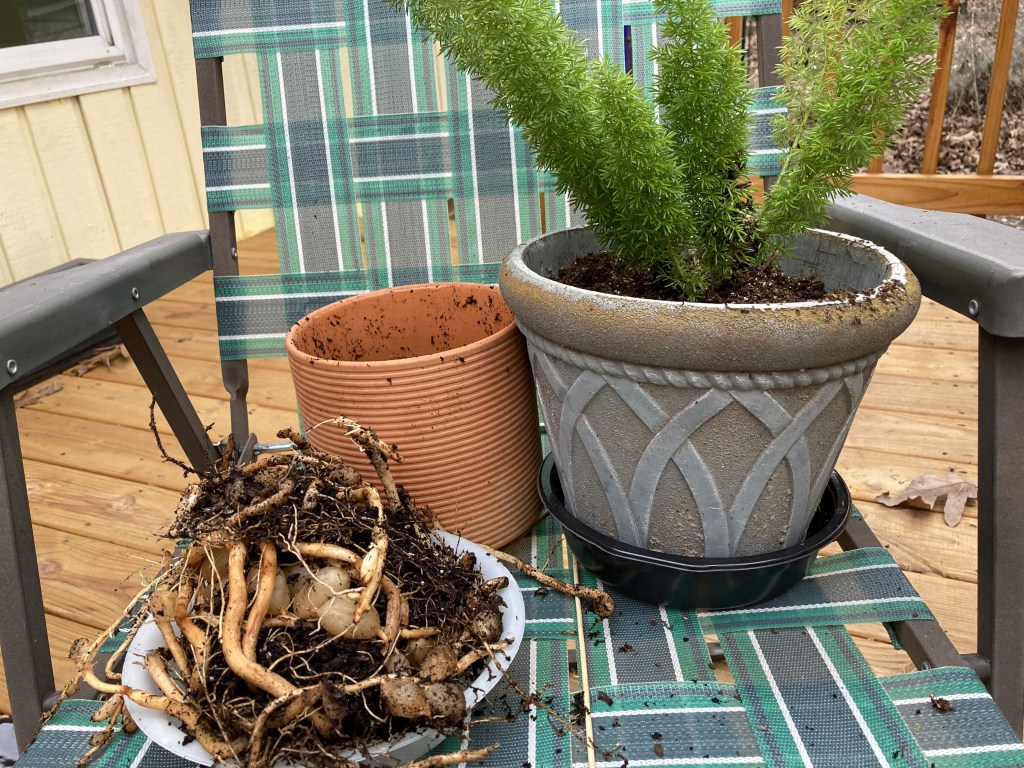
Success! We reached in to find out how the plant had stuck itself so thoroughly to the pot, and found that the remaining roots came out easily. They weren’t attached at all–they were just well and truly packed in there. Watering the plant had, if anything, caused the water-storing tubers to expand and wedge the plant in even more tightly.

To understand, see the loosened mass of roots and tubers that I pulled out of the pot after the drastically root-trimmed plant had been put in a different (and slope-sided) pot.

Foxtail fern and its roots

It’s hard to imagine it fitting in there.

As a side note, I do generally prefer a bit of slope to the sides of a pot. I dislike pots where the rim comes inward at the top and makes it more difficult to tip out a pot-bound plant. But the terra-cotta pot in question had perfectly straight sides, so I wasn’t expecting a battle.

I shall now put the plant out on the porch, where the cats are not allowed. We’ll see whether it survives its drastic pruning, and if so, how it manages the rest of the winter. It’s February–there’s supposed to be some winter still to go, whatever the blooming daffodils think.

Till next post.

Temporary Traces of Leaf on Stone

It isn’t just animals that leave traces of their passing. As the leaves fall in autumn, they leave marks–temporary ones–in mud and in stains. The sidewalks are marked with the tannic traces of fallen oak leaves and pine needles, and rain has collected the dust around the edges of wet leaves on my flagstones, creating mud traces of leaf even after it has dried and blown away.

I like looking at these interesting shapes and trying to guess what left them.

Traces of mud showing the outline of a tulip poplar leaf
Tulip poplar

Here we have what is almost certainly the trace of a tulip poplar leaf, those tall trees that have yellow-orange-green flowers in spring. Liriodendron tulipifera, if I’m remembering my high school class in dendrology correctly. (Thanks, Mr. Trott!)

I know we have tulip poplars nearby, so that makes sense. Here’s another.

Traces of mud show the outline of an oak leaf
Oak leaf

This one is pretty distinctive: some type of oak, maybe white oak. We have a lot of oak trees around our house, too. I can hear the acorns falling on my neighbors’ metal roofs, and also (only slightly less dramatically) on mine. It’s a nice reminder that fall is here.

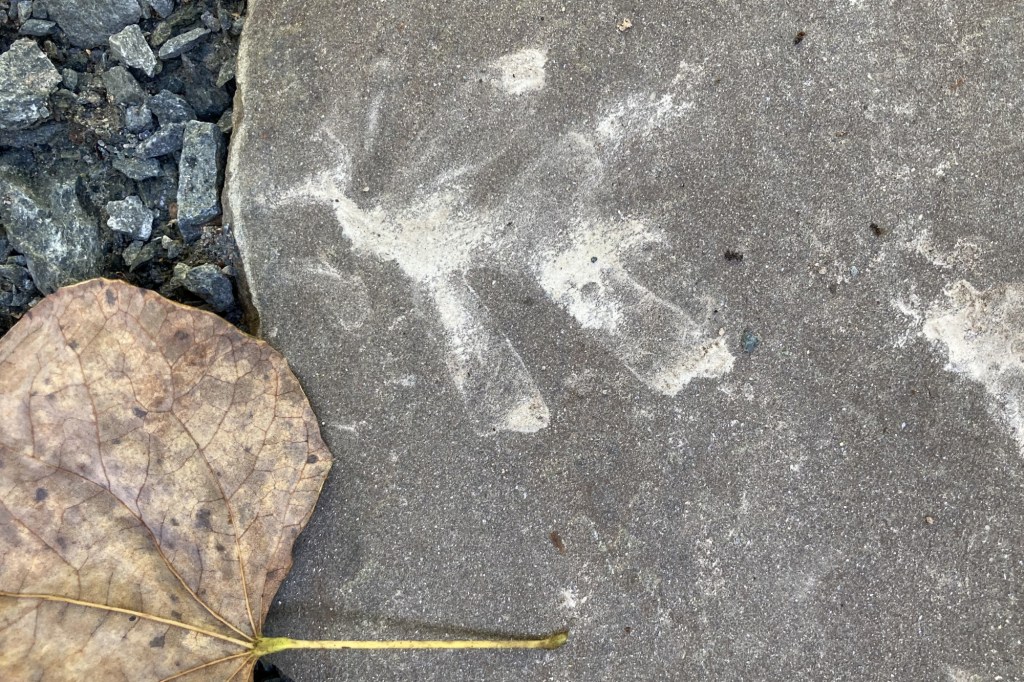
Traces of mud show the heart-shaped outline of a redbud leaf
Redbud leaf

I can feel especially confident about this one as there is a redbud (Cercis canadensis) overhanging my new flagstone patio. It was a volunteer that I never took out, and now I’m too attached to its heart-shaped leaves and pink-purple spring flowers to do anything about it. The flowers are edible (though I haven’t tried one for years), but the seeds are not. Don’t eat them!

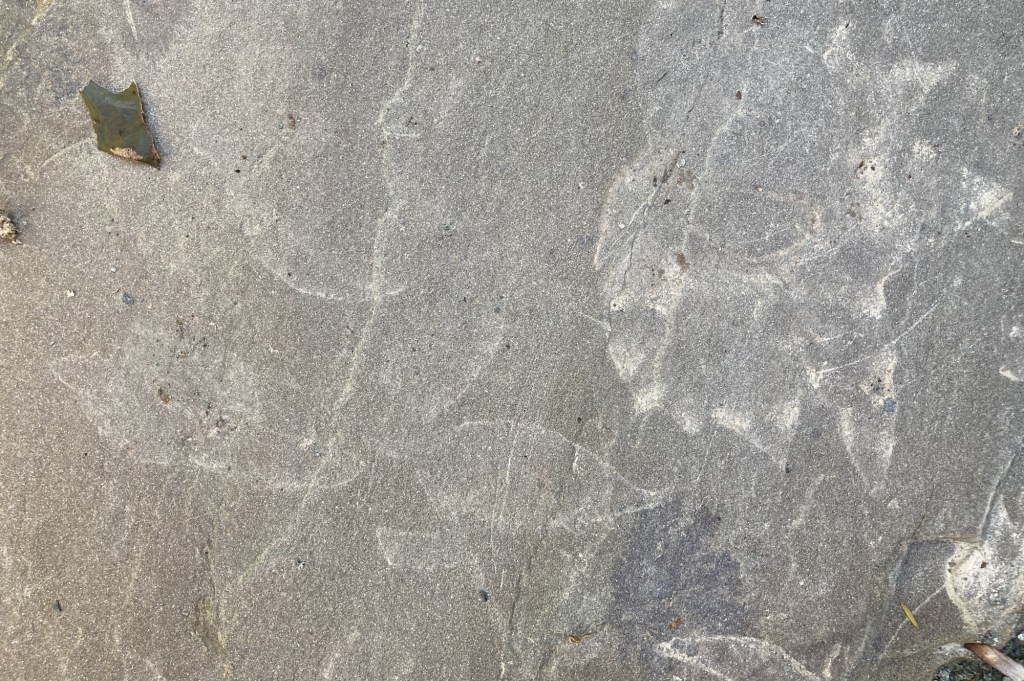
Mystery leaf

Here I can only guess. On the right, I think I see another tulip poplar leaf. On the left–is it traces of a hickory leaf, with its various leaflets, or just overlapping traces of some other leaves, maybe wild cherry? I really can’t tell.

These traces are temporary. One good rain will probably erase them. The brown stains on the sidewalks from oak and pine will last longer, but they too will fade eventually. Everything changes, so enjoy the little things while they last.

Till next post.