"The Poisoner's Handbook" and Reading About Real Evil

Recently I read The Poisoner’s Handbook: Murder and the Birth of Forensic Medicine in Jazz Age New York, by Deborah Blum. I was originally looking for information on poisons for a possible new mystery novel, but got caught up in the stories of poisonings, both accidental and deliberate, and the development of techniques for detecting them—not to mention the story of Prohibition in New York, and the politics that was inevitably involved along the way.
It was a very good book, but there was nonetheless something sort of creepy about reading an interesting story about a poisoning and remembering, suddenly, this really happened. Mary Frances Creighton really did kill first her brother, then a friend, with arsenic. A group of three people really did take out insurance on an old drunk, and then kill him with carbon monoxide after several attempts to kill him in other ways failed. Some people—too many—really are capable of doing evil things.
This brought to mind an incident from years ago, in college. Our class had been assigned a reading on pornography by someone whose name I have now forgotten. She described in impassioned terms some incredibly degrading images and corresponding attitudes toward women. Seriously, to say that these people were treating women as objects fails to recognize how much more carefully and gently we treat most of our inanimate possessions. It was extreme.
A number of us were sitting on the steps outside, waiting for class. One young woman started talking about the article, basically saying that it had seemed kind of over-the-top to her. “Who really thinks like that? None of the men I know,” she said.
An older student in the class, a soft-spoken man in his late twenties or thirties, heard her. “I’ve known men like that,” he told her. “They’re out there. Believe me.” I think everyone went quiet for a while after that.
So now I’m thinking maybe I should read about people who do horrible things, if only to remind myself that some people are capable of knowingly and willingly inflicting terrible suffering on others.  I do read about terrible things in the newspaper, but there’s a difference between reading about, say, dictators, who deal in evil on a scale that’s hard to comprehend (and often dealt out through intermediaries), and reading about quite ordinary individuals carrying out quite specific and describable crimes.
I’ve been lucky enough not to have had to deal with anyone really evil. Even people who are merely very unpleasant have generally been on the fringes of my life, not a daily part of it. As a result, perhaps, I tend to look for a charitable explanation for people’s actions.  
Often this is a good thing. But as the cases in The Poisoner’s Handbook show, sometimes there’s no room to wonder whether a person’s intentions were misunderstood or their actions excusable. Killing someone for insurance money makes one’s attitude toward other people quite clear. Sometimes, people really are just that bad.
It’s something to keep in mind.
Till next post.

Nancy Drew Computer Games and Mysterious Boxes

My daughter and I used to really enjoy playing Nancy Drew computer games together. We’d take turns at the mouse, clicking on objects and puzzles, moving around, and having conversations with the characters we met. An important part of playing these games is investigating anything that can be opened—doors, drawers, and boxes of all kinds.
Often these boxes require you to solve a puzzle in order to open them. In a computer game, the puzzle could be anything from sliding pieces to rotating colors in a specific order to… well, any kind of game you can play on a computer. In the real world, the puzzles are a bit more limited. Still, I love boxes that have a trick to them.
All boxes are a bit mysterious in that you can’t see what’s inside until you open them. (Okay, glass boxes are an exception.) Back when I was young, a neighbor who collected decorative boxes told me that a box should always have something in it, even if it is just a penny. I think she had it right.
assorted decorative boxes, some enameled, some inlaid, one painted ceramic
So even boxes that are neither practical nor tricky have two chances to delight you. They can be beautiful on the outside, and they can hold something interesting on the inside. For that matter, they can be decorated on the inside, which is a lot like holding something interesting.
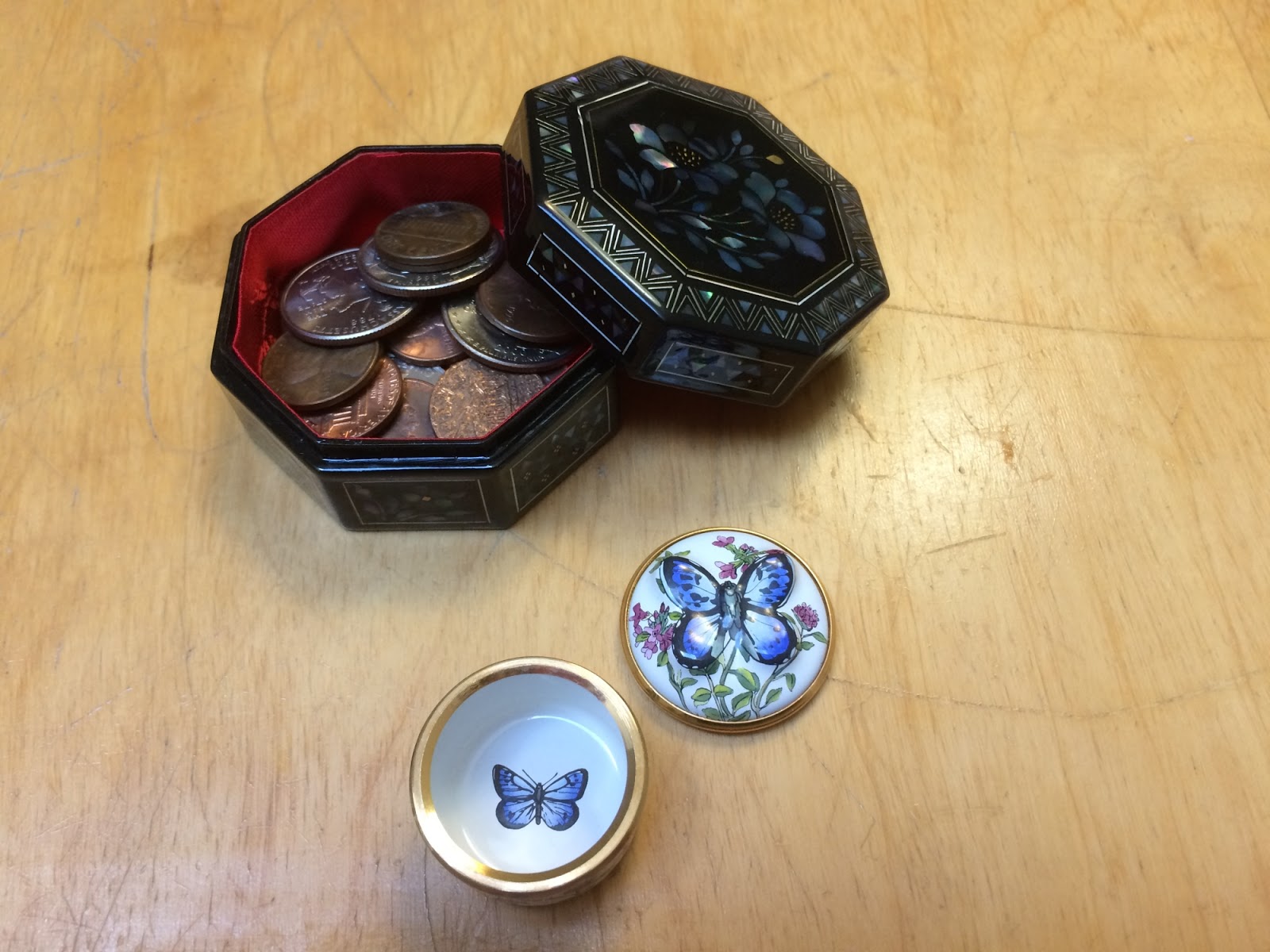
One opened inlaid box displaying coins, one open enamel box displaying painted butterfly on the bottom
Puzzle boxes offer a third delight—that of solving the puzzle. Even if you already know how a particular box is opened, there is something pleasantly sneaky in the knowledge that other people will not be able to open it without some difficulty.
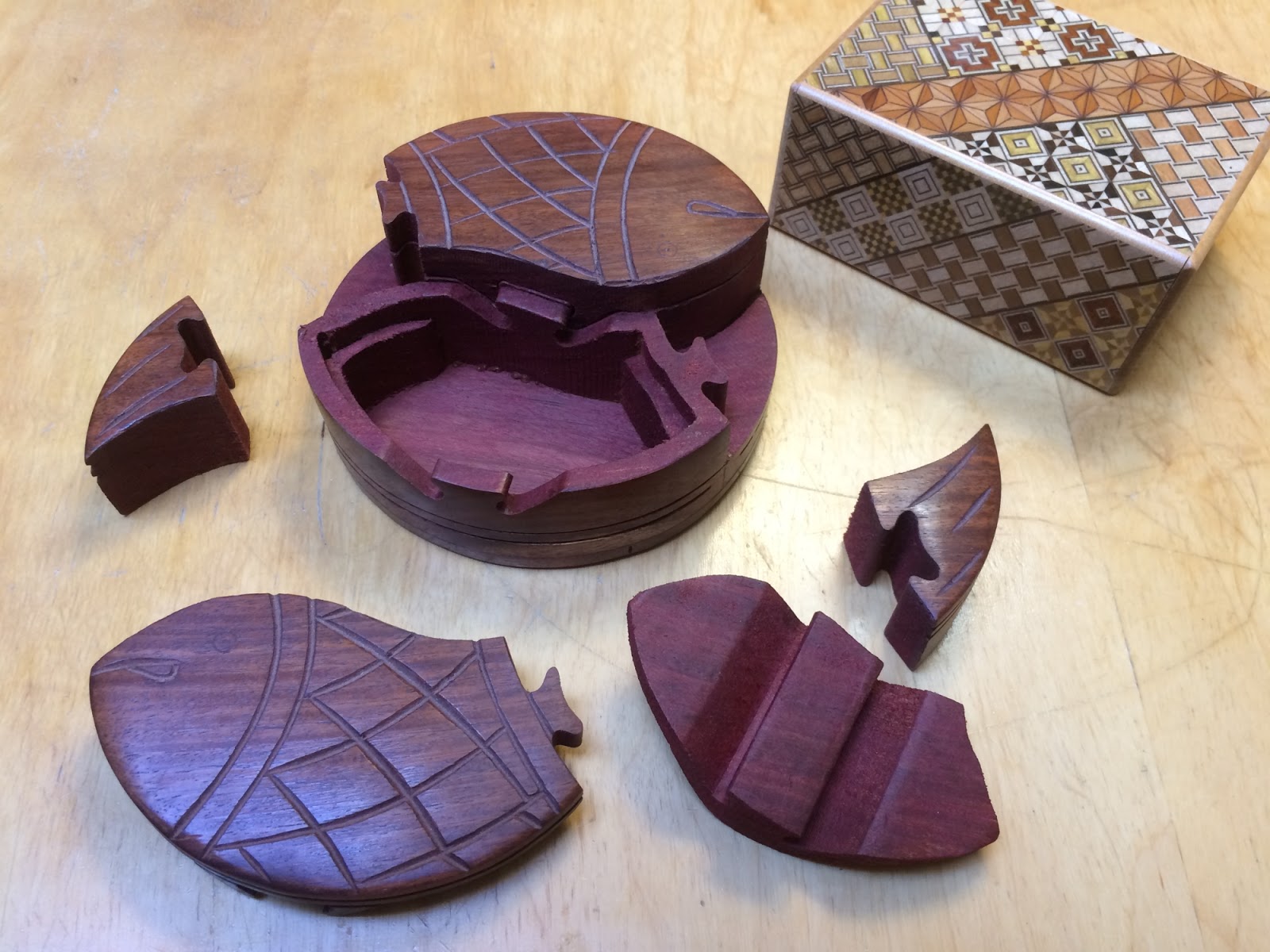
 I have two puzzle boxes. One, which I received from a friend, is only mildly tricky. The pieces of the fish have to be removed in a specific order, and some slide up while others slide sideways. Still, I love the fact that it is not a straightforward box.
The other box is a Japanese puzzle box. Opening this box involves sliding whole surfaces forward or back or up or down, in the right sequence. I believe it is one of the easier ones, and that is difficult enough for me.
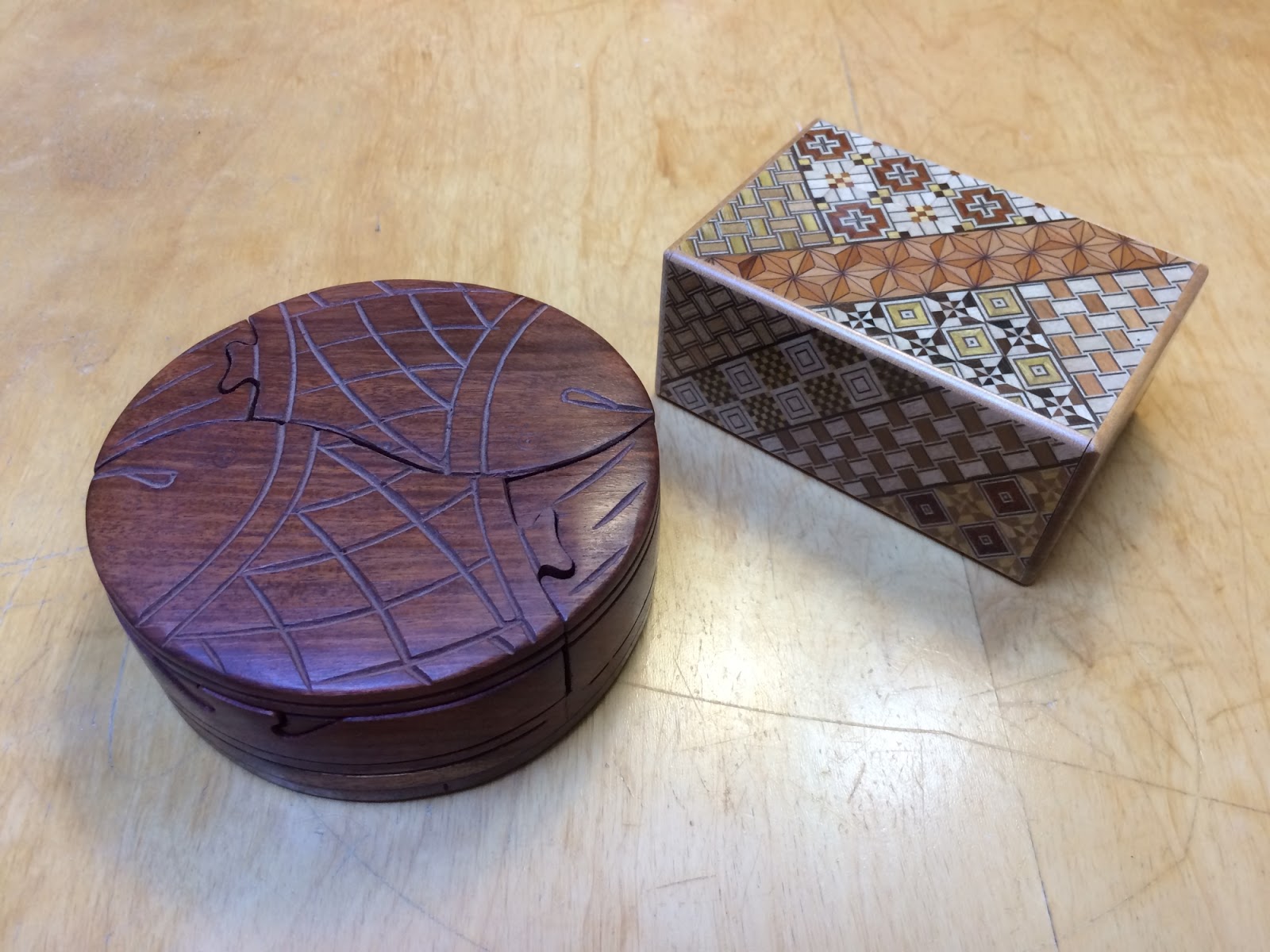
A fish-shaped puzzle box and an elaborately inlaid Japanese puzzle box
Photo shows a fish puzzle box partially opened.
Finding a place to display decorative boxes is a problem, though, especially if you end up with lots of little ones. What to do? Well, when I went looking for my small decorative boxes so I could take photos of them, I looked in… yep, more boxes.  One of those was a decorative box of the sort found at Michael’s.
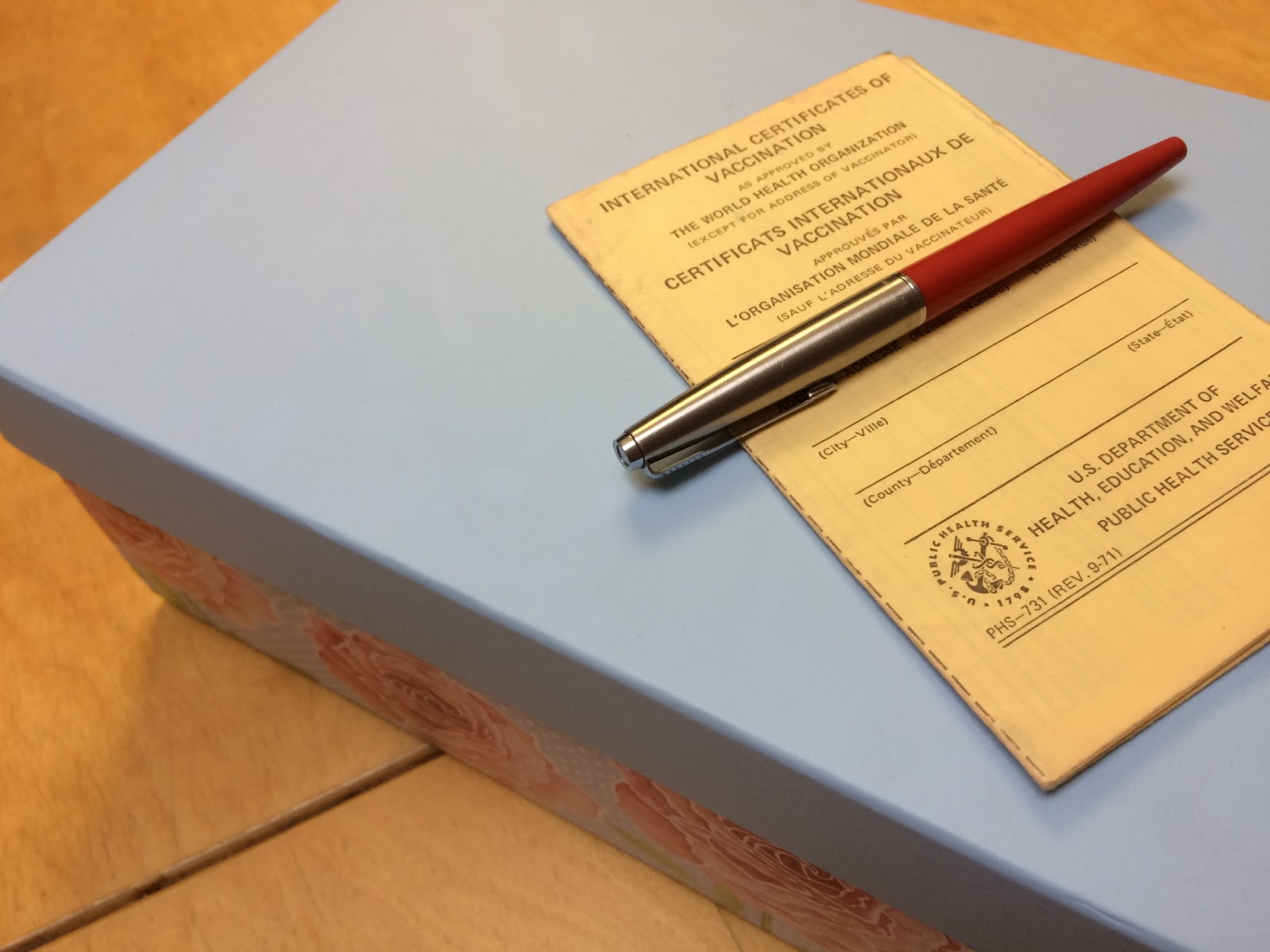
And speaking of mysteries and discoveries—in the same box I found the record of my smallpox vaccination, dated 1977.
Photo includes cover of international vaccinations certificate from the 1970s.
You never know what you’ll find.
Till next post.

The Pleasure of Pens

Long ago—maybe it was ten years ago, actually—my husband and I went to some event in our daughter’s elementary school classroom. Her teacher talked about things they’d been doing, and remarked that recently she had tried setting out a large selection of pens for the kids to choose from for a writing assignment. She was surprised that getting to choose a pen had made them more enthusiastic about actually writing. I, in turn, was surprised that she was surprised.
Of course choosing a new pen would make them want to write with it! Or does it not work that way with other grown-ups, the way it worked with those kids?
Didn’t that teacher, when she bought a new pen, find herself writing nonsense notes on a nearby scrap of paper to try it out, followed perhaps by some more extended and coherent remarks that happened to pop into her head as she watched the words appear in clear black or bright blue or even a vivid red?
Well, maybe not. Maybe it’s just me (and some other pen enthusiasts.)
I love pens. I like pencils, too, but pens come in such a variety of colors and feels.
By “feels”, I mean the difference between a gel pen oozing out a generous stream of viscous ink, and a ballpoint, pressed firmly to paper and smoothly putting down a thin line. Or a felt-tip, rubbed lightly along the page and leaving a vivid line of dye that sinks into and sometimes through the paper, versus a fountain pen, whose metal nib is run over the paper with hardly any pressure, leaving an equally inky, though hopefully not quite as penetrating, mark.
The above description only applies to pens that aren’t running out of ink, of course, and to ballpoints that run smoothly. A pen that is drying up is a frustrating object and makes writing unpleasant. I think I have avoided certain kinds of pens—rollerballs, in particular—because I’ve had too many experiences with ones that were halfway dry. It isn’t fair to the rollerballs. When they are fresh and full of ink, they write very well.
So part of the pleasure of writing is the feel of the pen on the paper. Another is watching the words appear. It helps if you have an interest in handwriting or calligraphy, so that you like to play with their appearance. Neat and upright, or elegantly slanted. Round and curly, or sharply angled, or full of flourishes. CAPITALIZED FOR EMPHASIS, or underlined, or even in italics. But even simple printing has something appealing about it when it fills a notebook page.
Samples of different handwriting by the same person
There’s more to writing than physically putting words on paper, of course. For me, writing is a way to organize my thoughts. Writing them down allows me to see them all together and keep track of them, in a way that I can’t easily do in my head. It’s so important that during a time when wrist problems made it difficult for me to write, I found it difficult to think as well.
I read a very interesting book about writing a while ago, about the two very different problems of writer’s block and hypergraphia– The Midnight Disease: The Drive to Write, Writer’s Block, and the Creative Brain by Alice W. Flaherty. I’d like to quote two short segments from it on hypergraphia.
“…Scientists are never happy until they can assign a number to the phenomenon they are studying, and researchers soon invented a simple way to do that with hypergraphia. They mailed a short letter to their patients with epilepsy, asking them to describe the state of their health. The average answer of patients without hypergraphia was seventy-eight words. The patients thought to have hypergraphia averaged five thousand words.” (p. 19)


“Hypergraphic handwriting tends to have distinctive physical characteristics. Hypergraphics often use highly elaborate or stylized scripts, even mirror writing like that used by Leonardo da Vinci. For emphasis, they frequently write in all capitals or in colored inks. They may not confine themselves to the main text, but may add exuberant annotations, drawings in the margins, and illuminated initials. Lewis Carroll, who most likely had temporal lobe epilepsy, exhibited several of these peculiarities—including what he called looking-glass writing and an exclusive reliance on purple ink—in the 98,721 letters he wrote from his late twenties until his death at age sixty-five.” (p.26)
That’s a lot of letters.
While I don’t find myself compelled to write, and don’t write to anything like the extent she describes in her book, there is something about this description that strikes a chord. Colored inks, elaborate scripts—of course. Annotations and marginal drawings? How wonderful! In moderation, anyway.
But I was talking about pens earlier and now I’m talking about writing, which leads me to wonder—how do people with hypergraphia feel about pens? Do they love trying out new pens and rediscovering old ones, or does the implement they use not matter? The author’s comment about colored inks suggests that it isn’t entirely irrelevant, so now I’m curious.
I’m also wondering why Lewis Carroll relied exclusively on purple ink. His signature color, maybe? I think I’d get tired of writing in the same color all the time.

Till next post.