Scented candles—fragrance and squishy wax


There’s a lot to like about scented candles.

First, there are all the different fragrances available. I’ve been fascinated with fragrance most of my life:  perfume, flowers, homemade potpourri, and soaps wrapped in delicate tissue. But candles have always been the easiest way to accumulate a lot of different scents in a compact and relatively inexpensive form.
When I was growing up, I read a lot about perfumery and the fragrance industry. I could have told you the difference between a top note and a base note, cologne as opposed to toilet water, and distillation versus enfleurage. I was particularly interested in people’s ability to identify different smells and the psychological effects thereof. Since I had a large collection of scented candles, I ran a totally unscientific study in which I blindfolded family and friends and handed them candle after candle, asking them to guess at the scent and describe their reaction to it. There wasn’t really a purpose behind the questions, just curiosity.
More recently I tried to make use of scent psychology by deciding to pair my stories to particular scents. For the Cinderella story I’m currently revising (The Slipper Ball), I decided to use Yankee Candle’s “Sage and Citrus”. The idea was that I would burn the candles as I worked, thus forever linking the fragrance to the work and making it possible to get into the right frame of mind simply by striking a match. So far I haven’t been consistent enough to get the plan to work, but I’ve still got plenty of revision ahead. And when I get back to the story about the psychic teenager (The Summer of the Deer), I’m going to run through my collection of Tyler Candle Company’s “Head Over Heals”(sic).
But scent isn’t the only appealing thing about scented candles. The wax itself has fascinating qualities as it goes from solid to liquid and back, with a soft, putty-like stage in between. As a kid, I loved to pour some of the melted wax out and squish it around until it hardened. My father showed me how to melt blocks of paraffin and make new candles in Dixie cup molds. Later, I graduated to dipped and braided candles, candles made in a duckie mold, “whipped wax”, and trying to carve designs in wax with wood carving tools (hint: warm wax is less likely to break off in chunks.)
I haven’t done much with candle-making for a long time, but some of the fascination with wax got passed on. For my birthday a couple of years ago, my daughter borrowed some essential oils and presented me with lemon- and peppermint-scented candles that she had made while I was out of the house. Aww…
On top of having fragrance and squishy wax, scented candles are an opportunity to use decorative candleholders, thereby delighting the eyes as much as the nose. Elegant or fun, sparkly or subdued—there are holders for every taste.
And then finally, scented candles are candles
Their flames are so pretty in a darkened room.
Till next post.

Books, Nostalgia, and Death


Warning: the following post might get a little depressing, but I’ve tried to end on a positive note.
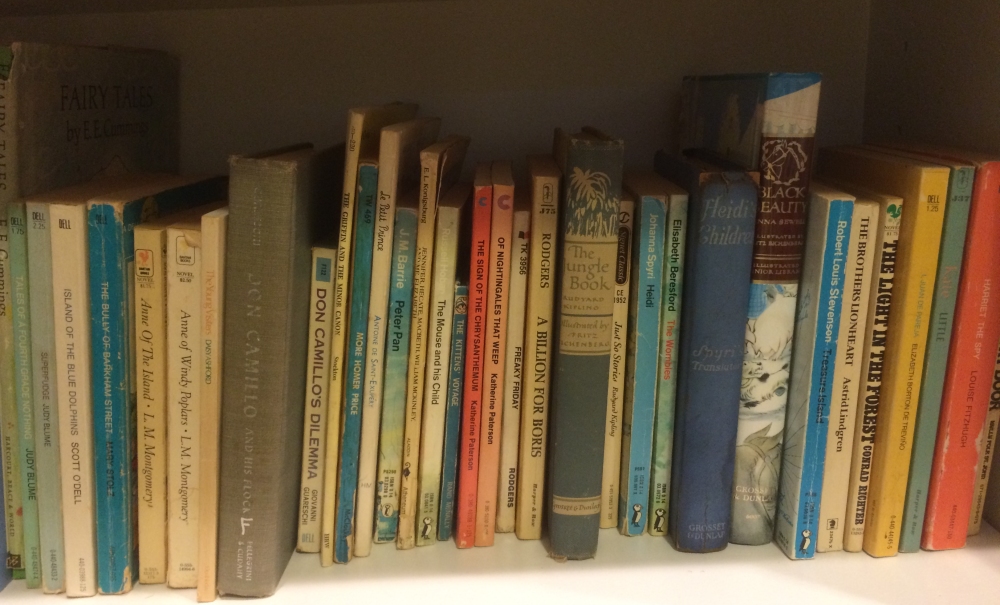
I’ve been sorting through my books this week, shelf by shelf. I lay them in rows on the floor, dust the shelf, and replace only the ones I really want to keep. That’s most of them, but I have so many shelves that I’ve managed to pile up a sizable stack for the  library nonetheless.
As I lay them out, I’m reminded of when I read them. The Deryni books? That was college. Piers Anthony and Anne McCaffrey? Mostly high school. Laura Ingalls Wilder? My mom read Little House in the Big Woods to me in first grade, and we went on from there. She still remembers the night we read the chapter “Fever and Ague” and stayed up really late to finish it.
Some of these books I read to my daughter when she was young enough to want to be read to: The Book of Three, Understood Betsy, The Westing Game. Some I got on audiobook so we could share them on long car trips: The Trumpet of the Swan, Bagthorpes Unlimited, Little Women. But a lot of the books I enjoyed growing up, especially the ones I read after age ten or so, she was never interested in reading.
I feel sad as I look at the lines of books on the floor, thinking of the time I spent repeatedly re-reading certain books and knowing that I will probably never read them again nor find someone else with whom to share them. They were important to me at the time, but there are lots of new books that are also good and worth reading, so except for the very best ones (and these are the ones I continue to re-read: Watership Down, Lord of the Rings, Peter Pan) it isn’t worth trying to talk anyone into reading them.
I can’t let go of them either, though, so there they sit on the shelf—the Gemma books by Noel Streatfield, the Prydain books by Lloyd Alexander (battered from much love), C. Dale Brittain’s A Bad Spell in Yurt (actually, I suddenly want to reread that one), and so many more. Do people even read Where a Red Fern Grows any more?
So I look at these rows of books that are slowly growing outdated, or at any rate forgotten, and I realize that as the world’s supply of good books continues to grow, almost all books face this fate. Books, like people, have a limited lifespan, with some living much longer than others but none forever. Just as some day I will be gone, the books that helped make me who I am will some day no longer be read—and that includes any books I might myself contribute to the current supply.
That thought is rather depressing, so here’s the attempt at a positive spin. Just as these books helped make me who I am, they also influenced the authors of the subsequent generations of books. Their effects live on beyond themselves, as I hope my own influence will.
And if that isn’t good enough, try this. There are some really great books out there—more than enough for a lifetime. You don’t have to read them all to be glad they exist.
Till next post.

Decluttering: on the one hand, and on the other


It’s January, the month of fresh starts and resolutions. It’s the month for … decluttering.
Clutter causes a lot of problems. I’m very familiar with these problems. I have pack-rat tendencies, and my papers and notebooks spread out over every available surface. 
The first problem is that clutter just looks bad. Those beautiful rooms you see in decorating magazines? No clutter.  Either their owners live incredibly spare lives, or (more likely) they have removed every bit of extra stuff from the room before the photo was taken, leaving only a few carefully angled books and knick-knacks to make the room look lived-in. (Exception: those Victorian rooms with the perfectly coordinated and arranged clutter—which means it isn’t really clutter.)
I’m not saying that if I decluttered, my house would suddenly be magazine-ready. I know there’s more to it. But wow, would it look a whole lot more attractive than it does now!
Workbench covered with art supplies, papers, fake flowers, boxes, and more.The second problem with clutter is that it interferes with leading a productive life. Sitting down to write or draw is a lot less appealing if I know I’m going to have to shove piles of stuff out of the way first. And I know it isn’t just me; my husband says the same thing about his overflowing work counter.
Also, at a certain point I start losing things in the clutter, which is very counterproductive. Where did I put the comments on last week’s work? I know it was in a folder, but it isn’t in my bag any more. And didn’t I have a large vase just the right size for these flowers? What did I do with it?
The third problem—and it isn’t a problem with clutter, exactly, but a more general problem with hanging on to stuff—is that it’s an inefficient use of goods. I could clear all the papers and knick-knacks and gadgets from my work surfaces by putting them into boxes and shoving the boxes in the attic. That would declutter a large part of the house and solve the first two problems I mentioned, but if I’m not going to use that rock tumbler/train set/reference book/vase, why keep it? Someone else could be polishing rocks or playing trains or reading about heraldry or arranging flowers, if only they had the right equipment. What a waste.
Thinking about all this fills me with the desire to Marie-Kondo my part of the house and get rid of everything that doesn’t “spark joy” (not including necessary but dull stuff like my printer and tax files and… you get the idea). Why keep so much stuff? Why not really pare down to the essentials?
And then I think about the romance of the attic.
Shelf with supplies for candles, psanky, rock polishing, and some toys.If you’ve read a lot of older children’s books, you’ve probably read some where children who are visiting aged relatives creep up into the attic and discover all sorts of amazing things forgotten in trunks, boxes, and dusty crates. In some books these are magic treasures that lead to wild adventures. In other books they discover secrets hidden in old letters and leather-bound books. Sepia-toned photos, old lockets, baby shoes—whose are they?
The discoveries don’t even have to be that dramatic to be interesting. My Granny’s cellar (she didn’t have an attic) had hatboxes, old tools, musical instruments, fancy writing desks, yarn from half-knit sweaters, ceramic toads, game boards, and I don’t remember what else. Oh yeah—a gold thimble. Really.
 
When M was little, we visited my parents a couple of times a year at their house. In the rooms of her grandparents’ house (not just the attic), she found a lot of blocks to play with, some Matchbox cars, my old Micronauts, a big doll (also mine) that makes a “Maa!” sound if you turn her over, blocks of watercolor paper, tiny plastic animals, and more. When I saved those things, was I planning for my daughter’s future entertainment? Of course not. Maybe some of those did “spark joy”, but mostly it was just chance that they never got disposed of.
So what attitude should I take to the wide variety of things cluttering up my house? Certainly there’s no point in keeping something that is falling apart, or just plain ugly. And it wouldn’t be a good use of other things to keep them packed away for that hypothetical attic explorer. Better to get them into the hands of someone who will use them.
But I think I can justify keeping an assortment of useless curiosities, so long as I don’t fill up too much space with them. Some tiny drawers, a few shoeboxes… some old toys and mementos…Of course, I’ve got a long way to go before I need to worry about not having enough stuff tucked away.
To close, here is scene that sticks in my memory from Pippi Longstocking, by AstridLindgren (trans. Florence Lamborn).

“Afterward Pippi invited them to step into the parlor. There was only one piece of furniture in there. It was a huge chest with many tiny drawers. Pippi opened the drawers and showed Tommy and Annika all the treasures she kept there. There were wonderful birds’ eggs, strange shells and stones, pretty little boxes, lovely silver mirrors, pearl necklaces, and many other things that Pippi and her father had bought on their journeys around the world. Pippi gave each of her new playmates a little gift to remember her by. Tommy got a dagger with a shimmering mother-of-pearl handle and Annika, a little box with a cover decorated with pink shells. In the box there was a ring with a green stone.”
Till next post.