Finding the Right Words–the importance of correct terminology


I am periodically reminded of how important it is, when talking to an expert in something, to use the correct words.  There are a lot of words that I know the meaning of only in a general sort of way. That’s good enough when I run into them in a story or hear them in a conversation about something else, but not adequate when I need to communicate a problem.
Imagine the following conversation.
Me: “My computer doesn’t have enough memory.”
Husband-who-works-with-computers-professionally: “Really? Not enough memory?”
Me: “Yes, my computer keeps saying it doesn’t have enough space to back up my Scrivener files.”
Husband: “Oh, your hard drive is full.”
Me (suddenly remembering that there is such a thing as RAM): “Yes, that’s what I mean.”
Husband: “I’ll take a look.”
I’m not saying that actually happened, mind you… but there are a lot of terms associated with computer use that  haven’t always been clearly distinct in my mind. There’s the computer itself (whatever components that refers to), and then there’s its operating system, any applications that have been loaded onto it (including a browser), and then a bunch of other files created by using those applications. It’s taken me a while to distinguish between the applications and the (data) files created with them. It doesn’t help that the applications are also themselves comprised of files. It’s easier to keep straight if I think about the files for my novel, Adrift, and distinguish them from the Scrivener program I used to write them with.
(A slight digression. Think of those scam calls—“Hello, I’m Betty from Windows, and I’m calling about your computer…” “No, you aren’t, because Windows is an operating system, not a computer company, and anyway Microsoft isn’t going to give me that kind of personalized attention unless I first give them buckets of money.”)
There are many other areas where I discover my vocabulary is lacking. The construction of my own house is a bit of a mystery. It has joists, studs, drywall (which is the same as sheetrock, I think), and up above it has a roof with rafters, eaves, gables (maybe?), and soffits (is that part of the roof?). I don’t think much about these words when I read them in passing, but when someone is discussing potential damage to the floor from a leaky shower and whether it has affected the joist, suddenly I’m interested.
I also need the right words so I can describe a problem over the phone accurately—and without sounding stupid to myself. I don’t want to tell the plumber, “The problem is the bathroom sink. The faucet. I mean, the tap. That thing you turn to start the water where one is for hot and one is for cold.” I’ve used the word “tap” before, but in the moment when it matters,  I find myself wondering, “Is that the tap?”
Inadequate vocabulary is most a problem in discussing subjects that, while important, are not of interest to me.  Since I’ve never been particularly into cars, it was some time before I really caught on to the distinction between “wheel” and “tire”. I always sort of thought of them as a unit, the four round things that roll. But don’t tell your husband you think the wheel is damaged when you really mean the tire. You could give him a heart attack. Or a stroke.
Okay, I’m exaggerating as a lead-in to my last set of examples—medical terms. As a kid, I lumped together “heart attack”, “stroke”, “heart failure”, “cardiac arrest”, “coronary”, and “apoplexy” as terms for a bad thing that could happen suddenly and which seemed, in popular expressions, to be linked to sudden shocks or anger.
Now that I’m older, I know that heart attacks involve a problem with the blood supply to part of the heart muscle, and strokes involve a problem with the blood supply to part of the brain. Not the same thing. On looking the other terms up, I find that “coronary” is often used to mean “heart attack” and “apoplexy” to mean “stroke”, but that heart failure means the heart is weak and not working very well, and that cardiac arrest just means the heart has stopped for whatever reason.
But being older and (a little bit) wiser doesn’t mean there aren’t other health-related words I’m misusing. There was some word I used in describing a problem to my doctor which I later realized probably had a very specific meaning for the doctor, and not the meaning I had intended. Further, the doctor, being used to the specific terminology, probably didn’t even realize that I was using it loosely and inaccurately. And that is a communication problem.
I wish I could remember now what the particular word was. Instead, I’ll just offer as an example “dizzy” versus “light-headed”, which apparently have slightly different uses.
Using the right words is important. With them, you can be precise in describing a problem with your computer or your health. Without them, you can inadvertantly create a lot of confusion. Eight-plus years studying philosophy contributed to my concern for correct use of words (“if…then…” is not the same as “if and only if”), but it didn’t teach me how to distinguish a joist from a stud, or a trot from a canter. Some distinctions only get learned when experience makes them relevant.

Reflecting On Reflections–the stories inside the shine


I love things that shine, sparkle, or shimmer, just because they are beautiful. I also love anything that holds secrets or points beyond itself. Some things, in reflecting light, do both.
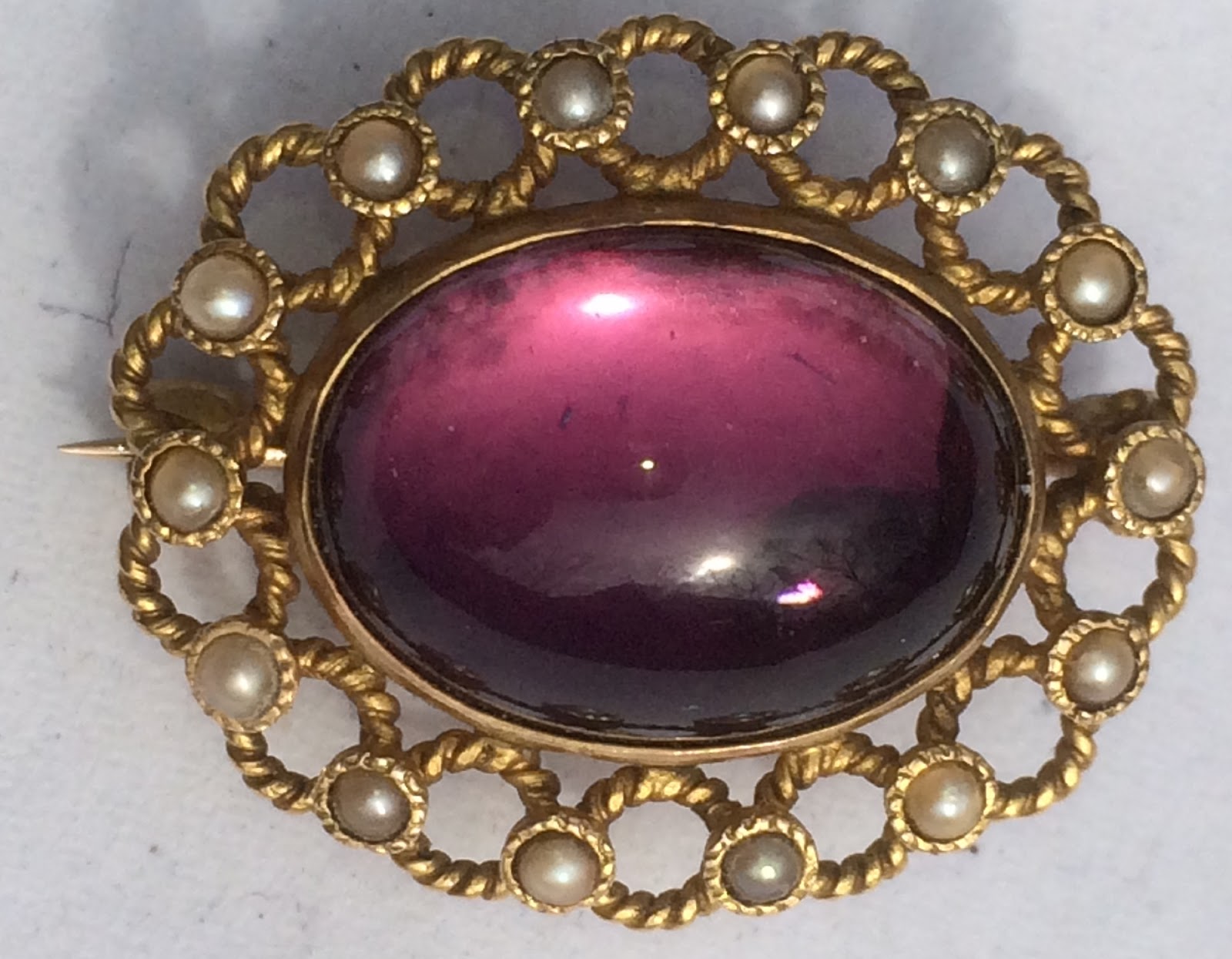
Recently I was fascinated by the way people incorporate drawings of cabochon-cut gems into Zentangle-inspired art. Cabochons are rounded and polished, not faceted, like smooth blobs of glass. In looking at demos of how to draw them, I was puzzled by the white highlight. Should the white spot be round, or a long bar? Where should it be placed? I looked at photos of cabochon-cut gems, using Google images (so useful for things like this!), trying to figure out how the bright spot works. In the photos, I saw reflections in the gems of… their light source.
Purple cabochon gem with reflected window.
Gem reflects window and potted plant.
Duh!
Some bright spots were shaped like windows, some like bars of overhead fluorescents, while others were merely a round bright spot (an incandescent bulb? the sun?). And sometimes there were multiple bright spots, because there were multiple sources of light.
But it wasn’t just the light source that I saw reflected in the gems. Was that the camera apparatus making the dark square shape? And the shop where this other photo was taken must have a whole bank of windows. In one gem, I even saw the silhouette of person sitting nearby.
Purple cabochon brooch with reflected trees.
Outdoors, you can vaguely see the trees as well as sky.
In each case, all I was looking at was a photo of a single gem, but the reflections told me more.
This shouldn’t have been news–we have mirrors in our cars precisely to give us information about things out of our line of sight. Reflections sometimes play a role in stories, too. I remember an Ellery Queen mystery (the TV series) where the lack of a reflection, where one was expected, revealed something important. And in Bladerunner, a reflection in a photo gives the detective a clue (at least, I think it was a reflection—it wasn’t entirely clear in the movie). A painting that includes something shiny, such as a silver teapot, might make a good clue in a mystery novel– the distorted reflection of a face could reveal that a third person had been present at the sitting and perhaps even who it was (by their distinctive hat, say).
Silver teapot with reflection of kitchen including two jars of peanut butter.
What kind of peanut butter do we buy? Two jars worth.
Reflections also show up in mysteries because of the misleading way they reverse the appearance of what they show. Someone who sees something in a mirror sees it reversed—information, and yet misinformation.
For the most part, shiny things are appealing because of the way that they play with the light, not because of what their reflections tell us. In fact, paying too much attention to the reflections in gems rather takes away from their immediate appeal. But I like knowing that if I want, I can see more than just the gem. I can see the world around it.

Till next post.

Purple cabochon brooch with reflection of two fingers.

Scented candles—fragrance and squishy wax


There’s a lot to like about scented candles.

First, there are all the different fragrances available. I’ve been fascinated with fragrance most of my life:  perfume, flowers, homemade potpourri, and soaps wrapped in delicate tissue. But candles have always been the easiest way to accumulate a lot of different scents in a compact and relatively inexpensive form.
When I was growing up, I read a lot about perfumery and the fragrance industry. I could have told you the difference between a top note and a base note, cologne as opposed to toilet water, and distillation versus enfleurage. I was particularly interested in people’s ability to identify different smells and the psychological effects thereof. Since I had a large collection of scented candles, I ran a totally unscientific study in which I blindfolded family and friends and handed them candle after candle, asking them to guess at the scent and describe their reaction to it. There wasn’t really a purpose behind the questions, just curiosity.
More recently I tried to make use of scent psychology by deciding to pair my stories to particular scents. For the Cinderella story I’m currently revising (The Slipper Ball), I decided to use Yankee Candle’s “Sage and Citrus”. The idea was that I would burn the candles as I worked, thus forever linking the fragrance to the work and making it possible to get into the right frame of mind simply by striking a match. So far I haven’t been consistent enough to get the plan to work, but I’ve still got plenty of revision ahead. And when I get back to the story about the psychic teenager (The Summer of the Deer), I’m going to run through my collection of Tyler Candle Company’s “Head Over Heals”(sic).
But scent isn’t the only appealing thing about scented candles. The wax itself has fascinating qualities as it goes from solid to liquid and back, with a soft, putty-like stage in between. As a kid, I loved to pour some of the melted wax out and squish it around until it hardened. My father showed me how to melt blocks of paraffin and make new candles in Dixie cup molds. Later, I graduated to dipped and braided candles, candles made in a duckie mold, “whipped wax”, and trying to carve designs in wax with wood carving tools (hint: warm wax is less likely to break off in chunks.)
I haven’t done much with candle-making for a long time, but some of the fascination with wax got passed on. For my birthday a couple of years ago, my daughter borrowed some essential oils and presented me with lemon- and peppermint-scented candles that she had made while I was out of the house. Aww…
On top of having fragrance and squishy wax, scented candles are an opportunity to use decorative candleholders, thereby delighting the eyes as much as the nose. Elegant or fun, sparkly or subdued—there are holders for every taste.
And then finally, scented candles are candles
Their flames are so pretty in a darkened room.
Till next post.