"You Need to Forgive Yourself"–why does this phrase set my teeth on edge?

In an episode of a television show I watched recently, one character advised another that “you need to forgive yourself.” I think this phrase gets thrown around too easily and too often. Whenever I come across it in fiction, I brace myself for plot twists that may be saccharine or implausible. When I hear it in real life, I get fidgety. Why does this phrase bother me?

In the first place, it seems too facile. Has this person actually done wrong? In that case, do they really have the authority to forgive themselves? It seems that the forgiveness they should be seeking is that of the person they have wronged. Granted, even if that person forgives them, they have to accept that they are forgiven, which I suppose involves forgiving themselves. But the other person’s forgiveness should come first, or at least be sought simultaneously.

Of course, the wronged person may not be able or willing to forgive them. I’ll agree that at some point, wrong-doers who have sincerely done their best to make amends may let themselves off the hook. They should forgive themselves. But only after they have done their best.

In the second place, “forgive yourself” is sometimes the wrong expression. Suppose this person hasn’t done wrong, but blames himself for things that were never really up to him in the first place. In the episode I am thinking of, another character said, “Don’t blame yourself for things that weren’t in your control.” Now that is true. People do blame themselves, and feel guilty, about things that are not their fault. However, telling someone that he shouldn’t blame himself and telling him to forgive himself are two different things. The results may feel similar–an easing of guilt (inappropriate guilt in the first case). But you can’t “forgive” yourself unless there is a wrong to be forgiven.

Finally, there is one area in which “forgive yourself” does seem appropriate. As human beings, we inevitably make mistakes. We step on people’s toes, say and do things we shouldn’t, and basically mess up. Repeatedly. This tendency, as opposed to the specific wrongs that result from it, isn’t our fault. We can’t help being human. At the same time, it does lead us to wrong others. So maybe it makes sense to say that we should “forgive ourselves” for our tendency to make mistakes, even as we try to avoid making them and try to make amends for the ones we have already made. We shouldn’t feel guilty for not being perfect. We should only feel guilty if we are not trying.

So maybe the character in the episode did need to forgive himself, as well as ceasing to blame himself for things out of his control. Maybe the phrase irritated me because I knew he also had a lot of forgiveness to seek as well–amends to be made, apologies to be offered–and that wasn’t explicitly addressed. Given his history, “forgive yourself” sounded more like a feel-good platitude and less like a real resolution to the problem.

But I think he got it right in the end.

Till next post.

The TV Show "Lucifer" and the Difference Between Real Evil and Stage "Evil"

Recently I’ve started watching the series “Lucifer” on Netflix. Lucifer Morningstar is the devil, and he is on vacation and running a nightclub in Los Angeles. I’m only on the third episode and it’s clear that he’s being influenced (for the good) by some of the people around him, but even apart from that influence, this character isn’t very devilish. He isn’t evil; he’s only “evil.”
That is, there’s a difference between real evil and stage “evil”, rather like there’s a difference between being a ballet dancer and simply wearing a costume of tutu and ballet shoes. I’m not complaining. If the character were truly evil, the show would be unwatchable. Who wants to watch a show with a totally unsympathetic main character?
(Note: I did just finish watching “Deathnote”, but the main character started off thinking he was pursuing justice, even if he was wrong about his methods. He became increasingly evil as the show went on, but he was opposed by some good characters and it made for a fascinating battle of wits. As long as you have equally important good characters in opposition and the main character isn’t completely evil, you can still have a very watchable series.)
Stage “evil” is the fun kind, the trappings of evil without the substance. Lucifer has devilish good looks and charm, a bold disregard for rules and authority, and a penchant for causing trouble. But let’s notice that the people he causes trouble for are usually themselves either troublemakers or really irritating people. He scares a school bully and terrifies a fraudulent street preacher. If he really wanted to increase the misery in the world, he should have encouraged them, not scared them. But the audience wouldn’t like him then, because that would be real evil.
He also runs a nightclub with scantily clad dancers and is often found in bed with a number of individuals of either gender who are equally scantily clad (and would be wearing even less if this weren’t a TV show.) But notice that it is strongly implied that all these individuals chose to be there, and that there is never the slightest hint that the nightclub dancers might be exploited or working for him only reluctantly. He’s sleeping with a psychiatrist, but there’s no suggestion that she might be married or otherwise attached. No one gets hurt.
I said that he does cause trouble for troublemakers, and Lucifer rationalizes his selectivity by saying that he is punishing evil-doers, and isn’t punishing evil what the devil is supposed to do? 
 That’s curious, because punishing evil doesn’t itself seem evil (though it isn’t merciful either.) If the devil is supposed to be evil, presumably he would encourage evil-doing in order to cause more misery. The devil is supposed to tempt people in ways that twist their souls and ruin their lives and the lives of other people as well.
But again, a main character who was truly evil wouldn’t make for an entertaining show. If you want to learn about real evil, there are plenty of documentaries, but I wouldn’t call them “entertaining.”
Why make a big deal about this distinction between evil and “evil”? Because real evil doesn’t come with labels, and people sometimes mistake stage “evil” for the real thing.
I’m thinking, for instance, of people I have known who find dark, occult-looking things appealing. Or maybe they’re into vampires. Stage “evil.” They’re playing with props. They aren’t really evil at all. But some people don’t seem to realize that. They take the appearance of stage “evil” as a desire for the real thing.
Granted, there are some people drawn to stage “evil” who really are kind of twisted, and others who do so in order to shock and offend (not exactly a kind motive). On the other hand, there are people who are drawn to exactly the opposite symbols (of goodness and light) while behaving in a genuinely evil manner. You really have to look at people’s deeds, not their outerwear or outer attitude.
So, I’m enjoying a TV show about the devil on vacation in Los Angeles. That’s okay. It doesn’t mean I’ve been drawn to the dark side. I know the difference between “evil” and evil.

Playing With Ink

When I was about eight years old, my grandmother gave me a Parker 45 fountain pen and ink cartridges. I still have it and it still works, though it had to be repaired once. Since then, I have accumulated other fountain pens: some that can take cartridges of ink, and some that must be filled from bottles. So today I’m going to talk about the fun of playing with ink colors.
Ink cartridges usually come in a limited range of colors. Parker offers black, blue, red, and green. I think they once offered turquoise, but I may be misremembering. Pilot offers cartridges in black, blue-black, blue, green, red, purple, and sepia (brown), which is quite a variety.
The fun comes when you change from one color of ink cartridge to another without rinsing your pen. Your words slowly change in color as the old ink gets flushed out of the nib. (Sorry, no photo.) This is playing with ink without any mess and fun for kids. (Just remember to show them how to write with a fountain pen—gently, and holding the pen at an angle, not upright. Nib right side up, and both sides of the split in contact with the paper–don’t write with the side of the nib.)
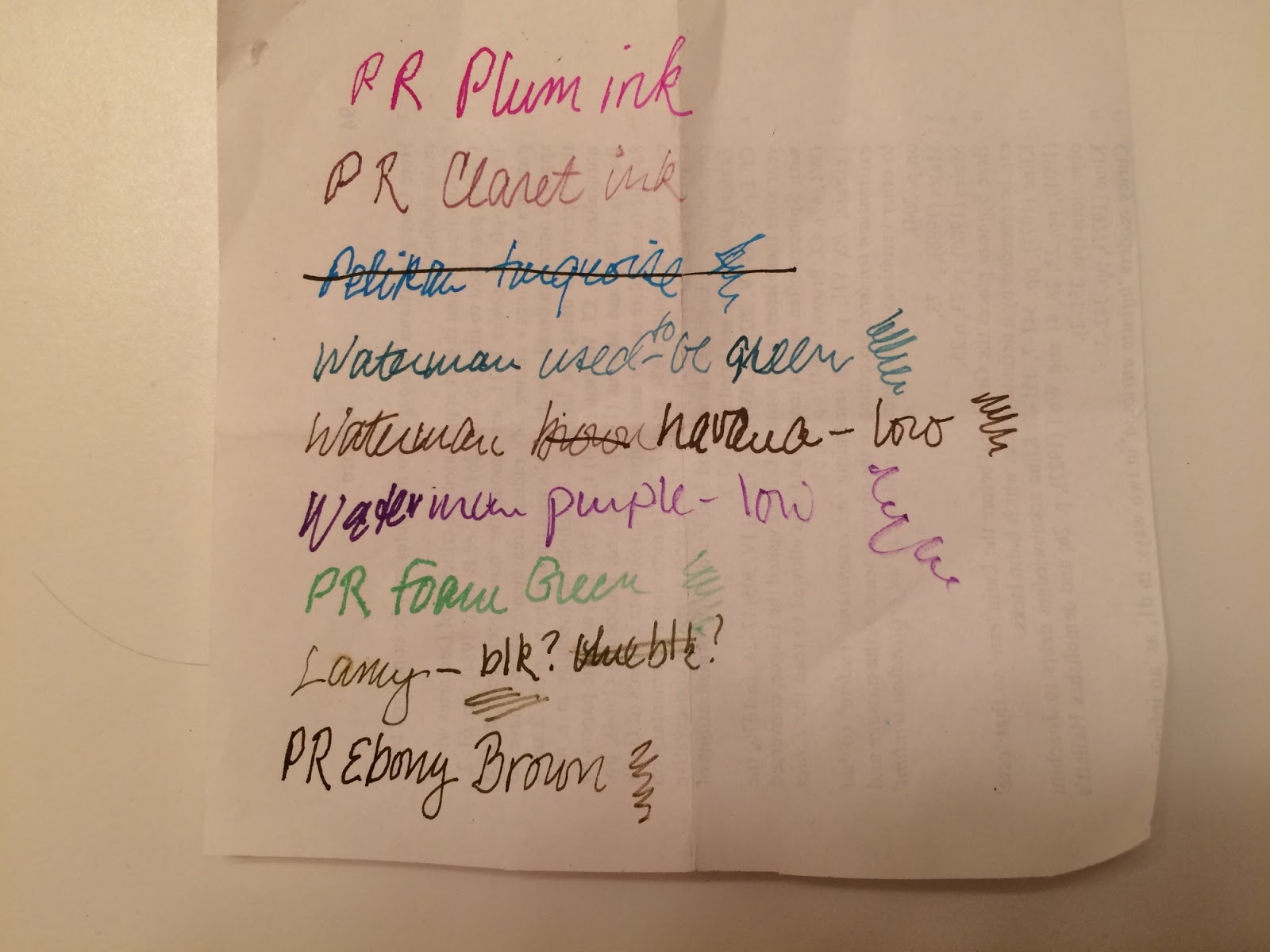
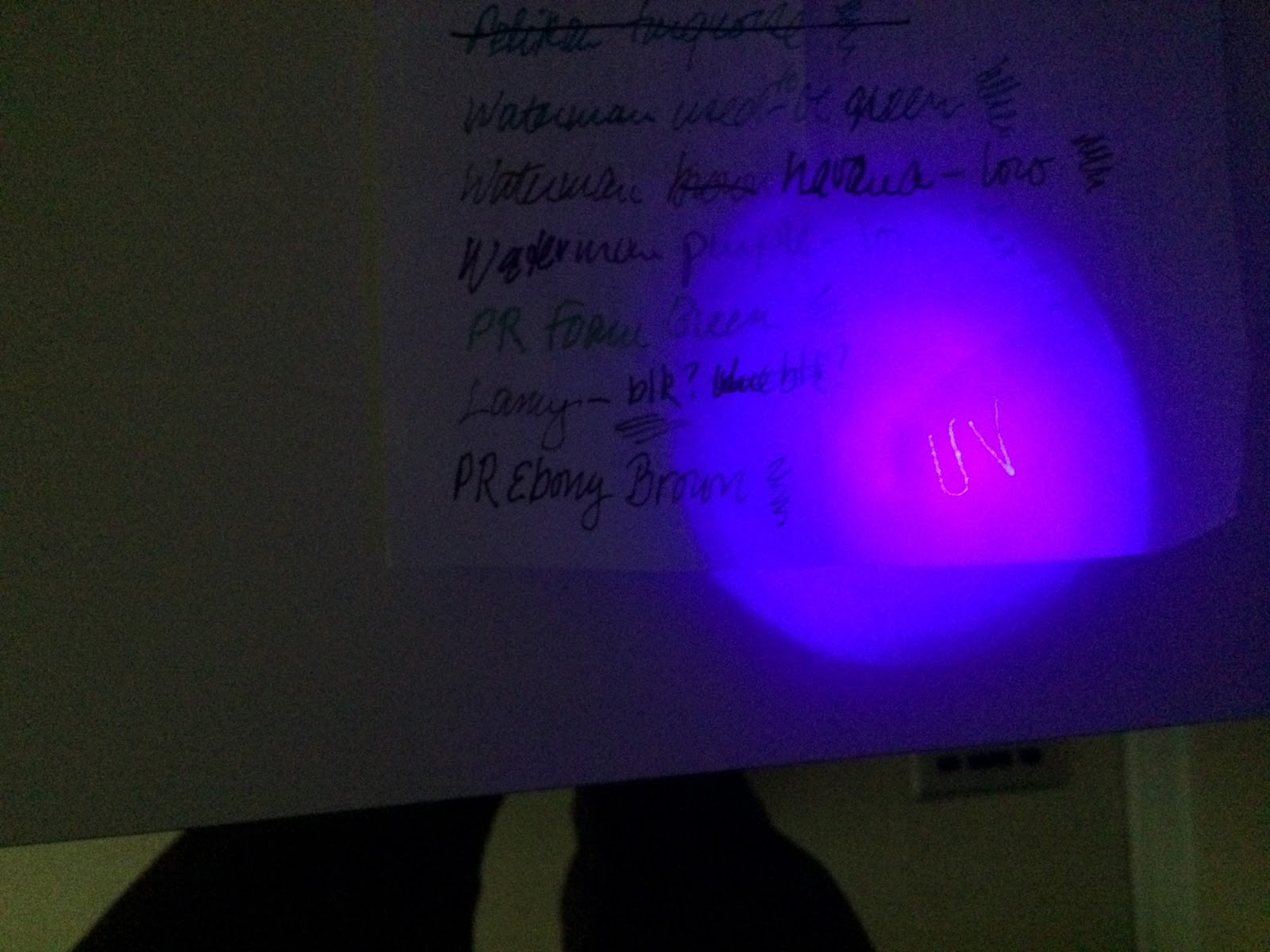
Bottled ink currently comes in an enormous variety of colors. I think most pen companies offer their own selection. Noodler’s Ink even offers an invisible ink that shows up under UV light. As far as I know, there is no need to match the brand of pen to the brand of bottled ink.
Ink bottles come in varied shapes as well as colors.
You can’t quite see it, but I tested the UV ink, too.
Here it is, with a black light shining on it.
Most of the cartridge pens can take a converter that allows them to use bottled ink. However, since you dip the pen into the bottle when refilling it, you shouldn’t go straight from one color to different one without rinsing out the pen. There’s way too much ink residue still in the pen, even if the pen has run completely dry. You don’t want to contaminate one color of ink with another. So you can’t do the same trick with bottled ink that you can with cartridges.
However, I just realized recently that writing with various dilutions of ink is also fun! I don’t know why it took me so long to try it. I started writing with a pen that had held violet ink and which I was trying to rinse clean. I had filled it for the umpteenth time with distilled water and it was still writing violet—but pale violet. (I think I needed to take the converter out and rinse the nib thoroughly.)
Testing various inks and pens.
Inks can do strange things when diluted, especially black ink. Probably you’ve seen the result of black marker on paper towel getting wet and spreading out in different colors that you didn’t realize were in there. For this post, I took two pens that I thought had been filled with black ink and refilled them with distilled water. Strangely, one started producing yellowish writing for a while, then darkened to a dilute black. The other behaved oddly (I should have taken a photo of the paper towel I was wiping it on), then settled down to a bluish black. Turns out I don’t even have a bottle of black ink. I must have filled one with Ebony-brown and the other with Blue-black.
I should also add that ink that has been diluted with water isn’t going to behave quite the same way as undiluted ink. I don’t know what other ingredients go into ink, but I am aware that there is more than just water in there. Probably there are ingredients that thicken it slightly, or help it flow or help it dry quickly… I don’t know.
Some people take playing with ink to higher levels. Some people mix ink colors and then fill their pens with them.  Other people refill cartridges from a bottle using a syringe. 
Maybe someday I will be one of those people. For now, I’m having enough fun swapping out cartridges to watch the color change, and writing with diluted ink en route to switching colors of bottled ink.
Till next post.