I Trust My Cat, and My Cat Trusts Me

Sometimes when I am sitting with a cat on my lap, watching Netflix, I am amazed that this creature trusts me enough to fall asleep there. I am certainly big enough to do her harm.
The trust works both ways, of course. She may be small, but I know how sharp her claws are. But I don’t even notice when she settles down mid-movie, though she could, if she wanted, shred my face.
Why do we trust each other? We certainly don’t have any contract with each other, enforceable or otherwise. We don’t even speak the same language. What we do have is our past experience with each other, and a strong need to trust.
I mention our need to trust because past experience alone isn’t enough. Bertrand Russell, in The Problems of Philosophy, points out that the chicken gets fed every day, right up until the farmer decides on a chicken dinner. How can my cat be sure she isn’t in the same position? The fact is, she can’t. But living with continual suspicion of each other—suspicion not based on anything in particular–would be an exhausting and unhappy way to live. We need to trust each other so we can relax and enjoy each other.
In the case of my cat, she is trusting me not to harm her. She also seems confident that I will put out food every day. It’s a fairly uncomplicated relationship, given that we can’t communicate well enough to set up rules. Otherwise I’d feel betrayed, rather than annoyed, when she scratches the sofa or climbs up on the table.
People have much more complicated motives than cats, and it’s harder to know when to trust them. Our lives together are full of rules, written and unwritten. Our decisions about whom to trust are still based on our shared past experience, though we can also consider what motives they might have. We can worry about the possibility that we are chickens being fattened up. But we desperately need to trust at least some people in order to be able to live and work together.
Sitting with my cat reminds me how important trust is to our sense of security, and oddly, how basic it is. It’s about expecting not to be harmed by the other. Maybe with a little food and treats thrown in.
Till next post.

Cats Like to Play, and So Do People

Everyone knows that kittens like to play at stalking and pouncing. They’ll play with shoelaces, with toes, and even with their own tails. Children too, like to play, and we know that they are practicing grown-up skills in the process. 
But it isn’t just young cats that like to play—grown cats do too, exercising their cat skills on fabric mice and wand toys when real prey isn’t around. Books on cats stress that this is good for adult cats, that having regular opportunities to practice their cat skills makes for a happier cat. This makes me think about people, and how grown-ups enjoy playing and practicing their human skills.
One of my cats started me on this train of thought because she would meow at me for no apparent reason. She wanted something, but it wasn’t food. It wasn’t “out.” Petting? A lap to sit on? I couldn’t tell, and she can’t speak human. She liked to play on occasion, and once in a while she would even chase her tail, like a kitten. Da Bird used to be both cats’ favorite—a feathery toy that could be whizzed through the air or dragged on the ground—but too often it seemed like they lost interest quickly. So I didn’t get it out much.
As I worked on a sewing project, she started playing with bits of the fabric.This reminded me that some years ago I had tied leftover strips of fabric together to make a rope that could be dragged around. Our cats sometimes enjoyed chasing and catching it. So I got it out of their toy basket (yes, they have a little basket of cat toys) and played with her for a while. Then I hung it over the back of a chair and left it there.
That chair happens to be right near where she tends to sit and meow. So I started flicking the fabric strip in the air the next time she was meowing in her undecided way.
Turns out she has much more capacity for playing than I realized, with the right toy and the right timing. She grabbed the strip out of the air, she chased it around the house, and she had a great time chewing on the knots in it. Weeks later, she’s still enthusiastic about it.
It could be that she will get bored with the strip of cloth, but I did read that cats prefer toys that give them a feeling that they are making progress, not just in catching the toy, but in tearing it apart. The cloth strips are easy to catch with her claws and the fabric does shred a bit with every capture. Actually, they were unravelling so much that I sewed some new strips with bound edges, so I don’t have to worry so much about her swallowing threads. 
When I play with her and see how much she enjoys exercising her “kitty skills” of stalking and pouncing, I think about all the opportunities to play with her that I’ve missed. I also think about people—grown-up people. Are our lives better if we get regular opportunities to exercise our “human skills?” Do we get enough of the right sort of play?
It’s interesting to make a list of  human specialties and consider the games we play. We are tool-makers and –users, also language-users and social beings, and we used to be hunters and gatherers for our living. As kids, we play tag and other chasing games, hide-and-seek (searching), and various kinds of pretend. We build sand castles and mudpies, and we have singing games and tell stories and jokes.
We have virtual versions of all of these as well, but maybe we need some of the non-virtual, physical games, too, to engage our whole selves, body and mind.
Something to think about.
Till next post.

The Great British Baking Show's Sarawak Style Cake–can I make a kek lapis?

Last week I watched the Great British Baking Show episode 7, “Festival Week” in which the contestants have to make a Sarawak style cake.  When the hosts announced that this was a cake in which the layers were grilled, my jaw dropped, wondering if they were going to have stove-top grills, or set up outdoors.

It turns out “grilled” is a Britishism for “broiled” (or else “broiled” is an Americanism for “grilled”–you know what I mean.) Even so, I’d never seen a cake broiled layer by layer, nor one that gets cut up and reassembled like a strip-pieced quilt to create colorful geometric patterns. It seemed such an odd way to create a thinly layered, colorful cake that of course I had to try the technique myself.

I had no ambitions to go the whole way and create a mosaic made of cake. I just wanted to make a colorful layered cake using this completely new (to me) method. So I looked up some recipes.

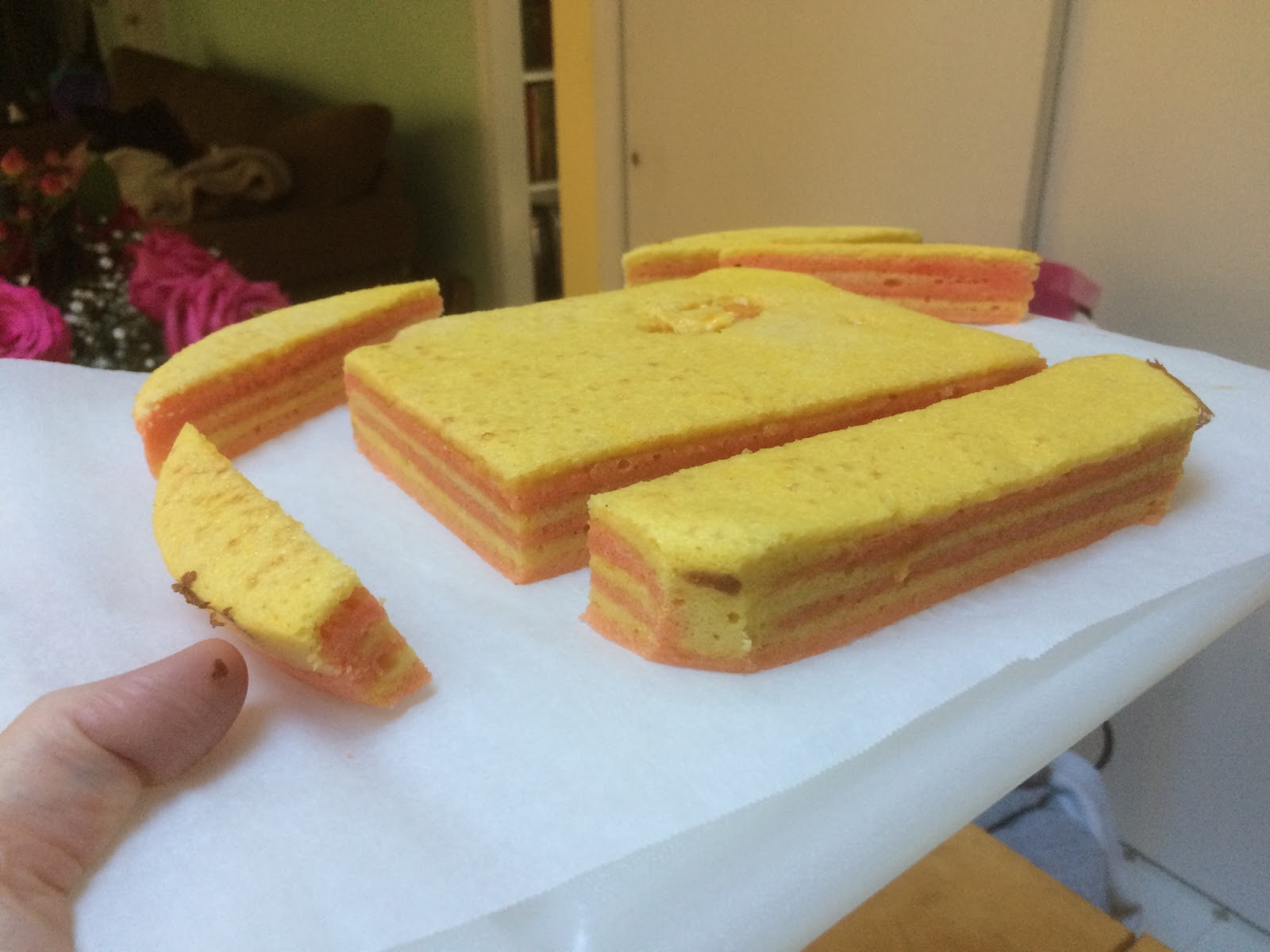
Quite a few of the recipes for sarawak kek lapis were not in English, which makes sense since it is apparently a Malaysian specialty. I did find one in English that didn’t take a dozen eggs to make–only seven. (Kek Lapis–Indonesian Layer Cake.) The layers weren’t colored and it seemed very mildly spiced, but I tried it, adding orange zest and cardamom and food coloring to make alternating layers.

Unfortunately, I was so nervous about overcooking the layers that I ended up undercooking them. When I tasted the edges, I realized that I hadn’t flavored it enough either. It did have pretty layers, though, where they weren’t gooey and underbaked.

Attempt at a sarawak kek lapis style cake with pink and yellow layersView of the layers of attempt at sarawak kek lapis cake

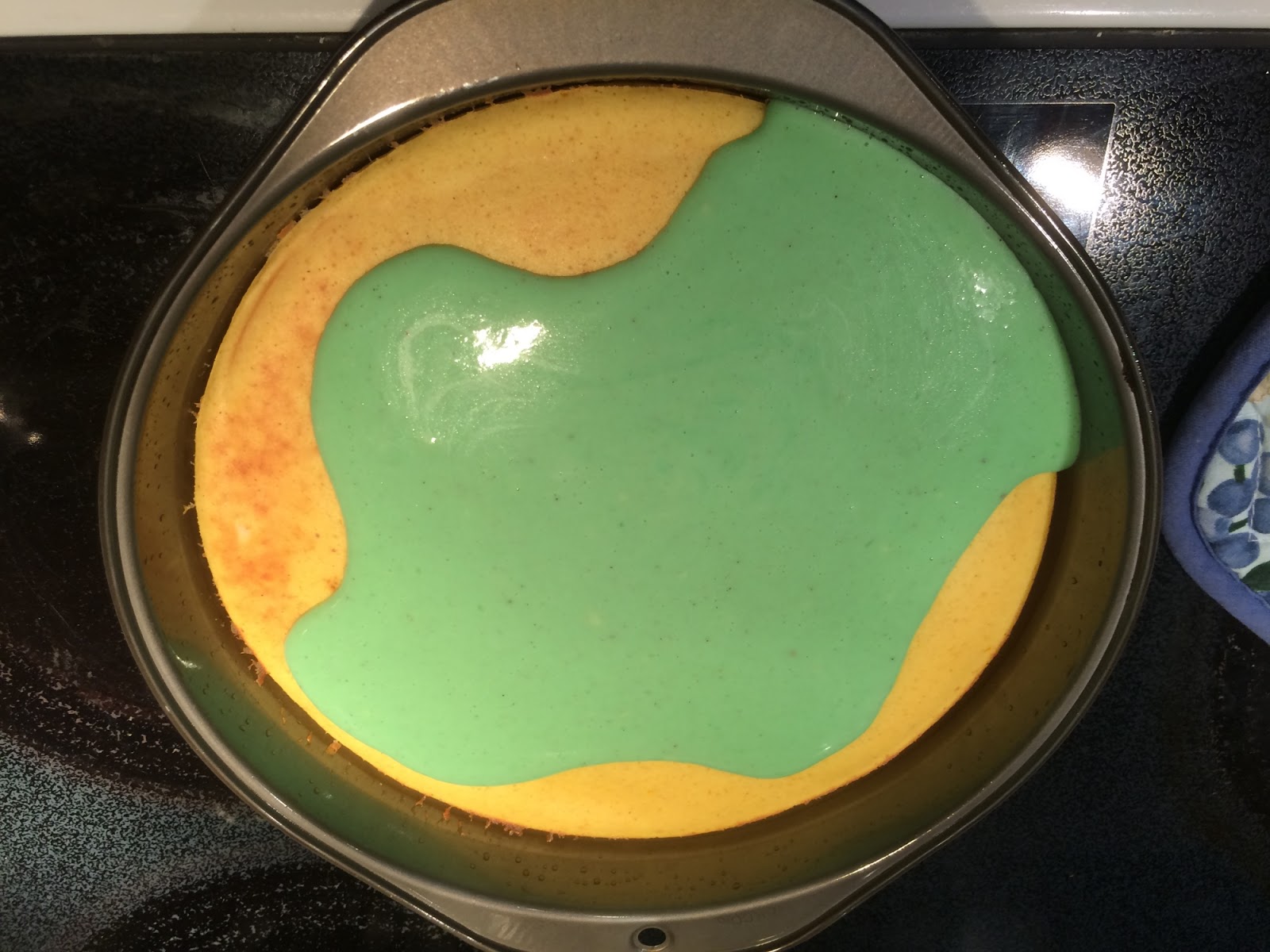
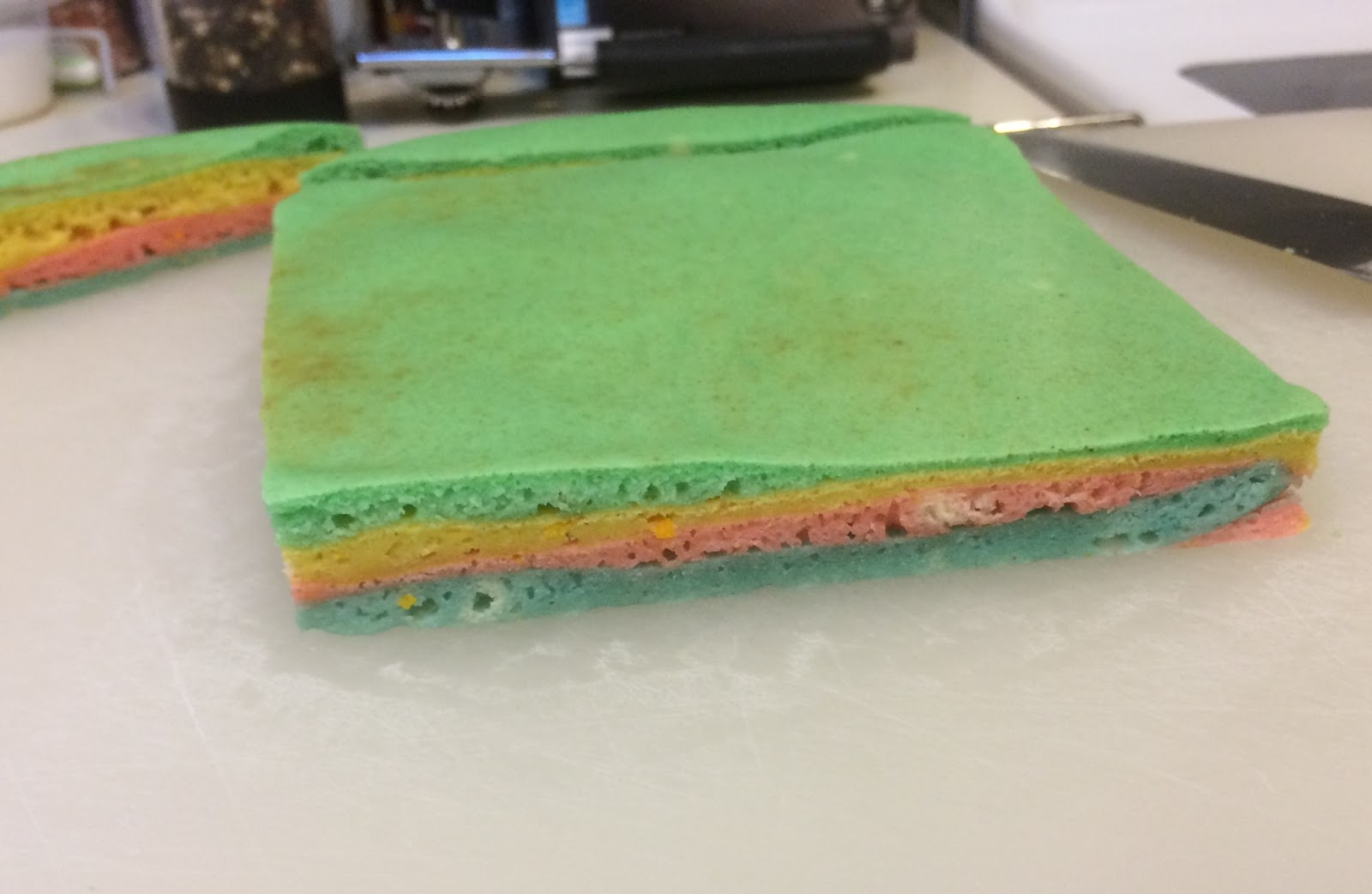
Something about the process of piling batter upon partially cooked batter made me think of pancakes. You know how the underside of a pancake shows where the first scoop of batter landed, and where subsequent additions of batter spread out from it? I decided to try making a version of kek lapis using pancake batter. I used an extra egg, thinking it would cook more quickly that way, and some extra sugar (pancakes aren’t very sweet by themselves.) I divided the batter into four bowls and colored them brightly.

I did get layers, albeit very, very uneven ones, and I did cook it all the way through. However, the result was very eggy, like the inside of a popover, only heavier. While I like popovers, I don’t like heavy, eggy cakes. The second try at a Sarawak style cake ended up in the compost like the first.

A four-layered attempt at making a sarawak style cake using pancake batter in green, yellow, pink and blue

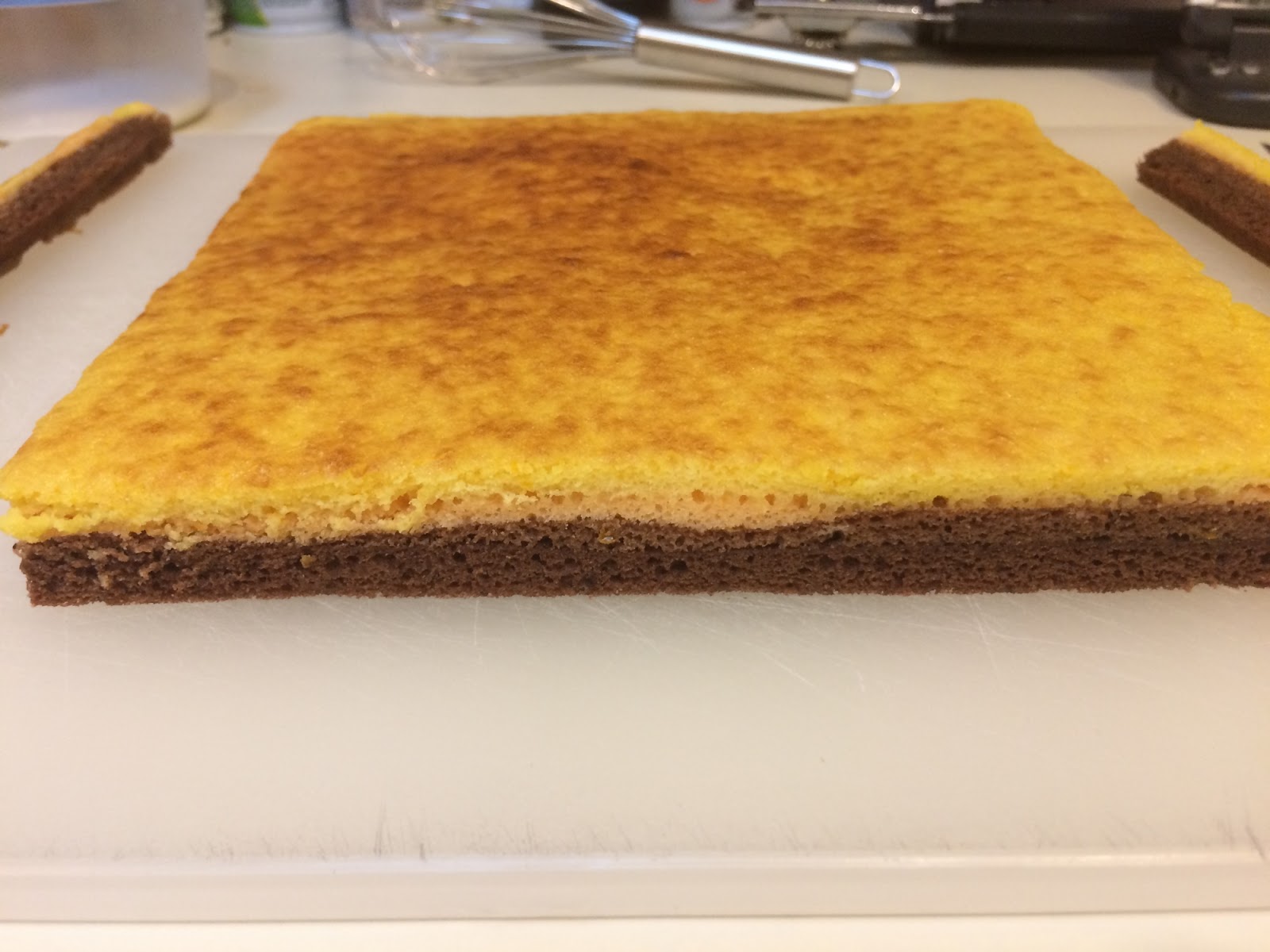
Finally I decided to use a familiar cake recipe, a hot-milk sponge cake from the Better Homes and Gardens (1996) cookbook. It’s a very sweet cake, but reasonably airy and light on butter, so I thought it might do. Also, it requires only two eggs and doesn’t require that the whites be separated out and whipped, which makes it a lot easier that the first kek lapis recipe. I added orange zest, then divided the batter into four bowls and added cocoa powder to two of them and food coloring to the other two.

Oops–stirring in the cocoa and food coloring definitely took away some of the carefully fluffed up volume. As the bowls of batter sat waiting their turn in the oven, I could see bubbles appearing on the surface. Not good. Perhaps I should have waited to stir in the color of each bowl until just before pouring it into the pan.

After baking–I mean broiling–the layers, I put the cake in the center of the oven at a more usual 350 to finish baking. I didn’t want another underbaked cake.

The result? Very uneven layers, but layers nonetheless. And with the orange zest, cocoa powder, and huge amount of sugar–a moderately tasty cake.

Hot-milk sponge cake with orange and cocoa layers, broiled like sarawak cake

I’m not sure when I would actually need such a cake, but perhaps I might want squares of colorful cake for some festive occasion.

Squares of hot-milk sponge cake with orange and cocoa layers, broiled like sarawak cake

Now that I’ve finally created an edible cake in the style of sarawak kek lapis–or at least the first stage of a kek lapis–I think I can move on to other baked goods. Time to watch some more Great British Baking Show!

Till next post.