Watching "The Sniffer" on Netflix–crime, odors, and subtitles on TV


Recently I have been watching a crime show on Netflix called “The Sniffer.” It is in Russian with English subtitles. After looking it up on Wikipedia just now, I find it is actually a Ukrainian show, though I was right in thinking the language was Russian. (My Russian goes no further than “nyet” for no.)
I started watching the show because of the premise—a detective who relies on his super-sophisticated sense of smell to solve crimes. Smell is an underrated sense and I wanted to see what they would do with it.
I’m inclined to think they give smell way too much credit for dramatic purposes. Estimating the age of the person who handled a piece of paper? And surely all the surrounding smells must create a lot of interference—other people who may have handled the paper earlier, for instance, or the drawer that it was stored in…
At the same time, I have to remind myself that dogs do some impressive things with their sense of smell, so perhaps not all the detective’s conclusions are as exaggerated as I think. And he does do research when a smell puzzles him. Most recently he bought dozens of strawberry yogurt products in an effort to determine what brand had that particular scent, on the grounds that the perpetrator likely worked at a yogurt factory.
Another interesting thing is the way the show attempts to depict the smells, using misty outlines to suggest traces of people in the air and flashing images of the specifics (the strawberries, e.g.) so that we don’t just see the detective sniff the object and then say, “Ah, a forty-year old man, non-smoker, and some sort of strawberry aroma, perhaps yogurt.”
Naturally the show is not all about crime and smells. There are story arcs for the people themselves—the detective, his love interest, his estranged wife who pops tranquilizers, his troubled son, and his partner who eats a lot of hamburgers and hits on women. Does his wife really want him back? I can’t tell. She’s a sly one, and kind of a mess.
I also keep looking for clues that this story is taking place in Russia (though I guess it’s actually the Ukraine—why “the” Ukraine? Is that just how I learned to say its name?) The lettering on signs is an obvious clue, and the police department (if that’s what it is) certainly looks unusual, but otherwise it’s hard to tell where it is taking place. Maybe I don’t know what to look for. I do notice that all the women who aren’t either quite old or quite young seem to wear clothes that show a lot of cleavage. That might just reflect the TV producers chasing ratings, though.
Thinking about it, I wonder if the furnishings are different. Some are clearly ultra-modern, all glass and spare lines and probably quite expensive, while others seem somehow old-fashioned. Perhaps what’s missing is the recliners and contemporary furniture. I’ll have to pay more attention in future shows.
I’d like to give interesting examples of places where the subtitles appear to miss the mark, using some odd expression that probably should have been translated differently, but unfortunately I didn’t write any down and can’t remember them now. I do remember one scene where the detective’s wife Iulia comes to see him and mocks him via security camera about his elevator, saying something that sounds a lot like “super-duper lift.”
Anyway, I’m having fun, though I suspect I wouldn’t still be watching if it were just another American TV show. Then again, maybe in that case I would discover that it actually has ingeniously clever dialogue.
The Many Mysterious Mints

Calling mints “mysterious” is a bit of an alliterative exaggeration. There isn’t much mysterious about mints, unless it’s the fact that such plain green leaves can provide such marvelous scents–scents that vary from pepperminty to perfume-y.

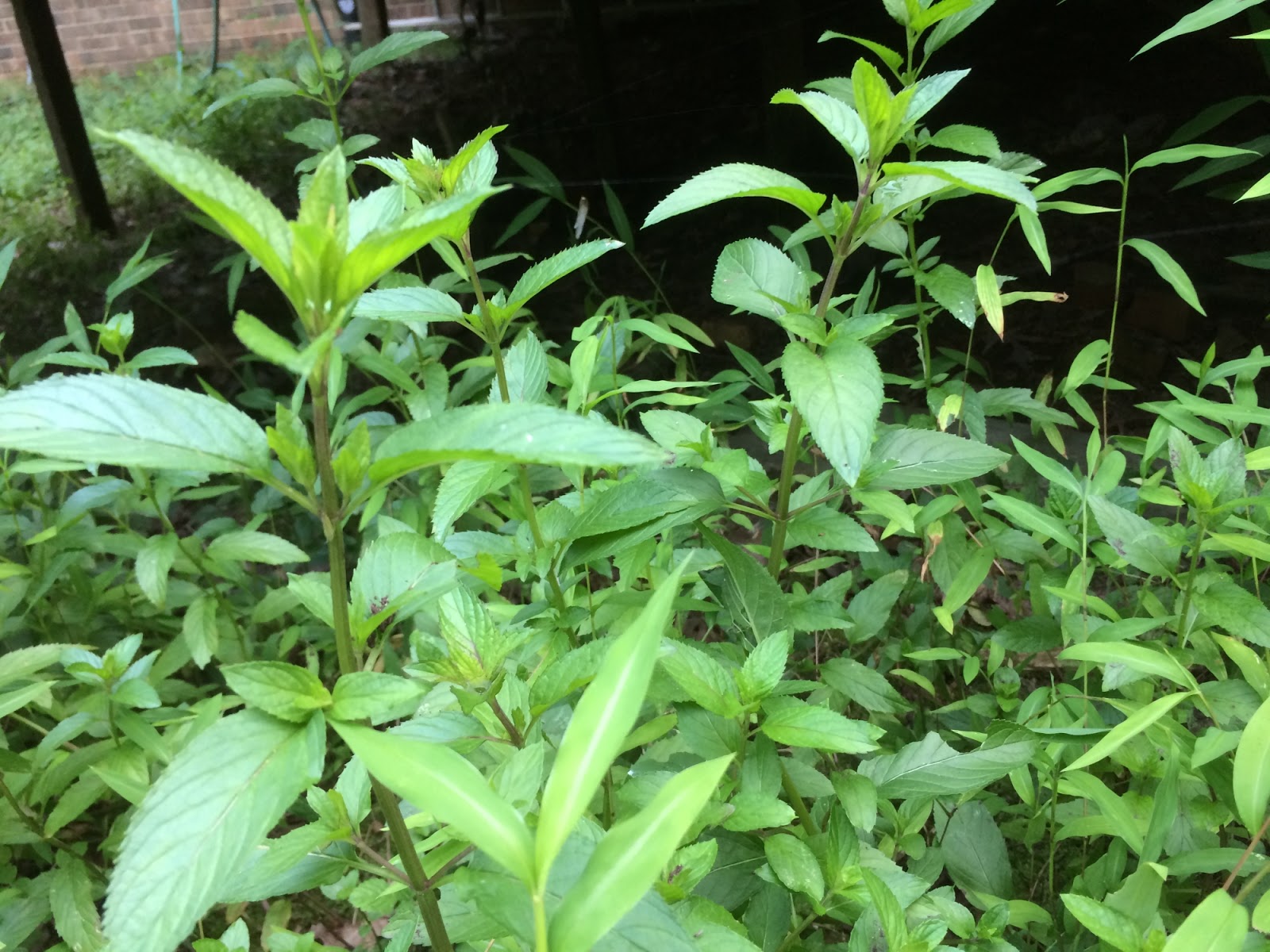
Peppermint plants with weeds in background
Peppermint
 It’s not surprising that I like mints. I like fragrant plants and I like plants that are easy to grow. Mints are both. Mints are also easy to propagate, so one plant can become several via cuttings and the extras can be passed along to friends. Even if you don’t take cuttings, a flourishing mint will spread and become more plants. In fact, the usual warning that comes with mint is “Plant it in a container or it will take over your garden.”

That’s true enough. I planted mint, both spearmint and peppermint, in a shady area by the deck where other plants didn’t want to grow. While the mint beds have had their ups and downs, sometimes flourishing and sometimes not, it is certainly true that whenever they are doing well, I have to keep pulling mint out of the adjacent “lawn”. Those stems move sneakily just beneath the surface, it seems, and suddenly peppermint pops up a foot away from its designated bed.

Spearmint plants with weeds including fern
Spearmint

The front of the house used to be an area of gardening desperation–gravelly soil on top of solid clay, shade, and lots of very hungry deer. I planted ferns and a groundcover (Lamium, which is also in the mint family though not a Mentha) and bergamot mint (a.k.a orange mint, not monarda/beebalm). As neighboring trees were taken down, providing a bit more light to our front yard, the mints flourished. (Apparently deer don’t care for bergamot-flavored leaves.) In fact, they are flourishing so much that the groundcover needs to be chopped back at least a couple of times a season, and the bergamot mint is trying to spread into the “lawn”.

Bergamot mint with stiltgrass in the background
Bergamot (orange) mint
I have four different mints now–peppermint, spearmint, apple mint and bergamot mint. Technically I think I bought two varieties of peppermint (chocolate mint smells like plain peppermint to me) and two varieties of spearmint that may have differed in leaf size (one was “Kentucky Colonel” and the other might just have been generic spearmint), but I can’t distinguish them any more. If I could only have two kinds of mint, I would choose peppermint and spearmint. What delicious smells!

The bergamot mint has more rounded leaves than either the peppermint or spearmint. It smells… like bergamot! Most people recognize the scent as “Earl Grey tea,” which is not surprising since Earl Grey is tea flavored with (actual) bergamot. Also in the front yard I have a small planting of apple mint that has survived despite being nearly choked out by stilt-grass. (Most of my garden is choked with stilt-grass this year.) Apple mint reminds me a lot of spearmint as far as its scent and color, but the leaves are slightly fuzzy. Maybe that’s where the name comes from, since it doesn’t smell like apples. The leaves have the pale green, fuzzy look of young apple foliage.

Flowering apple mint surrounded by stilt grass
Apple mint
There are other mints out there. I don’t grow pennyroyal. I love its name, but I once had a plant and the smell reminded me very pungently of a flea collar. 

I’ve tried to grow Corsican mint, but I can’t seem to keep it alive for long. I keep buying it, because it looks like the most adorable tiny-leafed, mossy groundcover, but with a strong minty smell. I would love to have pathways made of Corsican mint. The problem seems to be keeping it consistently moist and not letting taller plants shade it out. Maybe someday.

I saw on-line that there is a plant called “banana mint.” Does it really smell like bananas? I’m going to have to order one soon and find out.

So what do I use all this minty goodness for?

Surprisingly little. When I was a kid, I would have loved to have had access to all that fresh mint for potpourri and goodness knows what other mad concoctions. I would have filled sachets with the dried leaves. I would have strewn my room with it, and maybe tried packing some in oil as an attempt at enfleurage.

As an adult, I have a few recipes that call for mint (spearmint), and a couple of times my daughter and I tried distilling peppermint oil using a pot, a small glass bowl, an upside-down lid and some ice. We did produce minty water with a slight sheen of oil on it. Mostly, though, I just rub the mint leaves as I pass by and remark on how good it smells.

I do like sweet tea with a hint of mint in it. For some reason, it’s easier to make with dried peppermint. Fresh leaves seem to give a sort of green flavor to tea. It could be a matter of method–maybe fresh leaves need to steep in much cooler water. Spearmint also adds a nice hint of mint.

Methods of making sweet iced tea vary and people can be quite passionate about their own method. Here’s mine, for tea with a hint of mint.


Sweet Tea with a Hint of Mint

Put 4 cups of boiling water in a glass measuring cup with 2 iced tea bags (or 4 regular size) and steep for five minutes. Add a peppermint tea bag for the last minute, or steep longer for more flavor. 
 Mix in sugar (between 1/2 cup and 1 cup, depending on preferred sweetness) while tea is hot. Fill a 2-quart plastic pitcher more than halfway with (fresh) ice cubes. Pour sweetened tea over ice and stir well. Add more ice if necessary to bring to 2 quarts. Serve.

Facts vs. Feelings–an overdose of human interest stories?

The other day my husband told me that he was listening to gaming podcasts on his way to work instead of National Public Radio. NPR had been deluging him with human interest stories on Syrian refugees and other people in desperate circumstances. The constant tug at the heartstrings was making his morning drive a depressing and exhausting start to the day.    

I’ve heard that listening to stories about other people is a good way to develop the ability to empathize, to see the world through someone else’s eyes. I firmly believe this. Stories also give us a way to peek into other cultures and other living conditions. We need these stories. And some of these stories, certainly, should be about refugees. About migrant workers. And about children trying to survive in lands controlled by warlords.

But it is also true that one can get too much. Being bombarded by intense depictions of all the terrible things going on in the world can result in a sense of helplessness. Feeling helpless leads to paralysis, not action.

Obviously it is far better to be a commuter listening to a heart-rending story about a Syrian refugee, and feeling depressed about it, than it is to be the Syrian refugee. I don’t want to lose sight of that. But sympathetic suffering is not in itself an improvement in the world. It is good when it leads to reducing others’ suffering. No doubt the reporters on NPR hope their stories will inspire people to act. Probably they do, sometimes.

But compassion and sympathy are not sufficient for right action.

I don’t listen to NPR (or any radio, really) but there is something I have noticed both in Facebook posts and, I think, in newspaper editorials. There is a lot of appeal to emotion.  For example, I see a lot of the stories about undocumented/illegal immigrants that are focused on good people in untenable situations. I hear, for instance, about the children of such immigrants who fear being sent back to a country they have never known. I hear about people who have been valued contributors to their community for many years, but who could lose everything they have worked to build.

I don’t hear much about how we can create a workable, fair, compassionate and enforceable immigration policy so that we can avoid such situations in the first place. I don’t hear much about it from the left, and I don’t hear much about it from the right either. The appeals from the right seem to be equally emotional stories about hard working men and women (especially men) who can’t find jobs because the work has been taken by undocumented/illegal workers. (Exactly what jobs these are is a bit vague–presumably not the jobs that went overseas or that became obsolete, since they couldn’t have taken those jobs.)

Having a strong desire to improve things is not enough. Coming up with good policies requires knowledge of facts and context. Knowing which policies to support requires the same. Heart-stirring stories are good (in moderation.) Thoughtful discussions of cause-and-effect, historical background, and basic principles are also important.

If people in glass houses shouldn’t throw stones, then possibly I shouldn’t be posting this. My knowledge of practical details on most of these subjects is embarrassingly low. Then again, the fact that I’m falling short doesn’t mean that you shouldn’t try.
 
So, don’t get overwhelmed by the vastness of human need. Just pick your patch and dive in. That’s what I’m telling myself, anyway.