Murder (in) Mysteries–revisited

Long ago (or so it feels) I discussed writing a mystery without a murder in it (Writing a Mystery Without Murder In My Heart). I said, at that time, that while I loved reading murder mysteries and watching them on television, somehow writing a murder felt different.

Later on, however, I made further attempts at writing a murder mystery, and eventually wrote Alibis and Aspidistras, a cozy (murder) mystery. Trying to work out the details of the fictional killing still feels awkward, but as long I don’t have to make the death too realistic, I can write it and enjoy it.

Why am I bringing this up again? Recently I had the opportunity to be interviewed by Meredith Rankin for her Substack on crime fiction. ( “Meet Author Samantha Cornwell” –I really should have posted this link last week–my bad.) One of the things that interests her is people’s attitudes toward writing and thinking about murder, as she discusses in a different post “My so-called obsession with murder”, and I found myself thinking hard about this question again.

I’ve heard it suggested that the reason mysteries usually involve a murder is because murder presents higher stakes than any other crime, and that probably is part of the reason. Still, the importance of any particular stakes in a novel depends a lot on the context–in a novel set in a college, plagiarism could loom large. In fact, almost all motives for fictional murders feel like high stakes to the villain–that’s why they’re willing to kill someone.

To have a mystery, though, there must be questions. Who did it? Why? How? Some crimes allow for this–who stole the ruby? How did they get it out of the house unseen?–while other crimes don’t offer much mystery once the crime is recognized. If a published article turns out to be plagiarized, we probably know who and how, though perhaps not why.

What about true crimes? I don’t normally read that, but in reading a book about poisons, I did read several accounts of deliberate poisonings. It was interesting in a sobering kind of way, a way that reminds me what people are capable of. I am sometimes too inclined to assume that people are basically okay, and shocked when something reminds me of how dark people’s actions can really be. Meredith makes the point (in the second post I listed) that thinking about crimes can make us more aware of how we might be vulnerable.

I wonder if I can make use of that–the idea that a story can make us more aware of our vulnerabilities–in my next story. What would I particularly like to warn someone about? Writing is all about gathering ideas and finding interesting ways to incorporate them. Thank you for that thought, Meredith.

Till next post.

She Spies Shells By the Seashore–identifying shells on a North Carolina beach

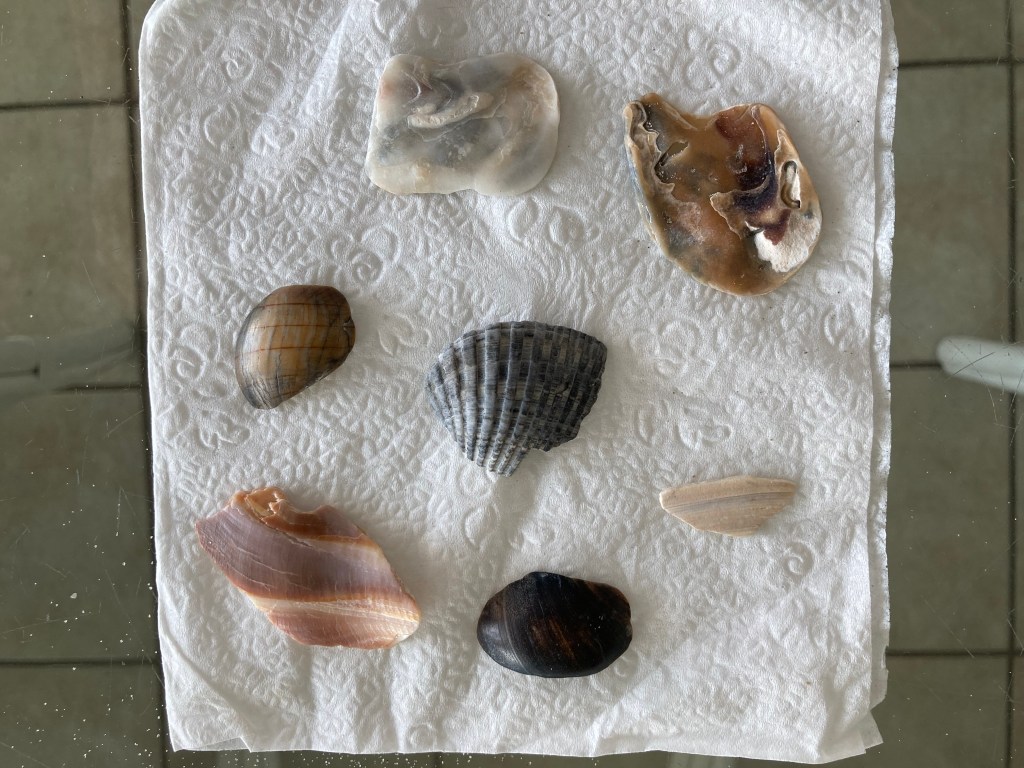
It’s the last full day of beach week. Before I return my interesting assortment of shells and shell fragments to the shore (I really don’t need to bring them home, where they will sit ignored on a shelf), I try to identify them using two guides I have brought along.

The guides aren’t the only nature-related books I’ve brought–I also have a book on plants and one on the beach itself (How to Read a North Carolina Beach by Pilkey, Rice, and Neal). I’ve looked at plants before, though the only one I reliably remember is pennywort, with its peltate leaves like little umbrellas. (I had to look that up–“umbellate” is for flower clusters. Also, to be more specific, “beach pennywort” or Hydrocotyle, since pennywort is the name for a variety of plants.)

Back to the shells.

I didn’t reduce the size so you can zoom in for more detail.

The pretty gold and silvery bits turn out to be jingle shells (or parts thereof.) I recognize the coquinas from previous years of looking at my beach books. Slipper shells turn out to have a distinctive underside, and ark shells (turkey or otherwise) have a very straight hinge with little toothy marks on it.

But why do the turkey ark shells have those rune-like markings on the flat part? When I picked up the first one, I thought someone had etched those on–how interesting–but clearly they are natural. Some seem to have more than others. Are they a part of the shell, or a sign of something that attacked it?

The book about North Carolina beaches clears up one thing that has puzzled me–the black shells that look like other shells, only black. According to the book, those shells were once buried in the mud of a lagoon. In those low-oxygen conditions, “the iron in the shells turns into iron sulfide, which gives them their black color.” Islands migrate over time, and eventually the shells end up on a beach by the ocean. The take-away–they aren’t a different kind of shell, just colored by conditions.

The stripes and streaks and swirls of color lead me to pick up bits and pieces as well. I don’t try to identify them. I just appreciate the variety of color and texture.

Time to shut down this computer and sit on the deck, enjoying the view of dunes and sea. The waves are sparkling out there.

But first–speaking of sparkling, last night my daughter showed me something amazing. In parts of the beach, stomping through the wet sand caused tiny lights to appear. Some kind of bioluminescent creature in the water. I’d never seen it before, perhaps because I almost never go out on the beach after dark.

Till next post.

EDIT: An article in the Chapel Hill magazine mentions the White Baby’s Ear Moon Shell. I think the white shell I have labeled with a “?” in the photo fits the description. What serendipity, to find the shell listed in an article when I was just flipping through the magazine at random.

“I’m a little teapot, here’s my spout”–a close-up of a family teapot

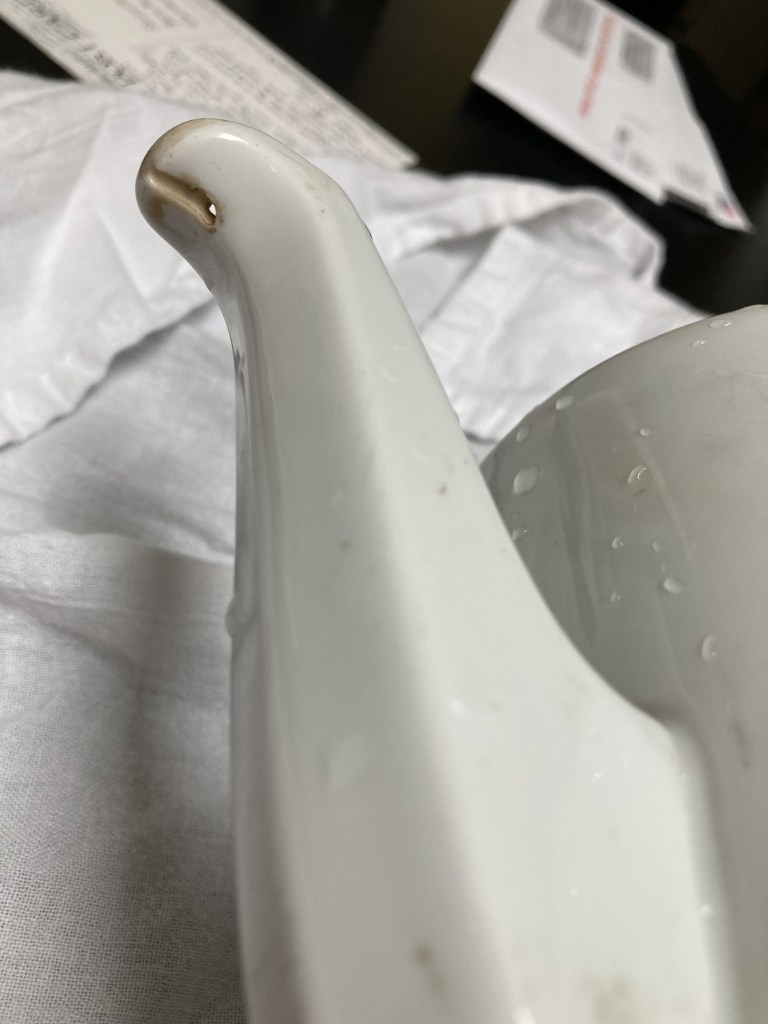
Above is a photo of the family teapot.

This is the teapot that traveled with my family since… I’m not sure when my parents bought it, but I’m currently sifting through family photos so possibly I will have a better answer later on. The steel part is a sort of tea cozy that fits over the plain white pot. No need to worry about the lid tipping off when you pour.

I love tea paraphernalia, and I have several teapots of my own. Some are inherited (silver with scallops, white with blue-and-gold); some were chosen (spring green, spring flowers). I like teapots with pretty designs or in appealing colors. I don’t like pots that are made to look like something else, such as a cake or a rabbit. That just isn’t my thing. I do like some teapots with simple, modern shapes, like this one. But there’s also one other important thing.

It has to pour well.

You’d think this would be required for any teapot, but I guess a lot of the really decorative teapots are bought by collectors and don’t get much use. (Mine don’t get much use, and I only have seven or eight! Imagine trying to use all of forty or so teapots!)

What makes a teapot pour well? I don’t know the answer. I do know that my parents’ teapot has a very unusual spout, and I can only assume it was meant to help it pour. I had never really looked at it, despite all those home-for-break teatimes, until now.

As you can see, there’s a small channel that runs down from the tip of the spout, and it is pierced.

And there’s a channel inside the spout that starts right at the hole. Is the drip meant to go back inside? Does this actually work? Did someone really do all this work to create a teapot that doesn’t drip? Surely this is more than is required.

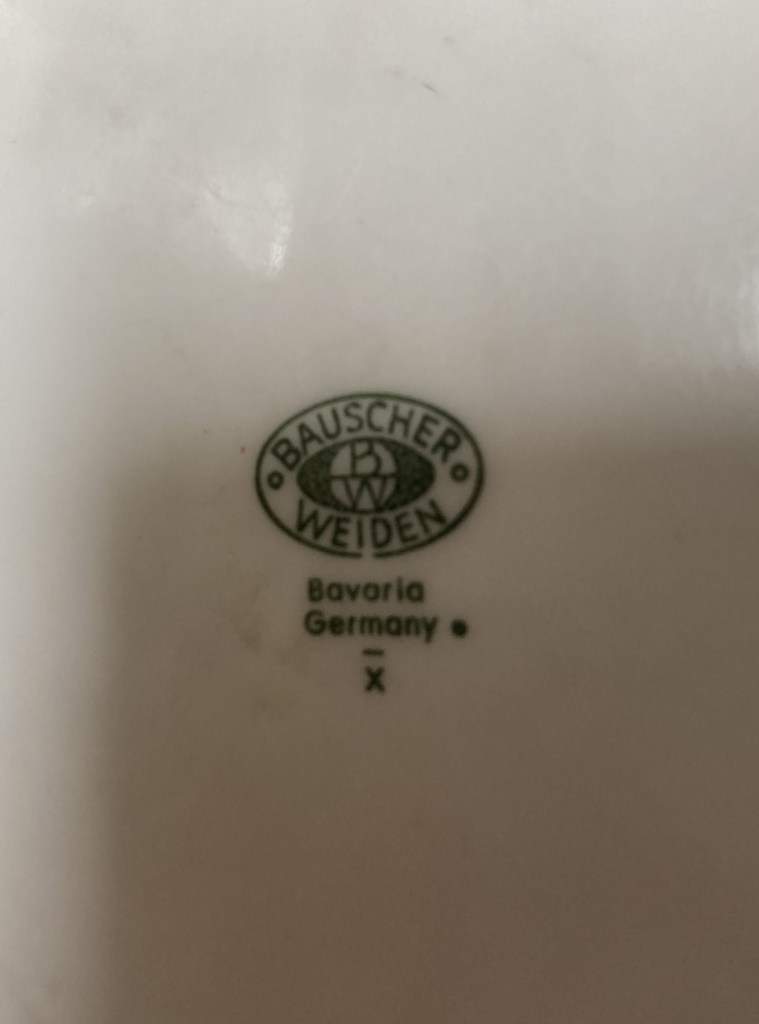
I just looked up this company. It appears that other pouring vessels they made in the past, such as coffeepots, did have pierced spouts. I couldn’t find out if this was true of their current products. I would love to read more about this feature, how it compares to other spout shapes, and who came up with it. Maybe someone out there can point me to an article?

Till next tea-time–and next post.