Emergency Preparedness Plan

Daily writing prompt
Create an emergency preparedness plan.

I rarely pay attention to the WordPress prompt, even when I check my dashboard. But emergency preparedness is something I am interested in, even though I have not done a good job of it so far.

Hurricane season is here, so I make sure we have some minimum preparation. Gallon jugs of water, batteries for the nice lamps a friend gave us, and we have a hand-crank radio in case I don’t have enough batteries for the bright yellow radio I’ve had for years and never use.

Some emergencies require evacuation. Tanker trunks carrying chemicals or fuel can spill after crashes. And we’re reminded all too often of the dangers of wildfires, of course. I ought to have planned some routes out of town, preferably ones less likely to get jammed with traffic if everyone leaves at once. I ought to have a go-bag as well, but I’m afraid I don’t. I do try to keep my gas tank at least half-full these days–the last thing you want in an emergency evacuation is to have to stop for gas (especially when everyone else is doing the same.)

Some emergencies occur on the road. I realize that paper towels and a trash bag are not really aimed at emergencies, but they’re good to have on hand. I ought to have a flashlight and batteries (stored separately–otherwise they tend to leak after a while,) but I’m not sure I do. I do have a basic first aid kit and a kit of emergency car supplies that I probably need to check over to see if it contains anything that expires.

The pandemic was an emergency for which most people were not well prepared, including me. I don’t normally have hand sanitizer on hand, let alone masks. Once it was clear that we really were in an emergency, I did go through our supplies: tylenol, cleaners with bleach, thermometers that still work, rags in case we needed to wipe down surfaces frequently, bottles of ginger ale and other things one likes when sick, and so forth. We were lucky and didn’t end up needing them, so I added canned goods and am calling it “the hurricane box.”

Of course, you have to keep rotating out the supplies to keep them fresh. I hope the US government has learned that lesson.

Regarding those jugs of water–you can’t assume you’ll have warning that you might need them. Someone wrote in the paper once that there was no reason to keep water on hand except if there was a hurricane or such threatening. Wrong. You can’t predict when your water supplier will have a fluoridation issue that requires them to drain their entire tank, on the same day that a major pipe that connects them to their back-up supply springs a leak and has to be closed down. Sometimes you just get a perfect storm of water issues.

We received messages that started by warning us not to drink the water and be conservative with other uses, and ended by telling us NOT TO USE THE WATER FOR ANYTHING as it was very low and could no longer be assumed safe.

The local stores sold out of water jugs and people drove to nearby towns to get more (and to enjoy their free-flowing taps.) But we didn’t have to rush, because we did have some jugs of water already. The water supplier worked night and day to fix the leak; the tank of excessively fluoridated water finished draining and was replaced; and after just two days, we had drinkable running water again.

Summing up my existing emergency preparedness plan:

  • Keep jugs of water on hand.
  • Keep gas tank at least half full.
  • Have fresh batteries available for your flashlight and radio (and know where they are.)
  • Have some non-perishable, no-heating-required food on hand.
  • Stock some of the drinks (and foods) that you like to have when you are sick.
  • Make sure your ibuprofen or tylenol has not expired, and that you have a thermometer.

There’s a lot more that I should be doing (emergency pet supplies? actual go-bag?) but it’s a start.

Till next post.

P.S. I really enjoyed the Great Courses lecture series “When Everything Fails: Surviving Any Disaster”, which I was able to borrow from my library. It isn’t really about all disasters–no zombie apocalypse or end of the civilization–but it is about the disasters that actually happen to people every year. It gives examples, talks about preparation, and also discusses how society has (gradually) tried to build a structure for assisting with these emergencies–and what some of its limits are.

More Delights of Light

If you’ve been following this blog, you know I am fascinated by the effects of light. I’ve written about shadows, reflections, rainbows, sparkle, and the aurora-like reflection of Christmas lights on the ceiling.

So, above you’ll see another effect of light: sunshine through a faceted piece of stained glass in a bathroom window at Saint Andrew’s Episcopal Church, Haw River, NC. Did its creator anticipate the interesting constellation-like points of light it would cast?

One more surprise of the light. It’s hard to tell from this photo, but this dragonfly glistened gold in the sun as though someone (or Someone) had made it out of gold wire–a piece of jewelry for the grass. It amazes me how insect exoskeletons can create those metallic and/or iridescent effects. Imagine if our skins could glitter like that!

Till next post.

Trying an Old Family Cake Recipe and a New (To Me) Frosting

My Grandpere, my father’s father, was a baker. When we celebrated birthdays while staying with him and Grandmere, he always produced a cake. Not a chocolate cake, though. I’ve never actually known what sort of cake it was, other than that it had two layers, a sort of whipped cream filling, sliced almonds patted onto the sides, and–for my birthdays–a glossy, smooth, pink frosting.

I do remember that it was delicious, even if I’m not sure what it was flavored with.

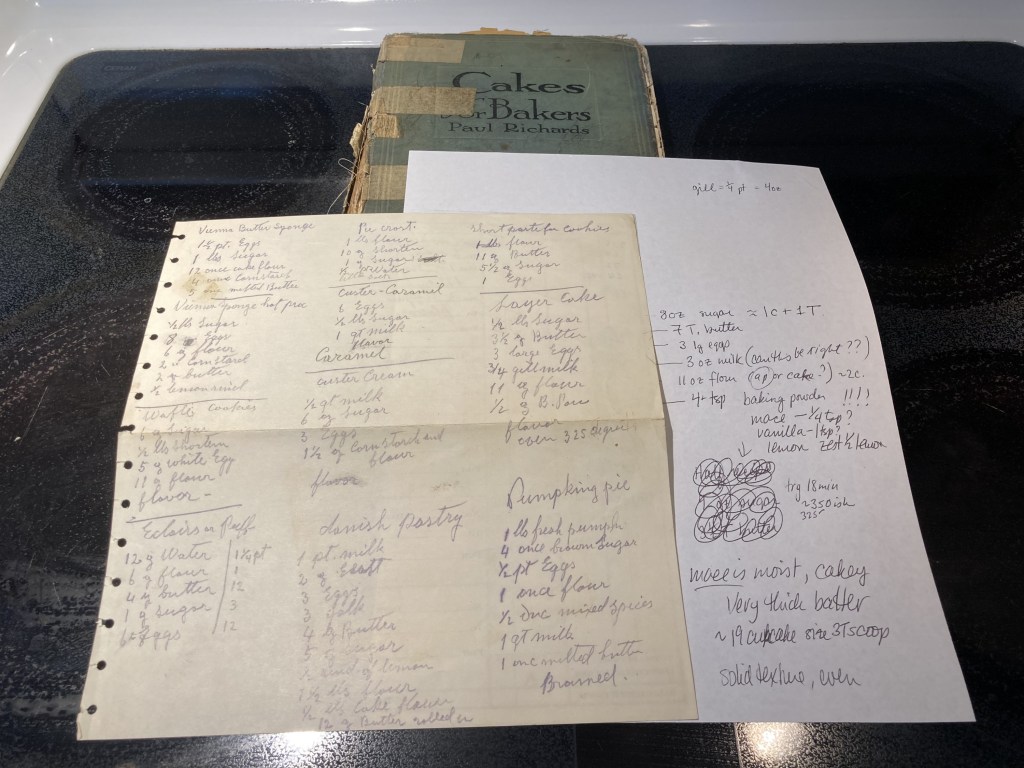
I have one of my Grandpere’s cookbooks, Cakes For Bakers. It’s clear that he used it, and it’s full of scraps of paper with recipes. I say “recipes,” but “lists of ingredients with a title” is a better description. I know I’ve looked through them before, trying to find out what cookie recipe he used, but this time I was curious about the cake recipes. “Mace” showed up several times, particularly in connection with something called “wine cake”, but also in a few other places. What would it be like to flavor a cake with mace?

One of the recipes says “layer cake.” I decided to try that, but add the “mace, lemon, vanilla” that shows up in the context of the wine cake. Mace is similar to nutmeg, and I already know that nutmeg and lemon are a nice combination.

However, I didn’t want to end up with us having to eat a whole cake, so I decided I would make the batter into cupcakes so I could freeze some for later.

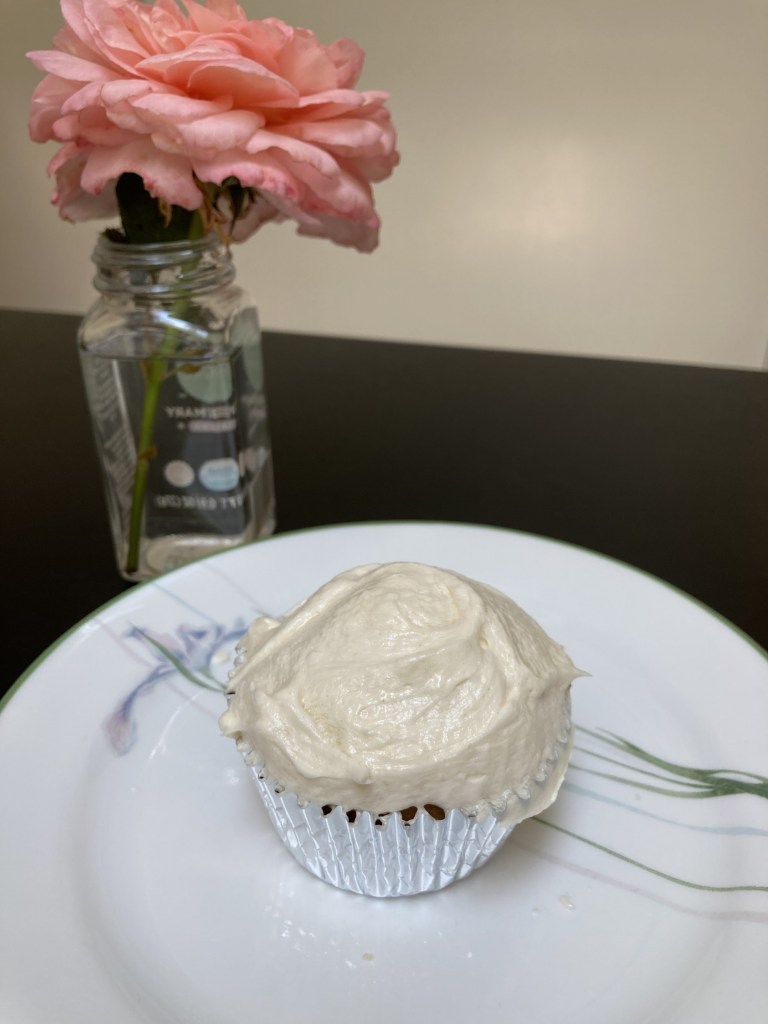
At the same time as I decided to try the cake, I also decided to try a new and unrelated frosting that I’ve been curious about–Ermine Frosting, which involves boiling milk and flour together. (It also has a lot of butter.) So, not one but two experiments–perhaps not as tightly linked as they should have been.

First, the cake. I deciphered and “translated” the measurements (what’s a gill?) and tried using the standard approach for a butter cake, creaming the butter and sugar, adding eggs, then alternating the flour mixture and milk. I guessed at suitable amounts of mace and lemon and vanilla. The result was a thick but tasty batter, and cupcakes with a fairly firm but good crumb. The flavor of mace was pretty strong–perhaps I should have gone heavier on lemon and lighter on mace.

The ermine frosting was intriguing. Some methods have you beat the butter and add the thickened milk/flour mix to it, while others have you add the butter to the thickened, beaten milk/flour mixture. I used the recipe from King Arthur Flour’s website, and heated milk with flour and sugar to make a cooked paste, then beat it till it cooled down some, then added butter. The texture is very smooth and buttery (no surprise that it is buttery) and I think it would be good with flavors besides vanilla. It reminds me of the texture of the filling that Phoenix Bakery in Pittsboro, North Carolina, uses in their doughnuts–silky with butter.

However, vanilla ermine frosting doesn’t seem a good match for these cupcakes. I’m not really sure what would be–something citrusy? Cinnamony?

This brings me back to the fact that the flavors–mace, lemon, vanilla–seemed to be connected to wine cake. In the cookbook and in the notes, the recipes for wine cake do not contain any wine. Is it so named because it is accompanied by wine? Or is there supposed to be wine involved later on?

When I looked up “wine cake” on-line, every recipe I found did in fact include wine as an ingredient (and often, cake mix and pudding mix.) So why is this cookbook’s “wine cake” so different? Why can’t I find out anything about the origins of this wine cake?

The internet can tell you a lot, but some mysteries resist easy answers. I should have asked more questions of my Grandpere, but I wasn’t interested in baking back then. I should have asked more questions of my father too, when I started baking, though I’m not sure how many more answers he could have provided. Maybe he didn’t ask those questions of his father either.

If you know anything about a “wine cake” that doesn’t contain wine but does contain mace, I’d love to hear from you.

Till next post.