Everyone Should Have a Party Trick


In The Breakfast Club, Molly Ringwald’s character, Claire, is asked what she can do. All the other kids in detention have started making claims about what they can do—one says she can write with her feet, another that he can make spaghetti. Claire says she can’t do anything, and someone replies that everybody can do something. So she reluctantly—but still with some pride—demonstrates her ability to apply lipstick (messily) without using her hands.
We should all have some sort of trick that we can show off on such occasions. Some people have actual magic tricks—you may have run into someone who can pull a quarter from your ear, then make the coin disappear and reappear again elsewhere.  That’s impressive. It’s especially good for astounding visiting children.
Other people can casually take up three clementines and start juggling them. I’ve noticed that people are impressed by even a very limited ability to juggle (unless they themselves can juggle, of course.) Juggling is also contagious—once someone juggles something, everyone starts trying to juggle. This can be dangerous if the objects used are breakable or messy, but clementines are pretty sturdy.
There are people who can square off discarded candy wrappers and fold them into beautiful cranes. Instead of a piece of trash, you have a decoration. Part of what makes it special, though, is watching the transformation.
Being able to play an instrument can be a party trick when the instrument is there in your pocket. My father-in-law is known for pulling out his harmonica on any occasion and playing a suitable tune.
Not all party tricks require props. My husband can pretend to inflate his hand. He blows “into” the thumb, the hand slowly opens up, he pinches the thumb “closed”—then he lets go and his hand goes hissing and spinning crazily about as it “deflates”. I’ve seen it many times and I’m still amused.
Reciting a poem is, or should be, a party trick as well. I think the most effective poems for this purpose are those that tell a story, such as “The Raven” by Edgar Allen Poe, or “The Highwayman” by Alfred Noyes. So I recommend memorizing one long poem to have on hand when you need it. I started memorizing “The Raven,” but didn’t get beyond the first couple of stanzas. I also only know about half of “The Singsong of Old Man Kangaroo” by Rudyard Kipling (perhaps not technically a poem, but it recites like one.) I still remember parts of “The Tale of Custard the Dragon” by Ogden Nash, which I had to memorize in sixth grade.
What brought all this to mind was my daughter’s showing me a hexahexaflexagon that a friend of hers had made. She was trying to remember how to fold one from a strip of paper. The first problem was how to get a series of equilateral triangles—she was sure there was a trick to it, and she was right. When she consulted her friend, she found out that she needed to fold the paper strip at an angle, trying to match edges in the same sort of way one folds a letter into thirds.
Having learned all this, she pointed me to a good (and entertaining) Youtube video. (I had been vainly trying to fold an equilateral triangle.) I was able to make my own hexahexaflexagon, and it occurred to me that this is a good party trick of the sort I mentioned earlier. It’s a bit like making a paper crane, but instead of leaving your audience (victim?) with a decorative sculpture, you leaving them madly flexing a hexagon, trying to find all the sides and looking baffled when a new one pops up after they thought they had found them all.
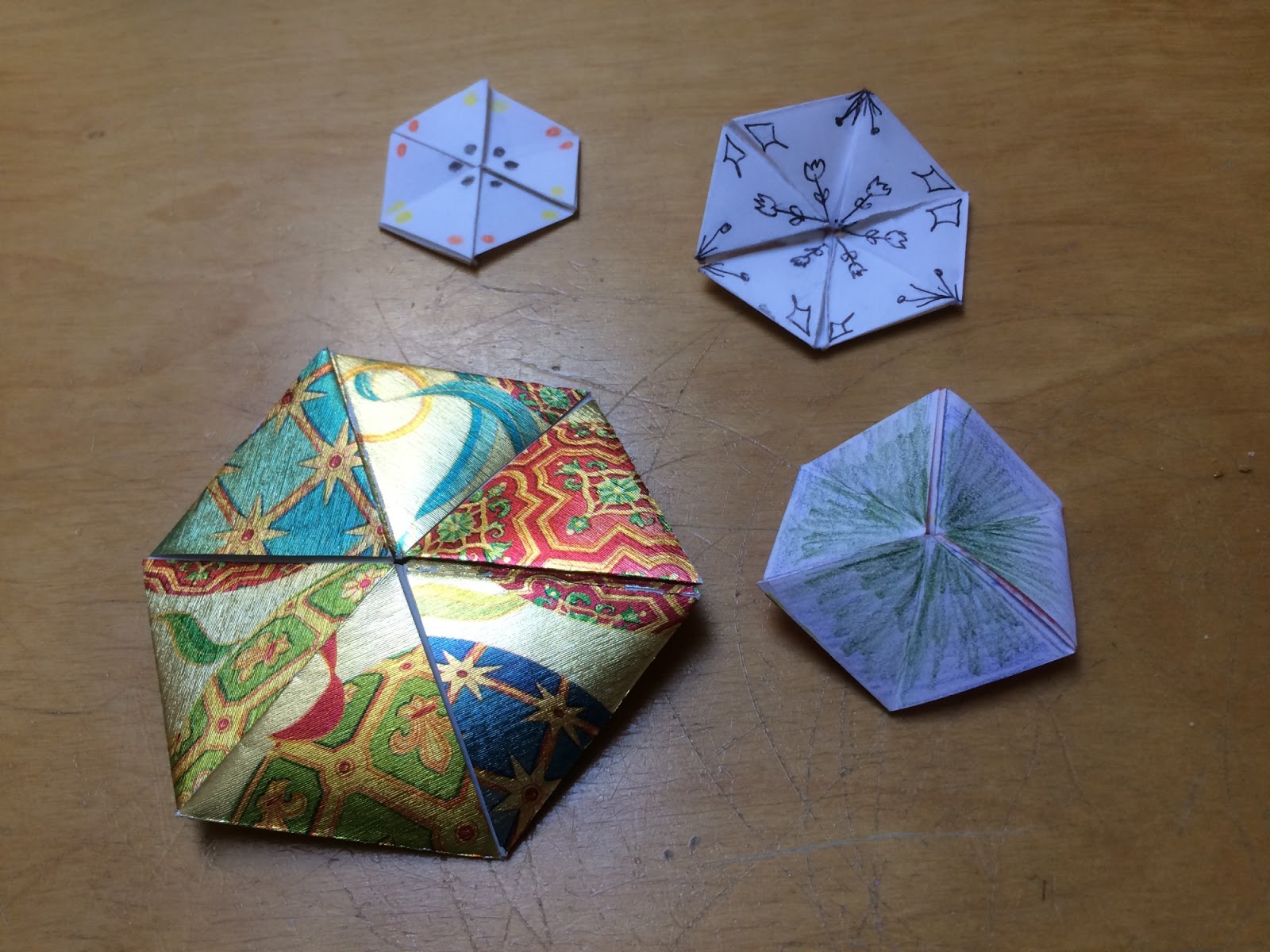
Hexahexaflexagons, one made of shiny wrapping paper
Hexahexaflexagons, one made from wrapping paper.
So there’s my early New Year’s recommendation—figure out what your party trick is, and if necessary, refresh your memory of it. Clearly I need to do so, since my cranes have been coming out deformed, my poems incomplete, and after a year of “frozen shoulder”, I’m out of practice at even the most limited juggling. Maybe I should get into hexahexaflexagons instead…
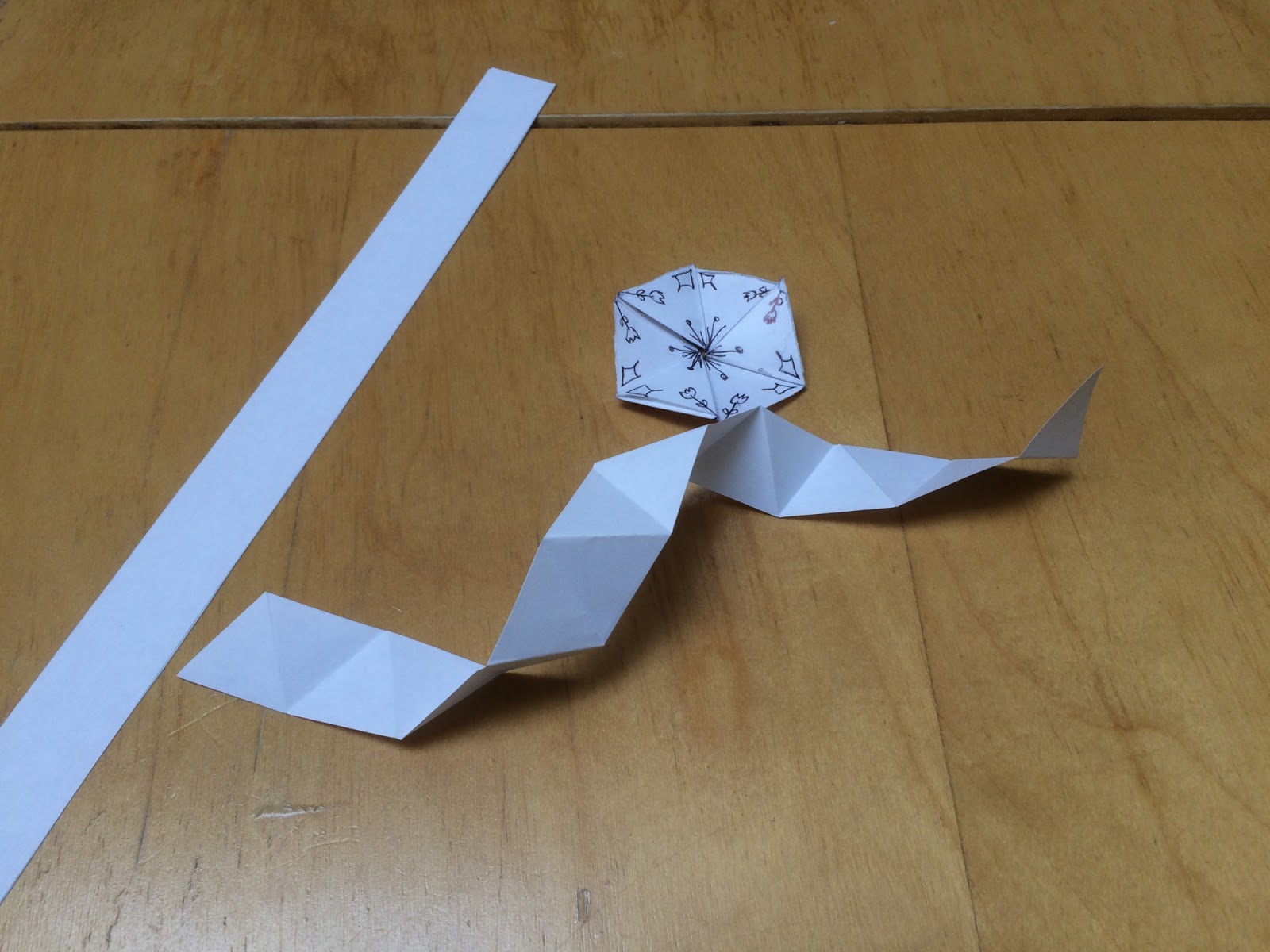
strip of paper folded ready for making a hexahexaflexagon
Hexahexaflexagon in process
Till next post.
P.S. The same friend who showed her the hexahexaflexagon also gave her a photocopy of a chapter from a book detailing the history of hexaflexagons and some of their properties. The most important bits are also revealed in the Youtube video series of hexaflexagons by Vihart, esp. “Hexaflexagons 2” which I HIGHLY recommend to anyone who wants to create one, and even those who don’t.
Maps, Mystery, and Adventure—decorating with story


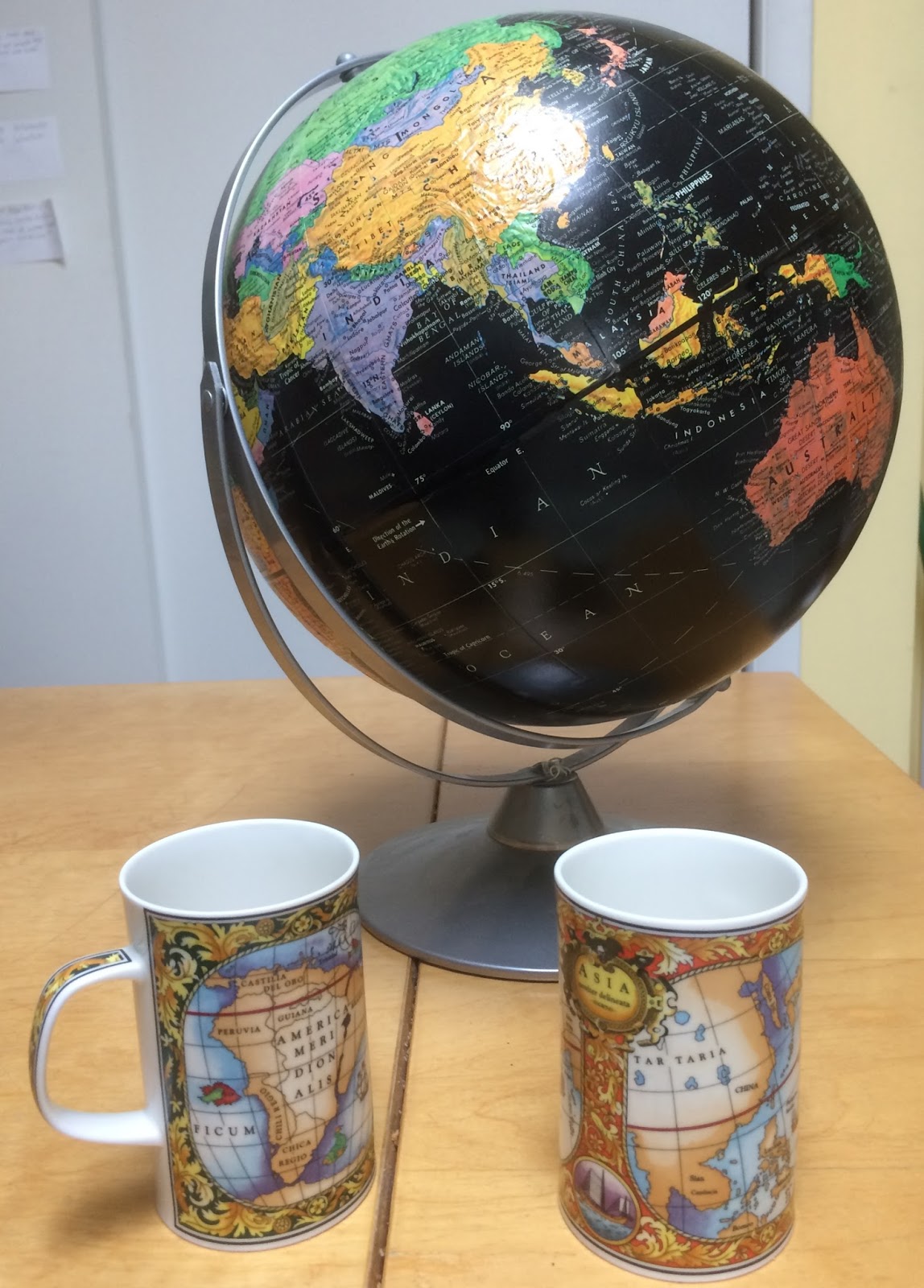
I have a pair of porcelain mugs decorated with antique map designs, and an out-of-date globe. What is it about maps, both real and fictional, that makes them so appealing as decoration?
two mugs decorated with antique maps and an out-of-date globe
Decorative maps (globe used to be current)
Some maps are intended to be almost purely functional—the paper road maps in my car (still!) are like that. I have seen even these maps used for decoration, especially if they depict a familiar area (e.g. get a mug with a partial map of your hometown on it), but generally maps tend to be less functional as they get more decorative.
But why decorate something with a map rather than, say, flowers or cars or an abstract design?
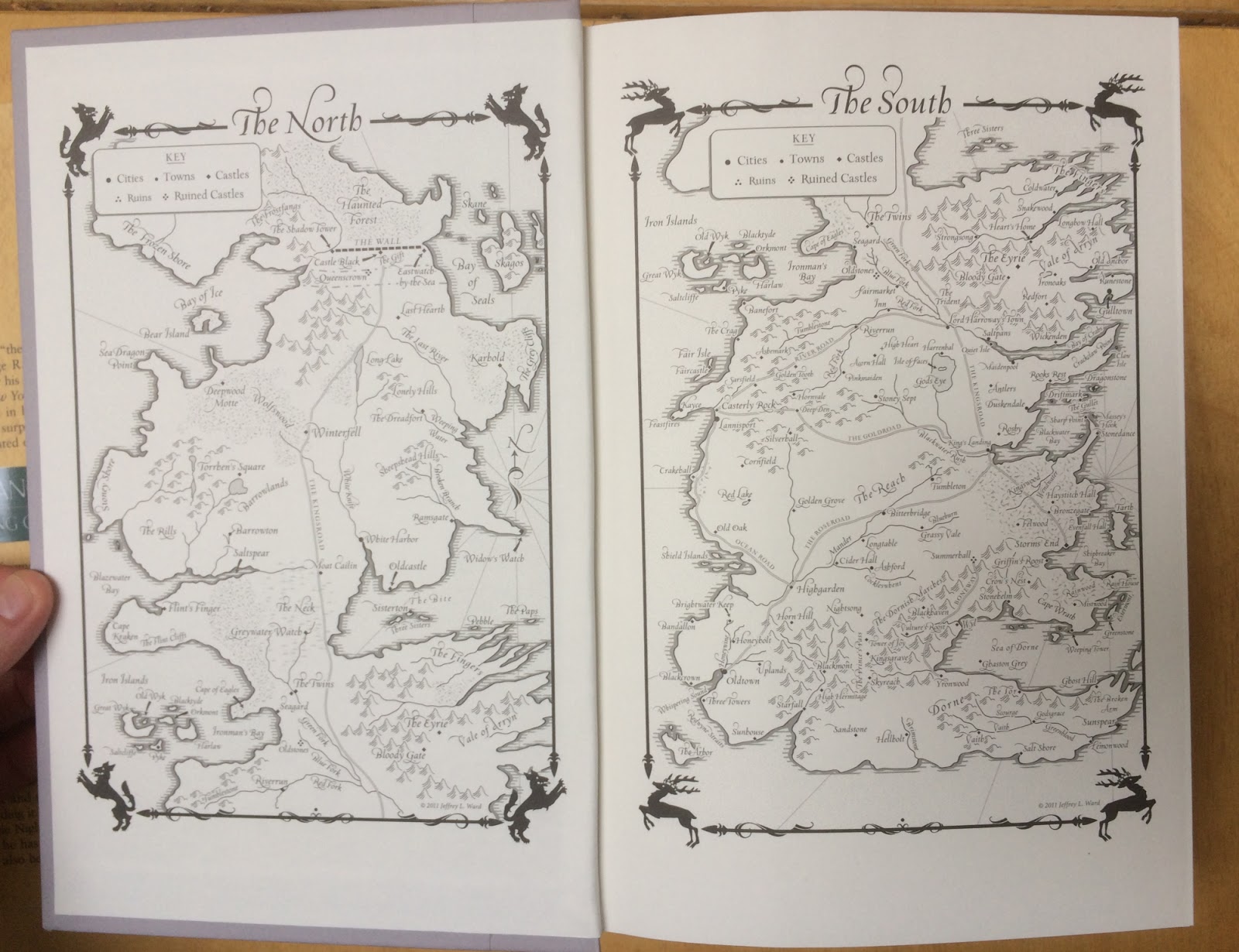
Maps show us worlds. Worlds that are, worlds that used to be, and worlds that never were, except in imagination. The right kind of map suggests travel, stories, and adventures. Antique maps, with their limitations and inaccuracies, recall a time when the world was a mysterious place and explorers really didn’t know what they would find. There might be sea serpents, golden cities—even buried treasure, where x marks the spot. In fantasy novels, maps show a world that may really have all those things. Maps are sufficiently popular in fantasy that someone even designed a spoof of fantasy novel maps.
photo of westeros map
Westeros, from Game of Thrones (rather than using Middle Earth as an example)
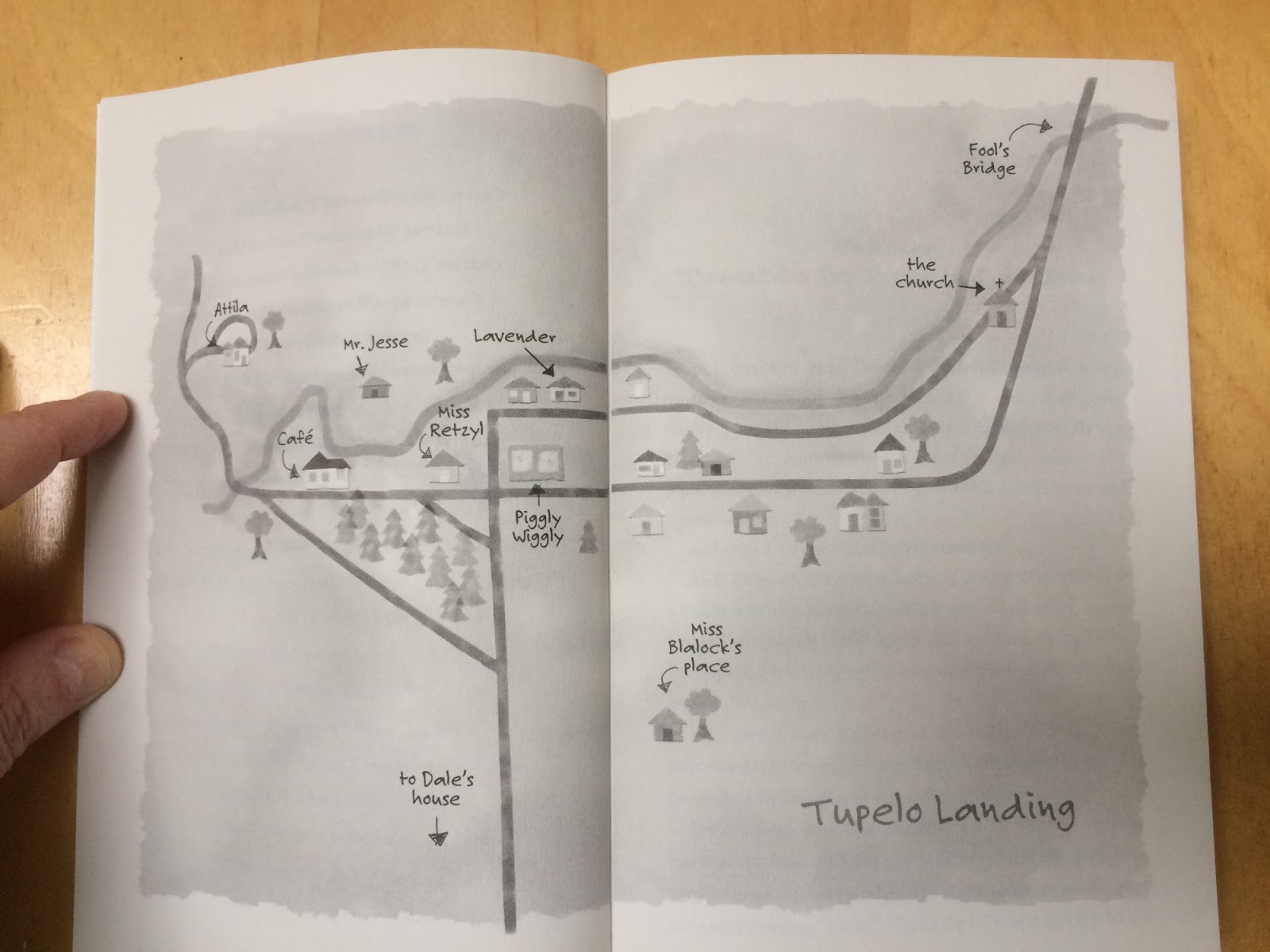
Maps in mystery novels have a quasi-functional use. A house plan can help the reader track who was where and when–and how a secret passage might have allowed someone to be where they supposedly weren’t. In her mind’s eye, she can see different possible scenarios suggested by the layout of the mystery’s setting.
photo of tupelo landing map
Tupelo Landing, from Three Times Lucky by Sheila Turnage
Maps of the world we know don’t have to be purely functional, or even functional at all. Consider the maps that are sometimes designed as souvenirs of a town, where streets aren’t to scale and landmarks are amusingly caricatured. They’re fun, decorative, and sometimes sentimental, but hardly something that will help you navigate, if you should find yourself without GPS and Googlemaps.
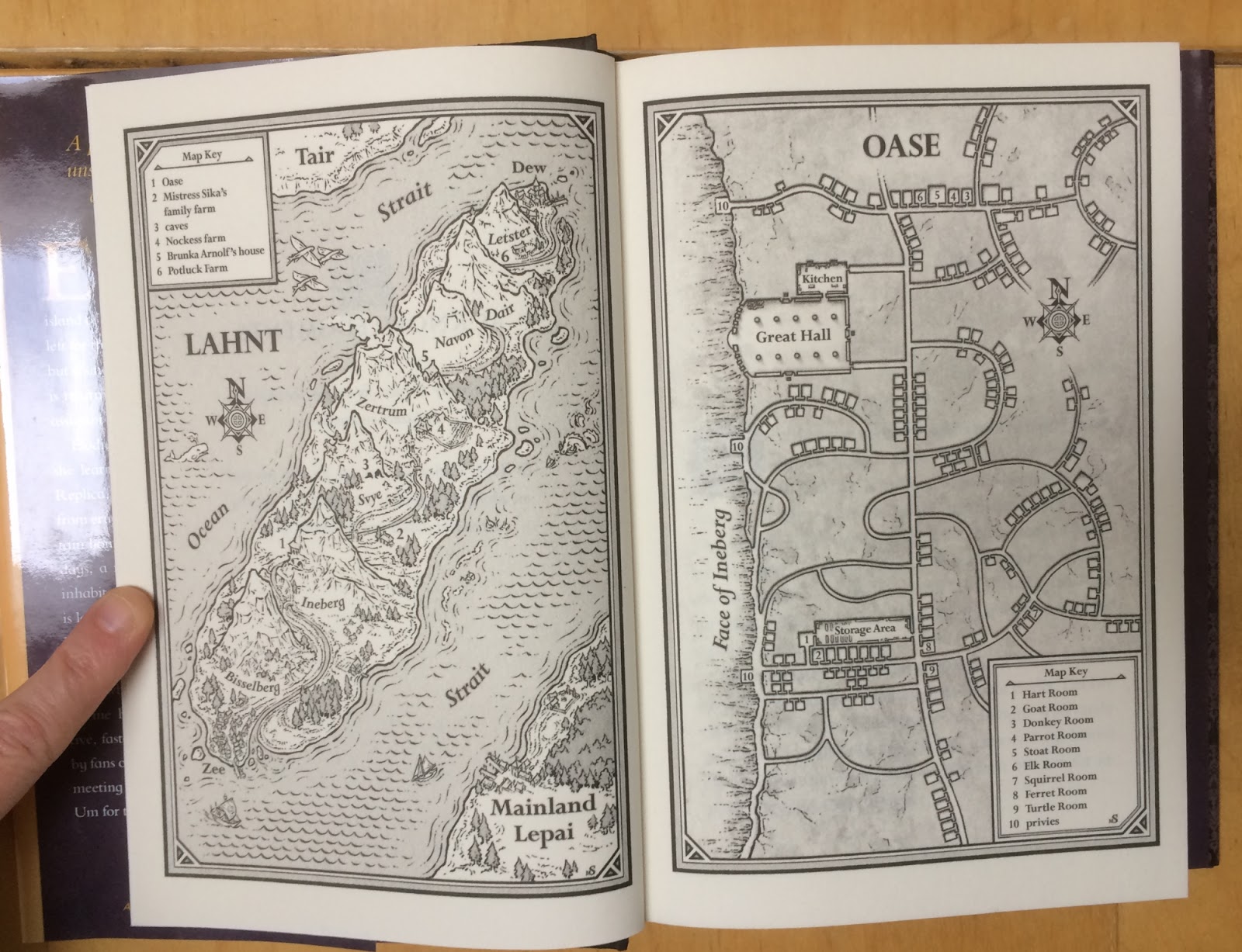
photo of map from Stolen Magic
Stolen Magic by Gail Carson Levine–fantasy and mystery both
In A Great Reckoning, by Louise Penny, an old orienteering map features heavily. But it isn’t a straightforwardly practical map—its maker clearly intended it to refer to landmarks in someone’s personal history. The map isn’t shown in the book, but it is described at various points.
“At first glance, it didn’t look like a map at all. While worn and torn a little, it was beautifully and intricately illustrated, with bears and deer and geese placed around the mountains and forests. In a riot of seasonal confusion, there were spring lilac and plump peony beside maple trees in full autumn color. In the upper-right corner, a snowman wearing a tuque and a habitant sash, a ceinture fléchée, around his plump middle held up a hockey stick in triumph.” (p. 35)
“Yes, it took a while to see beyond all that, to what it really was, at its heart.
A map.
Complete with contour lines and landmarks. Three small pines, like playful children, were clearly meant to be their village. There were walking paths and stone walls and even Larsen’s Rock, so named because Sven Larsen’s cow got stuck on it before being rescued.
Gamache bent closer. And yes, there was the cow.” (p. 36)
Finally, there is something intriguing about the names on a map, not just the images. Some place names are more interesting than others, and just giving an area a name somehow makes it special. Years ago, my daughter and I were at Great Wolf Lodge, a kind of hotel/amusement/water park. The hotel was set up so that the halls could be part of a game in which kids roamed around with electronic “wands”, which when waved at various items, caused them to do something or display something. In keeping with the magical theme, the halls and public areas of the hotel had names.  I should have written some of them down, but I think they were along the lines of “The Enchanted Forest” and such. I commented to my daughter that we should name the areas of our home something more interesting than “Hall Bathroom” and “Mom’s Study.”
(I did in fact name one area of our yard “The Fairy Garden”, and another area that happened to get planted in rosemary, lavender, chives, catmint, and butterfly bush, “The Purple Garden”.)
Having said all this, it is a curious truth that I have not had much luck making maps for the stories that I write. I have some general diagrams to help me keep straight left and right, north and south—but that’s about as far as it goes. And yet, I would love to have some pretty maps to illustrate them with. Maybe I’ll give it another try someday, allowing myself to emphasize beauty  and mystery rather than detail.
Here there be dragons.
Till next post.

Sun and suncatchers–rainbows in my room


In winter, the sun shines into my study.
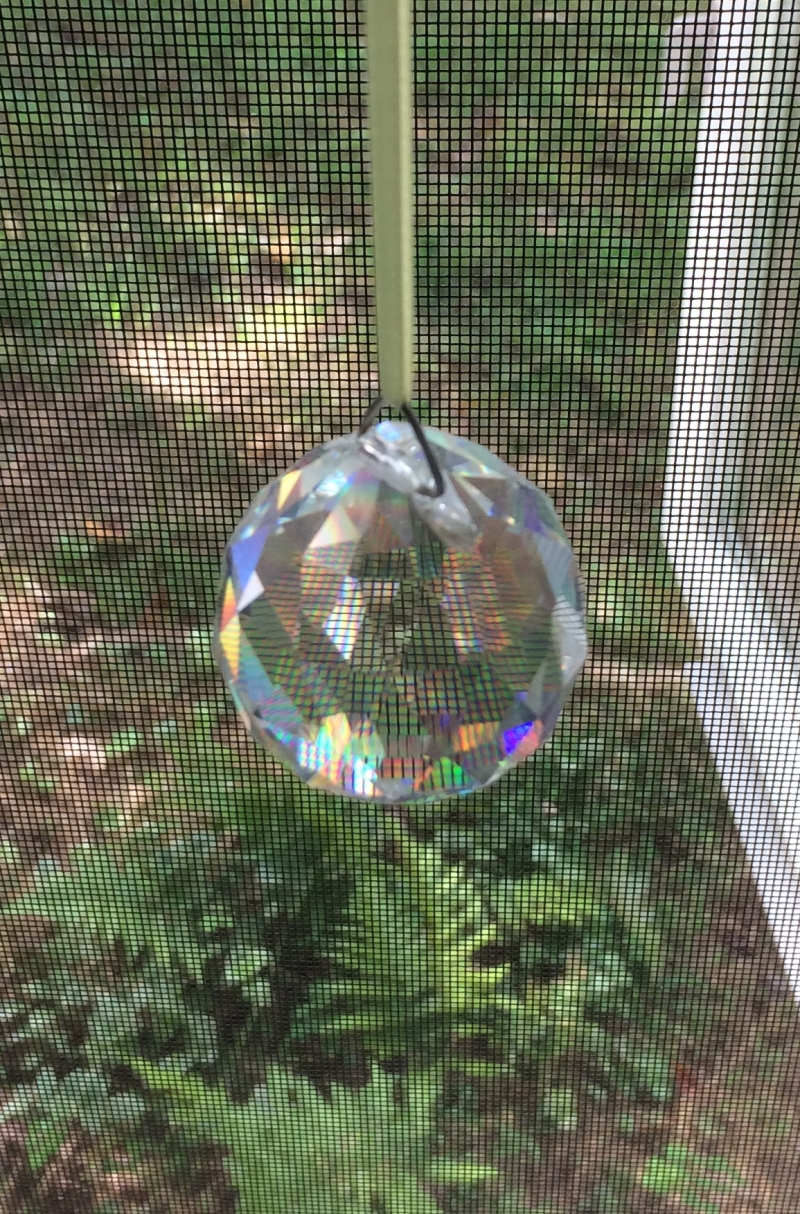
Chunky faceted crystal suncatcher in front of window screenIn my dreams, it shines on a room that is serenely uncluttered, where ferns and houseplants flourish, and where crystal prisms in each window cast drops of rainbow on the walls and floor.
In my dreams.
In fact, my study is so cluttered that I’m having trouble finding papers when I need them, and my houseplants are surviving tenuously on intermittent waterings. But I do have suncatchers in almost every window, and when the sun’s angle is right, my study is filled with tiny rainbows.
A glass ornament hung on a ribbon or plastic line isn’t going to stay perfectly still, and so the rainbows drift, lazily, around the room. If I nudge the prism, the rainbows jitter madly about for a moment, then race across the room, gradually slowing to near-stillness.
There’s a reason rainbows are associated with unicorns and fairies and other magical creatures. They are nearly magical themselves—sunlight split into colors. Sometimes, when I glance at a suncatcher from just the right angle, it lights up in a momentary blaze of color—green, maybe, or violet. I imagine that someone watching would see a tiny rainbow drifting over my face at that time, entrancing me.
The whole idea of rainbows brings out my whimsical side. Years ago, I lived in an apartment where I hung a suncatcher in the kitchen window. Mornings, I held my cereal bowl out so I could pretend I was flavoring my breakfast with rainbow. I still like the idea of rainbow-flavored cereal.
On the practical side of things, there are some difficulties in hanging chunky glass crystals (the best kind for rainbows) in a window. As I mentioned, they can swing if accidentally bumped into, and while I don’t know who would win in a contest between crystal glass and window glass, I’m sure it wouldn’t be good for either. A suncatcher on a shorter cord would be less likely to swing into the window, but it would also catch the sun less often. So most of my suncatchers hang in windows that have interior screens. The crystals would look better in windows without screens, but the screens provide extra safety for the windows.
The sun only comes through the crystals at certain times of day and only when it traces a more southerly path through the sky. But when I think about it, maybe that’s a good thing. If I had rainbows every day, all day, they wouldn’t seem as special.
Till next post.