The Versatile Bookmark


The other day a friend sent me an interesting bookmark. It is a cord with beads on either end for decoration. The idea is that you can leave it in the book as you read and it will not either fall out or make it difficult to turn pages, as paper bookmarks sometimes do. I’ve put it in a book I’m currently reading and am looking forward to trying it out.
Bookmark cord with beads on the ends inside a book on jewels
An appropriate book for a beaded bookmark
That’s one reason I’ve been thinking about bookmarks. The other is that every time I go to church, I am reminded that there there aren’t enough loose sheets in the program to mark all the hymns. If I don’t bookmark them, it takes me so long to flip to the correct page that I miss the beginning. So each time I say to myself, “I should bring some bookmarks.” Preferably with the words “First,” “Second,” “Third,” and so on at the top, so I know which one comes next.
I collected together all the bookmarks I could find and was interested to see that they fell into several categories.  The first and most obvious is that of standard-type bookmarks with beautiful pictures.
Paper bookmarks with beautiful drawings or photos on them
Decorative paper (mostly) bookmarks
There are so many of these out there, and they are so much fun to look at! I really liked the Eowyn marker, because I think Eowyn is interesting, but the metal horse bead on the tassel unbalances it and tends to make it fall out of books. The fact that it is so glossy probably doesn’t help either (not enough friction.) That brings me to the second category—bookmarks that come in different shapes and materials, often in an attempt to improve functioning.
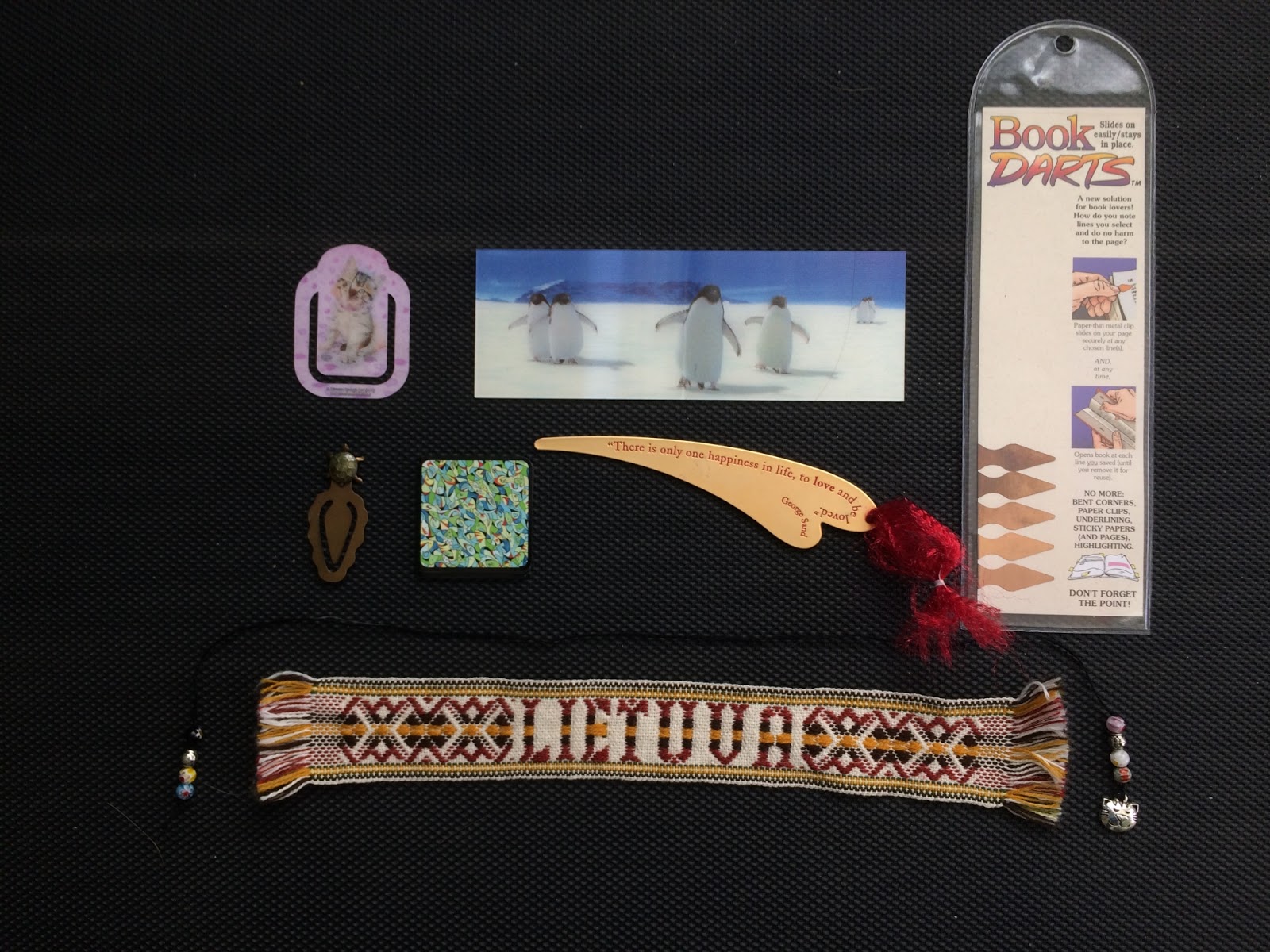
Bookmarks in metal, fabric, or with magnets
Bookmarks of various materials
So the magnetic bookmark (the small square) is designed to hold tight to your place, as are the book darts. They can be a problem in that they hold on so tightly, it takes longer to remove them to mark a new place. The two clip-shaped ones (the plastic kitten and the metal turtle) are also supposed to hold better, though I’m not sure they really do. If you look carefully, you can see the beaded string bookmark here—another one aimed at improved function as well as decoration.
The others are simply different materials–the lenticular (3D) bookmark, the woven bookmark (which also falls under the category of souvenir, although it was my parents that traveled, not me), and the metal one that is not a clip. Plain metal makes a terrible bookmark, by the way—it falls out of the book constantly.
Paper bookmarks are an excellent medium for advertising and informational messages. After all, they’re just bits of paper and so are very cheap to make. Bookstores in particular use them for advertising (no surprise there). The fact that they are bookmark-shaped means that they are more likely to be kept around and not tossed. Sometimes they remain in books and are rediscovered years later.
Promotional bookmarks
Bookmarks can also be a handy way to hand out printed information–especially if that information is book-related.
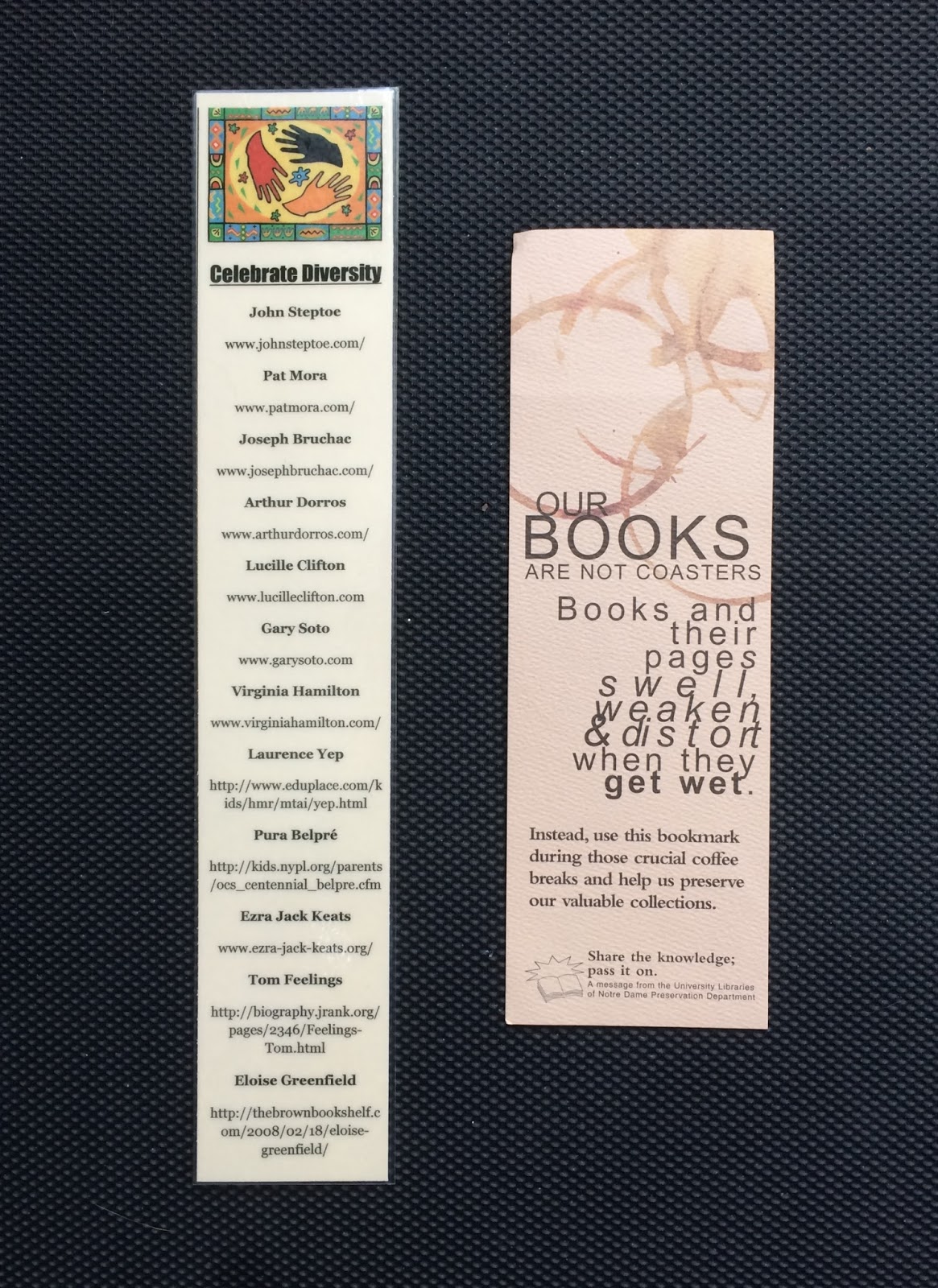
Informational bookmarks
Despite having such a wealth of bookmarks, I sometimes use the plain strips of thin cardboard that come in boxes of Red Rose teabags. They’re the right size and thickness, and when I am reading a particularly interesting nonfiction book, I can make notes right on the bookmark. (Alternatively, they can be decorated by visiting children.)
Strips of paper used as bookmarks, with notes or drawings
Plain, picturesque, or with jotted notes.
That brings me to the last category—the hand-made bookmark, usually paper, though occasionally woven or made of other material. Strips of paper are easy to decorate, and the fact that it is a “bookmark”, not merely a strip of paper, makes it seem more “gift-y”. (When I think about this, I’m surprised I don’t have even more bookmarks than I already do.)
What a great opportunity to make something fun, for yourself or someone else!
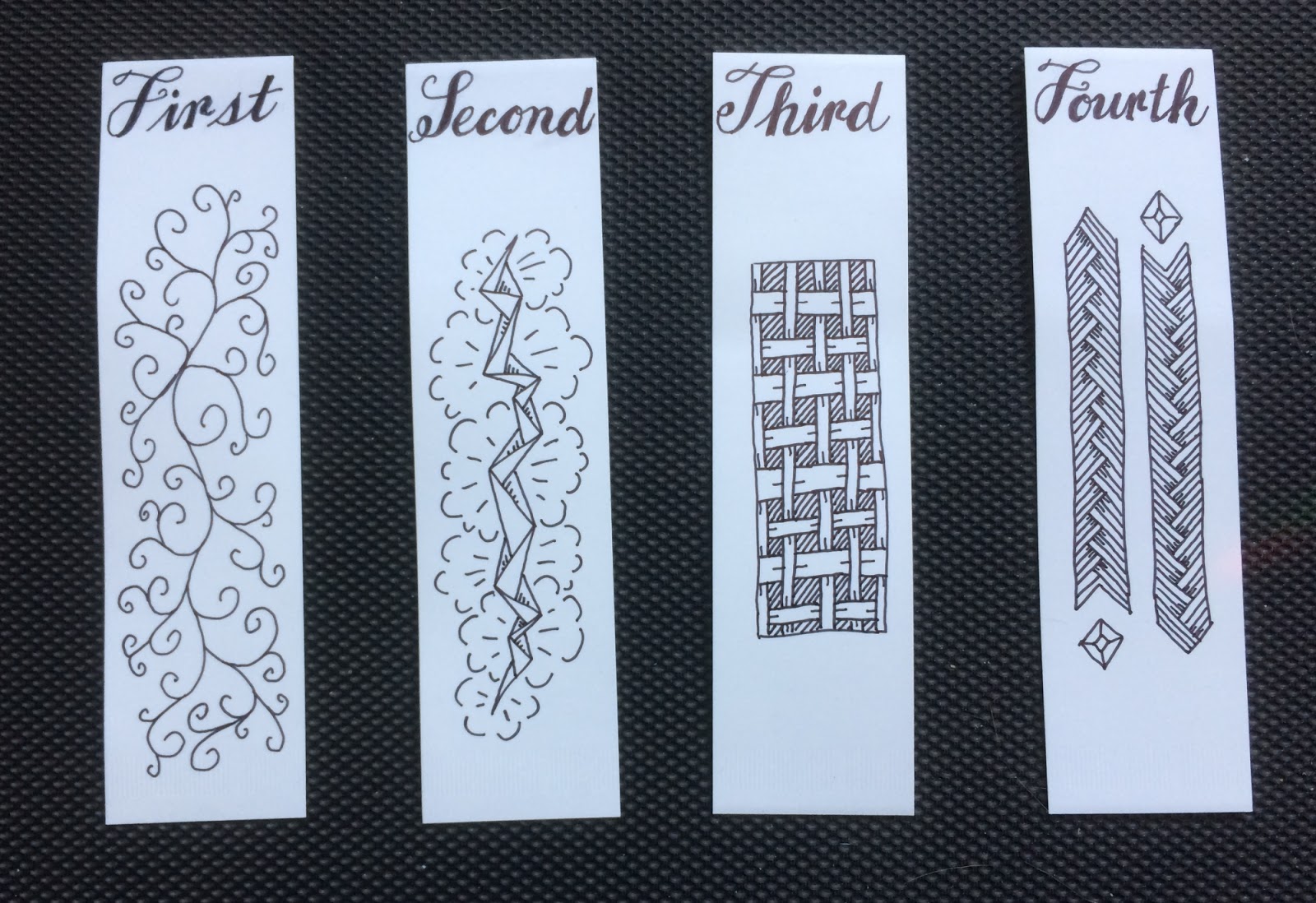
Homemade ZIA bookmarks numbered First through Fourth.
And here are the numbered bookmarks!

In Praise of Airport Art


This morning I was re-watching a documentary, “Empire of the Tsars”, and was once again wowed by what I was seeing. Though the documentary is about the tsars of Russia and not about Russian art or architecture, the film shows the narrator walking in and among some amazing sights.
Walls completely painted top to ceiling in golden images. Not sure if this was at the monastery the first tsar came from, or the private chapel of the last tsar. Maybe both.
St. Basil’s Cathedral, in Red Square, looking like a fairytale crossed with an Easter egg. (Have I mentioned that my house interior is pale green, pale yellow, aqua, and peach? There used to be some pink, too, till my daughter got older and repainted her room jungle green. Now it’s lavender, and entirely in keeping with the rest of the house.)
The Peterhof palace, with its fountains and gilt… lots and lots of gilt. (Have I mentioned my fondness for shiny things?)
And many other impressive buildings, with lots of golden trim, ornate carving, and so on.
On the one hand, I was deeply impressed with this reminder of what human beings can create. On the other hand, I was reluctantly reminded that many impressive and beautiful things have been built at great cost to a lot of ordinary people.
But it doesn’t have to be so, does it? We can have interesting things to look at without being horrible to people, can’t we?
Design in inlaid linoleum flooring at Indianapolis airport
Inlaid linoleum in Indianapolis
And so I want to say a few words in praise of the art on display in airports. I really like airport art. Silver trees spreading their branches up to the ticketing floor, delicate translucent jellyfish hovering above a concessions area, colored linoleum inlaid into pictures underfoot, and giant “marble” machines where balls clank their way past flags, down funnels, ring bells, and then come to rest on a ski lift for balls, being gently raised so they can start all over again.
I like art in public places generally, but airports seem a particularly good spot for a few reasons.
1.      Airports have vast spaces that can accommodate art that is two stories tall, or needs to be well above people’s heads, or runs the length of a (long) corridor.
2.      These vast spaces are indoors, so no worries about weather.
3.      Airports are full of people. Not just local people, either. And while some  of these people are in a hurry and aren’t going to look at the art any longer than it takes to walk past it, others have time on their hands (sometimes lots of time) and can stop and stare on their way to get yet another coffee.
4.      Art–some forms in particular–have the potential to take travelers out of themselves for a moment. I’m thinking in particular of those tunnels with lights and sounds, which feel a bit like you’ve temporarily left the airport for somewhere else. Of course, I’m sure there are some travelers for whom that somewhere else is not an improvement. They would rather just walk or people-move down another forgettable corridor on their way to terminal C.  You can’t please everyone.  I like the feeling of otherwhereness.
I imagine having art in the airport adds to the cost of something—concessions, perhaps, via increased rent? But given the number of people going through, and the cost of everything else associated with maintaining an airport, it doesn’t seem like it would be all that much per person. I’d be happy to pay a little extra for a more interesting travel experience. Not a huge amount extra, mind, so I suppose the gold leaf and ornately carved marble are out, and not just because they aren’t in fashion. (Then again, we are richer than we realize.)
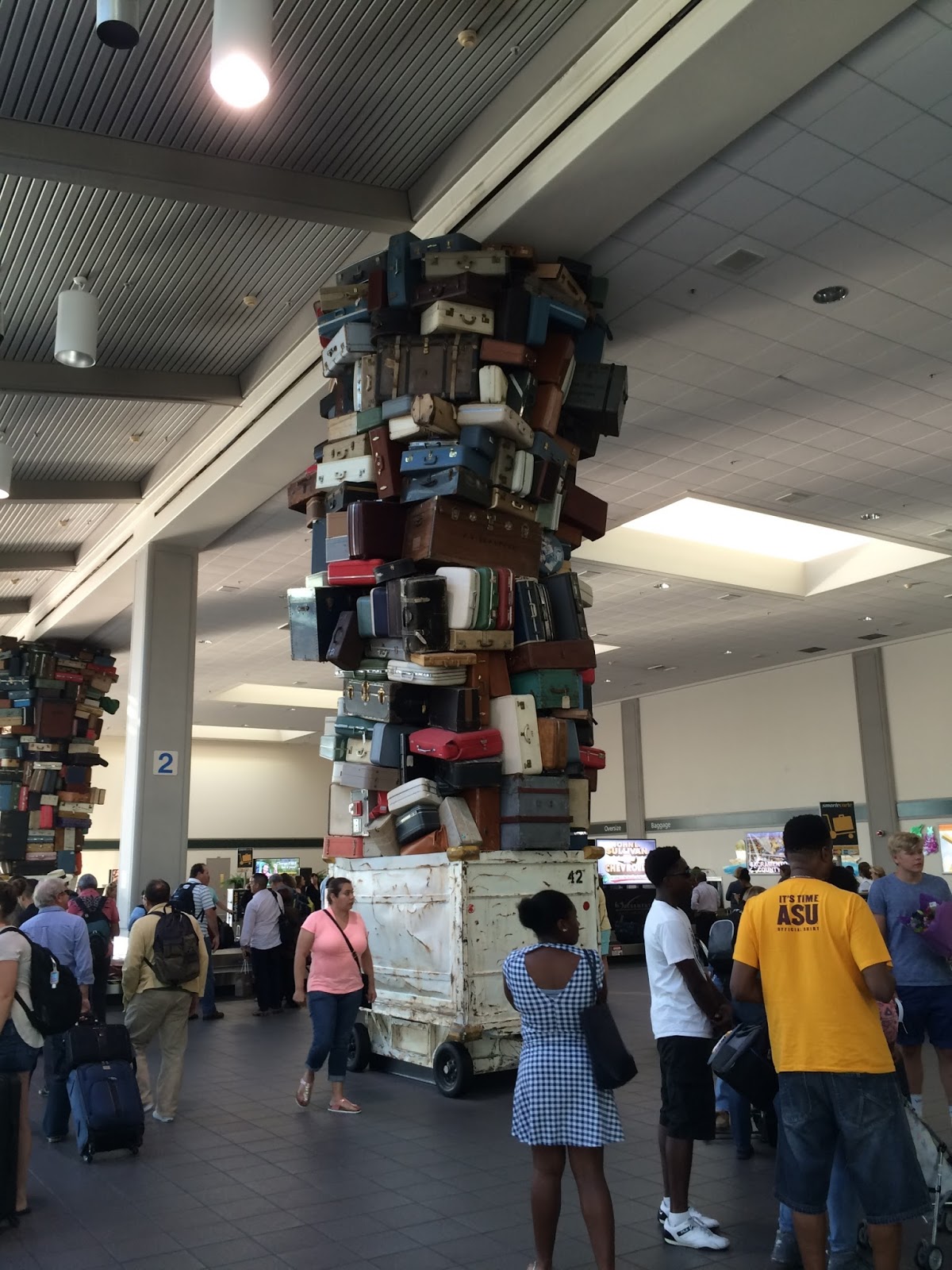
Art composed of old-fashioned luggage at baggage claim in Sacramento
Baggage claim in Sacramento
So the next time I’m in a new airport, possibly as a result of a canceled flight (thus going from Boston to Raleigh via Detroit, say), I will try to notice all the different artwork. Maybe I’ll take a few pictures as a reminder of what I’ve seen.
It isn’t the Peterhof palace, but it will give me something to remember on the plane ride home.

Sewing, Knitting, and (Un)happiness


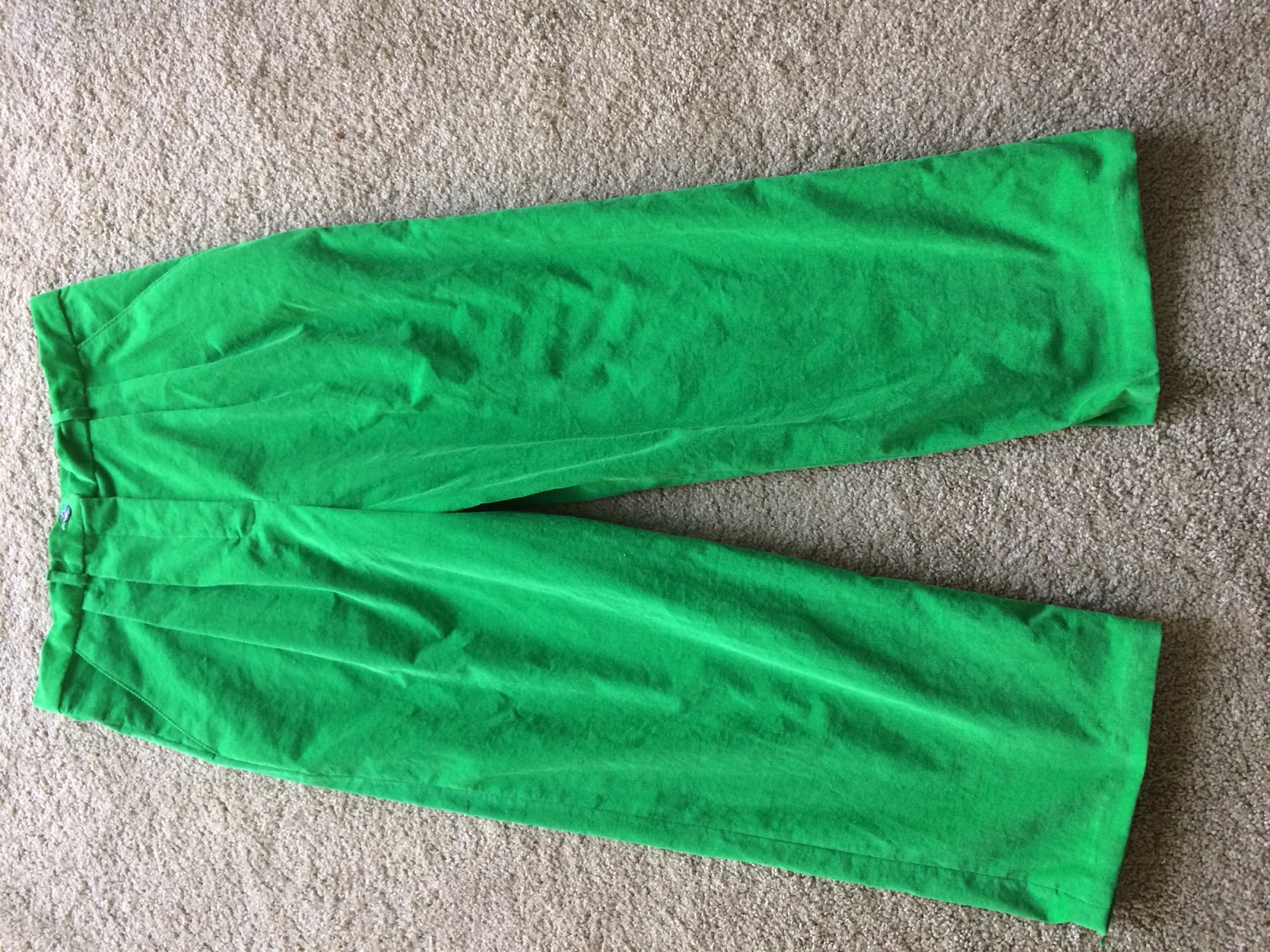
This week I’ve been sewing myself a pair of pants. Loose-fitting, double-pleated pants in emerald green, feather-weight corduroy.

It is a fact about sewing (and pretty much any other craft) that I cannot complete a project without mishap. I only use one pattern for pants, but I always seem to be making some minor change—trying to deal with their distressing tendency to split in the seat, or else fiddling with the waistline yet again to keep it current with my own.
Even when I don’t run into trouble with the changes I’m making, there’s usually a piece that gets sewn wrong-side out, or a seam that extends where it should not. Or something completely different—this time I spent over half an hour searching for my seam ripper, which eventually turned up under a sofa cushion. It’s frustrating.
So why am I sewing pants instead of buying them? Granted, stores don’t carry pants that meet all my criteria. (Double-pleats, loose-fitting, not too tight at the waist but not too loose in the seat, soft fabric, useful pockets…) Still, I could probably pay a sewing pro to stitch up a pair to my specifications. I could even get them to finish the seams properly, which I haven’t done for this pair.
Maybe it’s the same as my reason for trying to make French bread. It’s the challenge of the thing.
That’s probably part of it, but I don’t think the situation is quite parallel. At any rate, while thinking about this, two other things kept coming to mind. The first is a comment that my husband made. It echoes something in a book by Stephanie Pearl McPhee, the Yarn Harlot. If I could remember which book, I would quote it, since she puts things so wonderfully. But I can’t, so I’ll have to approximate.
Knitting projects, like sewing projects, often go awry. Knitters end up ripping out mistakes and having to re-knit chunks of their project. Other times, they discover that the size small sweater has somehow turned out to be a giant’s size small. And so forth. Unless the knitter is restrained and keeps her frustrations to herself, at some point her spouse may inquire, “Do you really enjoy knitting?”
It’s a reasonable question, given the amount of grumbling.
And the answer is, “Yes, I really do enjoy knitting.” Even if this blasted hat won’t go around my head…. Grumble grumble.
It’s easy to see how sewing projects and knitting projects are connected. Less clear is why I kept thinking of a section from a book I had recently looked at, The Pursuit of Unhappiness: The Elusive Psychology of Well-Being, by Daniel M. Haybron. The part that struck me actually comes right near the beginning of the book. First, the author comments on an experience that led him to the topic of the book. He used to spend summers on a small fishing island as a child, and remembers it as being a very different world, a good place to be, “the only place I’ve ever felt like a fully developed human being.” Later, he compares two hypothetical societies, A and B, and describes them like this:
“Consider then, two communities, A and B. A typical member of A, on a typical day, is in more or less the following condition: at ease, untroubled, slow to anger, quick to laugh, fulfilled, in an expansive and self-assured mood, curious and attentive, alert and in good spirits, and fully at home in her body, with a relaxed, confident posture. A denizen of B, by contrast, is liable to be: stressed, anxious, tense, irritable, worried, weary, distracted and self-absorbed, uneasy, awkward and insecure, spiritually deflated, pinched and compressed. The differences, let us suppose, owe mainly to difference in the prevailing ways of life in these communities.”
A bit later he says,
“Notice that the descriptions of A and B made no explicit reference to happiness or unhappiness. But it should be reasonably apparent that, nonetheless, happiness is precisely what they were about: what A has in its favor is that its residents tend to be happy, whereas the people of B tend not to be.”
What has this got to do with my experience sewing pants? I’ve just said that sewing includes a significant amount of time spent fussily trying to adjust the pattern and then discovering that I’ve messed up and must rip out some seams, all of which tends to produce frustration and anger. The author’s description of society A involves people feeling good in various ways, while it is society B that is described as habitually tense and frustrated.
But then I thought about the origin of his example—the island community that he described and the hard work of its inhabitants—and the fact that they undoubtedly had moments of similar frustration in making things work, but also presumably moments of great satisfaction with their work and its results. I thought about the fact that I genuinely do enjoy sewing, and what that means, and I’ve come up with two possible connections:
1.  Enjoyable activities don’t always look enjoyable.
2.  “Difficult” doesn’t equal “not happy-making.”
I’m stuck for a conclusion here. It seems trite to conclude simply that worthwhile activities involve some work, some parts that aren’t fun—but isn’t that what I’m saying? Or is there something more?
Maybe if I reread the book, which I don’t remember very well, I’ll have more to say. Meanwhile, I’ve got a nice new pair of pants.
Even if they do make me look nine weeks early for St Patrick’s Day.

green corduroy pants with two pleats sewn at home
Add caption

Till next post.