“Fresh Fruit Cream Cake”–even the name sounds delightful

The kittens rampaging through my house knocked an old issue of Cook’s Illustrated off a shelf–May/June 2024. I flipped through it, on my way to reshelving it, and stopped at a recipe for Fresh Fruit Cream Cake.

Something about the phrase “cream cake” just sounds irresistable to me, so I read (or re-read) the article and discovered the author Andrea Geary started with a cross between a castella cake (which I hadn’t heard of) and a chiffon cake. The technique sounded different–and interesting! I decided I must try it and find out what it was like.

I suspect the reason I didn’t make the cake when I first got the issue is that I am not really a fan of fluffy things with fruit on top. I have always looked dubiously at recipes for pavlova, for instance. But I do like strawberries with shortcake and whipped cream, and I thought that the right cake would be just the thing for strawberry season.

(It isn’t strawberry season now, obviously. I’m just thinking ahead.)

So I tried making a half recipe. This was a bit complicated since the cake is meant to be tall, but I worked it out by using a 6″ round instead of a 9″. It was close enough. I also didn’t bake it for quite as long.

Yes, it’s so tall it needs a collar.

I’m not going to give the recipe, since I don’t feel right copying out a recipe from a magazine. However, I’m going to tell you that there is only a cup of cake flour per six eggs. The recipe relies on whipped egg whites, uses a water bath in the oven, and bakes for around an hour. The result is a very fine-grained, fluffy, spongy cake (all those eggs). Not dense like pound cake, and not crumbly-delicate like most butter cakes. This one is flavored with vanilla.

I’m also going to tell you that the whipped cream that fills and tops the cake is made with 5 tsp instant pudding mix (it MUST be instant) per 2 1/2 cups of heavy cream. There is also some sugar, and I added vanilla extract as well because I didn’t think the pudding would add enough vanilla flavor. I found the pudding mix did not incorporate as well as it should have–there was a yellow sticky smudge on the side of the bowl–but I think it did help keep the whipped cream from oozing.
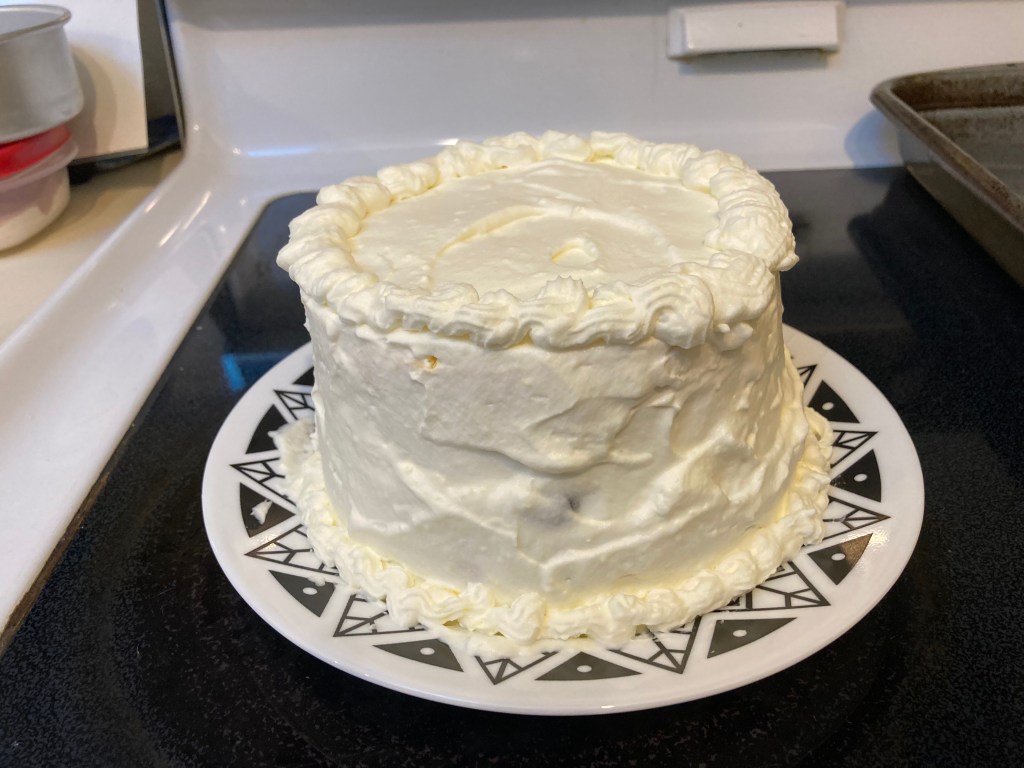
I could have taken more time with the frosting…

I enjoyed trying something new. The cake was pretty good and will probably make a really nice strawberry cream cake come April. But I’m pretty sure it isn’t going to displace any of our preferred birthday cakes.

Blueberries taste good with whipped cream, but are not attractive when cut in half.

Trying an Old Family Cake Recipe and a New (To Me) Frosting

My Grandpere, my father’s father, was a baker. When we celebrated birthdays while staying with him and Grandmere, he always produced a cake. Not a chocolate cake, though. I’ve never actually known what sort of cake it was, other than that it had two layers, a sort of whipped cream filling, sliced almonds patted onto the sides, and–for my birthdays–a glossy, smooth, pink frosting.

I do remember that it was delicious, even if I’m not sure what it was flavored with.

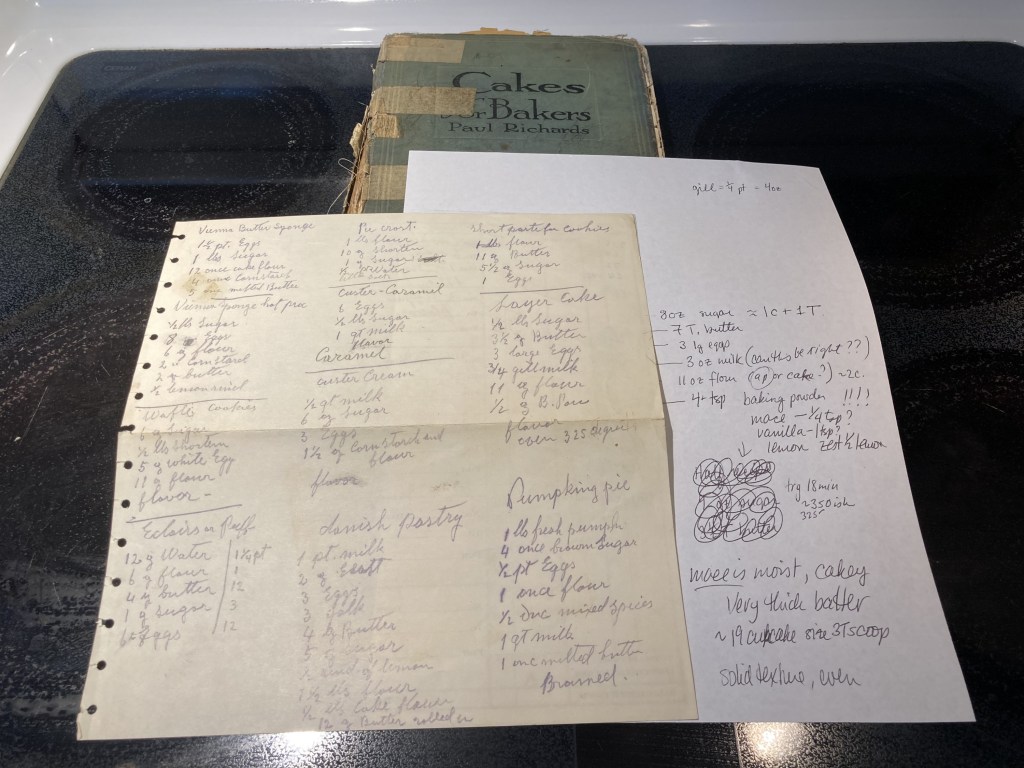
I have one of my Grandpere’s cookbooks, Cakes For Bakers. It’s clear that he used it, and it’s full of scraps of paper with recipes. I say “recipes,” but “lists of ingredients with a title” is a better description. I know I’ve looked through them before, trying to find out what cookie recipe he used, but this time I was curious about the cake recipes. “Mace” showed up several times, particularly in connection with something called “wine cake”, but also in a few other places. What would it be like to flavor a cake with mace?

One of the recipes says “layer cake.” I decided to try that, but add the “mace, lemon, vanilla” that shows up in the context of the wine cake. Mace is similar to nutmeg, and I already know that nutmeg and lemon are a nice combination.

However, I didn’t want to end up with us having to eat a whole cake, so I decided I would make the batter into cupcakes so I could freeze some for later.

At the same time as I decided to try the cake, I also decided to try a new and unrelated frosting that I’ve been curious about–Ermine Frosting, which involves boiling milk and flour together. (It also has a lot of butter.) So, not one but two experiments–perhaps not as tightly linked as they should have been.

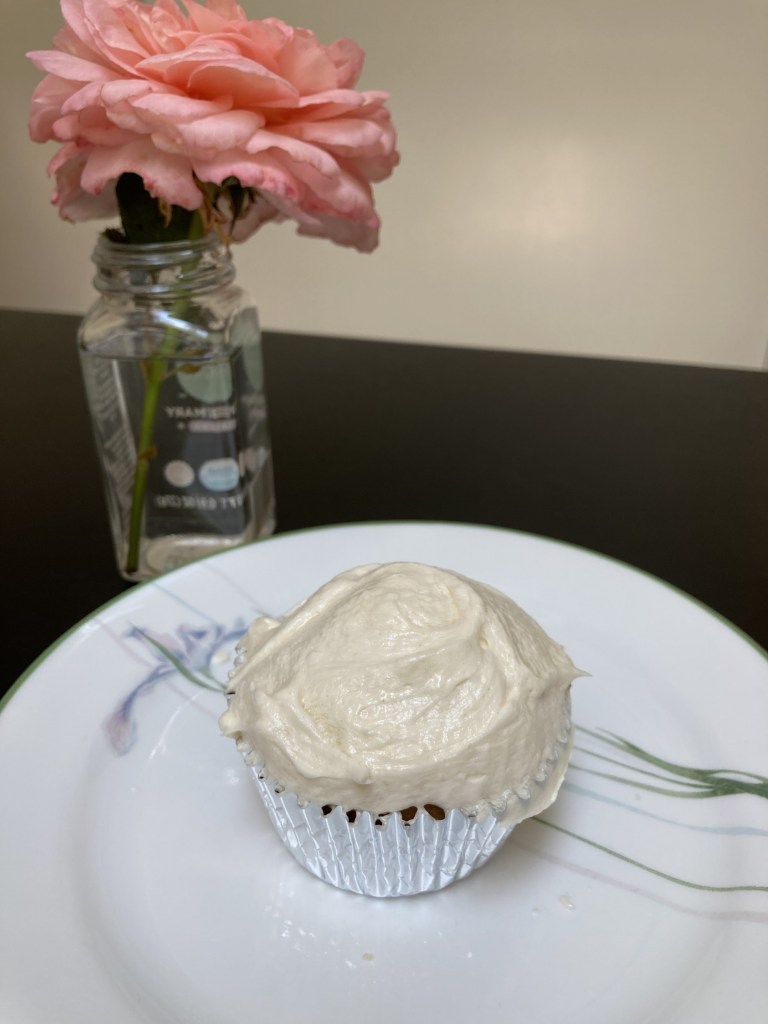
First, the cake. I deciphered and “translated” the measurements (what’s a gill?) and tried using the standard approach for a butter cake, creaming the butter and sugar, adding eggs, then alternating the flour mixture and milk. I guessed at suitable amounts of mace and lemon and vanilla. The result was a thick but tasty batter, and cupcakes with a fairly firm but good crumb. The flavor of mace was pretty strong–perhaps I should have gone heavier on lemon and lighter on mace.

The ermine frosting was intriguing. Some methods have you beat the butter and add the thickened milk/flour mix to it, while others have you add the butter to the thickened, beaten milk/flour mixture. I used the recipe from King Arthur Flour’s website, and heated milk with flour and sugar to make a cooked paste, then beat it till it cooled down some, then added butter. The texture is very smooth and buttery (no surprise that it is buttery) and I think it would be good with flavors besides vanilla. It reminds me of the texture of the filling that Phoenix Bakery in Pittsboro, North Carolina, uses in their doughnuts–silky with butter.

However, vanilla ermine frosting doesn’t seem a good match for these cupcakes. I’m not really sure what would be–something citrusy? Cinnamony?

This brings me back to the fact that the flavors–mace, lemon, vanilla–seemed to be connected to wine cake. In the cookbook and in the notes, the recipes for wine cake do not contain any wine. Is it so named because it is accompanied by wine? Or is there supposed to be wine involved later on?

When I looked up “wine cake” on-line, every recipe I found did in fact include wine as an ingredient (and often, cake mix and pudding mix.) So why is this cookbook’s “wine cake” so different? Why can’t I find out anything about the origins of this wine cake?

The internet can tell you a lot, but some mysteries resist easy answers. I should have asked more questions of my Grandpere, but I wasn’t interested in baking back then. I should have asked more questions of my father too, when I started baking, though I’m not sure how many more answers he could have provided. Maybe he didn’t ask those questions of his father either.

If you know anything about a “wine cake” that doesn’t contain wine but does contain mace, I’d love to hear from you.

Till next post.