On Communicating With the Government–I ponder different methods as I write to the FCC


This week there was considerable fuss, first about the FCC’s proposal to repeal the net neutrality rules, and then about the emails they received in response—in particular, those emails that appeared to have false or temporary addresses or to have originated from Russia. This started me thinking about our communications with our government more generally. Since we are usually communicating with our legislators about bills (rather than sending comments to the FCC), I’m just going to talk about that.
The point of communicating with your congressperson is to influence his/her decisions and change his/her behavior. There are three ways a communication (letter/email/call/visit) could do this.
(1) The content of the communication could be reasons for or against the bill in question.
(2) People’s communications could arrive in such profusion that it causes chaos and makes it impossible for the legislator to ignore the fact that people are concerned about the bill, and maybe also impossible to conduct the rest of his/her business.
(3) The communications could give evidence of grassroots opinions—that many people are very concerned about the bill.
The first possibility, that the communications will give the legislator reasons to change his/her mind, seems fairly unlikely. Probably by that point, he/she has already heard most of the reasons given by both sides, has made up his/her mind to some degree, and isn’t likely to even see, let alone be influenced by, any single communication. (Other people are opening the mail and answering the phone anyway, especially if the legislator is getting tons of mail and phone calls.) Still, that doesn’t mean the communication doesn’t need to offer any reasons. If nothing else, it will give the office workers who tally people’s positions a general sense of people’s reasons.
The second possibility, that the sheer volume of communications is what matters, suggests that politics is a matter of beating your legislator into submission, which is a pretty cynical view of things, though maybe with a grain of truth to it. Maybe we want the letters to be disruptive enough to get the legislator’s attention, but surely not so much that it prevents him/her from doing other useful things, or thinking about other forthcoming bills. Otherwise legislators won’t be able to do anything most of the time, and why would we want that?
The third possibility seems the strongest. If lots of people hold a particular opinion on a bill and hold it very strongly, then not only should the legislator, as representative, be concerned about representing their view, but the legislator’s vote on the bill could have an effect on his/her chances of re-election. And that’s a powerful motivator.
How much is his/her vote on the bill likely to affect his/her re-election? Well, how many people are for it, and how strongly do they feel? Both matter. If lots of people support the bill but only lukewarmly, the legislator could probably get away with voting against it. If only a few people support it, it doesn’t matter how much they care, they still only have a few votes to give.
So what kind of evidence do the various forms of communication give of these things? Long ago, when I was an intern in Congressman Whitehurst’s office*, I was given the relatively unimportant job of looking up the addresses of people who had signed their names to form postcards. Form postcards were, I think, supplied by political organizations and probably dropped off by them as well—I don’t think the individuals who signed the cards had to actually mail the cards themselves. But they did have to sign their names and maybe give their town. I was to look up the full addresses so the office could send them a form letter in response.
Remember, this was before most people had personal computers, and well before there was a world wide web. No cutting and pasting letters (except in the very literal sense) and no email. So there were form postcards, regular letters, phone calls (long distance was still expensive), and personal visits. Form postcards were the least important, because they took the least effort and expense on the part of the sender.
Now emails make communicating with your legislator easier, but as this week’s kerfuffle makes clear, there is the problem of knowing whether the email represents a particular individual, or if it has been sent by a bot, or if one individual or sneaky organization has sent many emails, and whether the sender is even an American and eligible to vote.
On top of that, emails can be sent with very little effort, especially if they are pre-written and addressed by an organization, so that the individual has only to enter his or her email address and click a button. So the emails don’t do a good job of showing just how much the sender cares about the issue. Is this a make-it or break-it issue for them, or just one among many concerns?
So I’m sending the FCC chairman and commissioners hand-written letters that will arrive with my local postmark on them. I doubt hand-written letters are a solution long-term. If people take to writing their letters by hand, some sneaky group may find a way to fake them. On the other hand, it costs 49 cents apiece to mail them, so maybe no organization will find it worth the money.
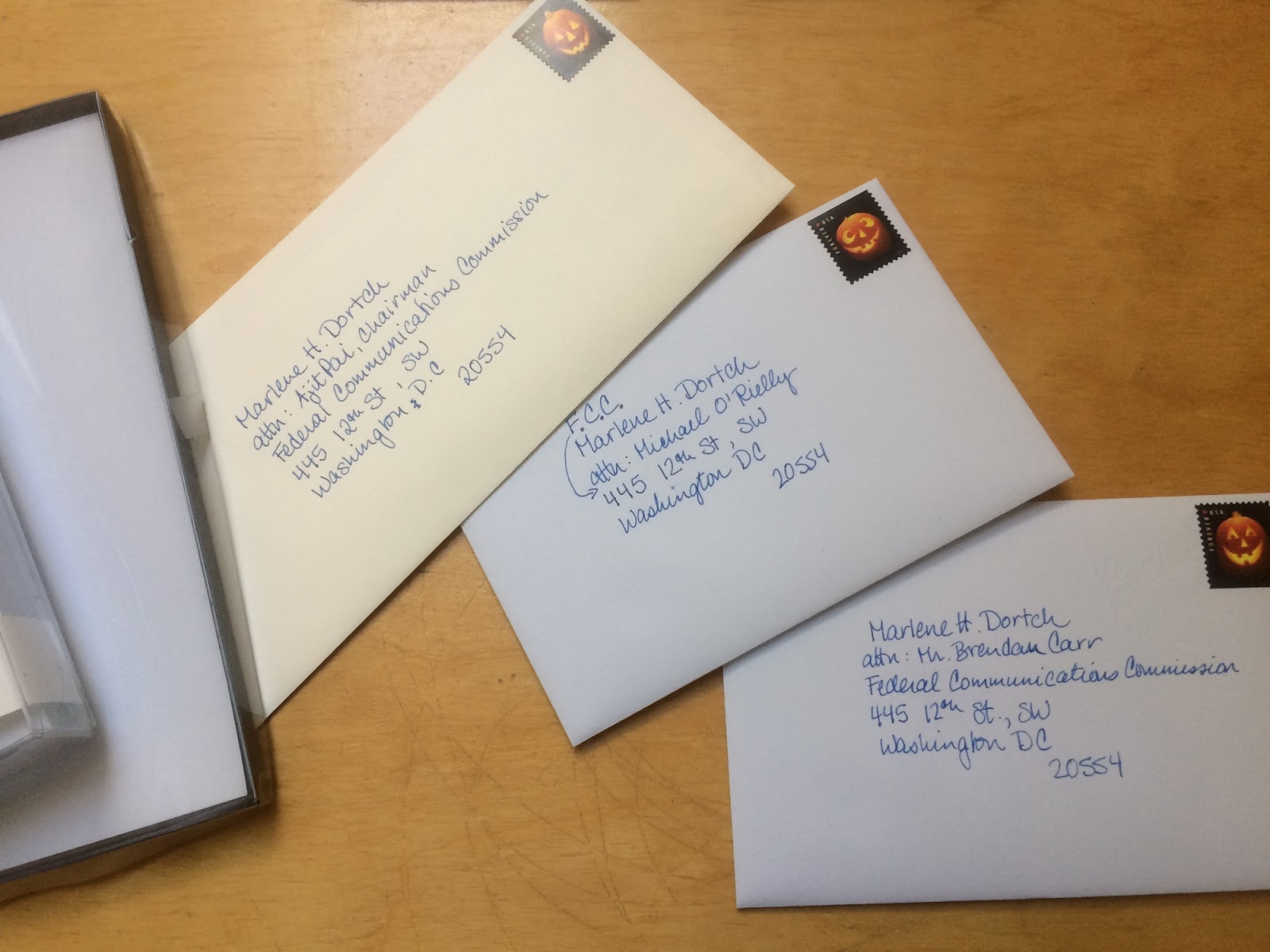
Hand addressed envelopes to commissioners of the FCC
On reflection, I should have sent a single letter to the FCC in general.
Till next post.
*I was politically apathetic in high school, but we were required to intern in a congressional office junior year. I had no idea where to start, so I took the suggestion of the program director and asked to intern in G. William Whitehurst’s office. They were lovely people, but I don’t remember ever actually trying to find out what their positions on any issues were. I’m not sure what most of the issues of the day even were, other than nuclear arms policies. I find it funny now, to think that I, who even then counted myself at least vaguely a Democrat, did my internship in a Republican’s office. I really had no idea what I was about. Fortunately, they were very patient. 

The Death of a Fraternity Pledge, Milgram on Authority, and Jump-starting a Car


There was a story in the November Atlantic about the death of a fraternity pledge after hazing . The article made me think about a lot of things (“Why do people do these things?” was one), but in particular I was reminded of Milgram’s famous experiments on authority. I’ll get to why in a moment.
In case you haven’t heard of the experiments, or need a reminder, Milgram wanted to investigate obedience to authority: how so many people could have done terrible things and claimed they were just “following orders”. So he brought people into a lab, one by one, introduced them to someone who was supposedly a fellow subject, and then had them test the other person on a list of words, administering increasing electric shocks for every wrong answer. Actually the other person, who was hidden in a booth, wasn’t getting shocks at all. It was just a recording that was answering. The recording would make a lot of mistakes, then start complaining that the shocks really hurt, insist on being released, protest that he had a heart condition, scream, then finally… silence. How far would the unknowing subject go in giving shocks, if the experimenter (in gray lab coat) were sitting nearby and insisting that the experiment must continue?
A whole lot farther than Milgram ever dreamed. Subjects might get very upset as their supposed partner started to complain, then scream, but when the experimenter (the authority) said to continue, most continued. Two-thirds continued all the way to silence.
Now on to the story of the pledge. I’ll keep it very brief. During hazing, a very intoxicated pledge opened the wrong door and fell down a flight of stairs. When he was retrieved, there was blood, apparent head injury, and other signs that he might be seriously injured. The members of the fraternity did not call 911 until twelve hours later, at which point he was unnaturally pale and cold and unresponsive—and even then they waited until they had tidied up a bit.
I’m not going to comment on the terrible things people do in order to cover their own rears. I want to make a different point. While the brothers were “attending” to him initially after his fall, another member came in, saw him, and got very worried. That member insisted they should call for help. He was quite literally pushed away by one of the others.
He was worried enough that he went to a higher authority, the vice president of the chapter, and told him what was happening. His concerns were dismissed and he was told that the other brothers knew what they were doing. And that, apparently, was that.
Now, I want to be clear. This guy is the closest thing to a hero in the entire sad episode. He recognized that the pledge was in danger and he tried to get the brothers in charge to call for help. When they wouldn’t, he went over their heads to someone with more authority. The police who reviewed the tapes (yes, most of what happened was caught on security cameras, no audio) apparently referred to him as the Good Samaritan.
But notice what he didn’t do. When appealing to two levels of authority didn’t get any action, he started to doubt that action was needed—even though he’d been sure enough after seeing the pledge that he went over his brothers’ heads. He didn’t call 911 himself.
Now granted, calling 911 would have been risky. If the pledge wasn’t actually in danger, he would no doubt have gotten his brothers in trouble for nothing (there was surely some underage drinking going on, at the very least.)
But he had been trying to convince them to take that very risk a little while earlier. Instead, he let himself be persuaded that they must know what they were doing by someone who wasn’t even on the scene. He was a good guy, but in the end, he went along with the authority.
Now back to Milgram. I don’t know what Milgram’s subjects were actually thinking, but I imagine some of them may have thought, “This guy is in charge—this is his experiment. He must have taken precautions to ensure no one gets hurt. He wouldn’t let me continue if he thought there was any danger—would he?
“Would he?”
But enough of internal injuries and dangerous electric shocks. Let’s talk about something more ordinary, something a lot of people have experience with: jump-starting a car battery.
The instructions in every manual and on every set of jumper cables tell you to attach the last clip to a metal part of the car, not to the battery. It’s a safety thing. There’s a small chance that vapor from the chemicals in the battery has been collecting above the battery and a nearby spark (such as might be caused by attaching the final clip to the battery) could ignite it. My husband always says never to attach the last clip to the battery.
But no one else I know takes that precaution. I was involved in a jump-start some years back (at least my car was) and the guy who was attaching the cables wanted to attach the last clip to the battery. I protested. He assured me he was a mechanic and had done this many times, … and I caved to his authority. I caved despite having read the instructions clearly printed on the jumper cables, despite having heard my husband tell me repeatedly that the last clip should go on a metal part of the car, and despite the fact that I had absolutely no evidence either that he was a good mechanic or a safety-conscious one.
It’s really hard to resist a (supposed) authority.
Till next post.
[Quick side note: there is less and less metal available to which you can attach the last clip. After the incident with the mechanic, I promised myself I would be firm next time. So the next time I helped someone jump-start her car, I insisted on doing it correctly and we were unable to get the car started, despite trying the clip in several locations. Later she got someone else to help. They attached it to the battery the way you aren’t supposed to do, and her car started right away.]

Learning American Sign Language–it's interesting, challenging, and (as with most languages) probably easier if you aren't shy


Last spring, my daughter and I (and one of her friends from school) started taking a class in American Sign Language. Since this blog is about the interesting (sometimes shiny) things that grab my attention, I thought I’d mention some of the features that make this an exciting language, and also say something about my experience trying to learn what is, to me, a very unfamiliar language.
First, some of the things I find interesting about ASL. One of the most obvious is the use of space and direction of sign. For example, if the signer wants to say that she gave something to her mother, she can indicate that she is going to use the area to her left as the space for “my mother”, and then direct the movement of the “to give” sign to show that the signer is giving something to her mother. By placing “my father” to her right, she can describe an encounter between her mother and her father, neither of whom is there, without repeatedly signing “my mother” and “my father”. (If her parents were there, she could simply point to them.)

As well as using space in interesting ways, facial expression is very important. (Our teacher keeps reminding us of this—apparently we have relatively inexpressive faces most of the time.) Expression seems to play much the role that tone of voice plays for English speakers, plus more. I say “plus more”, because I think there might be some signs aren’t really complete without the appropriate expression. I’m not sure though—I think the teacher said that if you sign “sad” without a sad face, it comes across as either sarcastic (which would equate to deliberately inappropriate tone of voice) or confusing (which suggests that you didn’t really communicate what you meant).
Then there’s the fact that there is no “is.” The verb “to be” is basically non-existent. And here I thought “to be” was such a basic, crucial verb! Apparently Russian doesn’t have it, either. Our ASL teacher, who is a CODA (Child Of Deaf Adults), knows quite a few languages.
One final thing that is really neat—ABC stories. Many signs incorporate the same hand shapes used for fingerspelling. For example, “family” uses an “f” shape on both hands, and the hands make a circle. (Isn’t that a nice sign?) In ABC stories, the signer tells a story using signs that incorporate the hand shapes from A to Z, in order. We saw a Halloween ABC story on a video in which the thumb of the “A” was Dr. Frankenstein’s surgical slicing open of his creature’s skull (to put in the brain) and the final “Z” was the terrified doctor’s mad zig-zag as he fled the scene of his creation.
I said earlier that ASL is, for me, a very unfamiliar language. The only languages I know are spoken, and I’m not used to watching movements for that level of meaning. (I’m used to gestures for simple stuff, like “Over there” or “Come here” or maybe a sarcastic playing of tiny violins.) Sometimes it feels like my brain is burning from the attempt to focus and recognize the words as they are signed—and our teacher is signing at what is surely a v-e-r-y s-l-o-w pace.
As I get more familiar with the signs, I expect I will be able to recognize them faster and the sensation of my brain burning will fade. Also, maybe I’ll be able to catch more than the first and last letter of finger-spelled words (and the “h”s—for some reason, they grab my attention.)
I neglected to mention earlier that the grammar of ASL is completely different from English. That’s another challenge—figuring out the order in which I should sign so as to get across my intended meaning. John gave Jane an apple. Is it BEFORE-APPLE-JOHN-GIVE-JANE (with appropriate direction of ‘give’)?  Still not sure.
Our teacher keeps nudging us to go to DeafChat meetings and practice our conversational skills with ASL speakers, but she seems to have gotten an entire classroom full of introverts and shy people. (We have a class of about five, now.) She tells us entertaining stories about traveling to other countries and practicing her conversational skills, laughing at her mistakes and urging us to do likewise. She’s right, of course, but I have a hard enough time talking to strangers in English, never mind when I can barely get beyond my name, the weather, and my favorite food (chocolate). It’s been a problem with every language I’ve learned (some French, some Spanish). Eventually, I hope, my vocabulary and nerve will both be sufficient to give it a try.
Anyway, American Sign Language is pretty neat and I commend it to your attention. Try it–whether because you think it is cool, or because you want to learn about Deaf culture or work with Deaf people, or because you want to be able to talk to your friends during noisy concerts. Just don’t use it to give answers across the room during exams—no matter what my ASL teacher says.
She’s just being mischievous.

A hand finger-spelling the letter H.
For some reason, “H” stands out.

 Till next post.