Crumpets and Tea–trying out a treat I've only read about

Buttered crumpets and tea. Crumpets always sounded appealing when they showed up in a novel, but for a long time I had no idea what a crumpet even looked like. I assumed it was a baked good (not exactly), and apparently good with butter (true), and I also vaguely assumed it was sweet.

Not so, apparently. When Cook’s Illustrated offered a crumpet recipe in their March/April 2020 issue, I decided I would have to try it. A few weeks ago, I did.

As I mixed the batter, I realized there was no sugar in the recipe. Well, there’s no sugar in a lot of French bread recipes either, but French bread works beautifully with butter and jam, as well as with savory toppings. So I just figured I would have to put jam on them.

Watching the crumpets cook was interesting. They got bubbles all over, which was almost disturbing, and the recipe advised touching the surface with a spatula to turn the bubbles into little holes, then flip the crumpet to cook the other side. The result, then, is something like a pancake absolutely full of little holes.

Crumpets have holes on top and a smooth side below
 

These many little holes are good at trapping the butter that melts on a hot crumpet, and that helps me understand one of the descriptions of buttered crumpets found in House of Many Ways, an excellent book by Diana Wynne Jones.

To set the scene–Charmain is at the palace, where she is unexpectedly invited to tea with the king and some newly arrived visitors.

     Charmain thanked the gentleman again and took two. They were the most buttery crumpets she had ever encountered. Waif’s nose swiveled to dab gently against Charmain’s hand. “All right, all right,” Charmain muttered, trying to break off a piece without dripping butter on the sofa. Butter ran down her fingers and threatened to trickle up her sleeves. She was trying to get rid of it on her handkerchief, when the lady-in-waiting finished saying all anyone could possibly say about the weather, and turned to Mrs. Pendragon. (p. 178)

 Charmain isn’t the only one having a problem. The lady-in-waiting asks about Mrs. Pendragon’s little boy.

    “Yes, Morgan,” Mrs. Pendragon said. She seemed to be having trouble with butter too and was mopping her fingers with her handkerchief and looking flustered.
    “How old will Morgan be now, Sophie?” Princess Hilda asked. “When I saw him he was just a baby.”
    “Oh, nearly two,” Mrs. Pendragon replied, catching a big golden drip of butter before it fell on her skirt. “I left him with–“

And now we’ll leave Charmain and Mrs. Pendragon to struggle with their hot buttered crumpets and other, as yet unmentioned, problems.

Back to my homemade crumpets. We toasted the crumpets (one was slightly underdone, one slightly overdone, one seemed about right) and buttered them.
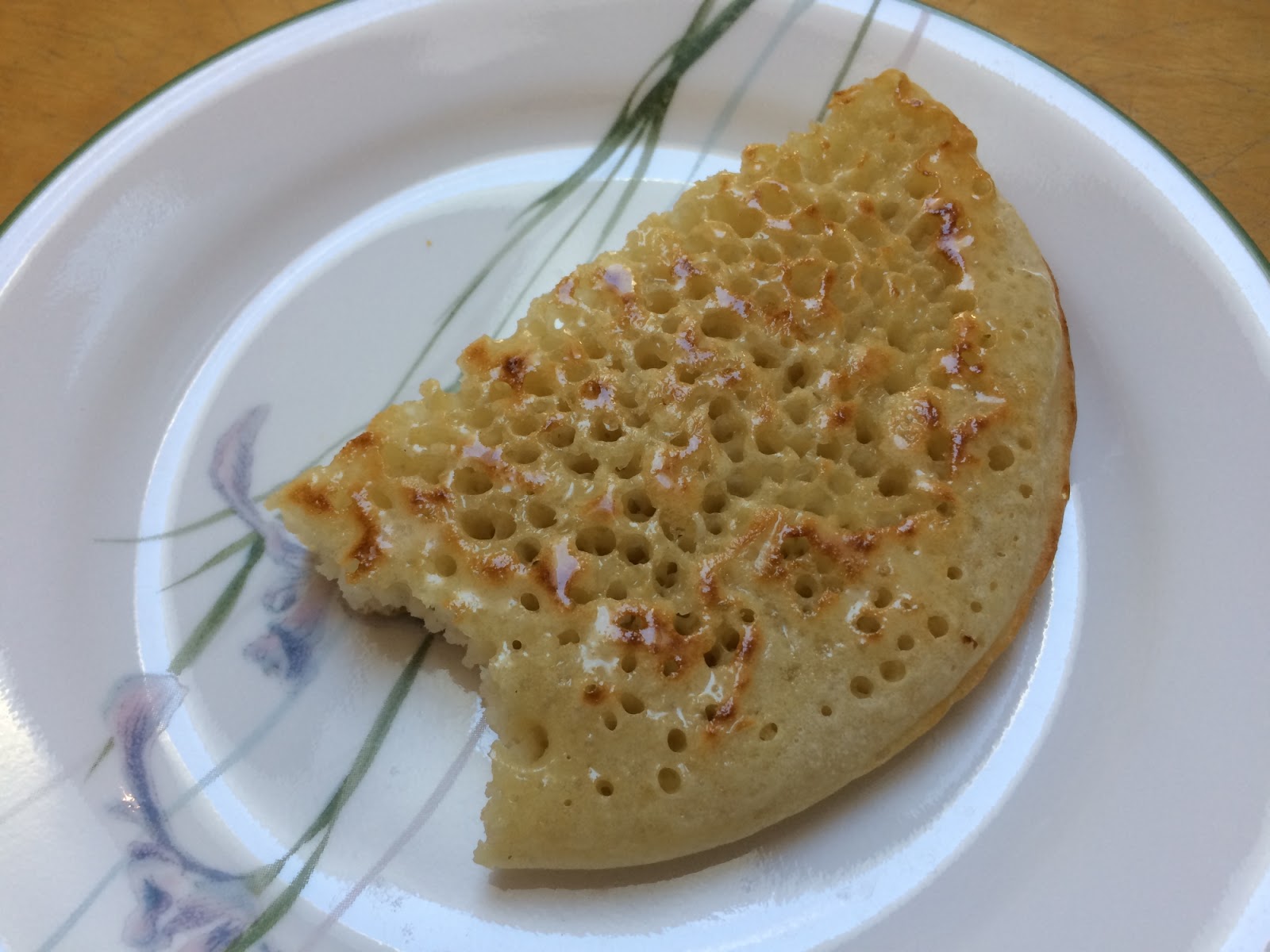
Buttered homemade crumpet (with a bite missing)

So what did these particular buttered crumpets taste like? Slightly salty. And buttery. It made me think about the appeal of plain bagels grilled in salted butter. Not sweet, but wonderfully buttery and chewy and slightly salty. The texture was different, of course, but the comparison helped me understand why they would be appealing.

I should add that I don’t like my sweets to be particularly salty. When I have bread and butter and jam, I always use unsalted butter. Salted butter puts me off jam almost completely. So perhaps for other people, crumpets and jam is a better combination than it is for me.

All in all, I’m not sure I’ll bother to make them again. It was fun, but there are so many other exciting things to make that I like better. I’m glad I tried it, though.

Till next post.

Athelas, Lembas, and Butterbeer–impossible delights in fiction

For February’s project, I’m working on a second draft of the cozy mystery I wrote in November for NaNoWriMo, currently titled Warnings at the Waterfront. In this story, I describe an award-winning lemon éclair as being
“a pastry oblong about five inches long, glazed with a streak of chocolate and dotted with yellow icing flowers… She took a bite and gooey lemony custard squeezed out the sides. It was sharp, sweet, and creamy all at once…”
Yum!
But could a lemon éclair be that good? It’s one thing to describe an item so that it sounds appealing to our sense of taste, smell, or sight. It’s quite another for such an item to exist, or even be possible. Lemon and chocolate is a tricky combination, and I’ve been experimenting with combinations of lemon curd and vanilla custard in an attempt to come up with an actual lemon éclair. So far, it falls significantly short of its fictional version.
Homemade lemon eclair with chocolate glaze
An attempt at a lemon eclair
There are plenty of wonderful things in books; things that I would like to exist, but which don’t. When I first read The Lord of the Rings, I was much impressed with athelas, aka kingsfoil, and its fragrance when crushed in the king’s hands and cast into water. Its fragrance is described as follows:
“and then he crushed them, and straightaway a living freshness filled the room, as if the air itself awoke and tingled, sparkling with joy. And then he cast the leaves into the bowls of steaming water that were brought to him, and at once all hearts were lightened. For the fragrance that came to each was like a memory of dewy mornings of unshadowed sun in some land of which the fair world in Spring is itself but a fleeting memory.”  (The Return of the King, p.173)
Wouldn’t it be wonderful to have an herb so deliciously fragrant that it could banish the Black Breath? Or, in our world, depression?
What would such an herb smell like? In my mind, athelas was a sort of combination of parsley (crisp and fresh) and peppermint (cool and sharp), without being either. I guess peppermint comes closest, at least for me, but I’d still like an athelas plant of my own.
There were plenty of other non-existent entities to long for in The Lord of the Rings. Lembas, the elves’ waybread, are described as  “very thin cakes, made of a meal that was baked a light brown on the outside, and inside was the colour of cream.” Not only do lembas taste better than the best of honeycakes, but
“the cakes will keep sweet for many, many days, if they are unbroken and left in their leaf-wrappings, as we have brought them. One will keep a traveller on his feet for a day of long labour, even if he be one of the tall Men of Minas Tirith.” (The Fellowship of the Ring, pp. 478-479)
 Maybe someone could come up with something that resembles lembas in flavor and texture, but they are unlikely to duplicate its nourishing qualities and long shelf-life.
A more modern example of a fictional delight is butterbeer. A mug of hot butterbeer on a cold day sounds like a great treat, but how would it actually taste? The name itself calls up the taste of butterscotch and root beer. I haven’t had the butterbeer that was created for Harry Potter fans, but I gather that butterscotch is one of the flavors involved. I suspect that if their version had turned out to be as good as the fictional version, it would be more widely available by now. And while I like butterscotch, it seems like a very strong, very sweet flavor for something you’re going to drink an entire mugful of. (Then again, perhaps I would have said the same of root beer, if I’d only ever had it in the form of candy.)
But back to my fictional lemon éclair. It just may not be a genuine possibility. One solution is to change the pastry in the book to something that could be genuinely wonderful (and so be able to include a recipe for it, should the book ever get that far.) That’s probably the best solution.
But that isn’t always the solution. Some books, especially fantasy, are better with a few impossibly wonderful things in them. We just have to accept that description outpaces possibility. Not every longing we have can be satisfied.
At least I’ve got peppermint.
Till next post.
P.S. Page numbers are from the 1965 paperback edition of The Lord of the Rings.

Virtual Versions of Real-world Activities–tidier, simpler, safer…but no substitute

Is there any danger that parents will let virtual versions of activities edge out the originals, perhaps in the interests of ease and tidiness? I hope not. The things kids learn from doing things in the real world cannot be replaced by virtual activities.

Let me start with some examples of virtual versions of real-world activities.
First,  consider “Cooking Mama”, a video game in which one follows procedures to “cook” various dishes. My daughter enjoyed this game when she was younger, and incidentally learned a few things about what ingredients go into what. That’s fine. But I would hate for anyone to regard this as cooking practice. Chopping pretend carrots is very different from chopping real ones. Safer, of course, but chopping real carrots gives a child practice in dealing with the physical world–in handling a knife, he judges how to position food for safe chopping, how much pressure to use, and how to keep his fingers out of the way. Similarly, while a child can’t get burned sauteeing virtual onions, neither will he learn how to judge doneness by sight and smell, nor discover that it matters how much oil is in the pan and how high the heat is.
Second,  consider computer art programs, which have gotten very good at imitating the appearance of paint, charcoal, and other media.  Digital art is a medium in its own right, with its own unique possibilities, and worth doing for itself. But it uses skills different from those required when applying actual pigment to a surface. Using a paint-tip in an art program does not require a child to judge whether there is enough—or far too much—paint on the brush. You cannot break a stick of virtual charcoal by pressing too hard. And while art programs include techniques not available with physical media such as paint, they also restrict the child in other ways.  She cannot mess around,  applying paint with toothpicks, sponges, or other objects at hand, discovering new effects in the process. Of course, she also can’t get paint all over her clothes, the table, and the bathroom sink.
My third example is pets, which is what prompted this post. When my daughter was young, Webkinz were popular, and Tamagotchi, and there seemed to be many games that let you “keep” a virtual pet. We also had real pets, and I kept noticing the differences between a virtual pet and a real one. Real pets are messy—sometimes very messy!—and the consequences of neglecting them more serious. Real pets are also much less predictable, and this is both good and bad. Good when they do clever, funny things that we never expected, like meowing when someone sneezes. Bad when they decide to go outside the litter box, or lick the frosting off the gingerbread house. Our real pets had personalities and quirks that slowly revealed themselves—one cat bold and forever searching the floor for crumbs, the other timid and prone to chewing on things, whether pencils, fingers, or plastic bags. Virtual pets are tidier, cheaper, and don’t scratch, but they aren’t nearly as interesting.
Having considered some of the ways in which virtual activities differ from their originals, why do I think it matters?
I think it matters because we all need practice in basic skills in dealing with the physical world. We never know when we will need them. As adults, we sometimes need to pour a glass of juice without spilling. We sometimes need to stick things together (tape isn’t always the answer!). Knives are useful for all sorts of things. We may need to help a friend paint a room without dripping paint off our brush.
It also matters because any simulation is a simplification of the real world, and we need to learn to deal with complexity. Even if we follow a cake recipe strictly, we need to be prepared to deal with real world factors that don’t show up in the recipe. Some ovens run hot. Different cake pans may lead to more or less browning. The baking powder might be old.
In the case of pets, there is additional difference between virtual and real. Real pet care has consequences for a creature other than oneself.  In Sherry Turkle’s book Reclaiming Conversation, she touches briefly on robot companions and pets, as well as A.I. therapists—on virtual relationships, you might say. Her concern seems mainly that conversation with computers may take the place of conversation with actual people, resulting in less practice in conversation skills (and so less conversation between people). Pets don’t talk, so conversation skills isn’t what I’m concerned about. But there is a relationship between a real pet and a person. Pets have their own needs, their own preferences, and part of taking care of them is respecting that. They are also vulnerable—we put them in situations where they cannot take care of themselves. The guinea pigs can’t get their own water and greens. The dogs can’t go hunting. Taking care of a pet is exercising responsibility and practicing some kinds of relationship skills.**
I started this by asking whether there is any danger of virtual versions of activities taking the place of their real-world originals. People are spending a lot more time with computers, but that doesn’t necessarily mean the real-world activities are being replaced. There also seems to be a trend toward making activities simpler, easier, and with less clean-up—packaging art activities with pre-cut bits and easy instructions,  offering meals that are half-way prepared to save time and effort—but even simplified, those are still real-world activities. I don’t know. I guess time will tell.
Till next post.
**I’m not suggesting every kid needs a pet, any more than every kid needs to practice painting or cooking. Besides that, the idea of giving a kid a pet to teach them responsibility leaves out the fact that parents need to step in as well, lest the pet suffer. Nor is this the reason people have pets—pets are fun! Pets are (sometimes) cuddly!