
Recently I’ve been inspired to make bread.
Usually the only bread I make is sandwich bread. We have a Zojirushi bread machine, and I love it. Bread is easy to make, tasty–the only disadvantage compared to store bread is having to slice it. Like Jacob Two-Two, I seem unable to cut a slice of bread that isn’t “a foot thick on one end and thin as a sheet of paper on the other.”
I think what happened is that I watched one too many episodes of The Great British Baking Show. This led to a couple of failed attempts at ciabatta. I blame this partly on the jar of yeast, partly on our oven’s inaccurate temperature readings and… well, the rest is mine. But making the ciabatta reminded me of the class my husband and I took, years ago, in bread-making.
We had actually signed up because I was interested in using different kinds of flour in my bread-machine sandwich breads, but the class turned out to be focused instead on mixing, raising, shaping, and baking types of French bread (and also some sourdough.) It was a good class, and when I saw that one of our instructors had written a book with all her bread-making knowledge (she was studying bread in graduate school), I naturally bought the book. Bread Science, by Emily Buehler.
 |
| The book. |
Here I must admit that I have only read parts of it so far. She goes into extensive detail about how bread works. I was interested to learn that the bubbles of gas in the dough are created by mixing–yeast can only enlarge the bubbles, not create new ones. I picked the book up again this week and re-read the sections about mixing, raising, shaping, etc. Then I tried to make the basic bread recipe, which uses a poolish.
A poolish, as we learned in that long-ago class, is a kind of preferment. As in “pre-ferment”. As in, something you make before you actually mix the dough and start the first rise. You take some of the flour, some of the water, and a pinch of the yeast and let the mixture rise overnight, basically. Then you mix that in with the rest of the flour, water, yeast, and salt. The point is to increase the flavor.
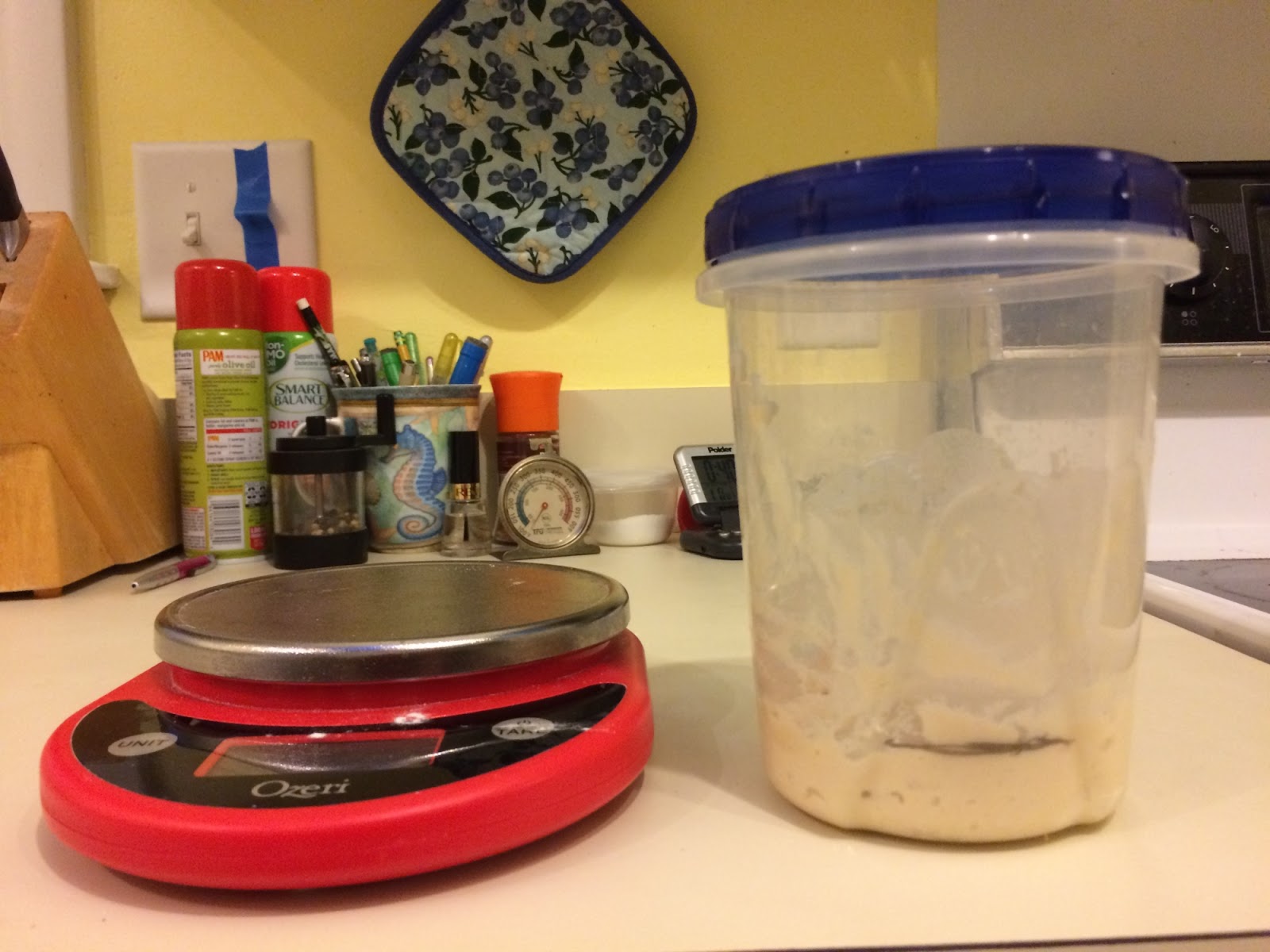 |
| The poolish, before it increased in volume. |
See the scale in the photo? I love my scale for all sorts of baking. Also, it can read in either grams or ounces. Very handy if you are trying to follow a British recipe, or a very precise American recipe.
I remember that the dough we mixed in class was on the sticky side, but my first run-through turned out incredibly wet dough. I reread the recipe and saw that she had warned that less water is needed in humid weather. Hmm, summer in the South… but then, air conditioning… but still at least 50% humidity… For the second batch, I reduced the amount of water and got a dough that was sticky but manageable.
 |
| The dough, before the first rise (I think). |
Then two rises, a “pre-shape”, and finally, time to make baguettes. Or in this case, given that I was making a half-batch and had only a regular size cookie sheet, two mini-baguettes.
 |
| The mini-baguettes before proofing. |
I did not bake them on my pizza stone, nor did I do anything much toward creating steam in the oven. I was still pretty pleased with the way they tasted and their shape. Maybe next time I’ll work on creating a better crust.
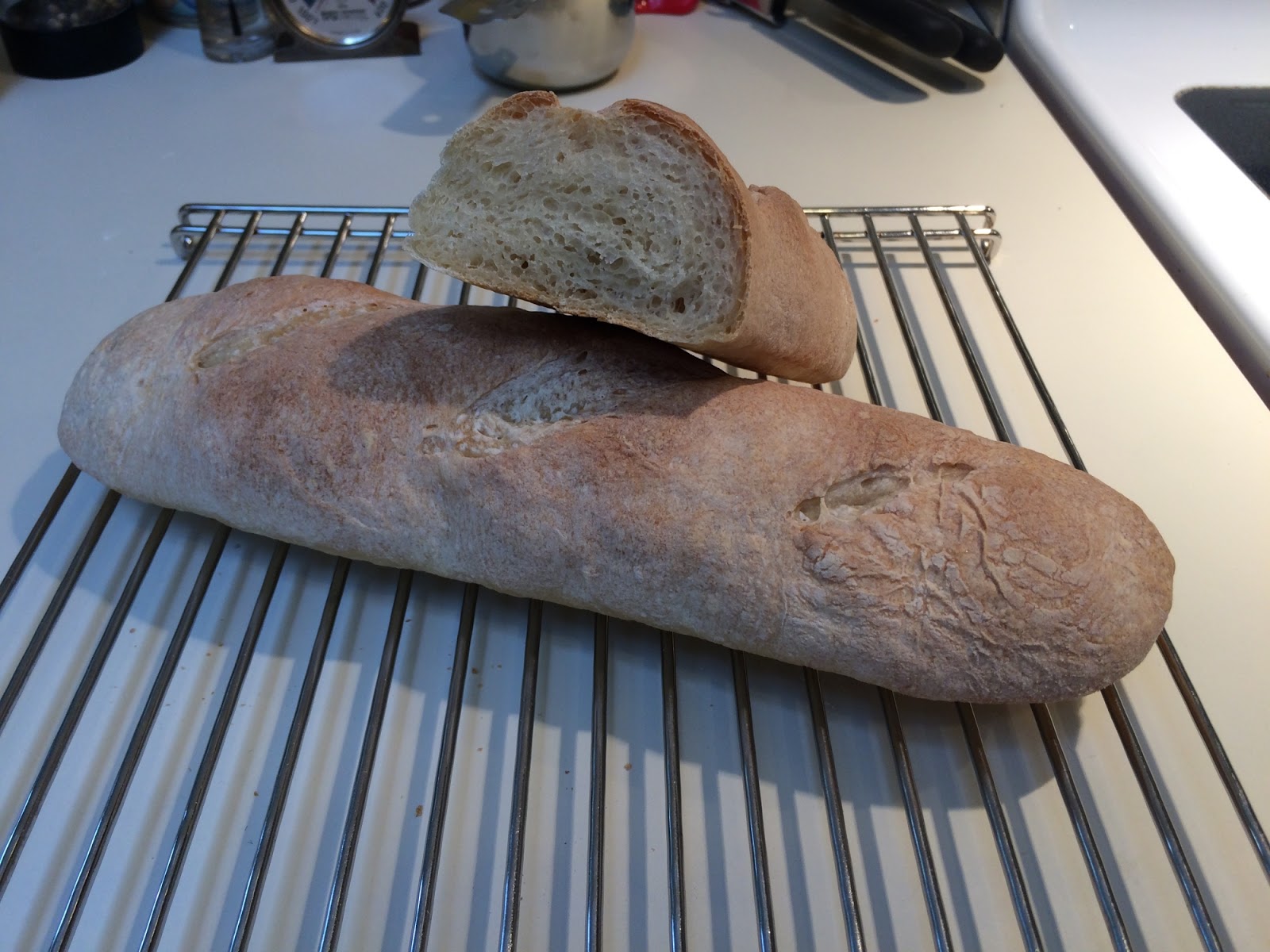 |
| The finished bread. |
So that’s the “how” of my recent bread-making. The other question is “Why?” Why go to all this trouble when I am fortunate enough to live very near a co-op that has an excellent bakery? (Note: this is where we took the bread class in the first place.)
As I said earlier, I don’t normally make bread apart from easy sandwich bread in the bread machine. I have good reason to make that–supermarket sandwich bread doesn’t taste nearly as good, and while I can get good sandwich bread at the co-op, I have more options if I make it at home. That’s a bit like sewing my own grocery bag or mini-backpack, where I am customizing it according to my own needs and preferences. But when I make French bread, I’m not trying to create something different and personalized–I’m trying to make it as French-bread-like as I can.
So why make French bread?
The answer has to be–to see if I can. Or, because it’s an interesting challenge. Apparently it falls into that category of things which I do just because it is fun to exercise one’s skills. (Crossword puzzles, for instance, or rudimentary juggling.) I suppose if I then got creative with the shaping (braids, crowns, bread alligators) then it would turn into an expression of creativity as well.
So what is the point of this whole post, besides a chance to show off photos of my lovely mini-baguettes? Just that it is a lot of fun to take on a challenge, to exercise skills (must try the ciabatta again), even when it isn’t also an expression of individual creativity.
So go forth and exercise some skills. And eat French bread.
Till next post.
 Ravens and Pears