Cats Like to Play, and So Do People

Everyone knows that kittens like to play at stalking and pouncing. They’ll play with shoelaces, with toes, and even with their own tails. Children too, like to play, and we know that they are practicing grown-up skills in the process. 
But it isn’t just young cats that like to play—grown cats do too, exercising their cat skills on fabric mice and wand toys when real prey isn’t around. Books on cats stress that this is good for adult cats, that having regular opportunities to practice their cat skills makes for a happier cat. This makes me think about people, and how grown-ups enjoy playing and practicing their human skills.
One of my cats started me on this train of thought because she would meow at me for no apparent reason. She wanted something, but it wasn’t food. It wasn’t “out.” Petting? A lap to sit on? I couldn’t tell, and she can’t speak human. She liked to play on occasion, and once in a while she would even chase her tail, like a kitten. Da Bird used to be both cats’ favorite—a feathery toy that could be whizzed through the air or dragged on the ground—but too often it seemed like they lost interest quickly. So I didn’t get it out much.
As I worked on a sewing project, she started playing with bits of the fabric.This reminded me that some years ago I had tied leftover strips of fabric together to make a rope that could be dragged around. Our cats sometimes enjoyed chasing and catching it. So I got it out of their toy basket (yes, they have a little basket of cat toys) and played with her for a while. Then I hung it over the back of a chair and left it there.
That chair happens to be right near where she tends to sit and meow. So I started flicking the fabric strip in the air the next time she was meowing in her undecided way.
Turns out she has much more capacity for playing than I realized, with the right toy and the right timing. She grabbed the strip out of the air, she chased it around the house, and she had a great time chewing on the knots in it. Weeks later, she’s still enthusiastic about it.
It could be that she will get bored with the strip of cloth, but I did read that cats prefer toys that give them a feeling that they are making progress, not just in catching the toy, but in tearing it apart. The cloth strips are easy to catch with her claws and the fabric does shred a bit with every capture. Actually, they were unravelling so much that I sewed some new strips with bound edges, so I don’t have to worry so much about her swallowing threads. 
When I play with her and see how much she enjoys exercising her “kitty skills” of stalking and pouncing, I think about all the opportunities to play with her that I’ve missed. I also think about people—grown-up people. Are our lives better if we get regular opportunities to exercise our “human skills?” Do we get enough of the right sort of play?
It’s interesting to make a list of  human specialties and consider the games we play. We are tool-makers and –users, also language-users and social beings, and we used to be hunters and gatherers for our living. As kids, we play tag and other chasing games, hide-and-seek (searching), and various kinds of pretend. We build sand castles and mudpies, and we have singing games and tell stories and jokes.
We have virtual versions of all of these as well, but maybe we need some of the non-virtual, physical games, too, to engage our whole selves, body and mind.
Something to think about.
Till next post.
That Smells Good!–the changing appeal of scents, in and out of context

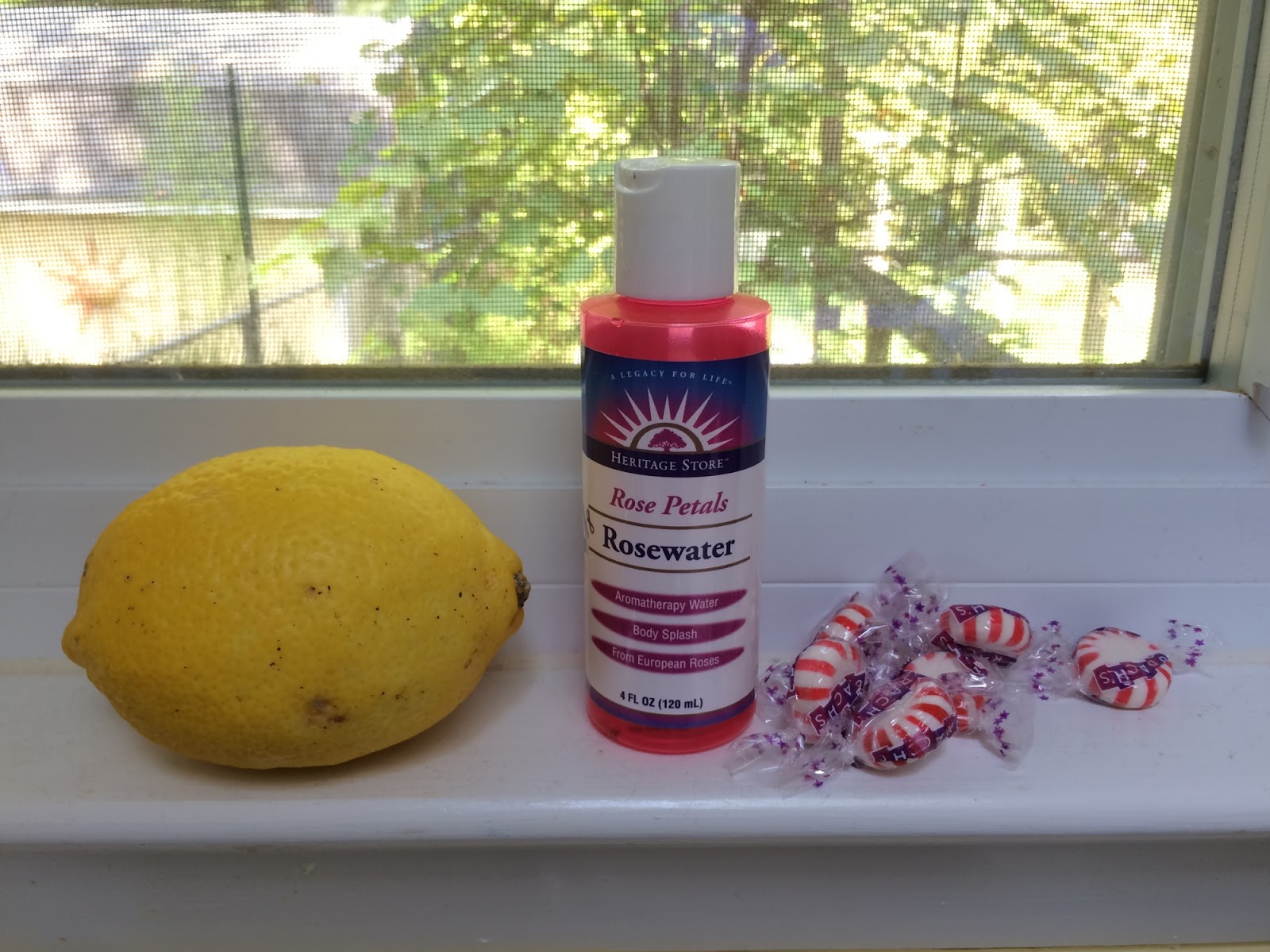
Windowsill display of lemon, rosewater, and peppermint candies

Peppermint, cinnamon, lemon–what do these scents have in common? Not much, considered strictly in terms of how they smell. One is minty, one is spicy, and the last one is citrusy. But they are all flavors as well, and I like them both as flavors and as fragrances.

That last connection isn’t automatic. Not every delicious food aroma is also good as a fragrance in its own right. For instance, the smell of chocolate–of brownies baking–is heavenly when I anticipate that I may get to eat some of them. Chocolate-scented stationery, however, does nothing for me. I’d rather perfume it with bergamot.

Oddly, I feel this distinction even more strongly when it comes to vanilla. I like the smell of vanilla in cookie dough or pudding, but I really dislike vanilla-scented candles, air fresheners, and heavily vanilla-based perfumes. Given how many of these vanilla-scented items are out there, I am clearly in the minority on this.

Most people (including me) would be reluctant to perfume their clothes or hair with the odor of sauteed onions and garlic. Onion-scented air-freshener? Ick. And yet, when I walk into the house and discover that the kitchen is fragrant with sauteed onions and garlic, my mouth waters and I say, “Wow, that smells good!” And it does. But only in the right context.

There are other fragrances that are pleasant so long as they aren’t in a food context. For some people, rose is one of these, while other people like rosewater-flavored desserts. I’m guessing that no one really wants their food to smell of lilacs or hyacinths, though, or Chanel No. 5. Bleah.

Is there any context that affects the appeal of a scent besides food? People do develop a familiarity with some scents in a cleaning context (lemon, peppermint), but nonetheless cleaning products do manage to be popular in a variety of other fragrances (floral, grapefruit, lavender, “sea salt”,…) Maybe personal fragrance–do we really want our bodies to smell like peppermint candy? Peppermint soaps and lotions certainly exist, but I’m having trouble imagining a perfume called “Fresh Mint Seduction” or “Lemon Heat”.

Can you think of any other contexts?

Till next post.

Christmas Carols and Klezmer–people can always surprise you

Just this morning I was looking at a schedule of events for my area and I was surprised to see a klezmer band listed. I noted down the date and time, and remembered a conversation with my father several years ago, a few years before he died.

He wasn’t doing well, either physically or mentally, and I was thinking about making him a music mix CD. I reasoned that he might not be able to play with his computer or get around much, but he could still listen to music. But what music would he enjoy?

I thought about all the music I could remember him enjoying during my childhood. Show tunes, maybe, or folk songs. Maybe Gilbert and Sullivan? The Firehouse Five?

So I asked him, “What kind of music do you like?”

I don’t remember the first kind he listed, but the second was klezmer.

Klezmer? Not only did I not know he liked it, I didn’t even know what it was.

“It’s Jewish jazz,” he said.

Eventually I made him a CD with selections of Christmas carols that he had always liked, and two klezmer pieces that I chose somewhat arbitrarily off iTunes. I played the CD for him once, and I don’t know whether he ever listened to it again. He probably forgot that it existed. But it made me feel as though I’d done something for him.

It also reminded me that people are full of surprises. Always.

Rest in peace.

In case you are curious, here are the carols (not necessarily the same version) available on Youtube, and links to the klezmer pieces.

“Still, still, still”

“Suber die glocken nie klingen”

“Il est ne, le divin enfant” 

“Approchez mes enfants”

“Entre le boef et l’ane gris”

“Un flambeau, Jeanette, Isabella”

“Doina” (The Klezmorim)

“The People’s Dance” (The Klezmorim) 30-second sample