"They Spoke French"–how stories get lost between generations


The stories you think you’ve passed on to your children are not necessarily stories they know.
Earlier this year, I was talking with my daughter about who-knows-what, something to do with languages, and I said that since my grandmere and grandpere always spoke to each other in French, and usually spoke in French to my father as well, I had grown up thinking it perfectly ordinary that grown-ups sometimes spoke to each other in a language the kids didn’t understand.
“What!” She nearly fell off the sofa. “They spoke French? I didn’t know that!” She had assumed that they spoke Italian, which would be a reasonable thing to assume if I hadn’t told her otherwise. My grandparents had come over from Italy, after all. Just… a French-speaking part of Italy. At least for Grandmere.
“I’m sure I told you!” And I probably had. Once. When she was very young. And apparently never again.
So she hadn’t known, and hadn’t had the slightest idea that her own Granny and Grampy could also speak French (though they didn’t normally speak it to each other, and probably hadn’t spoken it for years.)  Had she known, she said, she might—might—have considered taking French in school instead of Latin.
Suddenly things were clearer. I had wondered a little about her choosing Latin. I had offered good reasons why French or Spanish might be more fun (including that fact that I knew some of both and we would be able to talk together), and in the back of my mind I had wondered that the family connection didn’t seem to enter into her decision. But I’d never actually said, “Why don’t you take French? Your great-grandparents spoke French and your grandparents would probably be delighted.” No, I just assumed she’d considered that fact and decided that Latin would be more fun, especially since she already knew the Latin teacher and liked her.
And she did get a series of very fun Latin teachers. Later she went on the Latin Club trip to Italy, so the family connection did come in, sort of.
But how had I failed to pass on such an important bit of information? What else had I failed to tell her?
“You know Grandpere was a baker?” Yes, she did know that. Good.
“And Grandmere worked as a maid?” Yes, and now that my daughter knew Grandmere had spoken French, the story that Grandmere had passed herself off as a French maid, not Italian, made more sense. (Apparently French maids were desirable back then—Italian maids, not so much. Prejudice has a long history, though the groups involved change.)
But she had a question for me. “What did my other great-grandpa do?”
Uh.
Photography, though I don’t know whether he made any money at it. Some acting, apparently. And my mom always says that there was a brief spell when he sold used cars. And…uh…
I need to go back to my mom and ask more questions, I think. I wonder what stories she told me that I have now forgotten?
At any rate, this discovery led to a discussion of the family tree, a search for the two books I have relevant to that side of the family (though one is mostly a photo book), and the conclusion that we really ought to get a genealogy program and sort this all out. And, as my daughter said, we should write down all the stories I can remember, and all that Granny can tell us, so that my daughter can pass them on to her own children some day.
Maybe they’ll decide to take French in school.
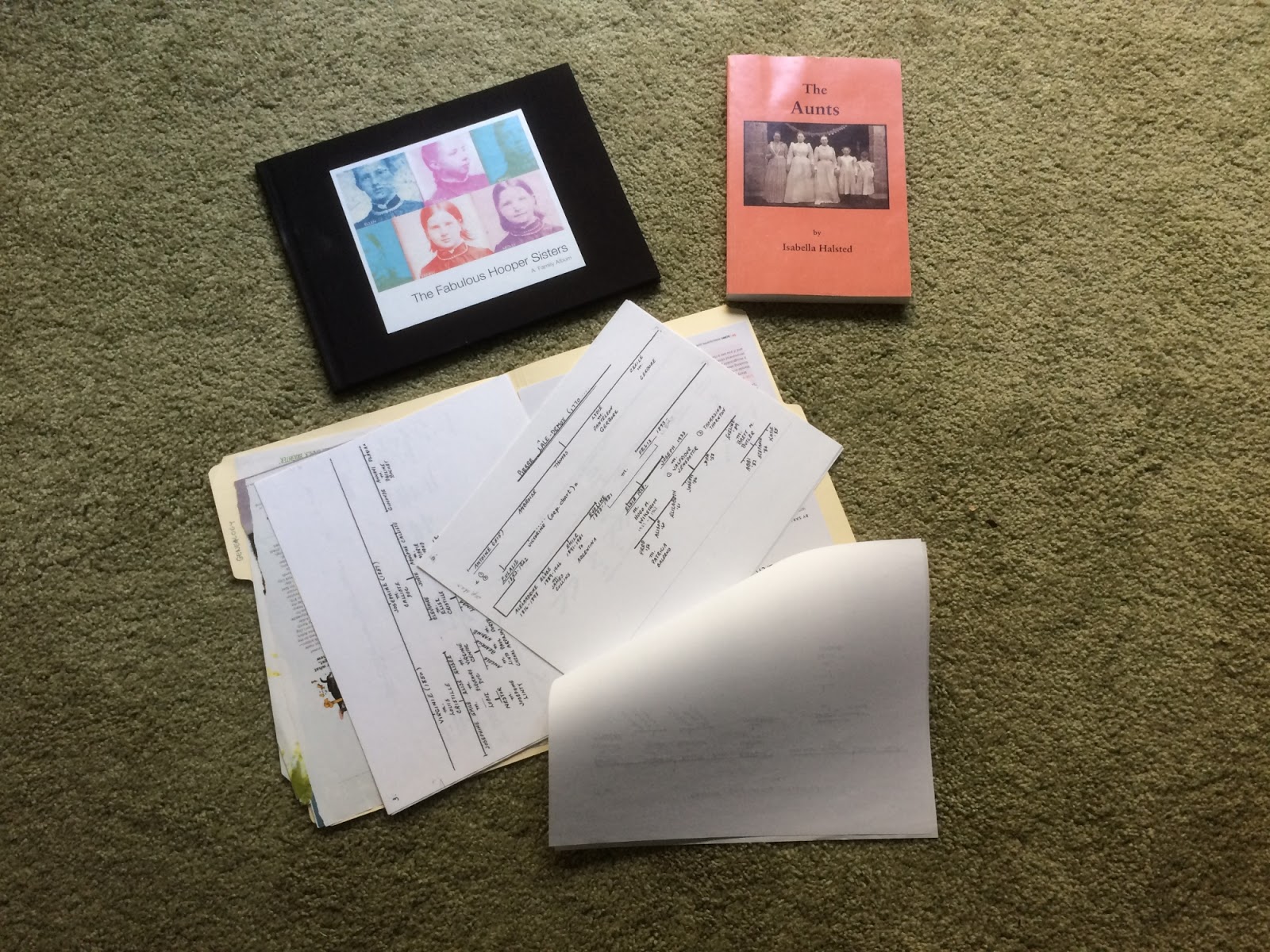
The Aunts by Isabella Halstead, The Fabulous Hooper Sisters, and assorted genealogy papers
Till next post.

The Dangers of “Updating” Your Décor


In the newspaper awhile ago, I saw an article titled: “Seven Ways to Update Your Décor”. And I said to myself, “Why on earth would I want to ‘update’ my décor?”
It makes sense to update things like computers and cell phones and smoke detectors—newer models are likely to have improved functioning. The same can’t generally be said for the latest thing in flooring or countertops or furniture. Mushroom-colored walls work about as well as walls that are off-white or hyacinth blue. So why “update” your interior?
The implied contrast is a “dated” look. Think of a room with wood paneling, a burnt-orange shag carpet, macrame plant hangers, … do I need to say more? Dated. But why is it “dated”?  Because at one time—I think it was in the seventies?–everyone had wood paneling and orange shag. This also explains why “dated” is a negative word. Like a song that gets played too many times on the radio (ooh—a dated simile, too!), the sheer overexposure burned people out on it.
Therein lies the problem. If you “update” your old flooring and counters to something that is currently popular, then in ten years (or less), your current choices will look “dated.” They will be “so terribly 2017”. So you’ll feel a need to “update” yet again.
Your décor should please you, the person who has to live with it. Admittedly, as a person living at a certain point in history, what pleases you is likely to have some similarity to what pleases other people at that point in history. Maybe your group is all madly into Dr. Who, or Game of Thrones, or a certain rustic look, or whatever.  Okay, take advantage of the availability of blue time-box prints and heraldic signs if you want. Understand that some of your tastes will change over time, and so will some of the things you surround yourself with. Maybe you really like light gray paint, or ice blue. If so, this may be a good year to get out the brushes.
But don’t change your décor simply because it’s fallen out of fashion. If you’re planning to sell your house in the very near future, that’s another story. Then you aren’t doing it for yourself at all. But otherwise, why step onto the “update” treadmill in the first place?

From the Annual Easter Egg Hunt to My Favorite Children's Books–five books I remember fondly


Very shortly, as soon as we get our trinket-prizes collected, the Third Annual C&C Easter Egg Hunt will begin. This egg hunt is not a casual look for hard-boiled eggs in the grass, but a serious week- (or more) length search for plastic eggs cleverly hidden around the house. Each of us will hide ten of these–blue, purple, or green–and then hunt for the others whenever we have a bit of spare time.
I love this event. I love the clever hiding places (my husband is the master of hiding eggs in plain sight, and my daughter tucked some away that could have stayed hidden for months if we hadn’t begged to know where they were) and I love to seek. Systematically.
The Great Easter Egg Hunt is also when I do some of my most thorough cleaning. After all, if I pull everything off a pantry shelf and wipe it down and then replace everything with careful attention, I ought to be quite confident that there are no eggs hiding on that shelf, right?
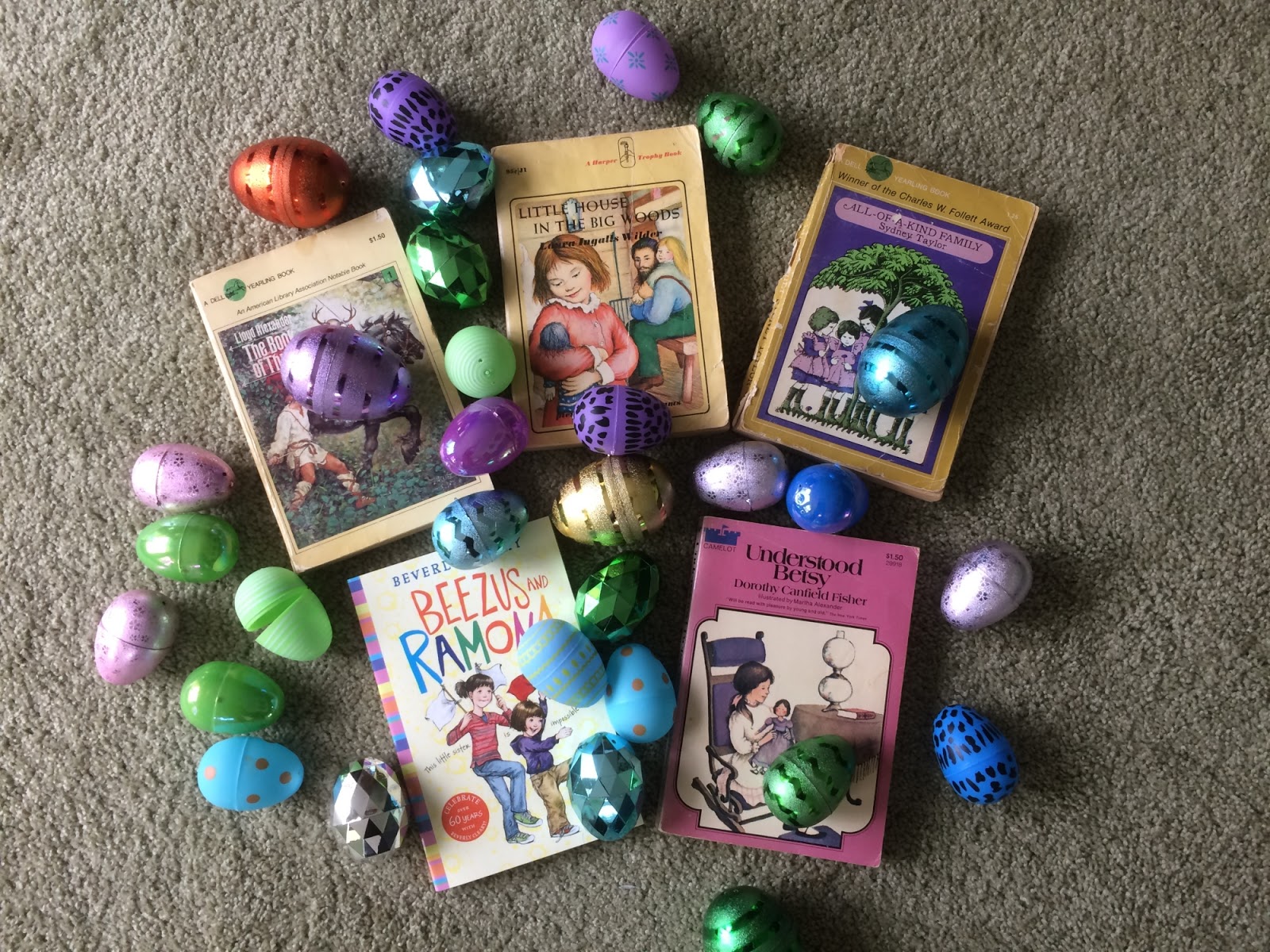
This hunting-cleaning invariably makes me think of the chapter “Dusting Is Fun” in All-of-a-kind Family (by Sydney Taylor). Mama, tired of constantly having to remind her daughters when it is their turn to dust the front room, hides ten buttons in the room and tells them they are going to play a game. The game is find the buttons, obviously, but while dusting. It’s Sarah’s turn, and by paying attention to all those difficult-to-reach spots, she finds them all.
Mama is wise enough not to make the game permanent. After everyone has had a turn, she only puts the buttons out occasionally, without warning, and in varying numbers. And once–a penny! A whole penny! (And for them, a penny buys a significant quantity of candy.)
Just recently, I was making a list of books from my childhood that I particularly liked and wanted to give to a friend’s daughter. (See also my post on books, nostalgia, and death.) After settling on Little House in the Big Woods (Laura Ingalls Wilder), Understood Betsy (Dorothy Canfield Fisher), Beezus and Ramona (Beverly Cleary), The Book of Three (Lloyd Alexander), and the aforementioned All-of-a-kind Family, I started wondering: why those books? How had those books influenced me, and how might they have influenced my writing?
It struck me that all the parents and guardians in those books had a streak of practicality, a kind of matter-of-fact common sense.  Mama handles chore-shirking, lost library books, bouts of stubbornness, and scarlet fever with admirable calm (which I admire even more now that I am a mother myself). And though I always thought Laura’s Ma was a touch too proper, she not only knows how to make everything from rag dolls to butter to straw hats, she also occasionally loosens her rules, allowing the girls to mold their cooked pumpkin into shapes, though normally they aren’t allowed to play with food, or (in a later book) declaring that they will play games instead of studying when she knows they are desperately worried about Pa and in need of distraction.
The Putney cousins, in Understood Betsy, are the calm contrast to devoted but fluttery Aunt Frances. They say almost nothing about to Betsy about how upsetting it must be to be whisked away from her family to a strange place, but it’s easy to imagine that Aunt Abigail is thinking, “Poor mite. What would make her feel better?” just before she scoops up the kitten and drops it in Betsy’s lap. And a few words from Aunt Abigail at bedtime, “do you know, I think it’s going to be real nice, having a little girl in the house again,” makes it clear that she is welcome.
The Book of Three is set in Prydain, a land of high kings, evil lords, enchanted swords, and deathless warriors. But Taran is frustrated that his life is far too ordinary—“I think there is a destiny laid on me that I am not to know anything interesting, go anywhere interesting, or do anything interesting. I’m certainly not to be anything. I’m not anything even at Caer Dallben!”. His guardian Coll obligingly responds by giving him the title of “Assistant Pig-Keeper” to Hen-Wen, the oracular pig. Taran is to “see her trough is full, carry her water, and give her a good scrubbing every other day.” When Taran points out that he does all those things already, Coll says, “All the better, for it makes things that much easier.”
Beezus and Ramona was not, strictly speaking, one of my childhood favorites. I read a lot of Beverly Cleary’s books and enjoyed them, but I didn’t fully appreciate them until I read the Ramona books to my daughter. Ramona’s world is the most similar to mine of the five books, and yet Cleary manages to make it incredibly entertaining by focusing on the little things–how a bored but imaginative younger sibling can interfere with baking, or the way the first bite of something is somehow the best–and turning them into adventures. Ramona is a definite challenge to the adults around her, as well as her sister, but they find practical ways to deal with her (buy a cake rather than try for the third time to make one, don’t mention the apple incident as it would feed her desire for attention, and—oh—why not make applesauce out of those apples?)
Am I making too much of this? Perhaps all childhood books are like this, especially those for younger children. After all, it is reassuring to think that parents are wise and calm. Probably most stories have some character with that quality. But not all children’s books feature the parents particularly (Secrets of Droon, for instance) and not all parents are good (Matilda, for a rather drastic exception).
At any rate, did reading these books lead me to be a sensible and matter-of-fact parent? It left me with the aspiration, certainly–I think I yell too much and get flustered too easily to actually qualify. In my defense, I’m not a fictional character.
I suspect the fondness for sensible parent/guardians does show up in my writing, though. In Persephone, Aunt Sarah and Aunt Mira are both practical in their own different ways. In Adrift, Aunt Kenata manages new babies and bad dreams, in contrast to the easily-upset Aunt Visala and taciturn Utanu. And I think Nana Sylvie might qualify as the common-sense influence in The Slipper Ball, though time will tell.
Till next post.