In Praise of Apricots

I am in love with apricots: tree, flower, and fruit.

Long ago, in a house in Tunis, we had an apricot tree. My family was only passing through, residents in the house for two years, but I remember the garden. It had a fig tree with a bough thick enough and horizontal enough to sit on. It had loquat bushes, mysterious and fuzzy. It had a walled garden where plants that looked like water lilies of the air suddenly appeared and bloomed with bright red and yellow flowers. (I’d never seen a nasturtium before.) And it had an apricot tree.

Delicate, scented white blossoms, followed by a shower of petals like something out of a romance or a fantasy novel. Heart-shaped leaves. And finally, small orange fruit. More velvety than fuzzy, and not tasting like tiny peaches but with their own distinct flavor.

Alas, I didn’t settle in a Mediterranean climate. There are no local apricot orchards. Despite the cautions listed on the Extension website, I did try to grow my own. I planted two trees. They grew, they bloomed, they fruited. I even got to eat some rather speck-marked fruit before the squirrels discovered them, and before the year that both trees died, probably from shot hole disease.

Not wanted to kill another apricot tree, I planted a fig in its place. And wow, has that fig grown!

But when you love something, it’s really hard to give up on it.  Every so often, I buy apricots in the store, hoping that this batch will be ripe enough. I am usually disappointed.

The last time I did so, I saved some of the pits–just because. I chilled them in damp coffee filters for a month or so, in case they needed cold treatment, and planted them. Now I have three seedlings growing in my window. I know fruit varieties are usually grafted, so I can’t expect to get the variety I planted, but I am eager to find out if they will eventually produce those lovely delicate blossoms.

Apricot blossoms after an ice storm


Here’s the puzzle. If I love apricots, should I keep trying to grow them even though they are poorly suited to this climate? Or should I accept my situation and stick to the many plants that will flourish here?

And another puzzle: why is it so hard to give up one’s fantasy garden? Be it fields of English bluebells in the Midwest, or posies of sweet peas in the scorching South, or fresh ripe apricots in an area of many false springs, is it partly because they are just out of reach?

Till next post. 


That Smells Good!–the changing appeal of scents, in and out of context

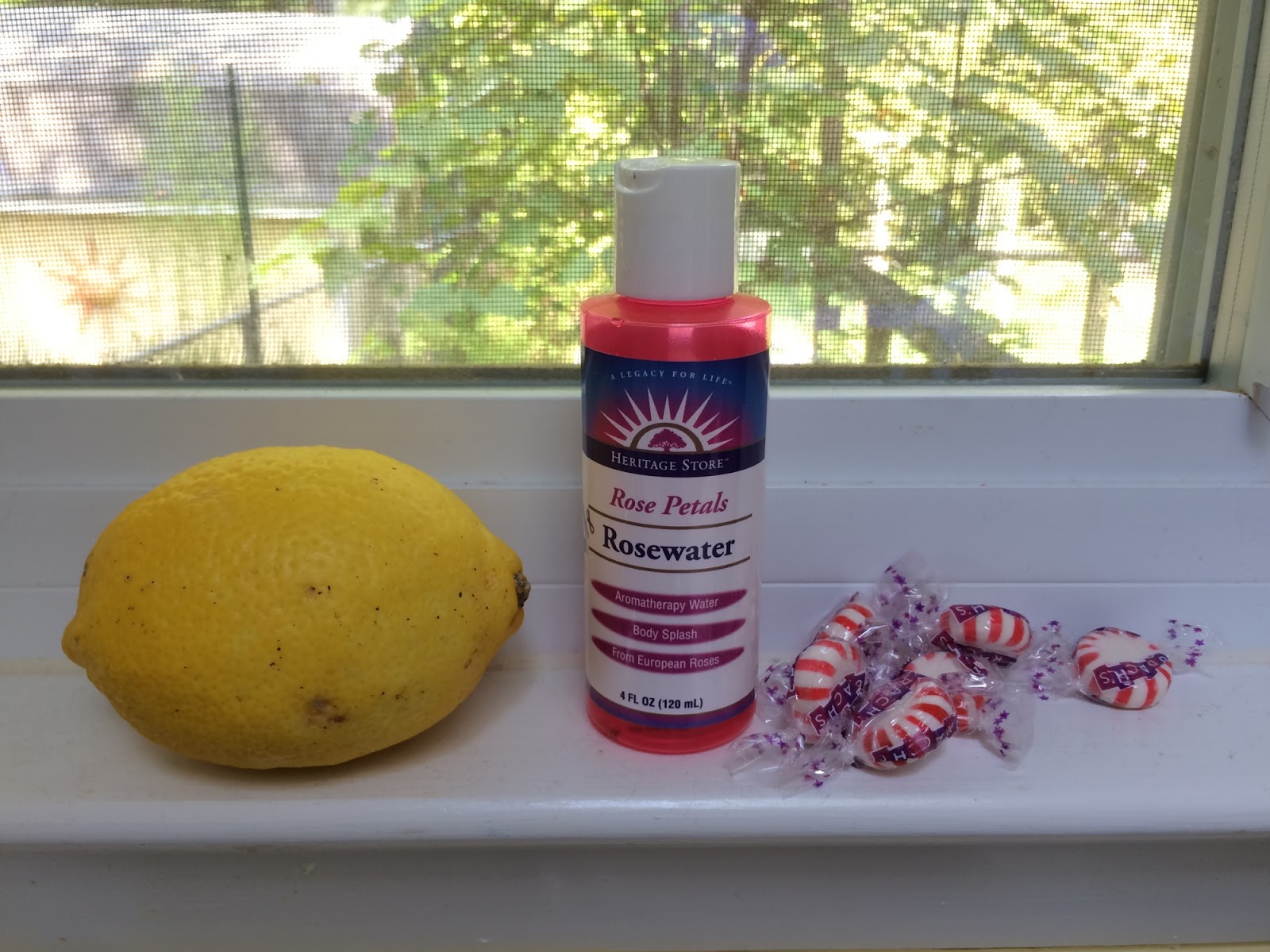
Windowsill display of lemon, rosewater, and peppermint candies

Peppermint, cinnamon, lemon–what do these scents have in common? Not much, considered strictly in terms of how they smell. One is minty, one is spicy, and the last one is citrusy. But they are all flavors as well, and I like them both as flavors and as fragrances.

That last connection isn’t automatic. Not every delicious food aroma is also good as a fragrance in its own right. For instance, the smell of chocolate–of brownies baking–is heavenly when I anticipate that I may get to eat some of them. Chocolate-scented stationery, however, does nothing for me. I’d rather perfume it with bergamot.

Oddly, I feel this distinction even more strongly when it comes to vanilla. I like the smell of vanilla in cookie dough or pudding, but I really dislike vanilla-scented candles, air fresheners, and heavily vanilla-based perfumes. Given how many of these vanilla-scented items are out there, I am clearly in the minority on this.

Most people (including me) would be reluctant to perfume their clothes or hair with the odor of sauteed onions and garlic. Onion-scented air-freshener? Ick. And yet, when I walk into the house and discover that the kitchen is fragrant with sauteed onions and garlic, my mouth waters and I say, “Wow, that smells good!” And it does. But only in the right context.

There are other fragrances that are pleasant so long as they aren’t in a food context. For some people, rose is one of these, while other people like rosewater-flavored desserts. I’m guessing that no one really wants their food to smell of lilacs or hyacinths, though, or Chanel No. 5. Bleah.

Is there any context that affects the appeal of a scent besides food? People do develop a familiarity with some scents in a cleaning context (lemon, peppermint), but nonetheless cleaning products do manage to be popular in a variety of other fragrances (floral, grapefruit, lavender, “sea salt”,…) Maybe personal fragrance–do we really want our bodies to smell like peppermint candy? Peppermint soaps and lotions certainly exist, but I’m having trouble imagining a perfume called “Fresh Mint Seduction” or “Lemon Heat”.

Can you think of any other contexts?

Till next post.

Garden Battles–fighting for my tomatoes (and roses)

In my imagination, a garden is a place of tranquil enjoyment where people move about slowly, smelling the roses and picking the fruits of their labor. Many public gardens are like this—well-tended spaces where visitors can soak up the atmosphere in comfort.
Not so in my backyard.
The problem isn’t with the work of gardening. Digging, planting, pruning, composting—I’m comfortable with those. I’m also okay with the fact that gardening takes time. I plant a fig and wait… and wait…three years now, and no fruit. But some day it will get there, I’m sure, as will the still-flowerless pomegranate bush. I’ve got time.
The problem is the pests. The four-footed pests, the six-footed pests, and those that have no feet at all.
The largest of the four-footed pests is the deer. Suburban deer are more and more numerous all the time. They are the main reason my landscaping is relatively boring. The back yard has plastic fencing attached to the chain-link to raise the height to nearly eight feet, but the front and sides of the house are undefended. As a result, my choices are limited. No hostas (deer candy), no roses (thorns will not stop them), no zinnias, no coneflowers. Even the azaleas get nibbled and so flower poorly. So I depend on rosemary, lavender, and irises where there is enough sun, and ferns and lamium in the shade.* The rest of the plants are restricted to the fenced backyard.
The fence doesn’t keep out other four-footed pests, though. The worst of these are the squirrels and the voles. The squirrels help themselves to my fruit before it has even ripened, running off with strawberries, green peaches, and half-ripe tomatoes. No fence will keep them out—I would have to cage my garden in chicken-wire to do that. 
While the squirrels attack from above, the voles attack from below. They leave neat little holes where plants once were. Sometimes I find a plant suddenly wilted and discover it no longer has any roots. I have lost whole rose bushes to voles, as well as tomato starts.
I haven’t included moles on my list of garden pests because they don’t eat plants and may in fact be snacking on the grubs of a different garden pest, the Japanese beetle. The Japanese beetle is certainly one of the most annoying of my six-footed pests, since it particularly likes the unopened buds of roses. Grasshoppers do damage to the leaves of plants, as does a mysterious brown beetle that only comes out at night. And then there is the tomato hornworm with its voracious appetite. It’s easy to pick off, though, so the worst thing about it is coming upon it unexpectedly when handling a tomato plant. (Shudder.)
Weeding is part of gardening, and I actually have fond feelings for the weeds that our guinea pigs used to enjoy: chickweed, wood sorrel, purslane, and dandelions. But sometimes a weed goes too far. I had just one summer of not being able to weed, and now the stiltgrass (Microstegium) is threatening to take over my entire yard. I am not kidding here. Naturally I would also like to be rid of the Youngia japonica and the mock strawberry (which does indeed mock me with a strawberry-like fruit that doesn’t taste like strawberries), but at least they aren’t growing knee-deep and dense enough to hide anything on the ground, from the garden hose to a yellow jacket’s nest.
The tiniest pests of all still make themselves felt in a big way.  I’ve lost rose after rose to black spot, a fungus, and a different fungus contributed to the deaths of two very well-developed apricot trees. I was afraid to replant apricots, lest the new ones go the same way, so now there is a fig in that spot. So far the fig is serenely unbothered by pests of any kind.
I have saved the very worst pest for last. This creature doesn’t eat, infect, or otherwise harm a single plant, but it has a bigger impact than any of the others. It is the mosquito. I can’t stay out more than ten minutes without long pants, long sleeves (in summer!), and DEET on all remaining exposed skin. Mosquitoes not only make it difficult for me to pull weeds, pick off bugs, and remove diseased leaves, but they also prevent me from enjoying my garden—which was the whole point of gardening in the first place.
And I can’t fence them out.
Till next post.
*Actually, I also have catmint, chives, thyme, sage, aromatic aster, assorted mints, and a pomegranate outside the deer fence. So far, they have not been eaten.