Sparkle, Shine and Scarcity


And now back to shiny things…
Because the story I am writing involves the theft of a fabulous ruby necklace, I have been reading books about jewelry. One very entertaining book, Stoned: Jewelry, Obsession, and How Desire Shapes the World by Aja Raden, focuses on the role of gems in history.
I had heard the story about DeBeers and “A diamond is forever” before—even before my daughter informed me that Adam, who Ruins Everything, had ruined diamonds for her. Stoned provided more details: the relative unimportance of diamonds early in our history, the difference that improved cutting techniques made, and the way that DeBeers turned them into something everyone wanted with clever advertising and choke-hold on the supply.
I hadn’t heard the story about Spain flooding Europe with New World emeralds and drastically reducing the value of their own crown jewels. Nor had I realized just how scarce, and prized, pearls once were.
The relationship between scarcity and value is interesting. I am sometimes amazed at the things we can create now—the materials, the finishes, the new techniques. Beautiful things are widely available to us. In fact, we fail to notice quite how many treasures we have because they are so very available and cheap.
For example, I have a bracelet I like–stretchy, silvery, and glittering. Now, my mom isn’t into jewelry. She has very little of it herself and no idea what is currently in stores. She saw me wearing the bracelet and asked when I’d gotten it. From her tone, I think she expected to hear that it was a special anniversary present. Instead, I said, “Six dollars at Walmart.”
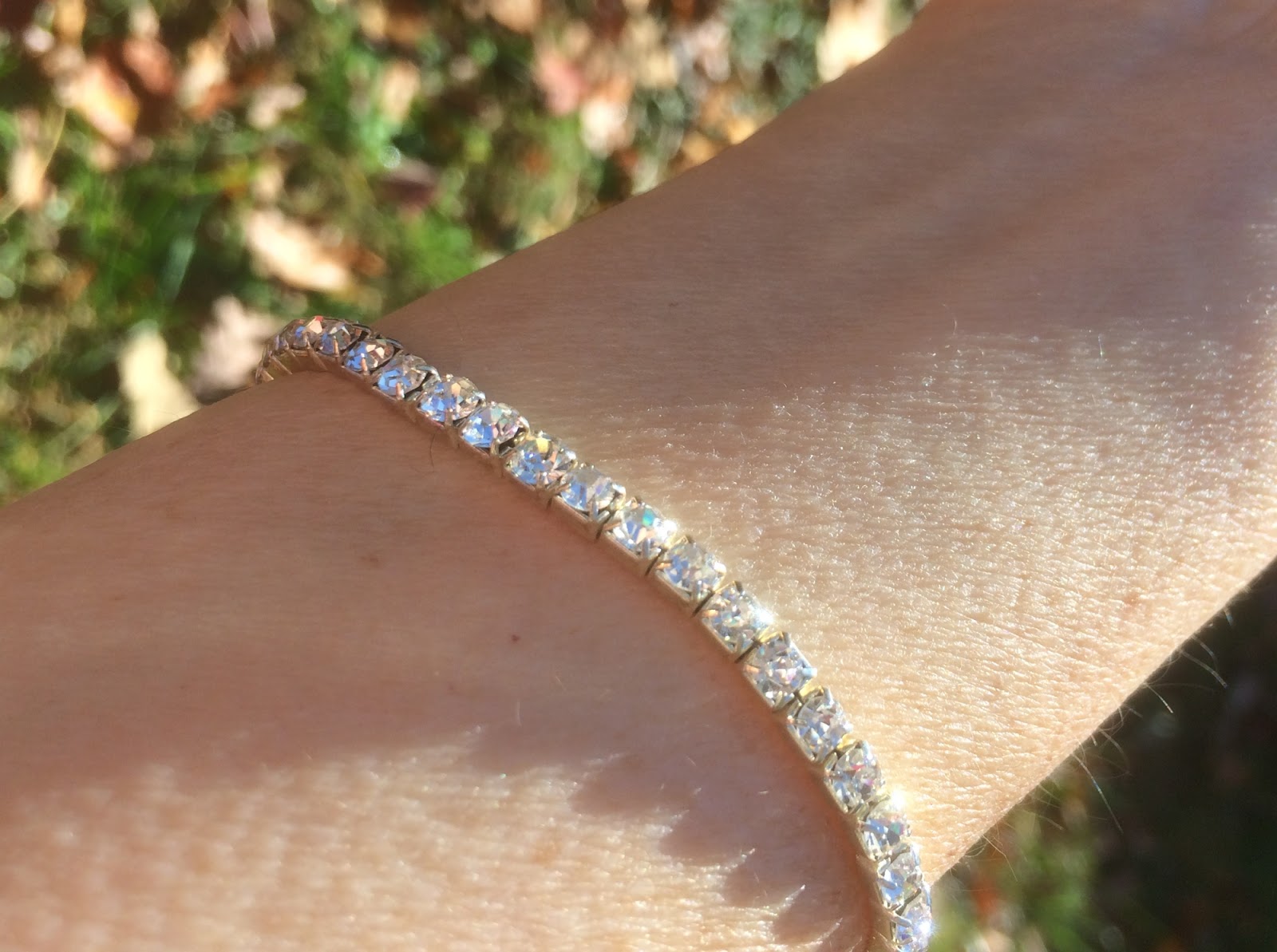
Sparkly stretch bracelet glitters like diamond in the sun.
Diamond tennis bracelet or kid’s costume jewelry?
Someone more familiar with today’s little girls would have recognized the style right away… but does that make the bracelet any less beautiful?
It’s not a rhetorical question. If you glance at it, think “cheap costume jewelry”, and look away… certainly you appreciate it less. But I think it’s fabulous. I hold my wrist up to the sun and watch it glitter. It isn’t durable (I’ve broken the stretchy cord on several already) but it is pretty. And what attracted humans to gems in the first place, if not their color, translucence, and sparkle?
And the bracelet is just the beginning! Little girls’ wardrobes are full of sparkle and shine that I would have begged for as a child, had it been available. (I did have shiny black patent leather shoes…)
We also now have the ability to synthesize precious stones—rubies, sapphires, diamonds. They are no less attractive for having been made in a lab, and there are many more of them to go around. Apparently some fancy watches have a crystal (the glass front of the watch) made of colorless synthetic sapphire! Imagine that—they can make a cylinder of synthetic sapphire wide enough for a watch face, and then slice off pieces of it. What else can they do?
Well, they can make a diamond ring. That is, a ring made of diamond, not a ring set with a diamond. It sounds like the sort of thing you’d find in a Richie Rich comic book. I couldn’t find out whether the diamond was natural or synthetic, but it seems like an odd and perhaps even wasteful way to cut a large diamond, which makes me think maybe it was synthetic.
It isn’t just gems that are shiny and beautiful and increasingly available. When I was in my teens, I bought postcards with what we would now call “holographic foil” on them at a science museum. I paid at least four times what regular postcards cost—maybe it was more than that. They were special! I taped them up on my wall for my friends to admire. Now I throw away used Christmas wrapping that would put those postcards to shame.
I could give further examples, but you get the idea. We have shine, glitter, and vivid colors enough for old-fashioned royalty.* Do we feel like royalty? Apparently not—everyone else is just as shiny, glittery, and colorful as we are.  And yet…wow.
Just…wow.
Till next post.
*Admittedly, we’re a little short on actual gold—never found that Philosopher’s Stone—but we have a lot of really good gold-colored paint and foil.
Writing a Mystery Without Murder In My Heart


It’s November! Finally it is National Novel Writing Month—NaNoWriMo. This year, I am trying to write a mystery–adult, not middle grade or young adult. I need 50,000 words by the end of this month, and a beginning, middle, and end.
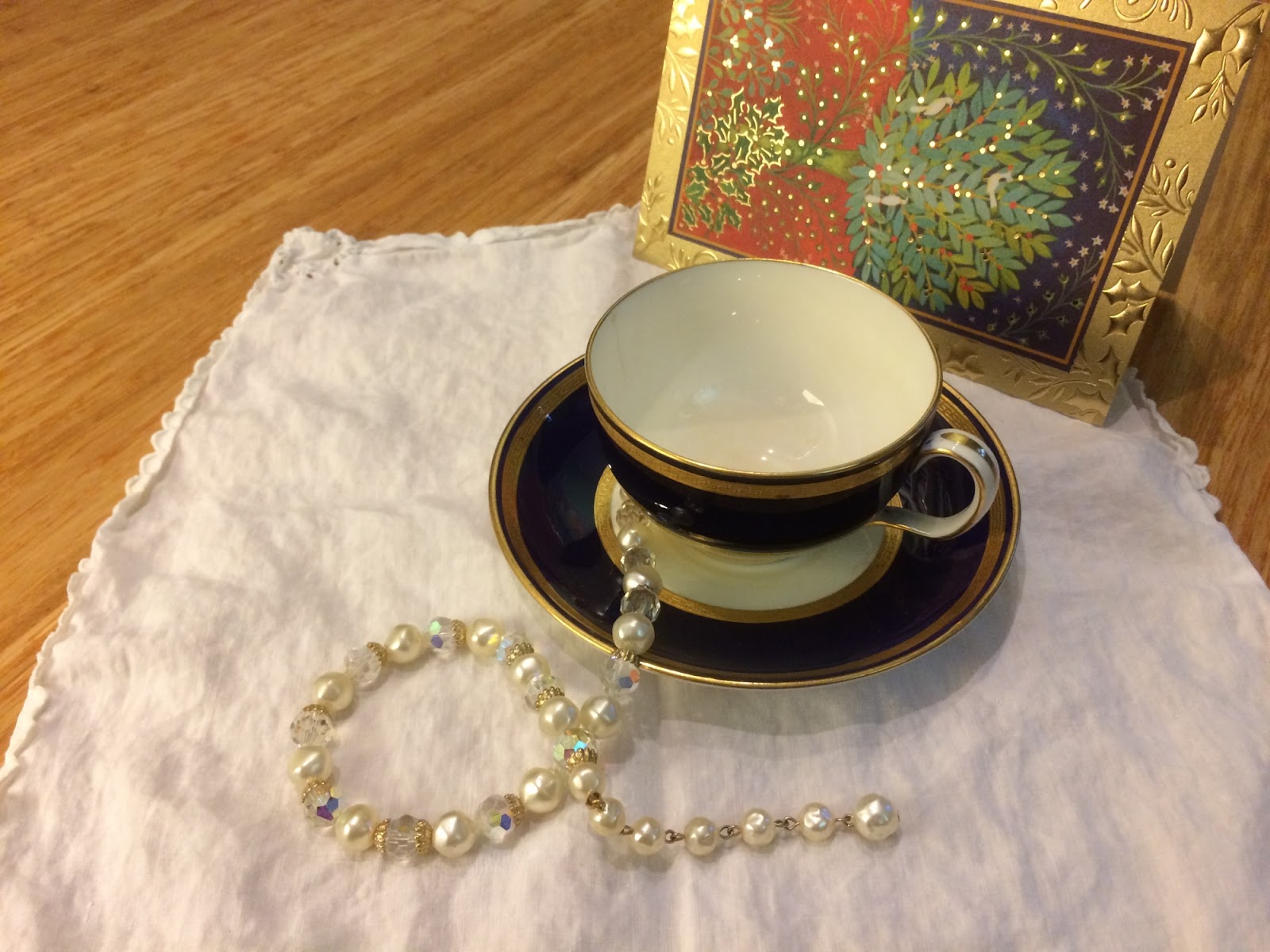
Tea cup on scalloped white napkin with necklace and Christmas card.
Tea, jewels, and Christmas–all part of the story.
I’ve tried to write mysteries before without success. Somehow my mind doesn’t work in the right way for plotting a clever murder (and how the murderer will nonetheless fail to get away with it.) I have the same problem with heists and other criminal plots. I love to read books with ingeniously carried out crimes, but I draw a blank when I try to think one up myself. I think other authors must look around them, wherever they are, and notice potential murder methods. As in “Hey, look at the spike on that beach umbrella. I wonder if you could kill someone with it, then put the umbrella up so no one would notice the blood on the spiky bit.” And other such thoughts.
Okay, so apparently I can come up with a murder method, at least a weak one. But it doesn’t happen easily or spontaneously.
There’s another, more serious, problem. I don’t really want to write about a murder.
I have no difficulty enjoying mysteries in which one (or two or three) people are murdered. You’d think it might bother me, but it doesn’t. Granted, I avoid the really dark, disturbing varieties of murder mystery, but I don’t read only the humorous or cozy variety, either. One of my favorite series is the one with Inspector Gamache, by Louise Penny, which is serious but not overly dark.
So why doesn’t murder bother me when I read a mystery? I suppose it’s sufficiently unreal, and so entirely expected, that I don’t take it to heart. And yet, when I set out to write a story in which one of my characters kills another one, it feelsdifferent. To make sense of the murder, I have to have a character who is so dark or so desperate that he is willing to kill. And I have to have other characters who can be suspected of being that dark or desperate. Suddenly it all feels much too serious—a world I don’t want to live in long enough to write about.
It could be partly that I have been very lucky in my family, neighbors, and co-workers throughout my life. I haven’t had a lot of experience with the kind of people that make you really want to kill them, or the kind of people that leave you scared for your own safety. Mostly I meet those people in fiction—and then I do see red and want violent things to happen to them. Maybe if I had to live with such people, I would be more interested in putting those people in a story and either killing them off in a painful manner, or meting out justice to them after having them kill someone. Or maybe it’s got nothing to do with that. I really don’t know.
So I’m not writing a murder mystery. At least, I don’t think so. The plan is for a robbery to take place, but lots of things could change over the course of the month. Somehow I’ve already gotten 10,000 words in (which is a speed record for me, I think) but I haven’t gotten much farther than introducing my cast of characters. That theft better happen soon or I won’t have a story.
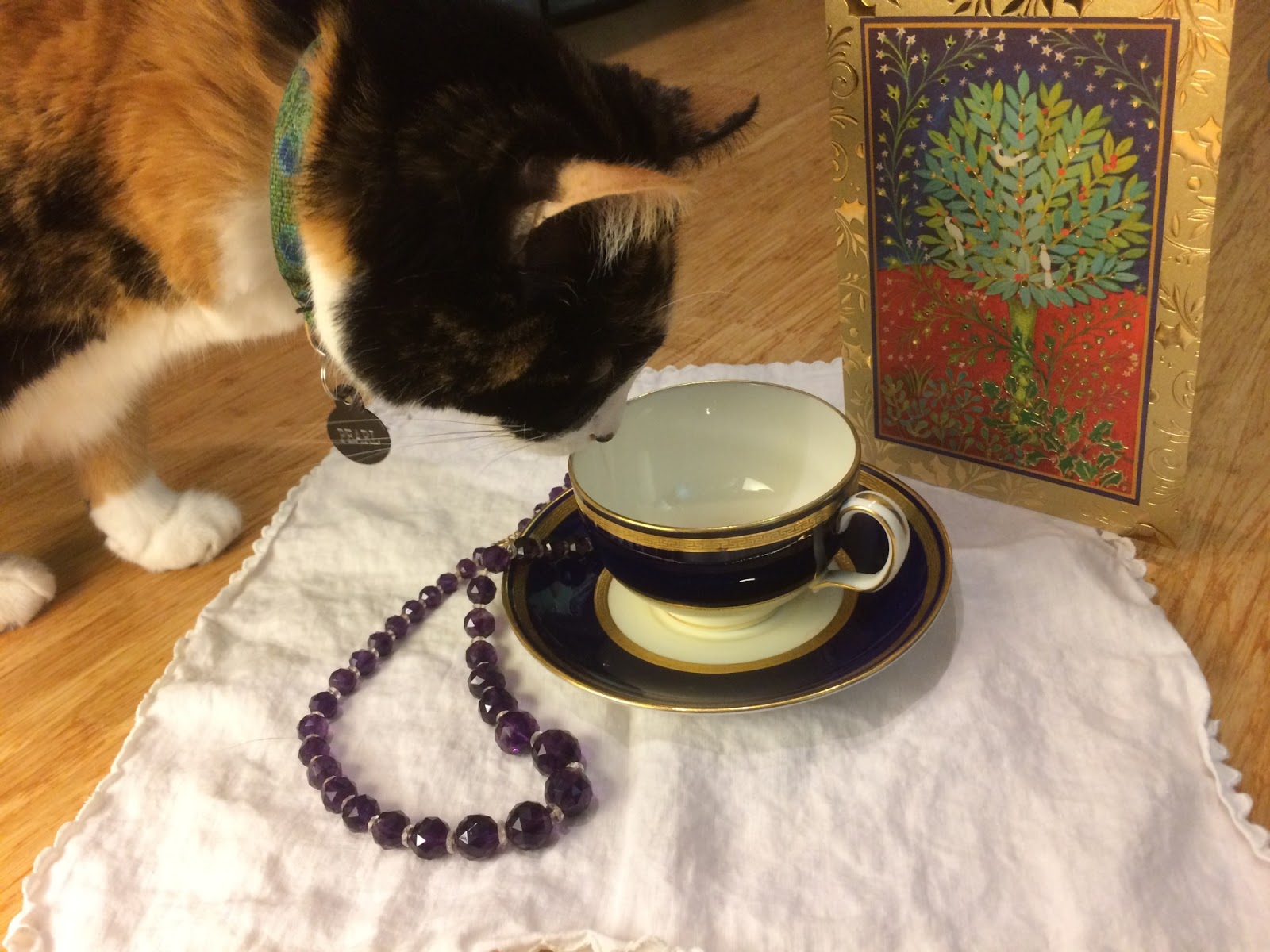
Cat sniffs the teacup on the white napkin near the necklace and Christmas card.
The cat investigates. Not in my novel, however.
Till next post.

"They Spoke French"–how stories get lost between generations


The stories you think you’ve passed on to your children are not necessarily stories they know.
Earlier this year, I was talking with my daughter about who-knows-what, something to do with languages, and I said that since my grandmere and grandpere always spoke to each other in French, and usually spoke in French to my father as well, I had grown up thinking it perfectly ordinary that grown-ups sometimes spoke to each other in a language the kids didn’t understand.
“What!” She nearly fell off the sofa. “They spoke French? I didn’t know that!” She had assumed that they spoke Italian, which would be a reasonable thing to assume if I hadn’t told her otherwise. My grandparents had come over from Italy, after all. Just… a French-speaking part of Italy. At least for Grandmere.
“I’m sure I told you!” And I probably had. Once. When she was very young. And apparently never again.
So she hadn’t known, and hadn’t had the slightest idea that her own Granny and Grampy could also speak French (though they didn’t normally speak it to each other, and probably hadn’t spoken it for years.)  Had she known, she said, she might—might—have considered taking French in school instead of Latin.
Suddenly things were clearer. I had wondered a little about her choosing Latin. I had offered good reasons why French or Spanish might be more fun (including that fact that I knew some of both and we would be able to talk together), and in the back of my mind I had wondered that the family connection didn’t seem to enter into her decision. But I’d never actually said, “Why don’t you take French? Your great-grandparents spoke French and your grandparents would probably be delighted.” No, I just assumed she’d considered that fact and decided that Latin would be more fun, especially since she already knew the Latin teacher and liked her.
And she did get a series of very fun Latin teachers. Later she went on the Latin Club trip to Italy, so the family connection did come in, sort of.
But how had I failed to pass on such an important bit of information? What else had I failed to tell her?
“You know Grandpere was a baker?” Yes, she did know that. Good.
“And Grandmere worked as a maid?” Yes, and now that my daughter knew Grandmere had spoken French, the story that Grandmere had passed herself off as a French maid, not Italian, made more sense. (Apparently French maids were desirable back then—Italian maids, not so much. Prejudice has a long history, though the groups involved change.)
But she had a question for me. “What did my other great-grandpa do?”
Uh.
Photography, though I don’t know whether he made any money at it. Some acting, apparently. And my mom always says that there was a brief spell when he sold used cars. And…uh…
I need to go back to my mom and ask more questions, I think. I wonder what stories she told me that I have now forgotten?
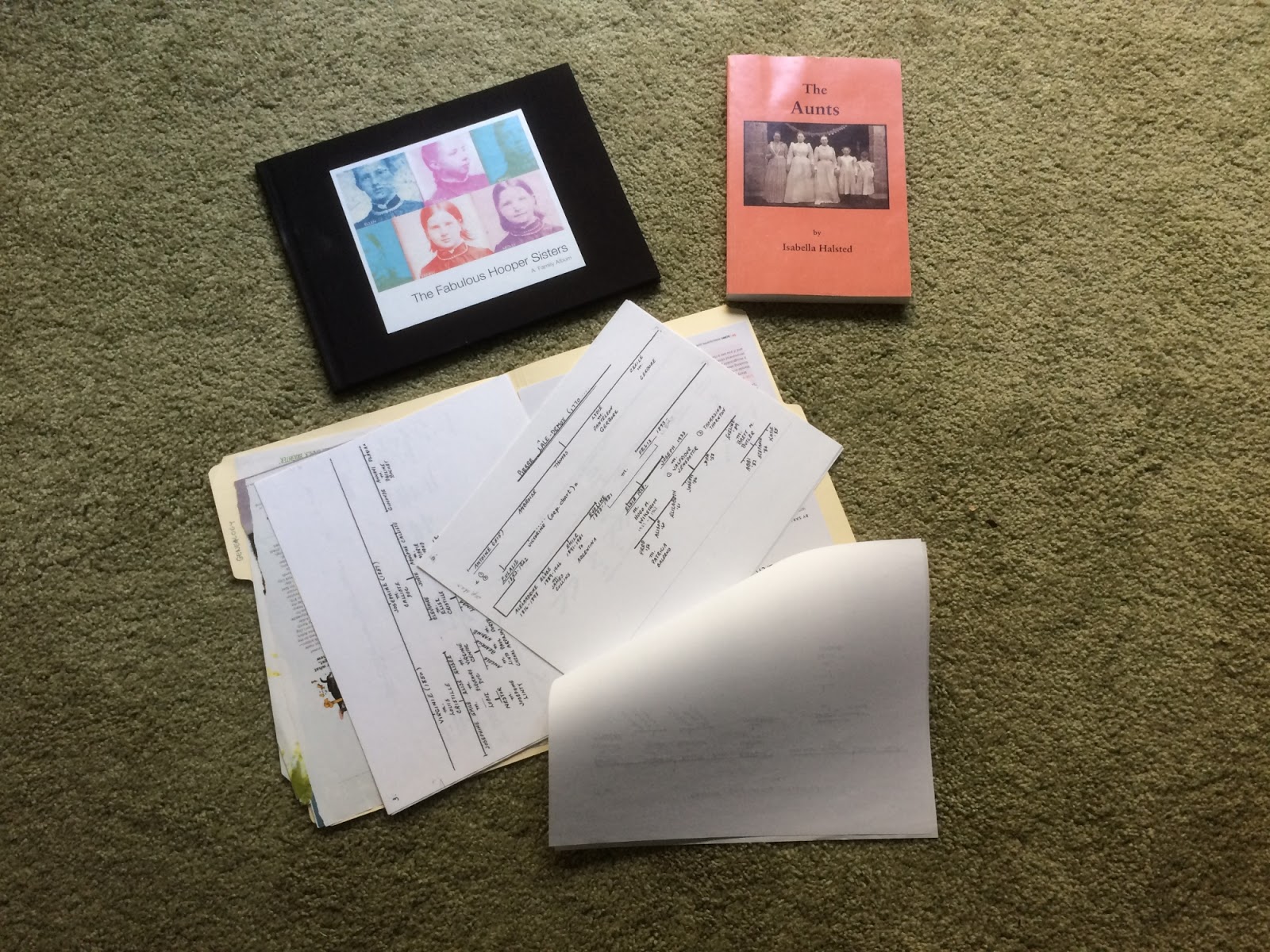
At any rate, this discovery led to a discussion of the family tree, a search for the two books I have relevant to that side of the family (though one is mostly a photo book), and the conclusion that we really ought to get a genealogy program and sort this all out. And, as my daughter said, we should write down all the stories I can remember, and all that Granny can tell us, so that my daughter can pass them on to her own children some day.
Maybe they’ll decide to take French in school.
The Aunts by Isabella Halstead, The Fabulous Hooper Sisters, and assorted genealogy papers
Till next post.