Addicted to Story


I am addicted to story.
Poetic and dreamy as that sounds, the reality is not so rosy.
My first thought was actually “I am addicted to Netflix.” It was only after I’d given the matter more thought that I realized the problem goes much deeper.
This past year I spent a lot of time watching mysteries and detective shows via Netflix. This was partly due to having first one shoulder, then the other, freeze. Frozen shoulder meant that there were some months when my shoulder ached a lot and carrying out everyday tasks, like moving laundry out of the machine or putting away dishes, could get quite painful (especially if I knocked something over and tried to catch it with the wrong arm!). So I spent a significant amount of time distracting myself with Netflix. Sometimes I checked out audiobooks from our library. It would have been nice to spend the time catching up on reading, but repetitively turning or flicking pages seemed to result in worse pain later.
As I improved and could do more, I kept watching shows on Netflix. Sometimes it was sociable—I watched with my daughter. She knit or drew; I cooked or put dishes away. Or at least, I tried to.
Because that’s the point, the reason for this post. I cannot watch a mystery and follow a recipe without missing parts of the plot and, too often, missing parts of the recipe as well. It isn’t just the problem of turning away from the television either, though obviously that makes it easy to miss a crucial clue or facial expression. I’ve tried to clean while listening to audiobooks. There isn’t anything to look at while listening to an audiobook, but my cleaning still suffers noticeably.
The problem is that my mind cannot successfully follow a story and make decisions at the same time. If I am listening to find out whether the body in the coffin really belongs to the missing lawyer, I am not simultaneously deciding whether I ought to degrease the stovetop, or whether it would be more productive to clear the papers off the table. To decide that, I have to tear my mind away from the story—and while I do so, I miss part of the story. The story experience is weakened, and the cleaning takes much longer than it should.
The same applies to any task that requires attention. I had started a simple sweater that required nothing but knitting around and around for ages. That I could knit while watching a show.  Then I started a shawl in its place, because it was clear that I wasn’t going to be able to pull a sweater over my head for months, but I could still drape a shawl over my shoulders. (Eventually I had to stop work on the shawl, too, because the repetitive motion of knitting resulted in increased pain.)
But even though the shawl pattern was very simple and repeated only four rows, most of which were either straight knitting or straight purling, the shawl suffered from being worked on while watching Netflix. I kept having to rip back stitches because I’d missed the occasional yarn-over, or because I’d mistakenly been purling in a knit row.
So I know, from repeated and varied experience, that I cannot watch a movie (or listen to an audiobook) and simultaneously follow any but the simplest recipe or knitting pattern, or do any but the most straightforward cleaning (drying dishes, e.g.). I know this.
And yet, as I start wiping counters or pull out a soup recipe, I find I am filled with the urge to turn on the television and see if there is anything good on Netflix that I haven’t watched yet. Or maybe just watch a Poirot episode for the umpteenth time—after all, I can’t miss as much if I already know who did it. I really, really, really want to watch something! The idea of just cleaning or cooking, without the accompaniment of story, seems so… bland.
It wasn’t always this way.
Still, why am I calling this an addiction? It isn’t really, and the term gets thrown around much too casually already. I won’t suffer physiological withdrawal from leaving the television off. The urge to watch Netflix isn’t alienating me from my family—they like watching it, too. It isn’t interfering in my daily life… well, not much. Not unless you consider the number of hours I spent watching Midsomer Murders, all 116 episodes, even though it isn’t nearly as good as  Death In Paradise.
I’m saying “I’m addicted” because even though I know I can’t successfully combine watching shows with other tasks, I’m having a hard time keeping myself from trying to do so—over and over again. The lure is just too great.
Further, I’m saying I’m addicted to story because it doesn’t actually matter if the story comes in the form of video, audiobook, or paperback. Books tend to be less of a problem because I really can’t do anything else while reading a book, so I don’t try. (If it is an ebook, I can walk on the treadmill while reading it, but walking is automatic enough that I can do both successfully.)
Having said that, there are some situations where my absorption in a book does pose a problem.  If I start a book in the evening, I often don’t want to stop reading to go to bed. I stay up too late and don’t get enough sleep. That has happened many times.
Also, I tend not to be very responsive to my family when I am in the midst of a good book. My daughter will not let me forget one evening when she was young and I wouldn’t put down my book long enough to read her a bedtime story. I suspect I asked my husband to take over that one night so I could keep reading—I almost always did read to her—but that isn’t the way she saw it. That night, she and the book were in competition for my attention—and the book won.
Now we’ve reached the part of the post where, having outlined the problem, I propose a solution.
Umm, willpower?
Disconnecting the router?
A resolution not to watch/read/listen to any story that isn’t truly worthwhile, and to give my undivided attention to those that are?
Well, I’m still working on it. I would be pleased to hear from anyone else with a similar problem, especially if they have found a solution that works for them.
Till next post.
The much-abused pink shawl in progress.
P.S. In case you were wondering, that total is 174 hours of Midsomer Mysteries, or about a month’s worth of forty-hour work-weeks. And it wasn’t the only thing I watched.
"A Little Princess"–self-discipline, kindness, and imagination…and a bit of moral luck

Even if you have already read the book A Little Princess, by Frances Hodgson Burnett, it is well worth re-reading. I picked it up again this past week to check a quotation and kept finding more and more to like in it.

 For starters, the book is full of lively descriptions. Sara’s wardrobe is enviable, with dancing frocks of rose gauze, petticoats with lace frills, and “velvet dresses trimmed with costly furs.” (14) There are comfortable rooms, with pleasant fires in the grate and soft chairs in which to sit, furnished with books and pictures and “curious things from India”. Later, we find ourselves in rooms in the bare and unwelcoming attic, with hard beds and whitewash flaking off the walls–but such a view of the sky and roofs! Sara herself provides lavishly imagined scenes through her story-telling–laughing merbabies with stars in their hair, fields full of fragrant lilies in heaven, and a sumptuous (though imaginary) feast.

But a story needs more than description, and A Little Princess has more. It has its heroine, Sara Crewe. When the story begins, Sara has just arrived in London from India, the only child of a doting and very rich father. But she is very far from the stereotype of a spoiled rich brat. She is well-mannered, kind-hearted, and very much in control of herself.

Frances Hodgson Burnett makes a particular point of the importance of self-control, and we see how Sara manages to restrain herself from unkind or ill-mannered responses, even when she has been much provoked. We admire her for it, and are delighted at how infuriated Lavinia or Miss Minchin is at being faced with such composure and steadfast good manners.

The restraint is not some magical innate goodness, but an effort that Sara makes–sometimes quite a difficult effort.

“Never did she find anything so difficult as to keep herself from losing her temper when she was suddenly disturbed while absorbed in a book. People who are fond of books know the feeling of irritation which sweeps over them at such a moment. The temptation to be unreasonable and snappish is one not easy to manage […] It must be remembered that she had been very deeply absorbed in the book about the Bastille, and she had had to recall several things very rapidly when she realized that she must go and take care of her adopted child. She was not an angel, and she was not fond of Lavinia.” (59-61)

Sara reminds herself that she is pretending to be a princess.

“If you were a princess, you did not fly into rages.” (62) 

Her imagination helps her with the difficult work of self-control.

Sara’s imagination makes her an appealing heroine because she uses it to tell stories to herself and to others. It draws the other children to her (in a world without videos or internet, a storyteller is much valued). Her imagination also helps her through hardships, as she can imagine more pleasant surroundings for herself–or if that is just too hard, she can pretend she is part of some dramatic and romantic story. Rather than living in a dreary attic, she is a prisoner in the Bastille, with Becky as the prisoner in the next cell.

Because Sara is so good at imagining how things might be different, she is also struck by the role of luck in her life. As she speaks with Becky the scullery-maid, she says,

“Why… we are just the same–I am only a little girl like you. It’s just an accident that I am not you, and you are not me!” (53)

At another point, she tells her friend Ermengarde,

“Things happen to people by accident.[…] A lot of nice accidents have happened to me. It just happened that I always liked lessons and books, and could remember things when I learned them. it just happened that I was born with a father who was beautiful and nice and clever, and could give me everything I liked. Perhaps I have not really a good temper at all, but if you have everything you want and everyone is kind to you, how can you help but be good-tempered? […] Perhaps I’m a hideous child, and no one will ever know, just because I never have any trials.” (36)

Of course, when her trials do come, she acquits herself admirably, but we can still puzzle over the role of luck (especially moral luck) in nature and in nurture, and wonder how one person comes to be so patient and determined, while another is self-centered and spiteful.

Sara’s strength and imagination would not make her nearly so appealing if they were not accompanied by great kindness. Sara is kind to the younger children and sympathetic to anyone who is suffering, whether they are suffering from hunger or from humiliation. We want Sara to flourish and be happy–she so deserves it.

I have two last remarks about this book. First, the movie they made of it some while back (set in America) makes a complete mess of it. It mistakes the crucial point. It is not the case that “all little girls are princesses”, as I believe Sara is made to say in the movie. It is true that being a princess is not a matter of wealth or birth or beauty, but Lavinia, for example, is clearly not a princess because she does not behave like a princess. She is neither kind nor well-mannered when things don’t go her way.

The second remark is that this is an old book, and while Sara’s kindness extends to all beings, the book still reflects to some extent some of the attitudes of its time and place. It is worth keeping in mind, but should not stop anyone from reading it.

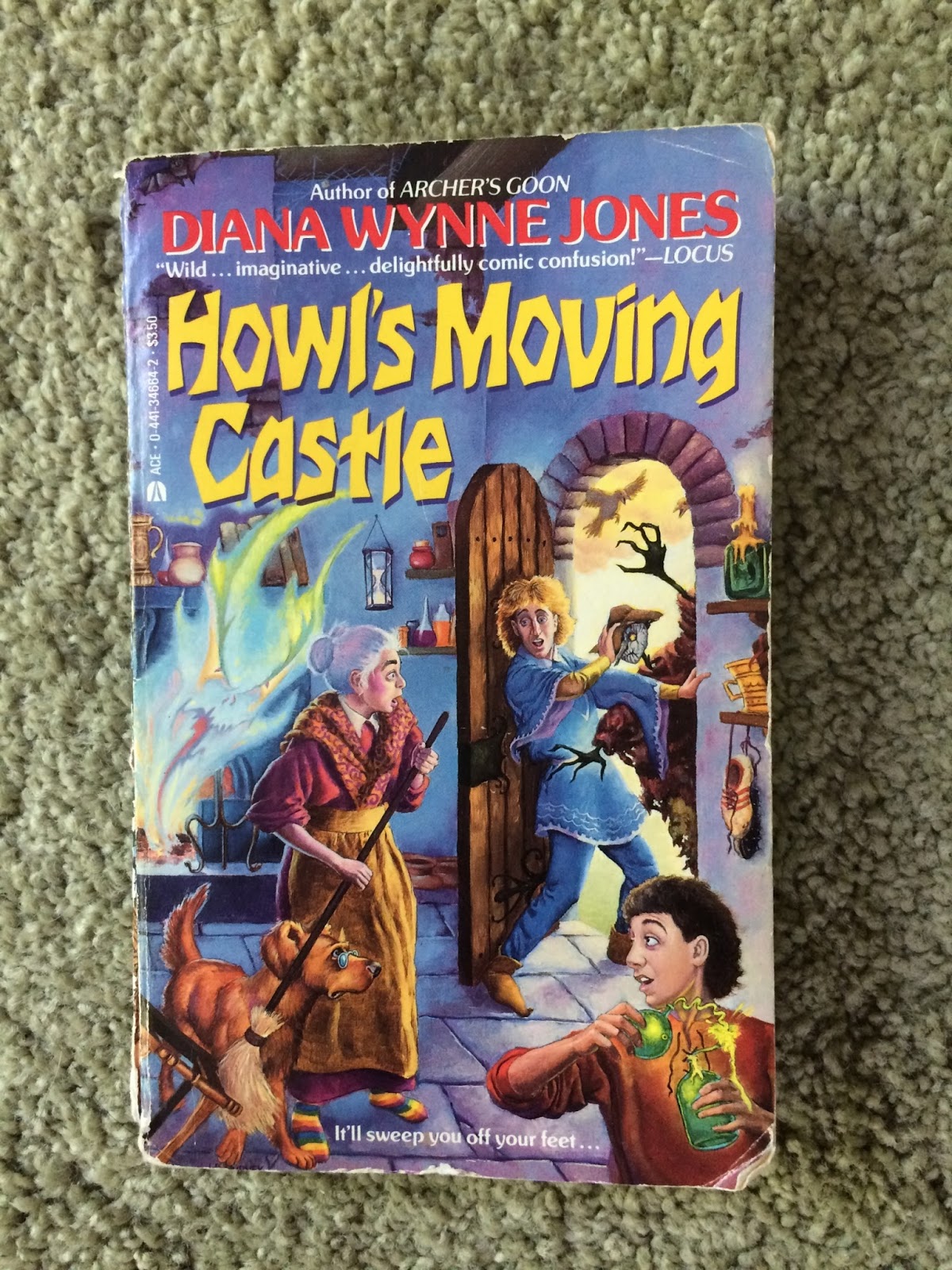
Reflecting on "Howl's Moving Castle" (the book, not the movie)–cleaning, fictional characters, and scented steam


Yesterday my daughter was writing quotations from Howl’s Moving Castle (the book, not the movie) to post on the pantry quotation wall. She told me that thinking about Sophie, the main character, inspired her to clean her room. That, in turn, inspired meto think of many things: cleaning, the touches of everyday life in books, and the way fictional characters motivate us to imitate them.
Howl's Moving Castle paperback

Sophie Hatter certainly does do a lot of cleaning in this book. She cleans remorselessly. (I love that phrase.) The dirt and spiderwebs don’t stand a chance. Nor does Michael.
“I wish you’d stop,” said Michael, sitting on the stairs out of her way. (p.43)
She doesn’t necessarily do her cleaning in the right order, however.
[Calcifer] crackled with mean laughter when Sophie discovered that soot had got all over the room and she had to clean it all again. That was Sophie’s trouble. She was remorseless, but she lacked method. But there was this method to her remorselessness: she calculated that she could not clean this thoroughly without sooner or later coming across Howl’s hidden hoard… (p.44)

Cleaning is a way of poking around without being obvious about it. It’s also a good way to tell whether you’ve searched someplace already, as I’ve discovered in the Great C&C Easter Egg Hunt. Diana Wynne Jones’s books often have some wonderful detail that makes me think, “Yes, exactly!” and this is one of them.

The word “method” also reminds me of a story my mother tells, about my grandmere coming to visit us in Geneva when I was a toddler and being disturbed by my mother’s housekeeping. “You have no method!” she complained. Apparently I inherited this lack and so have something in common with Sophie.
There are other lovely details in the book, like the description of the bathroom before Sophie gets to cleaning.
 
Sophie winced from the toilet, flinched at the color of the bath, recoiled from green weed growing in the shower, and quite easily avoided looking at her shriveled shape in the mirrors because the glass was plastered with blobs and runnels of nameless substances. The nameless substances themselves were crowded onto a very large shelf over the bath. (p.33)                                                                                 
This is one of the few areas in which I must say the movie did a good job. They really made that bathroom look terrible. Some years ago I commented on Facebook that M had gotten face paints for her birthday, and our bathroom sink looked like it belonged in Howl’s Moving Castle. I wish very much that I had taken a photo, but apparently I didn’t.
The bathroom is important, given Howl’s vanity. Every time I pass our bathroom right after M takes a shower, I think of Howl emerging from the bathroom in a cloud of hyacinth-scented steam. Of course, in our house it’s more likely to be lavender, or frankincense-citrus, or some other really interesting Zum soap combination.
I said earlier that I was thinking about the way fictional characters inspire imitation. It’s obvious with kids and cartoon heroes, but does it stop there? When I was taking t’ai chi classes, I sometimes imagined myself as a movie ninja, to feel that state of relaxed alertness that movie ninjas display. I want to deduce like Sherlock Holmes, read tracks like Jim Chee, maybe even quote poetry like Inspector Gamache. I’d like to sing like Aza of Fairest, or recite epics like Meryl of The Two Princesses of Bamarre. And I mean not just that I’d like to be good at it, the way they are, but that when I read those books, singing with others and reciting poetry suddenly seem like appealing activities. Even if I’m not particularly good at them.
I can’t conclude a post about Howl’s Moving Castle without a word about the movie. The movie is totally unlike the book. It is visually amazing and having Sophie’s appearance continually change is clever, but the characters are very different and so is the plot. Whether you liked the movie or not, consider reading Howl’s Moving Castle by Diana Wynne Jones. Just remember—the castle doesn’t look anything like the mechanical contrivance of the movie.
Side note: when did the English start saying “different to” instead of “different from”? I’m sure the British-authored books I read when I was young didn’t do this. I meant to look for an example in this book while I was re-reading it, but I got too caught up in the story.
Second side note: I have included quotations, which I think counts as Fair Use since this is sort of a review of the book and sort of educational (if you stretch the point a bit.) And everyone quotes little bits of this and that on the internet—not that that really proves anything.