Facts vs. Feelings–an overdose of human interest stories?

The other day my husband told me that he was listening to gaming podcasts on his way to work instead of National Public Radio. NPR had been deluging him with human interest stories on Syrian refugees and other people in desperate circumstances. The constant tug at the heartstrings was making his morning drive a depressing and exhausting start to the day.    

I’ve heard that listening to stories about other people is a good way to develop the ability to empathize, to see the world through someone else’s eyes. I firmly believe this. Stories also give us a way to peek into other cultures and other living conditions. We need these stories. And some of these stories, certainly, should be about refugees. About migrant workers. And about children trying to survive in lands controlled by warlords.

But it is also true that one can get too much. Being bombarded by intense depictions of all the terrible things going on in the world can result in a sense of helplessness. Feeling helpless leads to paralysis, not action.

Obviously it is far better to be a commuter listening to a heart-rending story about a Syrian refugee, and feeling depressed about it, than it is to be the Syrian refugee. I don’t want to lose sight of that. But sympathetic suffering is not in itself an improvement in the world. It is good when it leads to reducing others’ suffering. No doubt the reporters on NPR hope their stories will inspire people to act. Probably they do, sometimes.

But compassion and sympathy are not sufficient for right action.

I don’t listen to NPR (or any radio, really) but there is something I have noticed both in Facebook posts and, I think, in newspaper editorials. There is a lot of appeal to emotion.  For example, I see a lot of the stories about undocumented/illegal immigrants that are focused on good people in untenable situations. I hear, for instance, about the children of such immigrants who fear being sent back to a country they have never known. I hear about people who have been valued contributors to their community for many years, but who could lose everything they have worked to build.

I don’t hear much about how we can create a workable, fair, compassionate and enforceable immigration policy so that we can avoid such situations in the first place. I don’t hear much about it from the left, and I don’t hear much about it from the right either. The appeals from the right seem to be equally emotional stories about hard working men and women (especially men) who can’t find jobs because the work has been taken by undocumented/illegal workers. (Exactly what jobs these are is a bit vague–presumably not the jobs that went overseas or that became obsolete, since they couldn’t have taken those jobs.)

Having a strong desire to improve things is not enough. Coming up with good policies requires knowledge of facts and context. Knowing which policies to support requires the same. Heart-stirring stories are good (in moderation.) Thoughtful discussions of cause-and-effect, historical background, and basic principles are also important.

If people in glass houses shouldn’t throw stones, then possibly I shouldn’t be posting this. My knowledge of practical details on most of these subjects is embarrassingly low. Then again, the fact that I’m falling short doesn’t mean that you shouldn’t try.
 
So, don’t get overwhelmed by the vastness of human need. Just pick your patch and dive in. That’s what I’m telling myself, anyway.
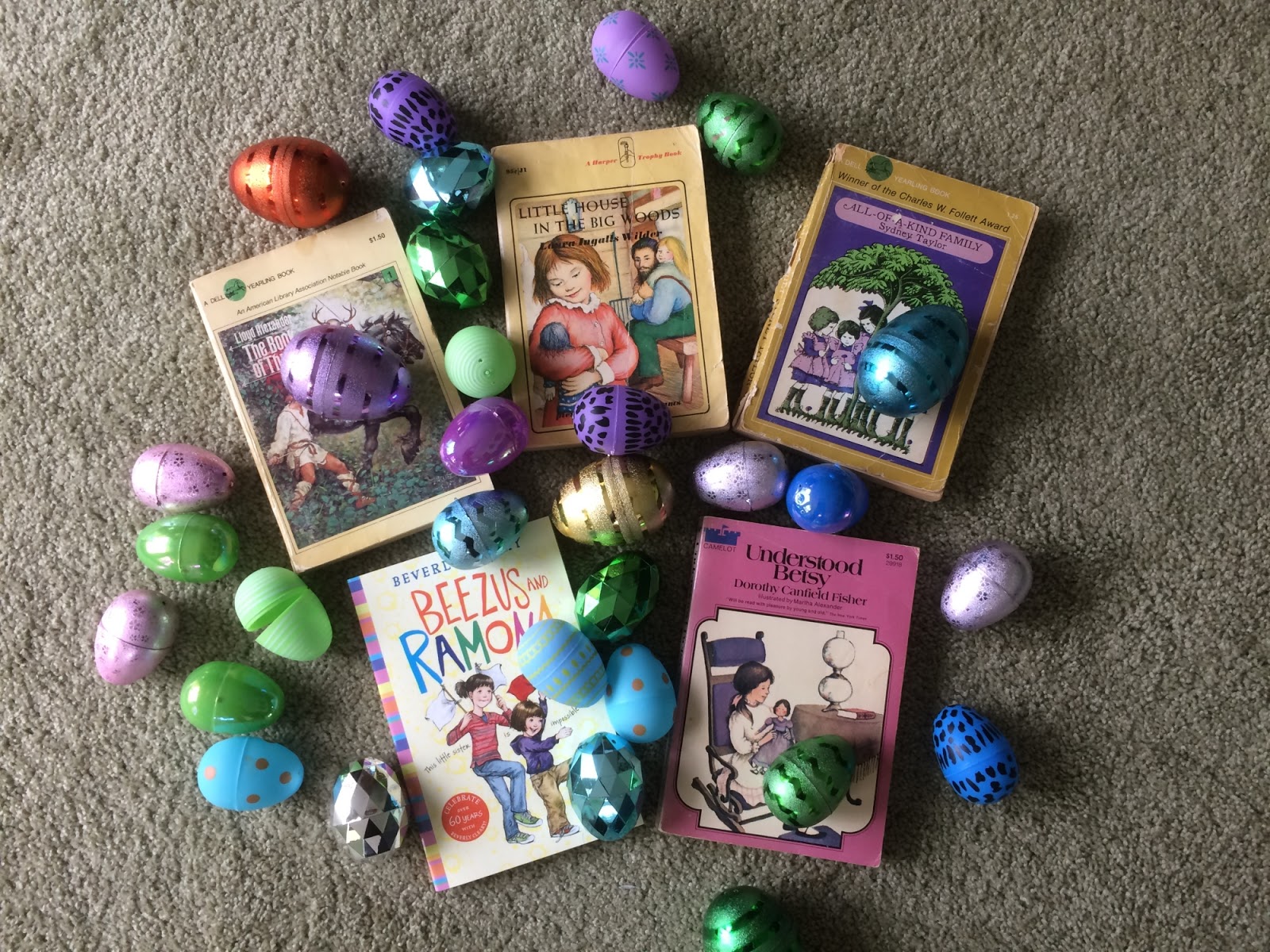
From the Annual Easter Egg Hunt to My Favorite Children's Books–five books I remember fondly


Very shortly, as soon as we get our trinket-prizes collected, the Third Annual C&C Easter Egg Hunt will begin. This egg hunt is not a casual look for hard-boiled eggs in the grass, but a serious week- (or more) length search for plastic eggs cleverly hidden around the house. Each of us will hide ten of these–blue, purple, or green–and then hunt for the others whenever we have a bit of spare time.
I love this event. I love the clever hiding places (my husband is the master of hiding eggs in plain sight, and my daughter tucked some away that could have stayed hidden for months if we hadn’t begged to know where they were) and I love to seek. Systematically.
The Great Easter Egg Hunt is also when I do some of my most thorough cleaning. After all, if I pull everything off a pantry shelf and wipe it down and then replace everything with careful attention, I ought to be quite confident that there are no eggs hiding on that shelf, right?
This hunting-cleaning invariably makes me think of the chapter “Dusting Is Fun” in All-of-a-kind Family (by Sydney Taylor). Mama, tired of constantly having to remind her daughters when it is their turn to dust the front room, hides ten buttons in the room and tells them they are going to play a game. The game is find the buttons, obviously, but while dusting. It’s Sarah’s turn, and by paying attention to all those difficult-to-reach spots, she finds them all.
Mama is wise enough not to make the game permanent. After everyone has had a turn, she only puts the buttons out occasionally, without warning, and in varying numbers. And once–a penny! A whole penny! (And for them, a penny buys a significant quantity of candy.)
Just recently, I was making a list of books from my childhood that I particularly liked and wanted to give to a friend’s daughter. (See also my post on books, nostalgia, and death.) After settling on Little House in the Big Woods (Laura Ingalls Wilder), Understood Betsy (Dorothy Canfield Fisher), Beezus and Ramona (Beverly Cleary), The Book of Three (Lloyd Alexander), and the aforementioned All-of-a-kind Family, I started wondering: why those books? How had those books influenced me, and how might they have influenced my writing?
It struck me that all the parents and guardians in those books had a streak of practicality, a kind of matter-of-fact common sense.  Mama handles chore-shirking, lost library books, bouts of stubbornness, and scarlet fever with admirable calm (which I admire even more now that I am a mother myself). And though I always thought Laura’s Ma was a touch too proper, she not only knows how to make everything from rag dolls to butter to straw hats, she also occasionally loosens her rules, allowing the girls to mold their cooked pumpkin into shapes, though normally they aren’t allowed to play with food, or (in a later book) declaring that they will play games instead of studying when she knows they are desperately worried about Pa and in need of distraction.
The Putney cousins, in Understood Betsy, are the calm contrast to devoted but fluttery Aunt Frances. They say almost nothing about to Betsy about how upsetting it must be to be whisked away from her family to a strange place, but it’s easy to imagine that Aunt Abigail is thinking, “Poor mite. What would make her feel better?” just before she scoops up the kitten and drops it in Betsy’s lap. And a few words from Aunt Abigail at bedtime, “do you know, I think it’s going to be real nice, having a little girl in the house again,” makes it clear that she is welcome.
The Book of Three is set in Prydain, a land of high kings, evil lords, enchanted swords, and deathless warriors. But Taran is frustrated that his life is far too ordinary—“I think there is a destiny laid on me that I am not to know anything interesting, go anywhere interesting, or do anything interesting. I’m certainly not to be anything. I’m not anything even at Caer Dallben!”. His guardian Coll obligingly responds by giving him the title of “Assistant Pig-Keeper” to Hen-Wen, the oracular pig. Taran is to “see her trough is full, carry her water, and give her a good scrubbing every other day.” When Taran points out that he does all those things already, Coll says, “All the better, for it makes things that much easier.”
Beezus and Ramona was not, strictly speaking, one of my childhood favorites. I read a lot of Beverly Cleary’s books and enjoyed them, but I didn’t fully appreciate them until I read the Ramona books to my daughter. Ramona’s world is the most similar to mine of the five books, and yet Cleary manages to make it incredibly entertaining by focusing on the little things–how a bored but imaginative younger sibling can interfere with baking, or the way the first bite of something is somehow the best–and turning them into adventures. Ramona is a definite challenge to the adults around her, as well as her sister, but they find practical ways to deal with her (buy a cake rather than try for the third time to make one, don’t mention the apple incident as it would feed her desire for attention, and—oh—why not make applesauce out of those apples?)
Am I making too much of this? Perhaps all childhood books are like this, especially those for younger children. After all, it is reassuring to think that parents are wise and calm. Probably most stories have some character with that quality. But not all children’s books feature the parents particularly (Secrets of Droon, for instance) and not all parents are good (Matilda, for a rather drastic exception).
At any rate, did reading these books lead me to be a sensible and matter-of-fact parent? It left me with the aspiration, certainly–I think I yell too much and get flustered too easily to actually qualify. In my defense, I’m not a fictional character.
I suspect the fondness for sensible parent/guardians does show up in my writing, though. In Persephone, Aunt Sarah and Aunt Mira are both practical in their own different ways. In Adrift, Aunt Kenata manages new babies and bad dreams, in contrast to the easily-upset Aunt Visala and taciturn Utanu. And I think Nana Sylvie might qualify as the common-sense influence in The Slipper Ball, though time will tell.
Till next post.

Finding the Right Words–the importance of correct terminology


I am periodically reminded of how important it is, when talking to an expert in something, to use the correct words.  There are a lot of words that I know the meaning of only in a general sort of way. That’s good enough when I run into them in a story or hear them in a conversation about something else, but not adequate when I need to communicate a problem.
Imagine the following conversation.
Me: “My computer doesn’t have enough memory.”
Husband-who-works-with-computers-professionally: “Really? Not enough memory?”
Me: “Yes, my computer keeps saying it doesn’t have enough space to back up my Scrivener files.”
Husband: “Oh, your hard drive is full.”
Me (suddenly remembering that there is such a thing as RAM): “Yes, that’s what I mean.”
Husband: “I’ll take a look.”
I’m not saying that actually happened, mind you… but there are a lot of terms associated with computer use that  haven’t always been clearly distinct in my mind. There’s the computer itself (whatever components that refers to), and then there’s its operating system, any applications that have been loaded onto it (including a browser), and then a bunch of other files created by using those applications. It’s taken me a while to distinguish between the applications and the (data) files created with them. It doesn’t help that the applications are also themselves comprised of files. It’s easier to keep straight if I think about the files for my novel, Adrift, and distinguish them from the Scrivener program I used to write them with.
(A slight digression. Think of those scam calls—“Hello, I’m Betty from Windows, and I’m calling about your computer…” “No, you aren’t, because Windows is an operating system, not a computer company, and anyway Microsoft isn’t going to give me that kind of personalized attention unless I first give them buckets of money.”)
There are many other areas where I discover my vocabulary is lacking. The construction of my own house is a bit of a mystery. It has joists, studs, drywall (which is the same as sheetrock, I think), and up above it has a roof with rafters, eaves, gables (maybe?), and soffits (is that part of the roof?). I don’t think much about these words when I read them in passing, but when someone is discussing potential damage to the floor from a leaky shower and whether it has affected the joist, suddenly I’m interested.
I also need the right words so I can describe a problem over the phone accurately—and without sounding stupid to myself. I don’t want to tell the plumber, “The problem is the bathroom sink. The faucet. I mean, the tap. That thing you turn to start the water where one is for hot and one is for cold.” I’ve used the word “tap” before, but in the moment when it matters,  I find myself wondering, “Is that the tap?”
Inadequate vocabulary is most a problem in discussing subjects that, while important, are not of interest to me.  Since I’ve never been particularly into cars, it was some time before I really caught on to the distinction between “wheel” and “tire”. I always sort of thought of them as a unit, the four round things that roll. But don’t tell your husband you think the wheel is damaged when you really mean the tire. You could give him a heart attack. Or a stroke.
Okay, I’m exaggerating as a lead-in to my last set of examples—medical terms. As a kid, I lumped together “heart attack”, “stroke”, “heart failure”, “cardiac arrest”, “coronary”, and “apoplexy” as terms for a bad thing that could happen suddenly and which seemed, in popular expressions, to be linked to sudden shocks or anger.
Now that I’m older, I know that heart attacks involve a problem with the blood supply to part of the heart muscle, and strokes involve a problem with the blood supply to part of the brain. Not the same thing. On looking the other terms up, I find that “coronary” is often used to mean “heart attack” and “apoplexy” to mean “stroke”, but that heart failure means the heart is weak and not working very well, and that cardiac arrest just means the heart has stopped for whatever reason.
But being older and (a little bit) wiser doesn’t mean there aren’t other health-related words I’m misusing. There was some word I used in describing a problem to my doctor which I later realized probably had a very specific meaning for the doctor, and not the meaning I had intended. Further, the doctor, being used to the specific terminology, probably didn’t even realize that I was using it loosely and inaccurately. And that is a communication problem.
I wish I could remember now what the particular word was. Instead, I’ll just offer as an example “dizzy” versus “light-headed”, which apparently have slightly different uses.
Using the right words is important. With them, you can be precise in describing a problem with your computer or your health. Without them, you can inadvertantly create a lot of confusion. Eight-plus years studying philosophy contributed to my concern for correct use of words (“if…then…” is not the same as “if and only if”), but it didn’t teach me how to distinguish a joist from a stud, or a trot from a canter. Some distinctions only get learned when experience makes them relevant.